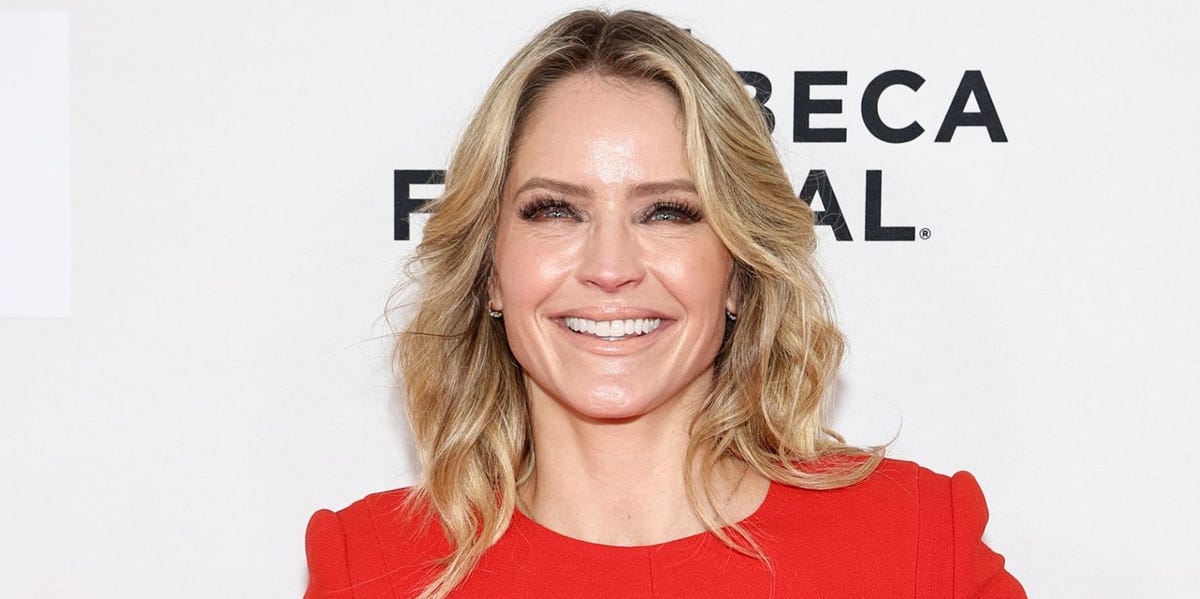
If daytime TV had a designated “most likely to make a serious point, crack a joke, and then accidentally speak for half of America in one sentence,” Sara Haines would be in the running. Long before The View rolled into Season 29, Haines had already carved out a specific kind of television lane: warm but not fluffy, sharp without sounding rehearsed, and relatable in a way that makes viewers feel like they are listening to a very informed friend who also remembers to laugh at herself.
That is why her career news ahead of The View Season 29 mattered. The update was not about a scandal, a dramatic exit, or some flashy reinvention involving neon blazers and a “new era” press release. Instead, it was better than that. Haines added another meaningful television credit to her résumé by appearing on PBS’s Finding Your Roots, a series that trades noise for substance and asks a surprisingly powerful question: Who are you before the cameras, before the job title, and before the audience applause?
For a host whose public image has always been built on candor, empathy, and a visible curiosity about people, the move felt less like a side quest and more like a perfect extension of her brand. Ahead of Season 29, it also reminded viewers that Sara Haines is not just one more chair at the Hot Topics table. She is one of the personalities helping define why the show still works nearly three decades in.
Sara Haines’ career news was more meaningful than flashy
The headline-making update was simple: while preparing to head into another season of The View, Haines was also set to appear in Season 12 of PBS’s Finding Your Roots. On paper, that may sound like one of those “TV host appears on other TV show” blurbs that vanish by lunchtime. In practice, it was much more interesting.
Finding Your Roots is not a typical celebrity stop. It is not a couch chat, a red-carpet cameo, or a lightly edited social media reveal. It is a deeply researched look at family history, ancestry, identity, and the stories that shape people long before they become public figures. That matters for Haines because her appeal has never been built on untouchable celebrity mystique. She works because she seems knowable. Viewers have watched her talk politics, parenthood, work stress, and personal growth with a kind of openness that does not feel factory-made.
So when her next notable move involved tracing her family history instead of launching a vanity project, it fit. Perfectly, actually. It gave audiences a version of Sara Haines that felt both new and totally consistent with the one they already knew.
Why the timing mattered ahead of The View Season 29
The timing added extra weight. The View entered Season 29 with all six permanent co-hosts returning, a sign of stability in a television landscape that treats cast shakeups like an Olympic sport. In an age when talk shows are constantly measured against algorithm-friendly clips, outrage cycles, and cancellation rumors, continuity matters. It tells viewers that the show knows what it is, and just as importantly, who makes it work.
Haines is a major part of that chemistry. She is not the loudest voice at the table, and that is exactly why she is valuable. Every ensemble needs a moderator-type energy even when that person is not technically the moderator. Haines often plays that role. She can soften a tense discussion, reframe a messy one, or ask the “regular person” question that brings a panel conversation back down to earth.
Season 29 also arrived with more than the flagship broadcast. The franchise expanded its surrounding ecosystem with the Behind the Table podcast and The Weekend View, turning the show from a one-hour daytime program into a broader conversation hub. In that environment, hosts need more than one-note on-air personas. They need depth. Haines showing up in a serious, emotionally layered PBS series added exactly that.
In other words, the career news was not random. It enhanced her television identity right as The View was stepping into another high-visibility season.
Sara Haines’ career arc makes this moment more interesting
Part of the reason this news landed so well is that Haines’ career has never felt prepackaged. Her path has included ambition, pivots, setbacks, and returns. That gives her a kind of credibility viewers can spot immediately, even if they do not know every detail of her résumé.
Before becoming a familiar face at ABC, Haines worked within NBC’s Today world. Later, she moved to ABC News, built visibility on Good Morning America, and became a permanent co-host on The View in 2016. She left in 2018 to co-host GMA Day, which later evolved into Strahan and Sara and then Strahan, Sara & Keke. Eventually, she returned to The View in 2020.
That sequence matters because television careers are often narrated as neat ladders: one bigger opportunity, then the next, then a glamorous close-up where everyone pretends there were no doubts in between. Haines has spoken more honestly than most about the uncertainty in her path. She has discussed feeling limited in earlier career stages and has also spoken candidly about difficult moments during previous projects. That honesty has become part of her appeal. She does not present herself as someone who glided effortlessly into the perfect job. She sounds like someone who fought to find the right fit.
And maybe that is why her return to The View has felt stronger than a simple comeback. It feels informed. She came back with more experience, more authority, and a clearer sense of her own voice. That evolution shows up on air. The version of Sara Haines viewers see now is looser, more confident, and less interested in performing certainty for its own sake.
Finding Your Roots gave viewers a new way to understand her
When Haines’ episode of Finding Your Roots eventually aired, it delivered exactly the kind of reveal that makes the series work so well. Her family history turned out to be rich, emotional, and distinctly American in all the complicated ways that phrase can mean. The episode traced her roots across frontier communities and older family lines, revealing surprising links that made Haines visibly emotional.
Among the standout discoveries was her connection to Presidents John Adams and John Quincy Adams, a revelation that hit her with the kind of delighted disbelief viewers instantly recognize as genuine. It was not polished-award-speech emotion. It was the far more entertaining variety: the “wait, are you serious?” reaction that happens when history suddenly turns personal.
That kind of moment works especially well for Haines because it matches the qualities people already associate with her. She reacts in real time. She wears surprise on her face. She does not over-manufacture gravitas when a simple human response will do the job better. On a show like The View, those instincts keep conversations from becoming robotic. On a series like Finding Your Roots, they make discovery feel intimate.
There is also something thematically neat about the pairing. The View is built on opinion, immediacy, and the conversation of the day. Finding Your Roots is built on context, memory, and the long story behind the person speaking. Putting Haines in both spaces highlights why she works so well as a television host. She is good in the moment, but she is also interesting beyond the moment.
Why Sara Haines matters to the current identity of The View
Every long-running panel show needs internal contrast. Not just political contrast, but tonal contrast. Whoopi Goldberg brings seasoned authority. Joy Behar has comic bluntness down to a science. Sunny Hostin often brings prosecutorial precision. Ana Navarro supplies fire and flair. Alyssa Farah Griffin offers a conservative perspective shaped by government experience. And Sara Haines? She brings accessibility.
That sounds deceptively simple, but it is a real skill. Haines often speaks from the angle of the audience member who is still thinking it through. She can be decisive without sounding doctrinaire. She can disagree without sounding like she enjoys the disagreement a little too much. In a media culture that often rewards maximum volume, she remains useful because she rarely seems to confuse intensity with intelligence.
That makes her a stabilizer inside a panel built on collision. It also makes her one of the hosts most likely to connect with viewers who are tired of television personalities treating every topic like a final exam in ideological performance.
So yes, the headline may have been about career news. But underneath it was a bigger reminder: Sara Haines has become one of the essential ingredients in The View’s modern formula. Not because she tries to dominate the table, but because she helps the table remain watchable.
What this career update says about her next chapter
If there is a theme tying together Haines’ recent professional narrative, it is range with restraint. She can handle live daytime debate, personality-driven podcasting, game-show hosting, and now a prestige-adjacent nonfiction appearance that lets viewers see a more reflective side of her. That range gives her career durability.
It also suggests she is in a strong position going forward. Television increasingly rewards people who can move across formats without losing their identity. Haines has become one of those talents. She is recognizable on a daytime panel, credible in a family-history documentary setting, and conversational enough for audio and streaming side projects. Not bad for someone whose public charm often makes the hard part look suspiciously easy.
The smartest career moves do not always scream. Sometimes they simply sharpen the picture. Ahead of Season 29, that is exactly what happened here. Sara Haines did not need a dramatic reinvention. She needed the right kind of visibility, and Finding Your Roots provided it.
In the end, that is what made the news worth paying attention to. It showed that Haines is still expanding, still surprising viewers, and still building a television career with more layers than people may assume at first glance. For a host who makes her living navigating the daily swirl of headlines, that might be the most valuable kind of career news there is: the kind that actually deepens your story.
Related experiences: why Sara Haines’ moment resonates with so many viewers
One reason this story lands beyond celebrity-news circles is that it mirrors experiences many regular people understand all too well. Sara Haines’ career news is not just about appearing on another show. It taps into the bigger themes of reinvention, validation, identity, and timing. Those themes are incredibly familiar, even if most people do not process them under studio lights.
Take career reinvention. A lot of people know what it feels like to outgrow a role while everyone around them assumes they should be grateful to stay exactly where they are. They may work hard, do everything right, and still hit an invisible ceiling. Haines has spoken about feeling boxed in earlier in her career, and that part of her story feels especially relatable. Plenty of viewers have had the experience of realizing, “I am not done growing, even if this company thinks I am.” That can be painful, but it can also become the turning point that leads to better work and a stronger sense of self.
Then there is the experience of returning to something in a different season of life. That part of Haines’ story may be even more relatable than the first act. People leave jobs, relationships, hometowns, or creative projects all the time, only to come back later with more confidence and a clearer voice. The second version is usually better. Not because life suddenly becomes easy, but because the person has changed. Haines’ return to The View carries that energy. She did not come back as a rerun of her old self. She came back sounding more certain of who she is.
There is also the deeply human experience of learning something new about where you come from. Family history can be emotional even for people who never appear on PBS. Sometimes it confirms stories you were told as a kid. Sometimes it complicates them. Sometimes it hands you a fact so unexpected that you laugh first and process later. That is why Finding Your Roots continues to connect with audiences. It turns genealogy into something larger than trivia. It reminds people that identity is layered, surprising, and often unfinished.
And finally, there is the emotional strain of public-facing work. Haines has been open about how exhausting it can be to comment on a difficult world in real time. That, too, feels relatable. Millions of people are balancing jobs, families, emotional overload, and the pressure to keep functioning while the news cycle behaves like it drank six espressos and chose chaos. Seeing someone on television admit that the weight of it all can be hard to carry makes her feel less polished and more real.
That may be the real reason this career moment matters. Beneath the headlines, Sara Haines’ story reflects a familiar set of experiences: being underestimated, taking the leap anyway, returning stronger, and discovering that there is always more to learn about both your work and yourself. That is not just celebrity content. That is life with better lighting.
Conclusion
Sara Haines’ career news ahead of The View Season 29 was not loud, but it was smart. Her Finding Your Roots appearance expanded her public story in a way that felt thoughtful, credible, and genuinely personal. At the same time, it underscored why she remains such an important part of The View: she brings curiosity, emotional intelligence, and a grounded perspective to a show built on daily friction and fast-moving opinions.
For viewers, the takeaway is clear. Sara Haines is not standing still. She is continuing to grow across formats while staying true to the qualities that made audiences connect with her in the first place. In television, that is not just good career news. That is staying power.