Note: This article is original, rewritten commentary based on the real 2022 social media moment when Elon Musk shared a photo of his bedside table and the internet quickly turned it into a meme format.
Introduction: One Nightstand, Four Diet Cokes, and a Million Jokes
There are ordinary bedside tables, and then there are bedside tables that look like they were arranged by a billionaire, a history professor, a gaming enthusiast, and a vending machine having a committee meeting at 2 a.m. When Elon Musk posted a photo of his bedside table on X, then still widely called Twitter, he probably expected people to react. What he got was something even more predictable: the internet immediately turned the image into a meme factory.
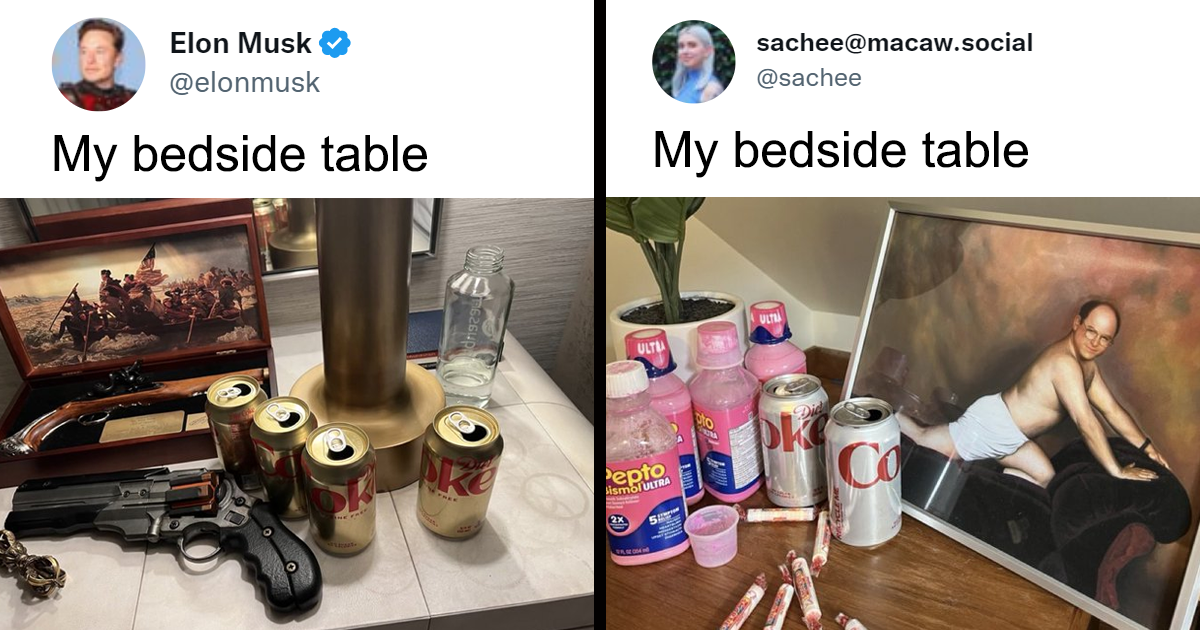
The photo showed an unusual collection of objects: several cans of caffeine-free Diet Coke, a reproduction of the famous “Washington Crossing the Delaware” painting, what appeared to be non-firing replica weapons, and a decorative Buddhist object often identified online as a vajra. The caption was simple: “My bedside table.” The response was not simple at all. Social media users zoomed in, analyzed, mocked, remixed, and recreated the scene as if it were a museum exhibit titled Extremely Online Man Before Sleep.
Why did this particular post become so memeable? Because it had the perfect recipe: a famous person, a strangely intimate setting, recognizable objects, and just enough chaos to make everyone ask, “Is this a joke, a brand statement, or a cry for a better interior designer?” In a digital culture where every public image becomes a prompt, Musk’s bedside table turned into a personality test for the entire internet.
What Was in Elon Musk’s Bedside Table Photo?
The original image became popular because it felt both staged and messy, luxurious and weirdly relatable. On one hand, it was posted by one of the most famous billionaires in the world. On the other, the Diet Coke cans gave the whole thing the energy of a college dorm during finals week. That contrast made it instantly funny.
The cans of caffeine-free Diet Coke were arguably the star of the image. They were scattered in a way that made people wonder whether Musk was making a joke, revealing a habit, or simply showing that even billionaires forget to clean up before taking photos. The beverage choice also added comedy: caffeine-free Diet Coke sounds like a compromise between “I want soda” and “I have a meeting with my cardiologist in the morning.”
The historical imagery added another layer. A picture connected to George Washington crossing the Delaware made the bedside arrangement feel oddly dramatic, as if Musk wanted to fall asleep under the spiritual supervision of American revolutionary ambition. The decorative and replica objects gave the scene a theatrical quality. It did not look like a nightstand so much as a prop table for a movie called Founder Mode: The Bedroom Cut.
Why the Internet Could Not Resist Turning It Into Memes
Memes thrive when an image is easy to understand but hard to explain. Musk’s bedside table photo checked both boxes. You did not need a long backstory to find it funny. A famous tech billionaire shared a picture of a chaotic nightstand. That alone was enough. But the more people looked, the more jokes they found.
Part of the humor came from the contrast between Musk’s public image and the everyday weirdness of the scene. He is associated with electric cars, rockets, artificial intelligence debates, tunnels, satellites, and large-scale ambitions. Yet here was a photo that invited everyone to discuss soda cans and bedside clutter. The meme economy loves lowering the temperature on powerful people. Nothing humanizes a billionaire faster than a nightstand that looks like it lost a fight with a convenience store.
The image also arrived during a period when Musk’s social media presence was under constant scrutiny. After buying Twitter in 2022, nearly everything he posted became news, commentary, or fuel for jokes. This meant a simple photo could travel far beyond its original audience. People were already watching his feed closely, so when the bedside table appeared, the reaction was immediate.
The 30 Meme Angles the Internet Ran With
Instead of one joke, the photo inspired dozens of angles. That is what made it such a durable meme. People did not just react to the image; they treated it like a blank template for identity comedy. Below are 30 original meme-style interpretations that capture the kinds of jokes the internet built around the moment.
1. The “Caffeine-Free Chaos” Meme
The biggest joke was that the table looked intense, but the soda was caffeine-free. It had the energy of someone preparing for battle while also trying not to stay awake too late.
2. The “Billionaire Dorm Room” Meme
Many people joked that the image looked less like a billionaire’s room and more like a college freshman’s nightstand after three deadlines and one emotional support soda.
3. The “History Homework Aesthetic” Meme
The George Washington artwork invited jokes about Musk falling asleep after reading one paragraph of a Revolutionary War textbook and deciding to make it his personality.
4. The “Video Game Inventory Screen” Meme
The table looked like an inventory menu from a role-playing game: beverage, relic, decorative prop, historical painting, and mysterious billionaire side quest unlocked.
5. The “Founder Mode Sleep Setup” Meme
People imagined the table as a productivity shrine for someone who dreams in spreadsheets, rockets, and unread notifications.
6. The “Tell Me You’re Online Without Telling Me” Meme
The arrangement felt extremely internet-coded: part joke, part flex, part confusion, and part “please quote-post this immediately.”
7. The “Diet Coke Pyramid Scheme” Meme
The multiple cans led to jokes about whether Musk was sleeping beside refreshments or building a tiny aluminum fortress.
8. The “Museum of Main Character Energy” Meme
Some users joked that the photo belonged in a museum exhibit about people who are physically unable to be casual online.
9. The “Nightstand as Personality Quiz” Meme
Viewers treated each item as a clue: Are you patriotic? Chaotic? Over-caffeinated but technically caffeine-free? A collector of props? The table had layers.
10. The “Before Bed Routine” Meme
Memes imagined Musk’s nightly ritual as checking notifications, sipping Diet Coke, contemplating history, and tweeting something guaranteed to become tomorrow’s discourse.
11. The “LinkedIn Alpha Male Interior Design” Meme
The setup inspired jokes about motivational posters, productivity gurus, and people who say “grindset” with total sincerity.
12. The “Least Relaxing Bedroom Decor” Meme
Most people keep lamps, books, or water near the bed. This table looked like it was preparing for a board meeting and a historical reenactment simultaneously.
13. The “Coke Zero, But Make It Political” Meme
The soda cans became a symbol of how the internet can turn even soft drinks into cultural analysis when the poster is famous enough.
14. The “Rich People Are Weird Too” Meme
The photo reminded everyone that money can buy many things, but it does not automatically buy a normal-looking bedside table.
15. The “This Is What My Algorithm Thinks I Want” Meme
People compared the table to a social media feed: history, tech celebrity, props, soda, and confusion all fighting for attention.
16. The “Roommate Red Flag” Meme
Some joked that seeing this nightstand during a house tour would raise immediate questions, starting with “Do you recycle?”
17. The “American Starter Pack” Meme
The Washington imagery, Diet Coke, and dramatic objects made the photo easy to parody as an exaggerated starter pack of American internet culture.
18. The “CEO Sleepover” Meme
The image inspired jokes about what a sleepover hosted by a tech CEO would include: soda, lectures about Mars, and absolutely no normal lamps.
19. The “Minimalism Has Left the Chat” Meme
Interior design fans had a field day because the table was the opposite of calming, clean, or Pinterest-approved.
20. The “Unread Notifications in Furniture Form” Meme
The cluttered energy of the scene felt like a physical version of having 4,000 unread messages and calling it “organized.”
21. The “What Your Bedside Table Says About You” Meme
People joked that therapists could skip the intake form and just ask patients to upload a nightstand photo.
22. The “Cyberpunk Convenience Store” Meme
The combination of modern celebrity, old historical imagery, and soda gave the table a strange futuristic-gas-station vibe.
23. The “Accidental Still Life” Meme
Art-minded users treated the photo like a still-life painting: objects arranged not for beauty, but for maximum online argument.
24. The “When You Have Money but No Coaster” Meme
The table’s practical details became part of the joke. A billionaire can launch rockets, but the internet will still ask about drink rings.
25. The “NPC Quest Table” Meme
Gamers imagined approaching the table in a video game and receiving a quest called “Retrieve the Fifth Diet Coke.”
26. The “Sleep Hygiene Has Been Defeated” Meme
Wellness-minded people joked that the setup was not exactly a poster child for calm sleep habits.
27. The “Branding Meeting Gone Wrong” Meme
Some memes imagined a public relations team asking for a relatable photo and receiving this instead.
28. The “Internet Archaeology” Meme
Users joked that future historians would study the image to understand the emotional climate of late 2022 social media.
29. The “Main Character Nightstand” Meme
The table did not whisper. It announced itself. That made it perfect material for jokes about people who accidentally make every object dramatic.
30. The “My Bedside Table” Parody Meme
The simplest format was also the best: users posted their own nightstands, messy desks, snack piles, pet beds, and random object collections with the same deadpan caption.
Why Bedside Table Memes Work So Well
A bedside table is personal. It sits beside someone at the most unguarded time of the day. That makes it funny when a public figure shares one voluntarily. People expect polished press photos, carefully chosen outfits, and corporate-approved statements. A messy or unusual nightstand bypasses all of that. It feels like accidental honesty, even when it may be carefully framed.
That is why the photo worked as comedy. The internet loves small windows into the private lives of famous people, especially when those windows contain details that feel odd, symbolic, or wildly overanalyzed. A nightstand can say “I read before bed,” “I drink water,” “I lose my phone charger daily,” or in this case, “Please prepare 700 jokes immediately.”
The meme also connected with a broader trend: people using object arrangements as identity statements. Desk setups, fridge tours, bookshelf photos, “what’s in my bag” posts, and bedroom corners all invite interpretation. The bedside table is just the sleepier cousin of those formats. When Musk posted his, the internet responded like a detective agency staffed entirely by comedians.
The Role of Elon Musk’s Online Persona
The memes were not just about the table. They were about Elon Musk as a public figure. His online persona has long mixed tech optimism, trolling, bold claims, jokes, cultural commentary, and spontaneous posts. That makes every image he shares feel like it might be serious, ironic, strategic, or all three before breakfast.
This ambiguity is central to why Musk-related memes travel quickly. Supporters may see a post as funny or authentic. Critics may see it as attention-seeking or strange. Casual viewers may simply enjoy the absurdity. The result is a rare kind of content that multiple audiences can share for completely different reasons.
In the case of the bedside table, the image gave everyone something to latch onto. Some focused on the Diet Coke. Some focused on the historical reference. Some joked about clutter. Some parodied the entire composition. The photo became less about the actual furniture and more about the performance of being online while famous.
What This Meme Says About Internet Culture
The reaction to Musk’s bedside table photo shows how modern meme culture works. A single image can become a shared template within hours because people are trained to remix everything. The internet no longer waits for official comedy. It creates its own captions, edits, comparisons, and parodies in real time.
It also shows that people enjoy decoding famous people’s environments. A public figure’s objects become clues. A soda can becomes a lifestyle debate. A painting becomes a personality symbol. A table becomes a thesis. Sometimes this analysis is playful. Sometimes it is too serious. Usually, it is both.
Most importantly, the meme proved that relatability does not require normal behavior. In fact, the opposite often works better. People did not share the photo because it looked like their own bedside tables. They shared it because it was just familiar enough to understand and strange enough to parody. That is the sweet spot where memes are born.
Experience Section: What the Bedside Table Meme Teaches Anyone Who Posts Online
There is a useful lesson hiding under all the jokes: the internet reads backgrounds as carefully as captions. When a public figure posts a photo, the main subject is only part of the story. People look at the shelf behind you, the mug on the desk, the tab open on your laptop, the reflection in the window, and the snack wrapper you forgot to crop out. Musk’s bedside table became a meme because it offered too many details to ignore.
For anyone who creates content, runs a brand, or simply posts online, the experience is a reminder that casual does not always mean invisible. A “quick photo” can become the entire conversation. Sometimes that is good. It makes a person seem human, spontaneous, and funny. Sometimes it creates a storm of analysis that no one expected. The more famous the poster, the stronger the microscope.
From a content strategy perspective, the post was fascinating because it did not need a polished campaign. It had natural virality. The caption was short. The image was unusual. The person posting it was already highly visible. Those three ingredients are enough to generate massive engagement. In fact, the lack of explanation helped the meme spread. If Musk had written a long caption explaining every object, the jokes might have had less oxygen. Mystery is meme fuel.
There is also a practical lesson about authenticity. Audiences often say they want real, unfiltered content. But when they receive it, they do not simply accept it; they interpret it. That is the bargain of posting online. A bedroom table can become a cultural artifact. A soda can can become a punchline. A familiar object can become a symbol because the audience brings its own assumptions, humor, and skepticism.
For everyday users, the takeaway is not “never post your room.” It is more realistic than that: understand that every public image has a story beyond what you intended. Before sharing, ask what people might notice first, what they might misunderstand, and whether you are comfortable with the joke if the image travels beyond your followers. The internet is not always cruel, but it is always observant.
The Musk bedside table moment also reveals why memes are such powerful cultural shortcuts. People used humor to talk about wealth, personality, sleep habits, branding, masculinity, clutter, celebrity, and online performance without writing essays about any of them. A meme compresses commentary into a laugh. That is why one odd photo can outlive hundreds of serious posts from the same week.
In the end, the experience is simple: if you give the internet a strange enough image, it will not merely look at it. It will adopt it, caption it, remix it, and invite everyone to bring their own bedside table to the party. Musk posted a photo. The internet built a comedy franchise.
Conclusion: A Nightstand That Became Internet History
Elon Musk’s bedside table photo became a meme because it was the perfect blend of celebrity, odd details, and visual chaos. It was not a polished announcement or a carefully edited brand campaign. It was a snapshot that looked personal, strange, and instantly remixable. That made it irresistible.
The best memes often come from moments that feel accidental. They give people just enough structure to understand the joke and just enough weirdness to create their own version. Musk’s nightstand had both. Whether people focused on the Diet Coke cans, the historical imagery, the dramatic arrangement, or the overall “what am I looking at?” energy, the result was the same: the internet did what it does best and turned a small personal post into a massive shared joke.
Years later, the image still works as a case study in how online culture processes famous people. Nothing is too small to become content. Nothing is too ordinary to become symbolic. And no bedside table, apparently, is safe from becoming a meme.