Some shopping destinations announce themselves with neon, sales racks, and a heroic amount of air freshener. Ma(i)sonry Napa Valley did the opposite. It whispered from a 1904 stone building in Yountville, served wine in a garden, placed serious art next to collectible furniture, and somehow made shopping feel like the civilized cousin of daydreaming. If a tasting room, design gallery, antique shop, sculpture garden, and private salon all went on a Napa Valley retreat together, Ma(i)sonry would be the elegant result.
For anyone searching for Ma(i)sonry Napa Valley today, the story comes with a helpful update: the original Ma(i)sonry concept is now part of the larger RH Yountville experience, with the historic Ma(i)sonry building reimagined as the RH Wine Vault. But the spirit that made Ma(i)sonry memorable still matters. It changed what a Napa Valley tasting room could be. It proved that wine, art, architecture, gardens, and objects for the home could live together naturally, without anyone needing to say, “This is a concept store,” while wearing extremely serious glasses.
What Was Ma(i)sonry Napa Valley?
Ma(i)sonry Napa Valley was a wine, art, and design gallery located in Yountville, California, in the heart of Napa Valley. The name itself was a clever little wink: a blend of the French word maison, meaning house, and the English word masonry, a nod to the building’s stone construction. Even the spelling seemed to say, “Yes, we are refined, but we also enjoy a parenthetical flourish.”
Founded by Michael Polenske, who was also behind Blackbird Vineyards and the broader Bespoke Collection, Ma(i)sonry opened in 2008 as an alternative to the standard stand-at-the-bar wine tasting model. Instead of rushing visitors through pours, the space invited them to sit, look, sip, wander, and discover. The experience felt less like checking off wineries and more like being welcomed into the country home of a collector with excellent taste and a very generous cellar.
At its peak, Ma(i)sonry brought together boutique Napa Valley wines, contemporary art, vintage furniture, artisan objects, and outdoor sculpture. Tastings were often seated and personal. The galleries were curated rather than cluttered. The gardens were staged like outdoor rooms, complete with sculptural furniture and century-old olive trees. The result was a lifestyle experience before “lifestyle experience” became the phrase every brand used to explain why a candle costs more than a toaster.
The Historic Stone Building: A Napa Valley Character in Its Own Right
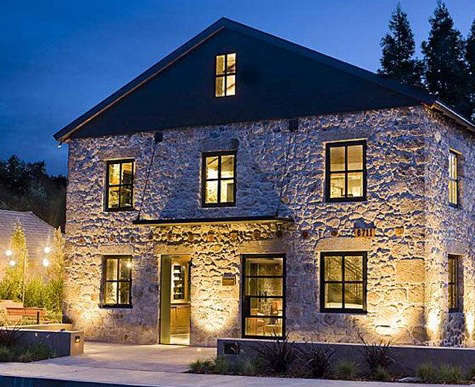
The first thing shoppers noticed was the building. Ma(i)sonry occupied a rustic stone house built in 1904 on Washington Street in Yountville. Local history identifies the building as the Charles Revegno House, a rare stone structure in town and part of Yountville’s historic fabric. Long before it became a design destination, it served as a private residence and later operated as the Burgundy House Inn.
The architecture gave Ma(i)sonry its soul. Stone walls, deep-set openings, and a sense of permanence made the interiors feel grounded. Nothing seemed temporary or over-styled. A contemporary chair could sit beside an antique table and somehow behave itself. A bold artwork could hang against rugged stone and look more interesting, not less. The building did what great historic spaces do: it made everything placed inside it look as if it had a story.
That sense of layered history became part of the shopping experience. Visitors were not simply browsing furniture. They were seeing how materials age, how scale works in a real room, and how design gains depth when it has a little dust of time on it. The building was not a blank white box. It was more like a very cultured hostquiet, sturdy, and impossible to upstage.
A Shopper’s Diary of Wine, Art, and Design
The original Ma(i)sonry was not designed for grab-and-go shopping. It rewarded lingering. One could begin with wine, move toward a sculpture, drift into a gallery room, admire a chair, step into the garden, and then begin mentally rearranging one’s entire living room. This is dangerous in the best way. Napa Valley already encourages fantasyvineyard views, long lunches, golden lightand Ma(i)sonry added the fantasy of living beautifully every day.
The furniture and decorative objects were not presented as isolated products. They were placed in rooms and gardens, often mixed with art and antiques, so visitors could imagine how pieces might work at home. Instead of asking, “Do I need this table?” the experience nudged a more seductive question: “What kind of life would I have if this table were waiting for me under an olive tree?” That is how design shopping gets you. It starts with proportion and ends with shipping logistics.
Among the types of pieces associated with Ma(i)sonry were handcrafted furniture, vintage artifacts, contemporary works, sculptural seating, Lucite pieces, large communal tables, and outdoor furnishings. The mood was Napa rustic with a worldly, collected edge. It was not farmhouse in the mass-market sense. It was farmhouse after a sabbatical in Europe, a friendship with artists, and a very good wine allocation.
Why Ma(i)sonry Felt Different From a Traditional Tasting Room
Many Napa Valley tasting rooms focus on the wine first and the environment second. Ma(i)sonry flipped that formula into something more immersive. The wine was important, but the setting shaped how people experienced it. A glass of Merlot-inspired Napa red tastes one way at a counter. It tastes another way when you are seated in a stone-walled gallery, surrounded by art, with garden light coming through the room.
This mattered because the wines poured at Ma(i)sonry often came from smaller or limited-production producers. For visitors, the collective model created access. Instead of needing to schedule separate appointments with multiple boutique wineries, guests could taste a curated selection in one elegant setting. This made Ma(i)sonry especially appealing for travelers who wanted depth without turning their day into a spreadsheet.
The experience also suited Yountville perfectly. Yountville is compact, polished, walkable, and famous for serious food. It is home to destination restaurants, luxury hotels, and a slower pace than downtown Napa. Ma(i)sonry fit that rhythm. It was a place to visit between lunch and dinner, after a morning tasting, or before deciding that, yes, vacation calories and vacation design purchases operate under separate laws of physics.
The Garden: Outdoor Shopping Without the Fluorescent Lighting
One of Ma(i)sonry’s most memorable features was its garden. The outdoor space functioned like a living gallery, with furniture, sculpture, fire features, and seating arranged among mature trees and stonework. It gave shoppers something online retail still struggles to provide: atmosphere. You could see how a table handled sunlight, how a chair looked against greenery, and how sculpture changed when viewed from several steps away with a glass in hand.
The garden also blurred the line between commercial space and hospitality. It did not feel like a store patio with a few planters placed out of obligation. It felt composed. Outdoor rooms invited conversation, and the furnishings appeared to belong to the landscape. This was a practical lesson for design lovers: outdoor spaces become more compelling when they are treated like real rooms rather than storage areas for weatherproof chairs.
For shoppers seeking Napa Valley design inspiration, this was the real takeaway. Ma(i)sonry showed how to mix raw materials, aged surfaces, sculptural forms, and comfortable seating without making a space feel stiff. The garden was elegant, but it was not afraid of texture. Stone, wood, metal, greenery, and linen-like neutrals worked together in a way that felt relaxed rather than decorated to within an inch of its life.
Ma(i)sonry and the Rise of Experiential Retail
Before every retail brand started talking about “experience,” Ma(i)sonry was quietly demonstrating what the word could mean. It did not rely on spectacle. There were no gimmicks, no selfie tunnel, no product wall begging for a hashtag. Instead, the experience came from authentic overlap: wine tasting, art viewing, design shopping, architecture, hospitality, and landscape.
This combination made the store feel useful to different kinds of visitors. Wine lovers came for boutique pours. Design travelers came for furniture and interiors. Art collectors came for sculpture and gallery pieces. Curious tourists came because the building looked irresistible. Couples came because it was romantic. Groups came because it was more interesting than another tasting counter. Everyone left with at least one opinion about a chair.
From an SEO and travel perspective, Ma(i)sonry became memorable because it sat at the intersection of several search intents: Napa Valley wine tasting, Yountville shopping, design gallery Napa, art and wine experience, and historic Ma(i)sonry building. That crossover appeal is why people still search for it years after the original format evolved.
The RH Yountville Chapter
Today, the historic Ma(i)sonry building is best understood through RH Yountville, a five-building compound that integrates food, wine, art, and design. RH transformed the stone building into the RH Wine Vault, offering curated wines from Napa and Sonoma in a dramatic two-story setting. Nearby, RH Restaurant, design galleries, courtyards, fountains, and outdoor living rooms continue the broader idea that hospitality and retail can share the same table.
This transition changed the name on the door but not the central lesson. The Ma(i)sonry building still represents a particular Napa Valley ideal: beauty experienced slowly. It is not merely a retail backdrop. It is a historic space that continues to host wine, design, and atmosphere in one walkable Yountville destination. Visitors who remember Ma(i)sonry may feel nostalgia; first-timers may simply see RH Yountville as a glamorous place to eat, sip, browse, and reconsider the quality of their patio furniture.
The RH version is larger, more polished, and more brand-driven than the original Ma(i)sonry. Yet it also reflects how influential the original idea was. Ma(i)sonry proved that a tasting room could be a gallery, a shop could be a salon, and a historic building could become a stage for modern lifestyle retail without losing its sense of place.
What to Look for When Visiting the Area Today
Start with the Building
Before focusing on wine lists or menus, take a moment to appreciate the stone structure itself. Notice the thickness of the walls, the old-world texture, and the contrast between historic architecture and refined contemporary design. In a valley full of polished tasting rooms, the building remains one of the most distinctive visual anchors in Yountville.
Study the Outdoor Rooms
The courtyards and gardens are a masterclass in outdoor living. Look at how seating groups are arranged, how shade is used, and how large tables create gathering points. Even if your own backyard is more “suburban rectangle” than “Napa sculpture garden,” the principles still apply: anchor the space, mix textures, and give people a reason to sit down.
Browse Like a Collector
The best way to approach a destination like this is not to shop with a checklist. Browse like a collector. Ask what materials keep catching your eye. Notice whether you are drawn to stone, weathered wood, linen, metal, or sculptural silhouettes. The value of a place like Ma(i)sonry is not only what you buy. It is what it teaches you about your own taste.
Pair Design Inspiration With Wine
Wine and design share a secret: both are about balance. Too much oak, and the wine shouts. Too many statement pieces, and the room starts performing community theater. Ma(i)sonry’s legacy is a reminder that restraint can be luxurious. A beautiful chair, a generous table, a textured wall, and one excellent glass can do more than a room full of objects competing for applause.
How to Bring the Ma(i)sonry Look Home
You do not need a 1904 stone house in Yountville to borrow from the Ma(i)sonry mood. Start with natural materials. Choose wood with visible grain, stone or ceramic surfaces, woven textures, and metal finishes that can age gracefully. Avoid making everything match too perfectly. The Ma(i)sonry look was collected, not cloned.
Next, create small moments of contrast. Pair a modern chair with an antique table. Place a clean-lined lamp on a rustic console. Hang contemporary art above a weathered bench. The magic comes from tension between old and new, rough and polished, practical and sculptural.
For outdoor spaces, think in terms of rooms. A table needs a purpose. Chairs need conversation distance. Planters should frame rather than clutter. Lighting should flatter people, not interrogate them. If your patio makes guests feel like they are waiting outside a dentist’s office, Ma(i)sonry would gently suggest more texture, lower light, and possibly a better bottle of wine.
Finally, let art and objects breathe. Ma(i)sonry’s appeal came from curation. It was not about having more. It was about giving each piece enough space to matter. A single sculptural object on a table can be more powerful than twelve accessories lined up like they are auditioning for a catalog.
Why Ma(i)sonry Still Matters
Ma(i)sonry Napa Valley still matters because it anticipated the way many modern travelers want to experience a place. They do not only want to taste wine. They want to understand the lifestyle around it: the architecture, the meals, the gardens, the objects, the pace, the story. Ma(i)sonry offered that in a way that felt personal and highly specific to Napa Valley.
It also showed that shopping can be cultural when it is curated with intelligence. The best design stores do not simply sell things. They train the eye. They show proportion, material, mood, and possibility. Ma(i)sonry did this beautifully, using wine as both companion and catalyst. After all, most people become more open-minded about furniture after the second tasting pour. This is not science, but it feels peer-reviewed.
For Yountville, the Ma(i)sonry story remains part of a larger identity built around food, wine, design, and hospitality. For shoppers, it remains a case study in how retail can become memorable when it respects context. For home design lovers, it remains inspiration for creating spaces that feel layered, sensory, and lived-in.
Extended Experience Notes: A Shopper’s Diary Walk Through Ma(i)sonry Napa Valley
Imagine arriving in Yountville on a clear afternoon when the light has turned honey-gold and everyone on Washington Street seems to be walking slightly slower than usual. That is the correct speed for Napa Valley shopping. Rushing here feels rude, like sprinting through a museum or drinking Cabernet from a paper cup. The stone Ma(i)sonry building appears with quiet confidence, not shouting for attention, but absolutely aware that it is the best-dressed structure on the block.
The first impression is texture. Before a label, before a price tag, before a tasting note, there is stone. It makes the experience feel grounded from the start. You step closer and notice how the building changes the mood. The world outside may be all reservations, itineraries, and “Are we late for the next tasting?” But the moment you enter, the tempo softens. This is not a place designed for panic. It is a place designed for looking.
Inside, the best approach is to let your eye wander before your wallet gets involved. A chair might catch your attention because its silhouette is confident without being showy. A table may look as if it has hosted better conversations than most of us have had all year. A piece of art may seem at first too bold, then suddenly exactly right against stone. This is the pleasure of a curated room: it argues gently with your assumptions.
The wine changes the shopping experience, too. Not because it turns every object into a good ideaalthough let us be honest, wine has assisted many design decisions throughout historybut because it encourages patience. You sit. You taste. You notice the weight of a glass, the shape of a table, the way outdoor light moves across a garden. Shopping becomes less transactional and more observational. You are not hunting. You are absorbing.
Outside, the garden offers the strongest lesson. Furniture belongs in conversation with its surroundings. A bench near greenery feels different from a bench against a wall. A large table outdoors becomes an invitation, not just a surface. Sculpture shifts as you move around it. The garden makes a persuasive case for designing outdoor spaces with the same seriousness as interiors. Your patio deserves more than two lonely chairs and a grill that looks emotionally unavailable.
The most useful souvenir from a Ma(i)sonry-inspired visit may not be something you carry home. It may be a clearer sense of what makes a space feel generous. Generosity is not always size or expense. It is comfort, proportion, material, and welcome. It is the feeling that someone thought about where you would sit, what you would see, and how the afternoon might unfold. That is the heart of Ma(i)sonry’s legacy: it made shopping feel like inhabiting a better version of everyday life.
By the time you leave, you may not have purchased a Lucite console, a sculptural chair, or a piece of Napa Valley art. That is perfectly fine. The real win is that your eye has been tuned. You may go home and move a chair, clear a tabletop, add texture to a room, or finally admit that your outdoor lighting has all the charm of a parking garage. Ma(i)sonry’s gift was not simply selling beautiful things. It was showing how beautiful things behave when they are given space, history, wine, and a little California sunlight.
Conclusion
Ma(i)sonry Napa Valley was more than a stylish stop in Yountville. It was a thoughtful blend of wine tasting, art collecting, design shopping, and architectural atmosphere. Its historic 1904 stone building gave the experience authenticity, while its curated furniture, sculpture, gardens, and boutique wines made it feel modern and alive. Today, the building’s role within RH Yountville continues the conversation, proving that the best retail spaces are not just places to buy things. They are places to feel inspired, recalibrate your taste, and perhaps develop a sudden but sincere belief that every home needs a better outdoor table.