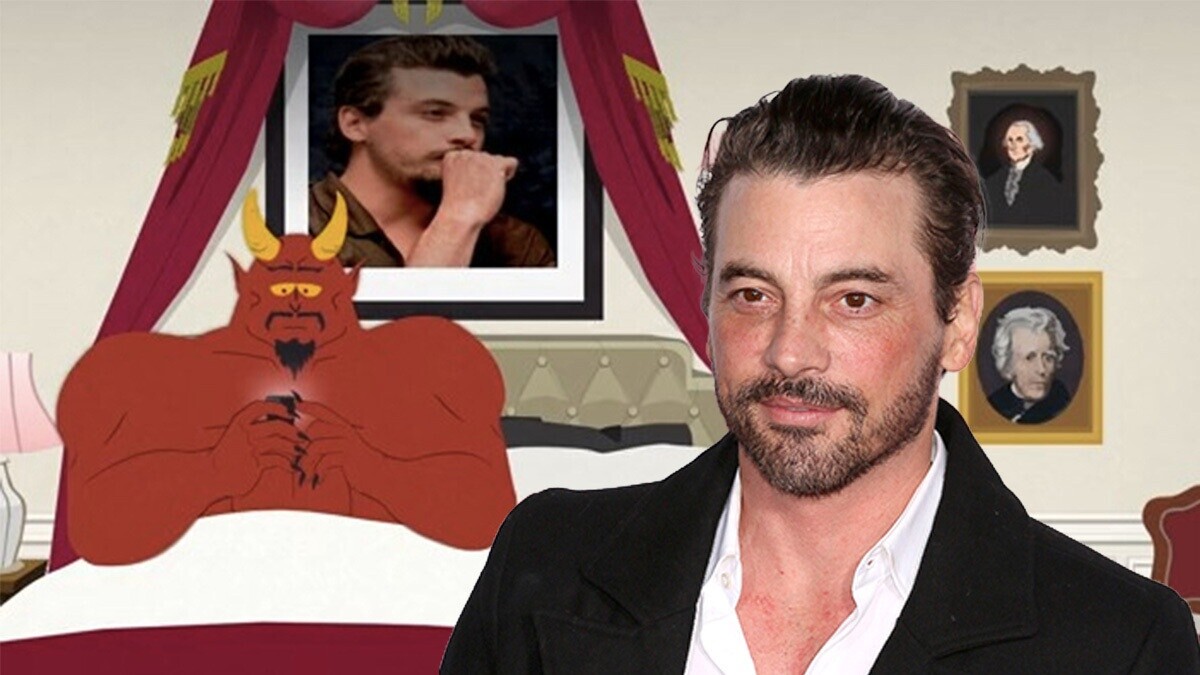
Some pop-culture mysteries arrive wearing a trench coat and carrying a dossier. Others show up in the background of an animated demon’s bedroom and quietly live rent-free in fans’ brains for 25 years. The Skeet Ulrich picture hanging over the Devil’s bed in South Park is very much the second kind.
If you have ever watched South Park: Bigger, Longer & Uncut and suddenly paused during Satan’s bedroom scene, you may have spotted it: a large, unmistakable portrait of actor Skeet Ulrich, the moody 1990s heartthrob best known to horror fans as Billy Loomis from Scream. It is not explained. It is not lampshaded. Satan does not turn to the camera and say, “Huge Craft fan, by the way.” The image simply exists, which somehow makes it funnier.
Then, decades later, the joke returned. In the Season 27 premiere, South Park brought Satan back into a politically explosive storyline, and there it was again: Skeet Ulrich, still watching over the Devil’s bed like the patron saint of dangerous cheekbones. Naturally, fans started asking the only reasonable question: why?
The Short Answer: Even Skeet Ulrich Was Surprised
The funniest part of the whole mystery is that Ulrich himself did not appear to have a grand secret explanation. According to his comments in an entertainment interview, the South Park team had contacted his manager before the movie and asked permission to use his likeness. Ulrich signed off without being told exactly how the image would be used.
That means he discovered the joke the same way many viewers did: by watching the movie and suddenly realizing that Satan had decorated his bedroom with a large picture of Skeet Ulrich. Imagine buying popcorn, settling into a movie, and finding out that the Prince of Darkness has chosen your face as romantic wall art. Hollywood is weird, but that is a special flavor of weird.
Ulrich’s reaction seems to have been good-natured. He has suggested that maybe the joke had more to do with Billy Loomis, his Scream character, than with him personally. He also joked about the possibility that perhaps he is a “fallen angel” and simply had not realized it yet. That is probably the healthiest possible response to learning that Satan has interior-design opinions about you.
Why Skeet Ulrich Made Sense as a 1990s Joke
To understand why the gag lands, it helps to rewind to the late 1990s. Skeet Ulrich was not just another actor with a cool name that sounded like it came from a skateboard brand. He represented a very specific kind of screen presence: brooding, attractive, suspiciously intense, and just dangerous enough to make parents uncomfortable.
In Scream, Ulrich played Billy Loomis, the charming boyfriend whose pretty-boy exterior hid something much darker. In The Craft, he appeared in another teen-culture touchstone loaded with goth energy, supernatural drama, and high-school chaos. By the time South Park: Bigger, Longer & Uncut arrived in 1999, Ulrich’s face carried a recognizable pop-cultural charge. He was the guy you cast when you needed someone handsome enough to be a crush and unsettling enough to be a threat.
That duality is exactly why the portrait works. Satan having a glamorous celebrity crush would already be funny. Satan having a crush on a 1990s bad-boy actor associated with horror, murder-mystery cool, and morally questionable charm is even better. It is a joke that does not need a punchline because the framing is the punchline.
How the Devil Became One of South Park’s Strangest Romantics
Satan first became a major South Park figure early in the show’s run, particularly through the Season 1 episode “Damien,” where he is tied to an absurd good-versus-evil boxing match with Jesus. At first, the character could have been just a muscle-bound underworld boss. Instead, the series gradually turned him into something stranger and more emotionally vulnerable.
In South Park: Bigger, Longer & Uncut, Satan is not simply plotting global doom. He is in a toxic relationship with Saddam Hussein, and the movie plays that dynamic like an outrageous relationship melodrama. Satan wants tenderness, respect, and a better life. Saddam wants control. It is ridiculous, offensive, theatrical, and oddly structured like a breakup musical staged in Hell.
That is where the Skeet Ulrich portrait becomes such a perfect background detail. It makes Satan’s bedroom feel less like a generic lair and more like the private room of a character with taste, longing, fantasy, and perhaps a weakness for 1990s movie villains with excellent hair. The joke is not only “Satan likes Skeet Ulrich.” It is “Satan has a celebrity poster like a lovestruck teenager.” For a character who is literally the Devil, that is wonderfully undignified.
The Season 27 Reappearance Made the Joke New Again
When South Park Season 27 premiered in July 2025, the show returned with the kind of controversy that has fueled it since 1997. The episode “Sermon on the ‘Mount” placed Donald Trump in bed with Satan as part of a broader satire involving politics, religion, lawsuits, media power, and Paramount. In other words, it was a normal quiet week in South Park country.
But amid the headline-grabbing political jokes, longtime fans noticed a familiar face over the bed. The Skeet Ulrich picture was back. It was not just a random callback; it connected the new Satan storyline to the old Satan lore from the movie. The series was effectively saying, “Yes, we remember. Satan still has a type.”
That reappearance mattered because South Park thrives on continuity that looks accidental until it suddenly becomes useful. The show often behaves like a cultural blender, tossing current events, old jokes, celebrity references, and gross-out humor into the same cup. The Ulrich portrait is a perfect example: a tiny background gag from 1999 becomes a fan-recognition prize in 2025.
What Did Skeet Ulrich Think About the Return?
Ulrich reportedly learned about the portrait’s return through friends contacting him. That is a very modern celebrity experience: you wake up, your phone is buzzing, and apparently you are once again decorating Satan’s bedroom on national television.
His response appears to have been playful rather than annoyed. He praised Trey Parker and Matt Stone’s comic instincts and joked that he might need to look back at the old paperwork to see whether the new use came with a paycheck. That joke is almost too perfect, because the phrase “the devil is in the details” has never been more literal.
His relaxed reaction also helps explain why fans enjoy the story. Some celebrities might bristle at being placed in such a bizarre context. Ulrich seems to understand that the joke is not really an insult. If anything, it is a strange badge of cult-comedy immortality. Not every actor gets a recurring visual gag in one of television’s longest-running animated series. Fewer still get to be the Devil’s preferred bedroom décor.
Why the Joke Still Works After All These Years
The Skeet Ulrich portrait works because it combines three kinds of comedy at once. First, there is surprise. Nobody expects a real actor’s glamour-style picture above Satan’s bed. Second, there is specificity. If the picture were of a generic handsome celebrity, it would be less funny. Skeet Ulrich is specific enough to feel like an inside joke but famous enough for many viewers to recognize. Third, there is silence. The show does not explain it, and that restraint gives fans room to obsess.
Comedy often gets weaker when it explains itself. South Park has always understood the value of dropping a ridiculous detail into the frame and walking away like nothing happened. The audience does the rest. Fans pause the scene. They ask questions online. They form theories. They argue about whether it is a Billy Loomis joke, a 1990s heartthrob joke, a gay-Satan joke, or simply something Trey Parker and Matt Stone found funny at 3 a.m.
The best answer may be: all of the above. The portrait is funny because it does not lock itself into one meaning. It is a celebrity crush, a horror reference, a period-specific pop-culture artifact, and a reminder that South Park has always enjoyed turning background nonsense into durable mythology.
Skeet Ulrich, Horror Fandom, and the Power of Accidental Icons
Ulrich’s connection to horror culture has only grown stronger with time. Scream did not merely make him recognizable; it made him part of one of the most influential slasher franchises in American film. Billy Loomis remains one of the genre’s most memorable villains because he blends teen-idol charm with cold-blooded theatrical menace. That combination is exactly what keeps fans returning to the character decades later.
Recent appearances, convention panels, and franchise callbacks have kept Ulrich in the conversation. His return in later Scream installments introduced him to younger viewers, while his casting in other horror-adjacent projects has reinforced his status as a genre favorite. The South Park portrait benefits from that longevity. What could have become an outdated 1999 joke instead feels like a time capsule that aged into fan lore.
That is the magic of accidental icons. Nobody can fully plan them. A poster in the background, a throwaway line, a strange prop, a blink-and-you-miss-it referencesometimes these small choices become more memorable than carefully engineered catchphrases. The Ulrich portrait belongs in that category. It is not central to the plot, yet people remember it because it feels both absurd and oddly perfect.
Fan Theories: Billy Loomis, Bad Boys, and Satan’s Taste
Fans have floated several theories about the portrait. The most obvious is that Satan is drawn to Billy Loomis energy: seductive, dangerous, dramatic, and probably not someone you should trust with kitchen knives. Another theory is that the joke is about 1990s “bad boy” celebrity culture, where actors like Ulrich became crush objects precisely because they looked like trouble.
There is also a simpler reading: Satan is canonically romantic, insecure, and emotionally messy in South Park. Giving him a celebrity pinup makes him feel hilariously human. The Devil may rule Hell, but he apparently still decorates like someone with a crush and a magazine subscription.
What makes the joke especially strong is that none of these theories needs to defeat the others. A good background gag can carry multiple meanings. It can be about Ulrich’s horror image, Satan’s romantic fantasies, and the show’s love of random celebrity weirdness all at once. Like many South Park jokes, it is both stupid and weirdly layered. That is not an insult. That is the brand.
What the Portrait Says About South Park’s Comedy Style
South Park has lasted for decades because it moves fast, hits hard, and rarely treats sacred cows gently. But the show’s smaller visual jokes are just as important as its big controversies. The Skeet Ulrich portrait is not a headline joke. It is not a monologue. It is not a political thesis. It is a background image that quietly tells viewers, “This world is ridiculous even when nobody is talking.”
That kind of detail rewards attention. It makes the show feel denser than its simple animation might suggest. A bedroom wall becomes a joke. A celebrity face becomes character development. A 1999 sight gag becomes a 2025 Easter egg. Fans enjoy that because it gives them something to discover and rediscover.
It also shows how South Park uses celebrity culture differently from many shows. Instead of simply parodying a celebrity directly, it may place that celebrity in a bizarre symbolic role. Ulrich is not mocked as a person. His image becomes shorthand for a type: the attractive, dangerous, slightly gothic screen presence that even Satan might admire.
Experiences Related to the Mystery: Watching the Joke Travel Through Time
One of the most entertaining experiences connected to the Skeet Ulrich South Park mystery is watching how different generations discover it. Older fans often remember seeing Bigger, Longer & Uncut when the film was still fresh, when Scream was a recent cultural explosion and Ulrich’s Billy Loomis image was instantly recognizable. For them, the portrait felt like a sharp little 1990s joke, a mischievous wink from a movie already stuffed with musical numbers, censorship satire, and gleeful vulgarity.
Younger viewers often encounter the gag differently. They may first know Ulrich from Riverdale, later Scream sequels, convention clips, or horror-fandom edits online. When they revisit the South Park movie and spot the portrait, the joke becomes a puzzle. Why is FP Jones from Riverdale in Hell? Why does Satan have Billy Loomis over the bed? Why does this feel like something the internet should have warned me about?
That generational confusion is part of the fun. Pop culture is not a straight line; it is a messy attic. You open one box labeled “animated satire” and find another box labeled “1990s horror crushes.” Then, somehow, Donald Trump and Satan show up in a Season 27 storyline and the same photo is still there, aging better than most celebrity posters and possibly better than the Devil’s relationships.
There is also a shared fan experience in the act of pausing. The Ulrich image is the kind of background detail that makes viewers grab the remote and say, “Wait, was that who I think it was?” That pause is powerful. It turns passive watching into detective work. Suddenly a joke is not just consumed; it is investigated. Screenshots circulate, Reddit threads bloom, and people who have not thought about the movie in years are pulled back into its weird little underworld.
For writers and pop-culture observers, the lesson is useful: small details can create long-term engagement when they feel specific, surprising, and unresolved. The portrait did not need a speech. It needed placement, timing, and confidence. By refusing to explain the gag, South Park allowed fans to keep it alive. The mystery became more durable than a neat answer would have been.
For Ulrich, the whole thing has become an unlikely footnote in a career already packed with cult favorites. He did not ask to become Satan’s wall art, but he has handled it with the kind of amused calm that makes the joke even better. In the end, the portrait is not just about why the Devil likes Skeet Ulrich. It is about how pop culture creates strange little shrines, sometimes on purpose and sometimes by accident. And if your face ends up above Satan’s bed, the best move may be to laugh, check the contract, and accept that you have officially entered television folklore.
Conclusion
The mystery of Skeet Ulrich’s picture over the Devil’s bed in South Park is delightfully simple and wonderfully strange. The show asked to use his likeness, he approved it without knowing the exact context, and the result became one of the most oddly enduring background jokes in South Park history. Its return in Season 27 only made the gag richer, reminding fans that the series never truly forgets its best bits of nonsense.
Whether the portrait is a Billy Loomis reference, a 1990s heartthrob joke, a glimpse into Satan’s questionable romantic taste, or all of the above, it remains a perfect example of how tiny pop-culture details can grow into lasting fan mythology. Satan may have many problems, but taste in wall décor? Honestly, he could have done worse.
Note: This article is written as original editorial analysis based on verified entertainment reporting and official episode information. It avoids unnecessary source-code artifacts and external source-link clutter for clean web publishing.