Most of us have done it. We are walking the dog, driving to work, or jogging with the heroic optimism of someone who bought new running shoes, and then we see an animal that did not make it across the road. We look away. We keep moving. Not because we are monsters, but because modern life has trained us to treat sadness like a pothole: notice it, swerve, continue.
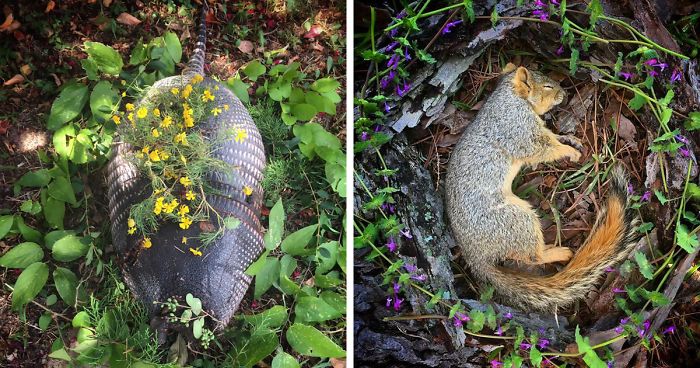
Dr. Amanda Stronza does the opposite. When she comes across a dead animal, she pauses. She moves the animal to a quiet place when it is safe and appropriate. Then she gathers what the landscape offersflowers, leaves, twigs, grasses, seeds, stonesand creates a small, tender memorial. Finally, she photographs the animal with dignity. The result is an art practice that is both heartbreaking and strangely comforting: animal memorial photography that asks us to see what we usually ignore.
The title sounds like something designed to break your heart before lunch, and yes, keep a tissue nearby. But the story is not only sad. It is also about compassion, road ecology, grief, attention, and the quiet moral power of noticing. In a world that often rushes past suffering at highway speed, Stronza’s memorials gently say: slow down, this life mattered.
Who Is Amanda Stronza?
Amanda Stronza is an anthropologist, professor, conservationist, and photographer based in Texas. Her professional life centers on wildlife, conservation, and the relationships between humans and animals. That background matters because her memorials are not random craft projects with a strong floral department. They come from a lifetime of paying attention to animals as individuals, neighbors, and fellow travelers on the planet.
Her animal memorials became widely known after online audiences discovered her photographs: small creatures encircled with flowers, birds resting among leaves, a squirrel honored beneath a tree, a fawn treated with the gentleness usually reserved for family. People responded because the images do something unusual. They do not sensationalize death. They soften our gaze. They make the viewer feel not entertained, but responsible.
Why These Animal Memorials Feel So Powerful
Animal deaths on roads are often flattened into one word: roadkill. It is a harsh little word, efficient and ugly, like a trash can with wheels. Stronza’s work resists that language. A raccoon is not “just roadkill.” A grackle is not “just a bird.” A turtle is not “traffic debris.” Each animal had instincts, movement, hunger, fear, habits, and a place in an ecosystem. Each was alive before it became something we were tempted not to see.
That is why the flowers matter. A circle of petals does not undo death, but it changes the way we witness it. It turns a roadside accident into a moment of recognition. It says: this was not nothing. This was someone’s brief, wild life.
The memorials also remind us that roads are not neutral lines across the land. They cut through habitats, migration paths, nesting areas, wetlands, forests, fields, and suburban edges where wildlife tries to survive among human infrastructure. A six-lane road may feel ordinary to us, but to a coyote, armadillo, turtle, frog, snake, or fawn, it can be an impossible wall made of noise, speed, and headlights.
25 Of The Most Heartbreaking Memorial Moments
Stronza’s work includes many species and many settings: highways, trails, yards, riverbanks, neighborhoods, and quiet patches of grass. The following 25 examples capture the emotional range of her memorial practice. They are not heartbreaking because they are dramatic; they are heartbreaking because they are ordinary. That is the point.
1. The Baby Animal Found In A Yard
One of the most tender memorials shows a tiny animal found in a yard, surrounded by spring flowers. The scene feels almost impossibly gentle, as if the season itself stopped to apologize.
2. The Squirrel Beneath The Tree
A squirrel found on a trail becomes more than a passing sadness when placed beneath a tree and circled with natural beauty. It is a small funeral, but it has the emotional weight of a cathedral.
3. The Coyote Near A Busy Road
A coyote memorial is especially striking because coyotes are often misunderstood as pests or nuisances. In Stronza’s photographs, the animal is not a problem to be managed, but a life interrupted while trying to navigate a human-built world.
4. The Spotted Fawn
The fawn memorial is one of the hardest to look at without feeling your heart quietly fold itself into a paper crane. Young, delicate, and still wearing the camouflage of babyhood, the animal becomes a symbol of innocence on the edge of traffic.
5. The Grackle In Austin
Grackles are common in Texas, which is exactly why honoring one matters. Common does not mean disposable. A bird seen every day is still a bird worth mourning.
6. The Armadillo With A Touch Of Texas Humor
Armadillos are often the subject of roadside jokes, but Stronza’s memorials gently turn the punchline into a pause. Humor may help humans handle sadness, but the animal still deserves respect.
7. The Young Raccoon
A raccoon memorial challenges the way we label clever urban animals as messy little bandits. Yes, raccoons raid trash cans like tiny masked burglars with questionable manners. They are also intelligent, adaptive beings trying to survive beside us.
8. The Coachwhip Snake
Snakes often get fear instead of sympathy. A memorial for a coachwhip snake asks viewers to look again and see strength, pattern, movement, and beauty rather than panic in noodle form.
9. The Small Bird By The Riverbank
A small bird found near water, held briefly and then honored, becomes a reminder that death is not always caused by roads. Nature has its own cycles, but attention can still turn loss into reverence.
10. The Tiny Shrew
A shrew is easy to miss in life and even easier to overlook in death. Encircled with stones and plants, the tiny creature becomes visible, almost monumental.
11. The Squirrel Taken Back Into The Circle Of Life
Some memorials do not remain untouched. A fox may carry the body away; insects may arrive; the earth takes over. That does not erase the memorial. It completes it.
12. The Small Animal Found During A Walk
Many of Stronza’s memorials begin during ordinary walks. That is part of their emotional force. Compassion does not always arrive with a plan. Sometimes it arrives while you are wearing sneakers and thinking about dinner.
13. The Barred Owl Tribute
Birds of prey often inspire awe in flight, but stillness reveals another kind of beauty. A memorial for an owl can feel like a quiet conversation between art, ecology, and grief.
14. The Turtle Near The Road
Turtles are especially vulnerable because they move slowly and often cross roads during nesting season. A turtle memorial carries a particular ache: the animal was simply trying to get somewhere, at turtle speed, which is to say with admirable commitment and no interest in our schedules.
15. The Rabbit In The Grass
A rabbit memorial can look almost peaceful, but that calm is what makes it devastating. The flowers do not hide the loss; they help us sit with it.
16. The Opossum Misunderstood By Almost Everyone
Opossums are useful, shy, and wildly underappreciated. A memorial for one feels like long-overdue public relations for an animal that never hired a branding agency.
17. The Sparrow Among Leaves
A sparrow is small enough to disappear from human attention. In a memorial, it becomes the center of the frame, the center of the moment, and briefly, the center of our conscience.
18. The Frog Near Wetlands
Frogs often cross roads near wet places after rain. Their losses remind us that even small roads can divide breeding habitats and feeding grounds.
19. The Deer At The Edge Of Suburbia
Deer live in the awkward overlap between wild land and human development. A deer memorial is not only about one animal; it is about the way neighborhoods expand into the places animals already call home.
20. The Lizard On A Warm Path
Reptiles are drawn to warmth, including sunlit pavement. A lizard memorial turns a tiny body into a lesson about how human surfaces change animal behavior.
21. The Moth Or Butterfly
Even insects can be memorialized. That may sound excessive to someone in a hurry, but it is also radical in the best way. It says attention is not reserved only for cute mammals with excellent eyelashes.
22. The Fox Seen Only After Death
Some animals are rarely noticed while alive. A fox memorial may be the first time a passerby truly sees the animal that had been sharing the neighborhood all along.
23. The Snake People Would Rather Avoid
Another snake memorial pushes against fear. The flowers do not make the snake less wild. They help us respect its wildness without needing to control it.
24. The Bird No One Else Stopped For
One of the recurring heartbreaks in this work is not only that animals die, but that so many people pass them without stopping. The memorial becomes a small act of correction.
25. The Unnamed Animal That Represents Them All
The most heartbreaking memorial may be the one without a famous species or dramatic story. It is simply an animal found, moved, adorned, photographed, and honored. That is enough.
The Art Of Turning Attention Into Compassion
What makes these memorials beautiful is their restraint. Stronza does not build elaborate monuments or force a message into neon letters. She uses what is nearby. A few flowers. A small ring of leaves. A quiet place away from tires and footsteps. The materials belong to the landscape, which makes the memorials feel less like decoration and more like a return.
This is also why the photographs work so well. They preserve the memorial for viewers who were not there, but they do not make the animal into a spectacle. The camera becomes a witness. The image says: look carefully, but look kindly.
What These Memorials Teach Us About Roads And Wildlife
The emotional message is simple, but the ecological message is larger. Wildlife-vehicle collisions are a major concern in the United States. Roads fragment habitat, separate animals from food and water, and create dangerous crossings during migration, nesting, mating, and everyday movement. Large animals can cause serious crashes, while smaller animals often disappear from official statistics entirely.
That is why conservationists support wildlife crossings, fencing, habitat corridors, and better road planning. A bridge or underpass designed for animals may not look poetic, but to a turtle, deer, elk, frog, or fox, it can be the difference between a safe journey and a final one. The most beautiful memorial, after all, is prevention.
What To Do If You Find An Injured Or Dead Wild Animal
Stronza’s memorials are moving, but they should not encourage unsafe behavior. If you see an animal on or near a road, your safety comes first. Do not stop in traffic, step into a lane, or handle wildlife without knowing the risks. Animals can carry disease, bite when frightened, or be protected by local laws.
If an animal is alive and appears injured, contact a licensed wildlife rehabilitator, animal control agency, local wildlife office, or veterinarian for guidance. In many places, it is illegal to keep or rehabilitate wild animals without a permit. If the animal is a turtle crossing the road and it is safe to help, wildlife agencies generally advise moving the turtle in the direction it was already traveling, not relocating it elsewhere. Turtles are not lost tourists; they know where they are going, even if they look like they are late for a meeting in 1847.
If the animal has died, the most respectful response may be simple: report it if it creates a road hazard, move it only if it is safe and legal, or pause for a moment of acknowledgment. Not everyone needs to create a floral memorial. Sometimes compassion looks like a phone call. Sometimes it looks like slowing down near wildlife crossings. Sometimes it looks like teaching children that animals are not objects, even when they are no longer alive.
Why The Internet Cried Over These Photos
People share these memorials because they touch a feeling that is difficult to name. It is grief, yes, but also relief. Relief that someone noticed. Relief that the animal was not left entirely unseen. Relief that tenderness still exists in public, even beside asphalt.
The photographs also give viewers permission to care about small things. Online life often rewards outrage, speed, and cleverness. Stronza’s memorials reward attention. They whisper instead of shout. Somehow, the whisper is louder.
There is also a universal human layer. Many people have lost pets, family members, or wild places they loved. Seeing an animal honored with flowers can awaken memories of our own goodbyes. The memorials become less about death itself and more about the human need to say: you were here, and I saw you.
Experiences And Reflections: Learning To See The Lives We Usually Pass By
The experience of encountering Stronza’s animal memorials can change the way a person moves through the world. After seeing her work, a roadside is no longer just a roadside. A patch of weeds becomes habitat. A ditch becomes shelter. A stretch of pavement becomes a dangerous border crossing for creatures who never signed up for urban planning.
Many people can remember the first time they saw a dead animal and understood what it meant. Maybe it was a bird below a window, a squirrel in the street, a frog after rain, or a deer at the edge of a highway. Children often ask the clearest questions: Why did it happen? Where was it going? Did anyone help? Adults tend to answer quickly because sadness makes us uncomfortable. But Stronza’s work suggests that staying with the question a little longer can be meaningful.
There is an experience almost everyone knows: the split second when you see an animal near the road and silently beg it not to cross. Your hands tighten on the wheel. Your foot hovers. Your heart becomes a tiny traffic controller in a reflective vest. When the animal turns back, relief floods in. When it does not, the moment can stay with you. That emotional jolt is evidence that we are not as indifferent as we sometimes pretend to be.
These memorials encourage a different kind of daily practice. Drive a little slower in areas marked for wildlife. Watch for turtles after rain. Give birds space near roadsides. Keep cats indoors when possible to protect small wildlife. Plant native flowers that support insects and birds. Support local wildlife rehabilitation centers. Teach younger family members that compassion is not embarrassing, even when it is directed toward a beetle, a snake, or an opossum with the facial expression of a Victorian ghost.
There is also a lesson about grief. Not every loss receives a ceremony. Not every life gets a marker. But ceremony does not have to be large to be real. A ring of leaves can be a ceremony. A moment of silence can be a ceremony. Moving an animal from danger, when safe, can be a ceremony. Even deciding not to look away can be a ceremony.
For writers, artists, photographers, teachers, parents, and ordinary walkers with muddy shoes, Stronza’s work offers a powerful creative prompt: make attention visible. You do not have to copy her memorials to learn from them. You can sketch a bird you saw, write a paragraph about a fox crossing at dusk, volunteer for a habitat project, or simply become the person who notices. The world does not become less heartbreaking when we pay attention. But it may become more humane.
And maybe that is the deepest experience these memorials offer. They do not ask us to be perfect. They do not ask us to save every animal or solve every ecological problem before breakfast. They ask us to pause. To honor. To admit that the small lives around us are not background decorations in the human movie. They are lives. Wild, brief, beautiful lives. And when one ends, even a handful of flowers can say what traffic never will: you mattered.
Conclusion
This woman creates beautiful memorials for dead animals she comes across, but the deeper story is not only about flowers, photography, or sadness. It is about restoring dignity to beings that modern life often reduces to obstacles or statistics. Amanda Stronza’s animal memorials invite us to look more carefully at the living world and to recognize how much life unfolds beside us, beneath us, above us, and sometimes tragically in front of us.
The 25 heartbreaking memorials are powerful because they transform avoidance into attention. They remind us that compassion can be quiet and still count. They also point toward a practical hope: safer roads, better wildlife crossings, stronger habitat protection, and a culture that teaches people to slow down for animals before memorials are needed.