Some artists need oil paint, marble, studio lighting, and a playlist so dramatic it could make a houseplant cry. Belgian artist and filmmaker Vincent Bal needs something much simpler: a random object, a beam of light, a piece of paper, and the kind of imagination that looks at a teacup shadow and says, “Obviously, that is an elephant.”
That playful way of seeing the world is the heart of Shadowology, Bal’s now-famous series of shadow illustrations made from everyday objects. A fork becomes musical staff lines. A glass becomes a UFO. A rubber duck shadow turns into a suspicious little burglar. Suddenly, the junk drawer is not a junk drawer anymoreit is a casting agency for tiny visual jokes.
The title “Shadows Of Random Objects Make Up Fun Illustrations By This Artist (50 Pics)” sounds like a simple online gallery, but the idea behind it is surprisingly rich. These works are clever, funny, minimal, and deeply human. They remind us that creativity is not always about inventing something from nothing. Sometimes it is about noticing what is already sitting on the desk, quietly waiting to become a dancing monster, a sleepy animal, or a detective with suspiciously excellent cheekbones.
Who Is Vincent Bal, the Artist Behind Shadowology?
Vincent Bal is a Belgian filmmaker, illustrator, and visual artist known for transforming the cast shadows of ordinary objects into humorous, hand-drawn scenes. Before becoming widely recognized for his everyday object shadow art, Bal built a career in film, writing and directing shorts, feature films, and family-friendly stories. That cinematic background matters: his shadow doodles often feel like tiny movie stills, each one hinting at a plot just outside the frame.
The origin story of Shadowology is wonderfully ordinary. While working on a film script in 2016, Bal noticed that the shadow of a teacup on his desk looked like a small elephant. Instead of ignoring it like a responsible adult with deadlines, he added a few lines, photographed it, and shared it online. The reaction was immediate and enthusiastic. From there, he challenged himself to create more shadow doodles, and the project grew into a daily creative practice.
What began as a quick experiment has become a recognizable art style, with books, prints, postcards, exhibitions, and a large social media following. Yet the charm of the work remains the same: it still feels spontaneous, humble, and delightfully low-tech.
Why These Fun Shadow Illustrations Work So Well
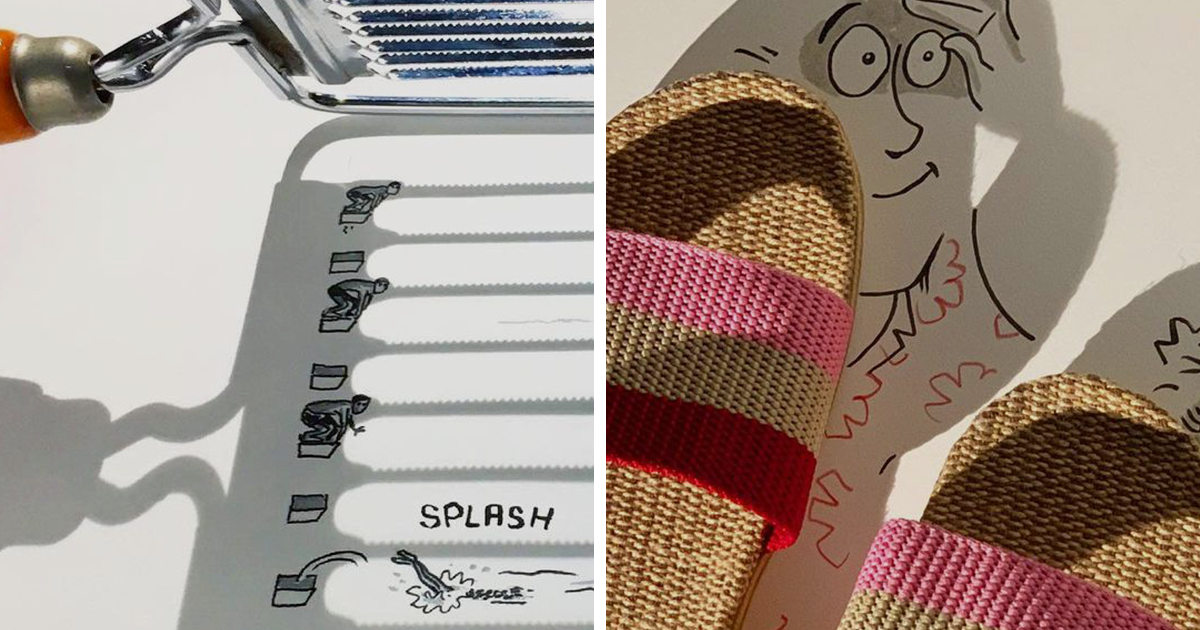
The magic of Bal’s art comes from the gap between what the object is and what its shadow becomes. A cheese grater may be boring if you are making dinner. But under the right light, its shadow might become fur, a fence, a costume, a storm cloud, or the body of a suspicious cat who definitely knocked over the vase.
This surprise is what makes random object illustrations so satisfying. The viewer gets two pleasures at once: first, the joy of recognizing the original object; second, the little brain-pop of seeing how the shadow has been repurposed. It is visual comedy with excellent timing.
The Art Is Minimal, but the Thinking Is Not
Bal’s drawings are usually simple. A few lines, a face, a hand, a shoe, a tail, a hatand suddenly the shadow becomes a character. But simplicity is not the same as easiness. In fact, the restraint is part of the skill. Too many lines would smother the illusion. Too few would leave the image unfinished. The artist has to know exactly when to stop, which is also a useful life skill when texting after midnight.
That balance makes his creative shadow drawings feel effortless. They look as if the object was always meant to cast that funny little story. The best ones make you think, “Why didn’t I see that?” That question is the engine of good visual art.
The Psychology Behind Seeing Pictures in Shadows
Part of the appeal comes from a familiar mental habit called pareidolia, the tendency to see meaningful images in random or ambiguous patterns. It is why people spot faces in electrical outlets, animals in clouds, and a judgmental expression in the front of a car. Our brains are extremely talented at turning visual noise into meaning.
Bal’s Shadowology plays with that natural instinct. He does not force a complete image onto the viewer. Instead, he gives the brain just enough information to finish the joke. The shadow acts like a puzzle piece, and the drawing supplies the missing context. Together, they create a little “aha!” moment.
This is also why the work feels accessible. You do not need an art history degree to enjoy it. You only need eyes, curiosity, and possibly a lamp. The images speak the universal language of “Wait, that spoon shadow is a penguin now?”
Everyday Objects Become Unexpected Characters
One of the strongest features of Bal’s shadow illustrations is his choice of materials. He uses the humble objects most people overlook: cups, forks, glasses, leaves, toys, kitchen tools, fruit peels, scissors, chargers, and other household items. These objects are familiar enough to feel intimate, but their shadows become strange enough to feel magical.
Kitchen Tools With Secret Lives
The kitchen is practically a theater for Shadowology. A fork can become music. A colander can become a helmet. A grater might become a furry creature. A wineglass may throw a shadow that turns into a trapped figure or a dramatic stage spotlight. Suddenly, making lunch feels less like meal prep and more like casting for a miniature Broadway show.
Toys, Gadgets, and Office Supplies
Bal’s work also makes brilliant use of objects that already have playful shapes. A rubber duck can become something completely unrelated. A phone charger might turn into a boat. A pair of glasses could become a character’s face, body, or environment. The fun lies in the mismatch: the more ordinary the object, the more delightful the transformation.
Nature Joins the Joke
Leaves, stems, stones, and shells can also create striking shadow shapes. A leaf shadow may suggest feathers, hair, wings, or waves. Organic objects are especially rich because their edges are irregular, giving the artist more visual accidents to chase. Nature is apparently an unpaid intern in the Department of Whimsy.
Why “50 Pics” Galleries Are Perfect for This Kind of Art
A single Shadowology image is charming. Fifty of them create a rhythm. As viewers scroll through a gallery, they begin to anticipate the transformation. First comes the object. Then the shadow. Then the drawing. Then the punchline. It becomes a visual game, and the viewer starts playing along.
This format works especially well online because shadow art is quick to understand but rewarding to revisit. You can enjoy one image in two seconds, then return later and notice the cleverness of the linework, the angle of the light, or the way the object remains visible without ruining the illusion.
In a digital world crowded with loud colors, heavy editing, and complicated effects, Bal’s fun shadow art feels refreshingly calm. It is proof that a strong idea does not need to shout. Sometimes it only needs a teacup and a sunny desk.
What Makes Vincent Bal’s Style So Recognizable?
Bal’s work has a clear visual identity. It is not just “drawing around shadows.” Many people can try that, and many should, because it is fun. But his style stands out because of the combination of humor, precision, and story.
1. The Shadow Is the Star
The drawing never bullies the shadow. Instead, it supports it. Bal lets the object’s shadow remain visible and important, which keeps the illusion honest. The viewer can still see the original source, and that transparency makes the transformation even more impressive.
2. The Humor Is Gentle
These illustrations are funny, but rarely mean-spirited. The jokes are playful, poetic, and sometimes slightly absurd. A shadow may become a sneaky thief, a dramatic animal, or a character in a tiny crisis, but the tone stays warm. It is the kind of humor that makes you smile before you realize you are smiling.
3. The Composition Is Cinematic
Bal’s background in film shows in the framing. Many images feel like scenes paused at the perfect moment. A character may seem to be running, hiding, reaching, floating, or performing. The paper becomes a stage, the object becomes a prop, and the shadow becomes the set design.
Shadowology as a Lesson in Creativity
The deeper message of Shadowology is not “everything is art,” although that is a nice thought and also a dangerous excuse to avoid cleaning your desk. The stronger lesson is that creativity often begins with attention. Bal notices small visual possibilities that most of us walk past.
That kind of noticing can be practiced. Look at the shadow of your coffee mug. Rotate a spoon under a lamp. Move a plant closer to the window. Watch how the shape changes. The first shadow may look like nothing. The second may look like a potato having an emotional breakthrough. The third might become the start of a drawing.
For students, designers, illustrators, photographers, and anyone trying to loosen up creatively, shadow art with everyday objects is a brilliant exercise. It removes the pressure to make something perfect. You are not staring at a blank page anymore; the shadow has already made the first move.
How to Try Shadow Illustrations at Home
You do not need fancy equipment to experiment with shadow drawing. A desk lamp, sunlight, a sheet of paper, and a pen are enough. Start with objects that have interesting edges: forks, scissors, toy animals, leaves, keys, glasses, strainers, or small tools. Place one object near a light source and rotate it slowly until the shadow suggests something unexpected.
Once you see a possible figure, add only the lines you need. Give it eyes. Add legs. Draw a hat. Turn a shadow blob into a bear, a dancer, a submarine, or a tired office worker who has had one too many meetings. The goal is not realism. The goal is transformation.
Take photos as you go, because shadows are slippery little performers. A small movement of the sun or lamp can change everything. That temporary quality is part of the beauty. Shadowology captures a moment when light, object, hand, and imagination briefly agree to cooperate.
Why This Art Feels So Good in a Complicated World
There is something comforting about art made from ordinary things. It suggests that wonder has not disappeared; it has simply been hiding behind the coffee cup. Bal’s work does not ask us to buy more, travel farther, or become more impressive. It asks us to look again.
That is why these whimsical shadow illustrations travel so well across cultures and platforms. They are simple enough for children to enjoy and clever enough for adults to appreciate. They invite viewers to slow down, laugh gently, and remember that imagination is not a luxury item. It is a way of paying attention.
Experiences and Reflections Inspired by “Shadows Of Random Objects Make Up Fun Illustrations By This Artist (50 Pics)”
The most enjoyable experience related to this topic is how quickly it changes the way you look at a room. After spending time with Vincent Bal’s shadow illustrations, ordinary objects start behaving suspiciously. A coffee mug is no longer just a coffee mug. It is a possible elephant, astronaut helmet, sleepy whale, or mysterious cave entrance. A fork is not merely a fork; it is a ladder, a rib cage, a set of musical lines, or the beginning of a tiny city skyline.
Trying this kind of art at home is both humbling and hilarious. At first, you may think, “I can do that.” Then you place a spoon under a lamp and produce a shadow that looks like a confused bean. You rotate it. Now it looks like a confused bean wearing a hat. Progress! After a few attempts, though, your brain begins to loosen. You stop asking, “What is this object?” and start asking, “What could this shape become?” That shift is the real creative reward.
One practical lesson is that lighting matters more than expected. A shadow can stretch, shrink, sharpen, blur, or completely disappear depending on the angle and distance of the light. Natural sunlight creates beautiful long shadows, especially in the morning or late afternoon. A desk lamp gives more control, but it can also create harsh edges. Moving the object by even an inch can turn a useless blob into the perfect outline for a bird or a running dog.
Another experience is learning to accept imperfection. Shadow illustrations work best when they keep some mystery. If every detail is explained, the charm fades. The viewer wants to participate. A few lines can be more powerful than a fully rendered drawing because the mind fills in the rest. This is why Bal’s style feels so alive: it respects the viewer’s imagination.
For families, teachers, or creative teams, shadow drawing can become a surprisingly fun activity. Put random objects on a table, shine a lamp across them, and ask everyone what they see. One person may see a dragon. Another may see a violinist. Someone else may see a taco with ambition. Nobody is wrong, which makes the exercise freeing. It encourages flexible thinking, visual storytelling, and laughter without requiring expensive supplies.
The topic also carries a gentle reminder about digital creativity. In an age of filters, templates, and instant effects, Bal’s Shadowology feels beautifully physical. The object is real. The light is real. The paper is real. The drawing is small and human. That handmade quality gives the work its warmth. It proves that technology can share art widely, but the original spark may still come from sitting at a desk and noticing a funny shadow.
Ultimately, “Shadows Of Random Objects Make Up Fun Illustrations By This Artist (50 Pics)” is more than a gallery title. It is an invitation to become more observant. It says: look at your surroundings again. The boring things are not always boring. The ordinary world has a secret cartoon department, and it opens whenever light hits the table just right.
Conclusion
Vincent Bal’s Shadowology turns the simplest ingredientslight, paper, objects, and a few drawn linesinto a playful universe of characters and jokes. His shadows of random objects remind us that creativity does not always require complicated tools. Sometimes the best ideas arrive quietly, shaped like a teacup shadow, waiting for someone curious enough to notice.
Whether you are an art lover, illustrator, teacher, student, photographer, or casual scroller looking for a smile, these fun shadow illustrations offer a refreshing lesson: imagination lives in the everyday. You just have to move the lamp.