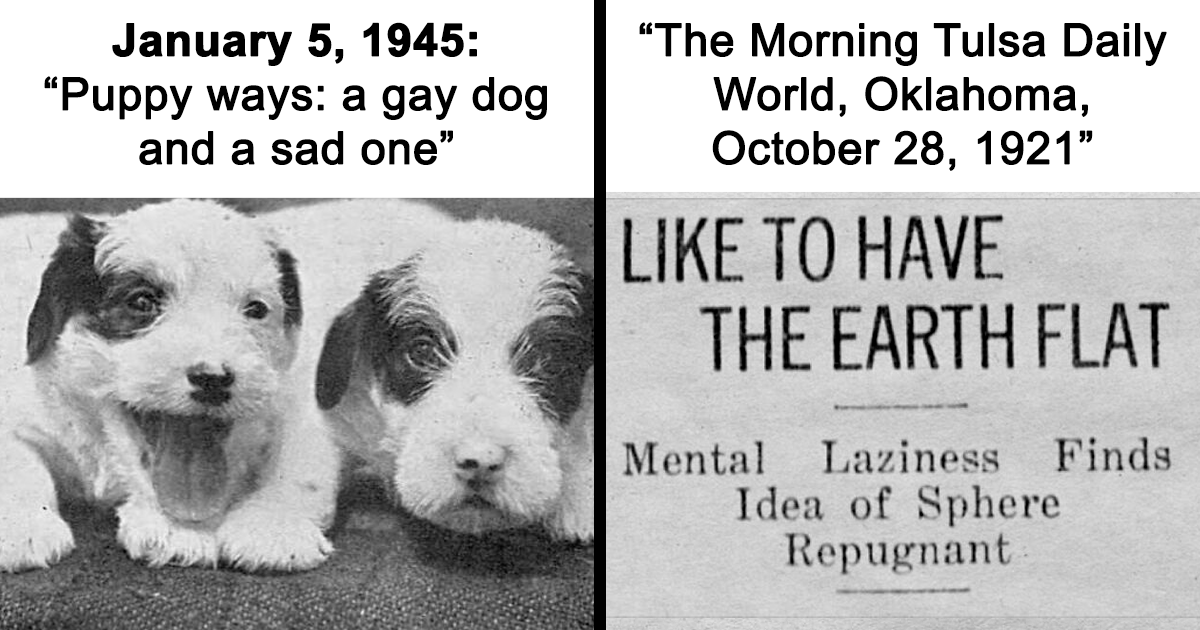
Every generation likes to imagine it invented chaos. We have workplace drama, questionable dating advice, fashion arguments, political shouting, strange health trends, nosy neighbors, outrageous advertisements, and people confidently giving opinions nobody requested. Then somebody opens a newspaper from 1908 and ruins the illusion.
Vintage newspaper clippings are miniature time machines, except instead of transporting us to grand presidential speeches or historic battles, they often deposit us directly into somebody’s complaint about marriage, a ridiculous classified ad, a sarcastic one-liner, or a headline that sounds suspiciously like something posted online yesterday.
Collections of funny newspaper clippings have become popular precisely because the paper may be yellowed, the typeface may look ancient, and everyone involved may have been wearing enough wool to survive an expedition to Antarctica, yet the underlying human behavior feels hilariously familiar.
Looking across dozens of these clippings, including examples preserved in historic newspaper archives and modern collections of vintage print oddities, one conclusion becomes difficult to avoid: technology changes quickly. People? Apparently we prefer the occasional software update.
Research grounding:
Old Newspapers Were Basically the Internet on Giant Sheets of Paper
It is tempting to imagine historical newspapers as solemn walls of serious information. Some certainly were. But newspapers have also spent generations competing aggressively for attention.
The rise of inexpensive newspapers in the 19th century expanded mass readership, while publishers increasingly relied on advertising and eye-catching presentation. By the late 1800s, major Sunday papers were experimenting with illustrations, humor pages, contests, women’s sections, children’s material, serialized fiction, and eventually colorful comics. In other words, publishers had discovered an important rule long before social media existed: information is useful, but entertainment keeps people looking.
Research grounding:
That helps explain why old newspapers are full of snippets that feel strangely modern. Readers wanted jokes, gossip, relationship stories, odd local news, practical advice, sensational headlines, and things to argue about. Today’s screen may scroll vertically instead of unfolding across the breakfast table, but the menu is remarkably recognizable.
The 80 Clippings Reveal the Same Human Habits Again and Again
1. Fashion Panic Was Alive and Well
Few things unite generations like older people worrying about what younger people are wearing.
A 1928 clipping from Ohio’s Circleville Herald, for example, joked about changing dress lengths and exposed knees. Nearly a century later, replace “hemline” with crop tops, ripped jeans, tattoos, or whatever teenagers are currently wearing, and the conversation requires surprisingly little editing.
Fashion outrage often presents itself as an emergency. Somehow civilization is always one garment away from collapse, yet civilization stubbornly continues while everyone eventually becomes nostalgic for the clothes that supposedly threatened it.
2. Workplace Complaints Did Not Begin With Slack
An 1877 Kansas newspaper clipping preserved in modern vintage-print collections offers an amusing glimpse into attitudes surrounding women clerks and whether they should sit while working. The specifics belong to another era, but the larger phenomenon is evergreen: people have always had very strong opinions about what workers should be doing with their bodies during business hours.
Today the argument might involve remote work, standing desks, four-day workweeks, mandatory office attendance, or whether someone whose status indicator says “away” is secretly reorganizing a sock drawer.
Old employment pages also reveal a more serious reality. For decades, American help-wanted advertising frequently separated jobs by gender, reinforcing discriminatory assumptions about which occupations belonged to men and which belonged to women. Those categories became the subject of legal and political battles before largely disappearing in the early 1970s.
Research grounding:
So yes, some old workplace clippings are funny. Others are reminders that historical absurdity could have real consequences.
3. Dating Has Always Been a Dangerous Hobby
Long before swiping, ghosting, orbiting, situationships, and whatever romantic vocabulary will appear next Tuesday, people were using newspapers to pursue love.
Personal advertisements offered strangers a chance to describe themselves, announce what they wanted, and quietly demonstrate that human beings have always been extraordinarily optimistic about their market value.
Newspaper advice columns later provided another public window into private relationships. Readers sent questions about spouses, dating, family disagreements, jealousy, money, manners, intimacy, and social expectations. Millions of other readers consumed those problems for the same reason audiences now devour relationship forums: officially, they came for advice; unofficially, everybody enjoys hearing about someone else’s disaster.
Ann Landers and Dear Abby became cultural institutions because personal problems rarely go out of date. Change the vocabulary and many letters could be posted to an online advice forum today without attracting suspicion.
Research grounding:
4. Newspapers Had Comment SectionsThey Were Just Slower
Imagine an online argument where every participant has to write a letter, find an envelope, purchase a stamp, mail the response, wait for an editor, and possibly discover three weeks later that the editor has decided their opinion is not worth the ink.
That was content moderation with cardio.
Letters to editors, opinion columns, reader submissions, syndicated advice, and reprinted commentary created public conversations long before digital platforms. Newspapers could be intensely partisan as well. The romantic idea that every earlier newspaper calmly delivered perfectly neutral facts does not survive much time in an archive.
Publishers had political preferences. Editors had personalities. Columnists had grudges. Readers argued back.
The speed was different. The instinct was not.
5. Clickbait Is Older Than Clicking
Today’s internet is regularly accused of inventing sensational headlines. History would like to enter the chat.
The famous newspaper battles associated with Joseph Pulitzer and William Randolph Hearst demonstrated how aggressively publishers could compete for circulation. During the yellow-journalism era, dramatic typography, emotional language, scandal, crime, illustrations, and eye-popping claims were powerful tools for selling papers.
Even earlier, the New York Sun attracted enormous attention with the 1835 “Great Moon Hoax,” a series describing supposedly fantastic discoveries on the moon. The stories were fiction presented with enough scientific flavor to fascinate readers.
Research grounding:
Modern version: “Scientists Found WHAT on the Moon? Number 4 Will Make Your Telescope Explode.”
The delivery system changes. Curiosity remains undefeated.
6. Short Jokes Were the Memes of Their Day
Some of the funniest vintage newspaper clippings contain almost nothing: one sentence, a tiny dialogue, a cartoon, a pun, or a deliberately ridiculous observation.
A 1934 clipping from Indiana’s Monroeville Breeze, for instance, circulated a joke comparing the usefulness of the moon and sun. A 1958 item from the Detroit Free Press played with supernatural humor. Other papers printed witty observations about marriage, children, neighbors, money, drinking, work, and age.
These tiny items served much the same function as today’s memes. They interrupted heavier material, rewarded the reader with a quick laugh, and were easy to repeat to another person.
“Did you see that joke in the paper?” was essentially “I’m sending you this meme,” except nobody received six notifications while trying to sleep.
7. Newspapers Recycled Viral Content Too
A joke appearing in one newspaper could turn up somewhere else because editors historically reprinted entertaining material and, later, relied extensively on syndication.
Before modern copyright practices and feature syndicates reshaped the industry, 19th-century publishers routinely borrowed jokes, stories, and other material from elsewhere. During the early 20th century, syndication helped distribute comics, columns, fiction, advice, and other features across enormous geographic areas.
Research grounding:
So when the same gag appears in multiple papers hundreds of miles apart, think of it as old-school reposting.
No retweet button was necessary. Just a typesetter.
8. Small-Town News Remains Comedy Gold
National newspapers get most of the history-book attention, but local papers preserve something arguably more entertaining: ordinary life.
Community newspapers recorded visitors, club meetings, minor accidents, unusual animals, neighborhood disputes, weddings, school events, local businesses, civic complaints, and incidents that probably became town gossip before the ink dried.
Remove the antique language and many of these stories resemble posts from a neighborhood Facebook group:
- Someone’s animal escaped.
- Someone parked somewhere inappropriate.
- Someone’s children are making noise.
- A mysterious object has appeared.
- The council has made a decision nobody likes.
- A local man has attempted something inadvisable.
- Several residents have opinions.
Human civilization may one day establish a permanent city on Mars. Within six weeks, somebody will complain that their neighbor’s rover is blocking the driveway.
Some Clippings Are Funny Because Language Changed
Old slang can make perfectly ordinary newspaper copy look surreal today. A 1925 Ohio clipping, for example, compared vocabulary associated with different generations of women. Such items reveal how quickly fashionable expressions can age.
Every generation thinks its slang sounds natural because everybody around them understands it. Then one hundred years pass and historians stare at it like archaeologists studying a mysterious inscription.
The same fate awaits today’s language.
Future readers may eventually encounter sentences involving “rizz,” “delulu,” “ghosting,” “doomscrolling,” and “main-character energy” and reasonably conclude that English temporarily suffered a systems failure.
Other Clippings Are Funny Because Language Has Not Changed Enough
The truly startling examples require almost no translation.
A complaint about laziness sounds familiar. A joke about husbands and wives sounds familiar. Anxiety over young people’s behavior sounds familiar. Complaints about prices sound familiar. Distrust of politicians sounds extremely familiar.
Even media criticism repeats itself. People worried about sensationalism, misinformation, propaganda, distraction, and the cultural effects of popular newspapers long before anyone worried about social networks.
Research into American journalism history shows that the boundary between fact, exaggeration, entertainment, advocacy, and outright fabrication has been debated for centuries. Modern platforms dramatically accelerate distribution, but human vulnerability to emotionally irresistible stories is considerably older than Wi-Fi.
Research grounding:
Why We Love Funny Vintage Newspaper Clippings
Part of the pleasure comes from contrast. Formal typography gives even the silliest statement an undeserved air of authority.
A ridiculous internet comment looks ridiculous. Print the same thought beneath a dignified 1920s masthead and suddenly it appears to have been officially certified by history.
Another pleasure is recognition. History is often taught through presidents, wars, laws, inventions, and economic crises. Newspaper fragments restore the background characters.
Here are impatient workers, fashionable teenagers, exhausted parents, lonely singles, smug commentators, amateur philosophers, dramatic neighbors, terrible advertisers, ambitious salespeople, and professional busybodies. They remind us that the past was populated by ordinary humans rather than sepia-colored statues.
There is also the thrill of accidental comedy. Headlines can acquire new meanings as language changes. Advertisements can become absurd because products disappeared. Advice that once sounded respectable may now seem spectacularly misguided.
And sometimes the writer was simply funny on purpose.
Not Everything Old Deserves Nostalgia
Vintage humor requires context.
Historical newspapers also preserved racism, sexism, discriminatory advertising, stereotypes, dubious medical claims, and social attitudes that harmed real people. A clipping can be historically fascinating without deserving admiration.
This distinction matters because nostalgia has a selective memory. It remembers stylish typography and clever jokes while conveniently misplacing everything unpleasant in a drawer.
The most rewarding way to read old newspapers is therefore neither to mock the past nor romanticize it. Read them as evidence of how people lived, laughed, argued, sold things, judged one another, and gradually changed.
Sometimes the lesson is “people have always been hilarious.”
Sometimes it is “thank goodness that changed.”
Occasionally, and rather alarmingly, it is both.
The Internet Did Not Invent Human WeirdnessIt Industrialized It
Modern technology certainly changes scale. A strange remark that once reached thousands of local newspaper readers can now reach millions worldwide before lunch.
But the raw materials of viral culture were already present in print: provocative headlines, surprising facts, emotional stories, public arguments, celebrity fascination, personal confessions, advice, advertising, cartoons, gossip, contests, and quick humor.
The internet added speed, search, video, global distribution, instant responses, and an infinite supply of strangers willing to explain why everyone else is wrong.
Newspapers supplied much of the prototype.
What Browsing These Old Clippings Actually Feels Like: A 500-Word Experience
Browsing collections of vintage newspaper clippings produces a peculiar experience. At first, everything feels distant. The type is cramped. Advertisements use phrases nobody would approve today. Photographs are grainy. Names and businesses have vanished. Prices appear impossibly low until you remember the salaries were also impossibly low. The page seems to belong to another civilization.
Then somebody makes a joke about their spouse.
Suddenly the century separating you disappears.
That recognition is the addictive part of exploring old newspapers. You stop searching only for major historical events and begin looking at the little columns hiding around them. A presidential election might occupy the front page, but three columns away someone is complaining about fashion. A major industrial story may sit beside an advertisement making heroic promises about a household product. Somewhere below both, an editor has squeezed in a joke about a lazy employee.
The experience resembles scrolling through a modern feed more than expected. One moment is serious, the next ridiculous, then commercial, then personal, then political. Your attention jumps constantly. The technology is primitive by modern standards, but the competition for that attention is obvious.
Another enjoyable part is spotting ideas that appear modern until an old clipping destroys your claim to originality. Think dating is complicated now? People advertised for partners in print. Think everyone recently became obsessed with giving strangers advice? Newspapers built enormously popular columns around exactly that. Think provocative headlines are a digital-age problem? Publishers were fighting circulation wars with sensational stories long before anyone could click anything.
The funniest moments often come from tiny local reports. These pieces were probably considered ordinary when printed. Decades later, their extreme specificity makes them wonderful. A runaway animal, an eccentric resident, an unfortunate misunderstanding, or a civic argument can reveal more everyday personality than a textbook chapter.
But prolonged browsing also changes the mood. Humor sits beside evidence of social inequality, discriminatory employment practices, sensational reporting, and beliefs that have aged badly. That contrast prevents the past from becoming a comfortable costume drama. People were funny because they were people, but they also lived inside institutions and assumptions very different from ours.
Ultimately, the strongest impression is familiarity mixed with humility. We like believing that every modern argument is unprecedented because being unprecedented makes us feel important. Newspaper archives disagree. Our grandparents and great-grandparents worried about changing values, annoying trends, irresponsible youth, expensive living, troublesome technology, difficult relationships, political nonsense, and bad manners.
They laughed at absurdity, too.
That may be the best reason to browse these clippings. They shrink historical distance without pretending history was simpler. Behind every faded headline were people improvising their way through ordinary life, exactly as we are.
Their paper has aged.
The comedy barely has.
Conclusion: Different Decades, Same Species
The appeal of these 80 funny, sassy, and spot-on newspaper clippings is not merely that old newspapers contained strange things. Of course they did. Today’s media contains strange things approximately every seven seconds.
The real surprise is how many observations still work.
Fashion battles, workplace complaints, romantic disasters, generational arguments, sensational headlines, political frustration, weird advertisements, parenting problems, public oversharing, and neighborhood drama repeatedly emerge from newspapers separated from us by decades or even more than a century.
Technology has transformed how these conversations spread, but it did not invent the personalities behind them.
Yesterday’s sarcastic newspaper paragraph is today’s viral post. Yesterday’s classified ad is today’s marketplace listing. Yesterday’s advice column is today’s relationship forum. Yesterday’s letter to the editor is today’s comment threadonly with better spelling and much slower fighting.
So the next time modern life feels uniquely ridiculous, remember that somewhere in an archive there is probably a brittle piece of newsprint proving somebody had essentially the same complaint in 1928.
They just couldn’t add a reaction GIF.
Note: Historical newspaper material can reflect outdated stereotypes, discriminatory practices, or social attitudes. Examples discussed here are presented for historical and cultural context rather than as endorsements of those views.