Learning English can feel like joining a board game after everyone else has been playing for three hours. The native speakers know the shortcuts, half the rules appear to be optional, and whenever you finally understand something, somebody introduces an exception.
English is wonderfully expressive, globally useful, and frequently hilarious. It is also a linguistic attic packed with Germanic grammar, French vocabulary, Latin spellings, Greek roots, borrowed expressions, historical leftovers, and several boxes nobody has opened since the Middle Ages. Pronunciation changed, spelling often stayed behind, and generations of learners were left asking reasonable questions such as, “Why does colonel sound like kernel?”
From silent letters and irregular verbs to unpredictable prepositions and idioms involving broken legs, here are 40 English language frustrations that have made learners stare into the distance and reconsider every decision that brought them to the lesson.
Why Is the English Language So Frustrating?
Many languages contain irregularities, but English has collected an impressive number of them. It developed over centuries while absorbing words from Old Norse, French, Latin, Greek, and many other languages. Those borrowed words did not always abandon their original spelling patterns at the border.
Meanwhile, spoken English continued evolving. Vowels shifted, consonants disappeared, regional accents developed, and standardized spelling arrived before pronunciation had finished redecorating the house. The result is a language in which rules are useful guidelinesright up until they meet a word that has inherited three historical identities and refuses to cooperate.
40 English Language Frustrations Every Learner Understands
1. “Though,” “Through,” “Thought,” and “Tough” Look Related
These words appear to be members of the same cheerful family. Then they introduce themselves as “tho,” “throo,” “thawt,” and “tuff.” The letters ough are less of a pronunciation guide and more of a surprise subscription service.
2. “Cough,” “Bough,” and “Dough” Continue the Chaos
Once learners survive through and tough, English offers cough, bough, and dough. They end with the same four letters yet produce three different sounds. At this stage, guessing is not a strategy; it is a lifestyle.
3. “Colonel” Is Pronounced Like “Kernel”
The spelling suggests “col-oh-nel.” English speakers confidently say “kernel.” Historical borrowing and pronunciation changes explain the mismatch, but explanations rarely comfort the learner who has just pronounced it carefully during a presentation.
4. “Queue” Uses Five Letters to Say One
The word queue is pronounced exactly like the letter Q. The remaining four letters wait silently behind it, forming what is arguably the most appropriately spelled line in the English language.
5. Silent Letters Are Everywhere
Why does knight need a k and a gh? Why is there a b in debt, an s in island, and a p in receipt? They are historical souvenirs that modern learners must carry without making any noise.
6. “Read” Changes Sound but Not Spelling
Today, you read a book, pronounced “reed.” Yesterday, you read it, pronounced “red.” The spelling gives no assistance. Only the surrounding sentence can prevent an unexpected trip through time.
7. “Lead” Can Be a Verb or a Metal
A person can lead a team, pronounced “leed,” while a pipe may contain lead, pronounced “led.” English apparently decided context should perform the work normally assigned to spelling.
8. Stress Can Change a Word’s Job
A REcord is a noun, but to reCORD is a verb. The same pattern appears in PREsent and preSENT, or CONtract and conTRACT. Put the stress on the wrong syllable and your sentence may suddenly change careers.
9. The Schwa Makes Vowels Mysterious
Unstressed vowels often collapse into the relaxed “uh” sound known as the schwa. That is why carefully sounding out every written vowel can make perfectly recognizable English sound oddly mechanical. The letters are present; the speakers simply stopped giving each one individual attention.
10. “A” and “An” Depend on Sound, Not Letters
It is a university because “university” begins with a consonant-like “y” sound. It is an hour because the h is silent. Learners who were told to look for vowels soon discover that English would rather they listen.
11. Pronunciation Varies by Region
Words such as route, caramel, either, and pecan may be pronounced differently by perfectly fluent speakers. A learner can imitate one teacher accurately and still be “corrected” by another speaker from somewhere else.
12. Native Speakers Reduce Half the Sentence
Textbooks teach, “What are you going to do?” Everyday speech may sound closer to “Whaddaya gonna do?” Learners prepare for six clearly separated words and receive one rapidly delivered verbal accordion.
13. The Verb “To Be” Refuses to Behave
I am, you are, he is, we were, and they have been all belong to one verb. It is the most essential verb in English and apparently used that influence to negotiate its own rules.
14. The Past of “Go” Is “Went”
Most learners expect goed. English responds with went, a form inherited from another historical verb. It is less a conjugation and more a surprise replacement player entering the game.
15. Irregular Verbs Demand Memorization
Teach becomes taught, buy becomes bought, and bring becomes brought. Then sing becomes sang and sung, while ring follows along. Patterns exist, but they rarely arrive with guarantees.
16. Other Verbs Do Not Change at All
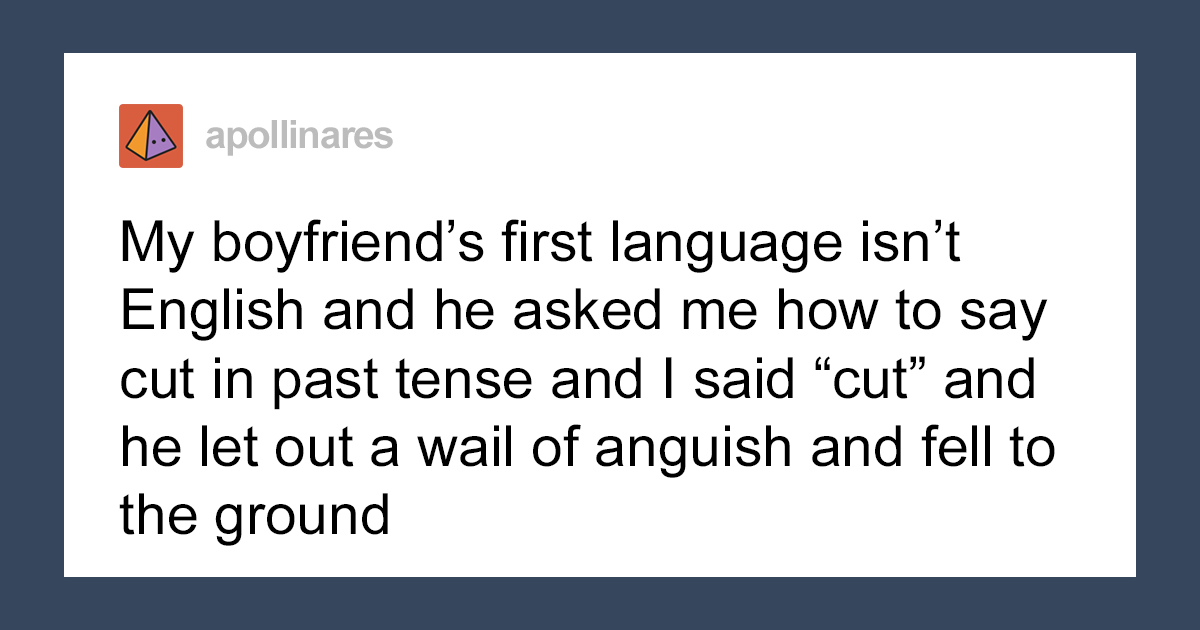
Cut, put, hit, and set keep the same form in the present and past. After memorizing dozens of irregular transformations, learners may become suspicious when English suddenly announces that no transformation is needed.
17. “Lie” and “Lay” Test Everyone’s Patience
You lie down today, lay down yesterday, and have lain down before. You lay an object down today, laid it down yesterday, and have laid it down before. Even many native speakers quietly avoid the entire situation.
18. Questions Need the Mysterious Verb “Do”
English says, “Do you like coffee?” even though do does not describe an action in the sentence. Learners reasonably wonder why “Like you coffee?” is unacceptable. The answer is grammar, which is another way of saying, “That is simply how the machine operates.”
19. Negatives Also Recruit “Do”
“I like coffee” becomes “I do not like coffee.” The extra verb appears solely to carry the negative. Modal verbs and forms of be follow different patterns, ensuring that the rule remains interesting in the least relaxing way possible.
20. Articles Are Tiny but Dangerous
The difference among a, an, the, and no article can depend on whether something is specific, general, countable, previously mentioned, or culturally understood. Three tiny words can generate an astonishing quantity of red ink.
21. Some Nouns Refuse to Be Counted
English normally treats information, advice, furniture, and equipment as noncount nouns. You cannot usually request “an advice” or “three informations.” You need a piece of advice, because the noun apparently requires packaging.
22. One Mouse, Two MiceBut One House, Two Houses
If mouse becomes mice, perhaps house should become “hice.” It does not. Historical sound changes affected particular words, leaving modern learners to discover that visual similarity does not guarantee grammatical solidarity.
23. Goose Becomes Geese, but Moose Stays Moose
The plural of goose is geese. The plural of moose is moose. “Meese” may feel beautifully logical, but English rejects it with the confidence of a language that has never had to defend itself in court.
24. Some Plurals Arrive from Other Languages
English contains forms such as criteria, phenomena, alumni, and analyses. Alternative English plurals also develop over time, producing choices such as cactuses and cacti. Even plurality can become a historical discussion.
25. “Fish” and “Fishes” Can Both Be Correct
Fish commonly refers to multiple individual fish, while fishes may refer to multiple species. Learners seeking one simple plural receive a miniature marine-biology lesson instead.
26. Prepositions Rarely Translate Neatly
You arrive at an airport but in a city. You are on a bus but in a car. You work at a company, in an office, and on a project. The physical logic is not always available for comment.
27. Words Choose Their Own Prepositions
Someone is interested in art, good at chess, afraid of spiders, and responsible for a task. Many combinations must simply be learned together, like couples who refuse to explain how they met.
28. Gerunds and Infinitives Change the Meaning
“I stopped smoking” means the habit ended. “I stopped to smoke” means another activity paused so smoking could begin. Moving one small word transforms a healthy decision into a cigarette break.
29. Phrasal Verbs Hide New Meanings
Give means one thing, but give up, give in, give away, and give out mean very different things. Knowing the base verb provides clues in roughly the same way that knowing a person’s last name reveals their favorite meal.
30. Some Phrasal Verbs Can Be Separated
You can turn off the light or turn the light off. With a pronoun, however, you normally must turn it off, not “turn off it.” The particle may move, but only under supervision.
31. Other Phrasal Verbs Cannot Be Separated
You may look after a child, but you cannot “look a child after.” Unfortunately, English does not place a visible label on separable and inseparable phrasal verbs. Learners must remember which relationships permit personal space.
32. Idioms Sound Slightly Alarming
Before a performance, English speakers may say, “Break a leg.” A simple task is “a piece of cake,” while revealing a secret means “spilling the beans.” Literal translation produces injuries, desserts, and unnecessary kitchen cleanup.
33. Contronyms Can Mean Their Own Opposites
To dust can mean removing dust from furniture or adding a fine powder to something. To sanction can mean approving an action or penalizing it. Context must determine which side of the dictionary has entered the room.
34. “Inflammable” Means Flammable
The prefix in- often signals negation, as in inactive. Yet inflammable means capable of catching fire. Safety labels increasingly favor flammable, possibly because a grammar lesson is inconvenient during an emergency.
35. Contractions Can Have Multiple Expansions
I’d can mean I would or I had. He’s can mean he is or he has. Learners must inspect the following verb and reconstruct the sentence like grammatical detectives.
36. “It’s” and “Its” Reverse Expectations
Apostrophes often show possession, but its is possessive without one. It’s means it is or it has. The rule is defensible, but it still feels as though the apostrophe has switched teams.
37. Homophones Create Invisible Traps
There, their, and they’re sound identical. So do to, too, and two. Listening provides no spelling information, while spell-checking may not object because every option is technically a real word.
38. “Affect” and “Effect” Refuse to Stay Simple
Usually, affect is a verb and effect is a noun. Then English introduces the verb effect, meaning to bring something about, and the noun affect, used in psychology. The helpful shortcut immediately requests legal representation.
39. “Who” and “Whom” Survive in an Awkward Truce
Who traditionally functions as a subject, while whom functions as an object. In everyday American English, many speakers avoid whom except in formal expressions. Learners must therefore understand a rule that fluent speakers may or may not use.
40. Compound Words Cannot Choose a Relationship Status
Some compounds are open, some are hyphenated, and some are closed. You set up a computer using a setup guide. An everyday habit happens every day. English spelling occasionally resembles a relationship status marked “It’s complicated.”
What Learning English Frustration Actually Feels Like
The most memorable English-learning experiences rarely happen during quiet vocabulary exercises. They happen in real conversations, when a learner knows the correct word but cannot persuade their mouth to produce it before the subject changes.
Imagine spending an evening practicing the word vegetable. You pronounce every visible syllable with care: “veg-et-a-ble.” The next day, a native speaker compresses it into something closer to “vej-tuh-bul” and immediately asks a follow-up question. Your brain is still searching for the missing syllable while the conversation has moved on to salad dressing.
Restaurants provide another excellent laboratory for linguistic panic. A learner may confidently request a desert rather than a dessert, turning a pleasant meal into an expedition across a dry landscape. The server understands from context, but the learner remembers the mistake at 2:13 a.m. for the next seven years.
Then there is the dangerous stage when learners understand every individual word but not the sentence. A coworker says, “Let’s play it by ear.” The learner knows play, ear, and possibly by. None of those definitions explain why a meeting has not been scheduled. This is when English stops feeling like mathematics and starts behaving like jazz.
Phone conversations intensify the challenge. There are no gestures, facial expressions, or helpful objects to point toward. A speaker says, “Could you hold on?” and the learner briefly wonders what object requires holding. Someone promises to “get back to you,” but does not specify where they went. The learner says “yes” in the universal hope that context will eventually rescue everyone.
Written English creates different adventures. A student may learn that adding -ed creates the past tense, only to encounter went, saw, caught, and flew. After memorizing those forms, the student writes costed and discovers that cost was already finished. English congratulates effort by introducing another list.
Perhaps the funniest experience comes when learners begin thinking in English. At first, this feels like a major victory. Then an idiom from one language enters an English sentence without permission. The expression may be perfectly logical at home but sound like surrealist poetry to an American listener. Everyone pauses. The learner explains. The listener says, “Actually, I like that phrase.” A mistake becomes an unofficial cultural exchange.
Progress also produces a strange new frustration: the ability to recognize errors everywhere. Movie subtitles look wrong. Advertising slogans omit grammar deliberately. Native speakers confuse your and you’re online. The learner who once feared making mistakes discovers that many lifelong English speakers are improvising with extraordinary confidence.
That discovery is liberating. Fluency does not mean knowing every irregular plural, regional pronunciation, and rare grammatical distinction. It means communicating, adjusting, asking questions, and surviving occasional misunderstandings with a sense of humor. Native speakers use context constantly, forget words, revise sentences halfway through, and debate pronunciation among themselves.
English may drive learners to utter frustration, but each confusing encounter also becomes a story. The first successful phone call, the first joke understood without translation, and the first dream conducted entirely in English can make all those silent letters feel almost worthwhile.
How to Survive the Weirdest Parts of English
The best approach is to learn expressions in context rather than treating every word as an isolated object. Record useful combinations such as interested in, responsible for, and look forward to. When studying a new verb, learn its past form and common phrasal verbs at the same time.
Listening matters just as much as reading. Podcasts, films, conversations, and pronunciation recordings reveal stress, reductions, rhythm, and regional variation that spelling cannot show. Shadowing short audio clipslistening and repeating immediatelycan help connect familiar written words with their real spoken forms.
Most importantly, treat mistakes as evidence of active learning. A learner who experiments will occasionally choose the wrong article, preposition, or pronunciation. That is not failure. It is simply English collecting another small fee for access to the language.