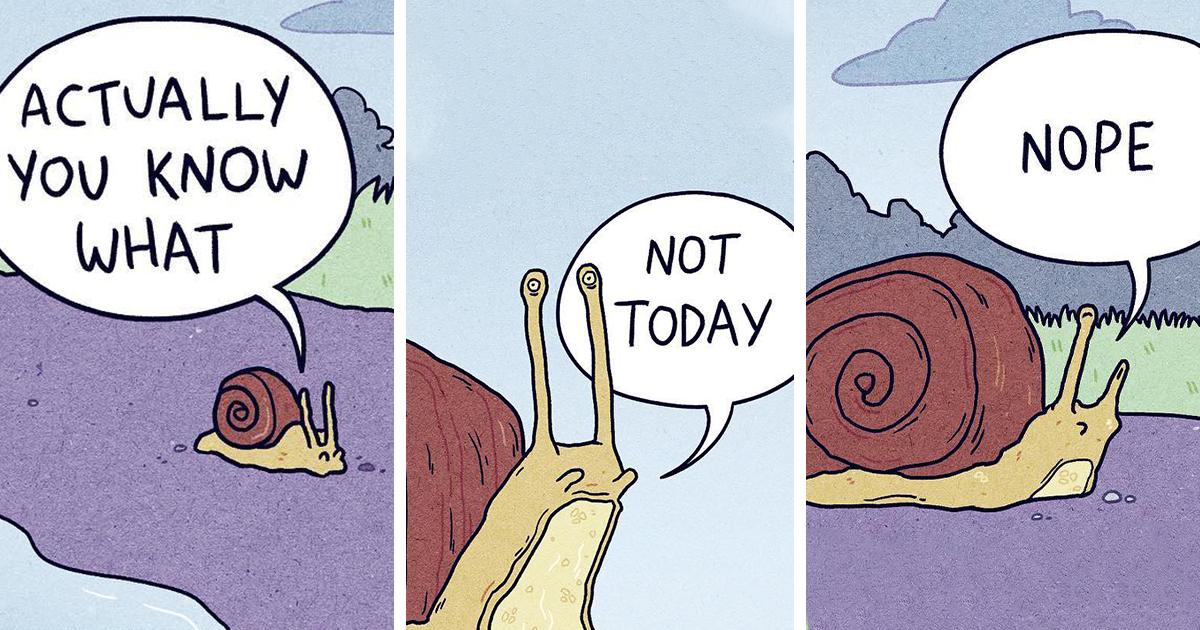
Life doesn’t move in a straight line. It zigzags. It doubles back. It spills coffee on your shirt five minutes before a “camera-on” meeting.
And somehow, in between the victories (finding matching socks) and tragedies (your phone at 2% with no charger), you keep going.
That’s why relatable comics hit like a tiny, pastel-colored truth bomb: they turn everyday chaos into something you can laugh at instead of
dramatically staring out a rainy window like you’re in an indie movie.
Evie Hilliar (known online as YEEVZ) has a gift for capturing that exact vibethose weird little life moments where your brain
is doing cartwheels and your face is trying to look normal.
This roundup is a written celebration of the kinds of scenes her comics love: the awkward pauses, the overthinking spirals,
the oddly specific fears, and the surprise warmth when something finally goes right. Consider it “new pics,” but translated into the
moments and punchlines that make her work so recognizable.
Who Is Evie Hilliar (a.k.a. YEEVZ)?
Evie Hilliar is an Australia-based comic artist whose work blends two signature ingredients: sharp, simple jokes and
honest nods to mental health. Her comics often take the smallest everyday eventwaiting for a text, walking into a room and
forgetting why, making one harmless comment and replaying it for three business daysand give it a twist that feels both absurd and accurate.
In interviews, Hilliar has described her creative engine as being fueled by a brain that runs fast and feels a lotmeaning ideas show up
constantly, even when they’re inconvenient (like at 2:00 a.m. when your only goal was sleep). She’s also spoken about the importance of
balancing living with making: you need real experiences to spark new comics, but you also need time at the desk to turn those
experiences into something shareable.
The result is a catalog of funny, relatable comics that don’t just point and laugh at lifethey kind of give life a gentle noogie and say,
“Yeah… same.”
Why Relatable Comics Feel Like Therapy (But With Better Timing)
They compress the chaos into something you can hold
A good comic takes a swirling messstress, confusion, embarrassment, social anxiety, the emotional whiplash of adulthoodand turns it into a
clean little sequence. That structure is soothing. It’s not “fixing” your problems, but it is putting them in a box with a lid and
a punchline.
They help you laugh without pretending everything is perfect
The best “life ups and downs” humor doesn’t require you to be fine. It just gives you a different angle. Sometimes the joke is the only
umbrella you’ve gotand it’s better than standing in the storm arguing with the weather.
They create instant community
Relatable comics are basically social shorthand. You send one to a friend and it means:
“I’m going through it,” “I’m thinking too much,” and “Please validate my existence with a single laughing emoji,” all at once.
25 Funny, Relatable Comic Moments (a Written Tour of Life’s Highs and Lows)
-
1) The “How are you?” question that opens a secret trapdoor
You answer “Good!” like a responsible citizen, then your brain immediately starts listing every existential concern you’ve ever had.
The comic version shows the split second between “good” and “actually, here’s my full internal spreadsheet.” -
2) Overthinking: the hobby you never signed up for
One innocent memory becomes a full courtroom drama. You are the defendant, prosecutor, judge, and person in the audience whispering,
“Oof, they really did say that.” -
3) The moment you realize you’re “adulting”… badly
You pay a bill, feel powerful for 12 seconds, and then remember you forgot to buy dish soap for a week. Victory and failure holding hands,
skipping down the street. -
4) Social battery at 100%… then 3%
You start the hangout like a charismatic talk-show host. Half an hour later, you’re negotiating a polite exit strategy and thinking,
“I love everyone, but also: silence.” -
5) The “I’ll do it later” lie you tell yourself with confidence
Later arrives. You greet it like an old enemy. The humor is in the sincerity: you truly believed Future You was a different, more capable
person. Future You is, unfortunately, still you. -
6) Texting logistics that turn into scheduling a summit
“We should hang out!” becomes “I can do April 2031 for 12 minutes.” The comic timing lands because it’s not exaggerationjust the honest
math of busy lives. -
7) The brain that refuses to be a calm, cooperative organ
Your mind is supposed to help you survive. Instead, it’s doing parkour off worst-case scenarios. The joke is the visual metaphor:
a perfectly ordinary day interrupted by mental gymnastics. -
8) The tiny compliment that becomes your personality
Someone says, “Nice shirt,” and you store it like a family heirloom. Three years later you’re still thinking, “Remember when I was
Shirt-Compliment Person?” -
9) Being productive in a way that looks unproductive
You reorganize pens. You open five tabs. You read one sentence. Suddenly it’s night. The comedy comes from the mismatch between effort
and resultlike running hard on a treadmill going nowhere. -
10) The awkward interaction replay highlight reel
You wave at someone who wasn’t waving at you. Your body survives. Your brain, however, schedules a recurring meeting titled
“Why Did We Do That?” forever. -
11) The “I’m not insecure” sentence immediately followed by insecurity
You start with confidence, then one stray thought shows up like a raccoon in your kitchen: unexpected, chaotic, and somehow in charge.
-
12) When you try to be chill but your face betrays you
Internally you’re going, “Play it cool.” Externally you look like a cartoon character trying to hold in a scream. Relatability lives in
that gap between intention and expression. -
13) The weirdly specific fear that arrives uninvited
Not a big dramatic fearsomething oddly niche that makes you pause mid-task and think, “Why would my brain bring this up right now?”
It’s funny because it’s familiar. -
14) The sudden wholesome moment that catches you off guard
You’re braced for disappointment and thensurprisesomeone is kind, something works, the day softens. The humor is gentle: a quick shift
from doom to warmth. -
15) The “I’ll start tomorrow” optimism spike
Tomorrow is your favorite imaginary place. Tomorrow is disciplined, hydrated, and owns matching containers. Today is eating cereal out of
a mug and calling it a plan. -
16) When therapy language enters the group chat
Someone tries to set a boundary and accidentally sounds like a self-help audiobook narrator. It’s not making fun of growthit’s celebrating
how clunky growth looks in real life. -
17) The creative block that feels personal
You sit down to create and your brain goes, “No.” Not “no ideas,” just “no.” The comedy is the dramatic tension between ambition and the
internal dial tone. -
18) The short conversation that becomes a life story
Someone asks a simple question. You answer, then keep answering, then discover you’re unpacking your entire emotional backstory in aisle
seven of a grocery store. -
19) The “I’m low-maintenance” myth
You’re totally chill… except you need very specific conditions: snacks, quiet, reassurance, and the ability to leave early without anyone
noticing. That’s not high-maintenance; that’s “human.” -
20) When your body wants one thing and your brain wants another
Your body says, “Rest.” Your brain says, “Let’s list every responsibility you’ve ever had.” The punchline is usually a visual tug-of-war,
and you’re the rope. -
21) The dating app vibe: hope, confusion, and tiny panic
You try to be normal, but the format is already weird. The comedy comes from how quickly a simple swipe can turn into a personality crisis
and a sudden urge to delete all apps forever. -
22) Accidentally oversharing because you got too comfortable
You make a joke. People laugh. You feel safe. Then you say something startlingly personal and immediately consider moving to a new city
under a different name. -
23) The tiny “win” that keeps you going
You don’t conquer the worldyou respond to the email, drink water, take the walk, or do the one small task. The comic makes it heroic in
the most relatable way. -
24) The internal pep talk that sounds like a chaos goblin
Motivation isn’t always inspiring. Sometimes it’s a weird little creature inside you yelling, “We’re doing this!” while you’re still
wearing pajama pants at 3 p.m. -
25) The emotional whiplash of being okay… and then not
A single day can hold calm, laughter, stress, tenderness, and “why is my brain like this?” That’s the ups-and-downs theme in one line:
you’re not inconsistentyou’re alive.
What Makes Evie Hilliar’s Humor Work (Even When the Topic Is Heavy)
She treats feelings like real weather
The mood shifts aren’t “plot twists.” They’re the forecast. A joke can live next to a serious moment without canceling it outbecause that’s
what real life does. Your brain can be anxious and also notice something hilarious in the same minute.
She uses exaggeration like a spotlight, not a mask
The best relatable comics don’t hide the truththey highlight it. The exaggeration is there to make the feeling visible. You’re not laughing
because it’s fake; you’re laughing because it’s close enough to hurt (in a friendly way).
She captures the “tiny absurdity” of modern life
Not everything is a grand tragedy. Sometimes the funny thing is that we’re all walking around with a thousand invisible rules in our heads,
trying to act normal while the world keeps being weird.
How to Use Relatable Comics as a Real Mood Booster
- Save the ones that feel like a mirror. Not to doom-scrolljust to have a quick “I’m not alone” button on hard days.
-
Share intentionally. Send one to a friend with a short note (“This is us,” “This is my brain,” “Thought you’d laugh”).
Comedy is better when it connects. -
Take the hint when you’re spiraling. If you’re laughing at a comic about overthinking… and also overthinking, that’s a
decent cue to step away, breathe, and reset.
Extra: of Real-Life Experiences These Comics Feel Like
If Evie Hilliar’s comics had a secret power, it would be this: they make you recognize yourself without feeling judged. Most of us don’t need
another lecture about “getting it together.” We need a tiny moment of reliefthe kind that says, “Yep, you’re doing the human thing again.”
Think about the classic experience of walking into a room and forgetting why you’re there. In real life, you stand in the doorway like a
confused Roomba, waiting for your memory to reconnect to Wi-Fi. In a comic, that moment becomes a clean joke with a beginning and an end
and suddenly you can laugh at it instead of treating it like evidence that you’re falling apart.
Or take the modern ritual of replying to messages. You see a text, feel affection, and immediately feel pressure. You don’t want to respond
too fast (what if you look desperate?), but you also don’t want to respond too slow (what if you look rude?), and somehow a friendly “lol”
becomes a strategic choice that would impress a chess grandmaster. That’s not because you’re dramatic. It’s because our brains are constantly
translating social life into tiny decisionsmost of them invisible, most of them exhausting.
Then there’s the “good day / bad day” whiplash. You can wake up feeling capable, handle three tasks like a champion, and then get derailed by
something ridiculous: a missing sock, an email with a weird tone, a random memory that shows up like it paid rent. Relatable comics nail that
shift because they don’t pretend your mood is a straight staircase. It’s a bouncy house. Sometimes you’re up. Sometimes you’re face-first.
The most comforting experience these comics echo is how often people do small, heroic things without applause. You answer the call you didn’t
want to answer. You go to the appointment. You eat something real. You take a short walk even though you’d rather melt into the couch.
A comic can make those moments feel seenlike, “Hey, that counts.” Because it does.
And finally: the big one. The feeling of being “fine,” except your brain won’t stop narrating. You can be in a totally safe situation and
still feel like your thoughts are sprinting. Seeing that experience turned into humor can be a pressure release valve. Not because laughter
erases stress, but because it gives you a little distance from it. It turns “my brain is doing this to me” into “wow, brains really do be
like that.” And sometimes that tiny shift is enough to help you keep goingone weird, funny, relatable day at a time.
Conclusion
Evie Hilliar’s comics work because they tell the truth in a way that doesn’t sting. They spotlight the awkward, the anxious, the hopeful,
the exhausted, and the unexpectedly sweet parts of everyday lifethen hand you a punchline like a warm drink.
If you’ve ever felt like your brain is loud, your schedule is messy, and your emotions are doing parkour, these “ups and downs” moments will
feel less like chaos and more like community.