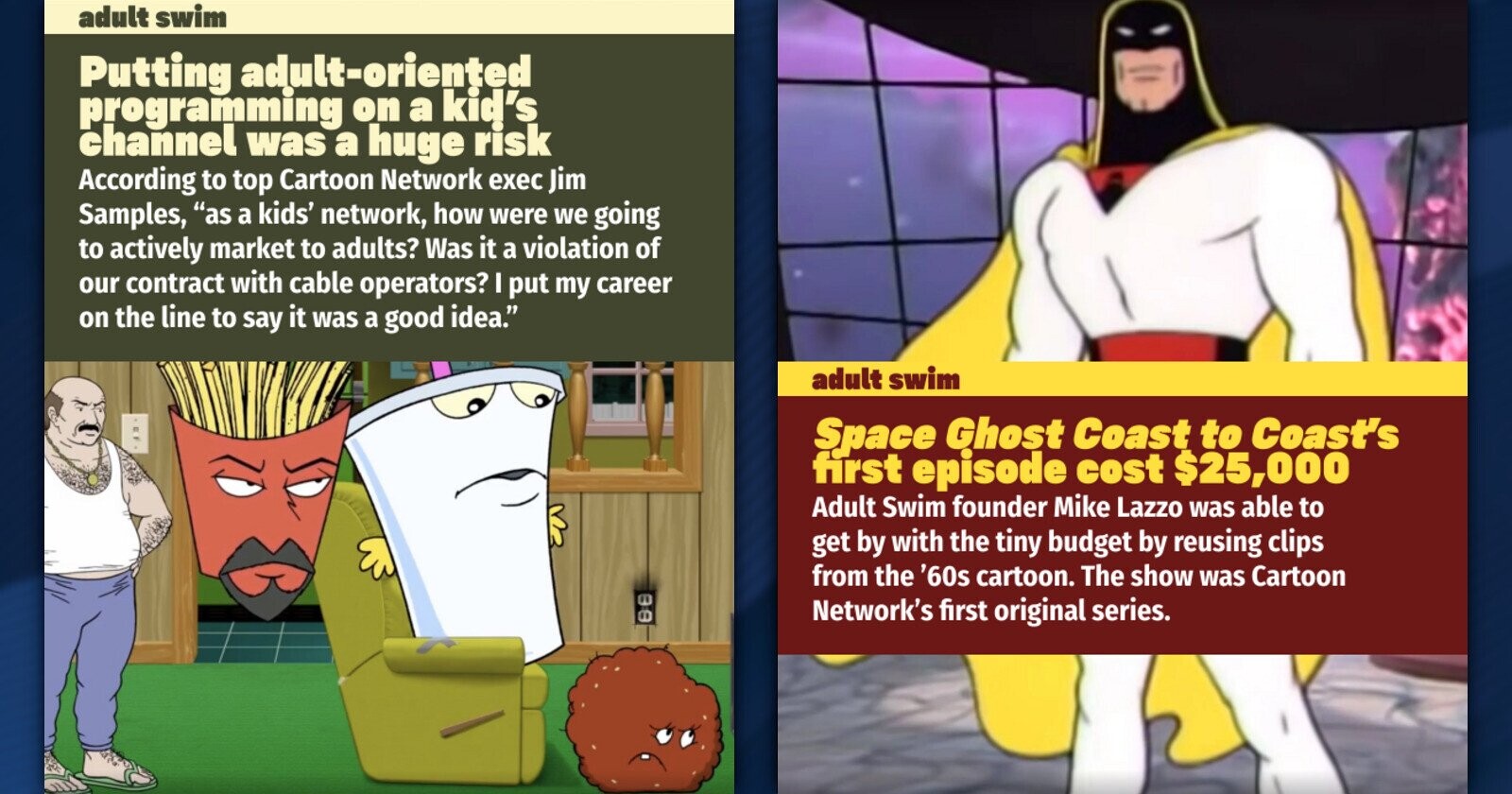
If regular television is a neatly made bed, Adult Swim is the mysterious stain on the pillow that makes you ask, “What exactly happened here?” For more than two decades, Cartoon Network’s late-night alter ego has turned insomnia into a lifestyle and weirdness into a business model. It gave viewers mutant fast-food detectives, anti-comedy fever dreams, existential fake infomercials, anime cool enough to make sleep feel optional, and bumpers that somehow felt like philosophy homework written by a prankster.
That is why Adult Swim still matters. It was never just a place to watch cartoons after dark. It became a cultural lab where absurd animation, low-budget genius, experimental live action, and internet-brain humor all got thrown into the same blender. The result was a brand that felt half comedy club, half public-access hallucination, and somehow totally confident about it.
Why Adult Swim still haunts pop culture
Adult Swim did something rare in television: it made being a little confused feel exciting. Its best shows did not beg for approval. They assumed you could keep up, or at least enjoy being left in the dust. That attitude helped shape modern comedy, adult animation, meme culture, and even late-night viewing habits. So if you have ever stared at a black screen with white text and thought, “Why is this strangely profound?” congratulations. You have already been in the pool.
13 Adult Swim facts that deserve a flashlight and a strong cup of coffee
1. Adult Swim officially launched on September 2, 2001, and it wasted absolutely no time being weird.
Adult Swim debuted as Cartoon Network’s nighttime programming block on September 2, 2001. The first show viewers saw was the Home Movies episode “Director’s Cut,” and that same launch night also included Cowboy Bebop. That pairing tells you almost everything about the network’s DNA right away: one part awkward alt-comedy, one part impossibly cool anime, and zero interest in playing safe. Adult Swim did not tiptoe into television history. It moonwalked into it at 10 p.m. and kept going until the normal people were asleep.
2. The very first marquee show was basically a rescue mission.
Home Movies had been canceled by UPN before Adult Swim helped give it a second life. That early save mattered. It established the block as a place where oddball shows that did not fit the usual TV mold could survive and even thrive. Instead of chasing broad appeal, Adult Swim built a reputation for spotting brilliance in material other networks had shrugged off. In hindsight, reviving Home Movies feels less like a programming decision and more like the network’s mission statement written in dry-erase marker.
3. Adult Swim’s roots go back to Space Ghost Coast to Coast, which helped invent its whole attitude.
Before Adult Swim had a name, it had a spirit, and that spirit wore a mask and interviewed celebrities badly. Space Ghost Coast to Coast helped define the network’s comic worldview: recycled animation, deadpan pacing, awkward silences, surreal interviewing, and jokes that felt funnier the more they ignored television rules. The Williams Street team learned early that old animation assets could become brand-new comedy with the right brain chemistry. Adult Swim did not spring from nowhere; it grew out of a clever act of TV vandalism.
4. Those famous early bumpers with old people at a pool were not random. They were branding genius.
Early Adult Swim bumpers showed elderly swimmers at public pools while a lifeguard barked warnings like “All kids out of the pool!” On paper, that sounds like a concept assembled during a fever. In practice, it was perfect. The imagery translated the name literally, gave the block an instantly recognizable voice, and let viewers know they were entering a different part of the channel. Adult Swim did not arrive with glossy polish. It arrived like a strange local rule everyone was expected to obey. No kids. No whining. No normalcy.
5. Aqua Teen Hunger Force proved that a show could look cheap, sound ridiculous, and still become a defining masterpiece.
Aqua Teen Hunger Force is one of the clearest examples of Adult Swim’s superpower: taking something that sounds fundamentally unmarketable and turning it into a cult institution. A floating milkshake, a box of fries, and a wad of meat solving almost nothing should not have become iconic. Yet the show’s anti-logic, deadbeat suburban setting, and fearless stupidity made it foundational Adult Swim. It taught viewers that the network would reward originality over polish every single time. The joke was never that the show looked low-budget. The joke was that low-budget freedom could be funnier than prestige.
6. One Adult Swim movie promotion caused a real bomb scare in Boston.
In 2007, a guerrilla marketing campaign for Aqua Teen Hunger Force Colon Movie Film for Theaters went spectacularly off the rails when electronic signs featuring Mooninite characters were mistaken for explosive devices in Boston. Authorities shut down roads, bridges, and parts of the city while panic spread. It remains one of the wildest collisions between niche comedy culture and real-world consequences. Leave it to Adult Swim to produce a moment where a joke involving pixelated aliens somehow triggered a full civic meltdown. Few brands can say they made television history and municipal history at the same time.
7. Adult Swim helped turn anime into midnight appointment television for American fans.
The block’s early embrace of anime, especially with Cowboy Bebop, gave countless American viewers a gateway into a deeper world of animation. Watching Spike Spiegel stalk across the screen at midnight on a channel that had aired kids’ cartoons earlier in the day felt thrillingly illegal, even when it was not. Adult Swim understood that anime did not need to be treated like an educational import or a niche curiosity. It could be cool, stylish, adult, and central to the late-night lineup. For a generation of viewers, Adult Swim was not just where anime aired. It was where anime became an identity.
8. At one point, Adult Swim was beating traditional late-night TV with younger viewers.
For a block that specialized in mutant absurdity, Adult Swim was also a serious ratings machine. In the 2010s, it often outperformed standard late-night competitors among younger adult viewers, especially in the under-35 crowd. That matters because it proved the network was not just a cult favorite muttering into the void. It was a force. While talk shows polished their monologues and celebrity couches, Adult Swim was pulling younger audiences with reruns, original animation, and comedy that looked like it had been discovered in a cursed vending machine. Weird, it turns out, scales nicely.
9. Too Many Cooks aired at 4 a.m. and still became a full-blown cultural event.
Only Adult Swim would bury an eleven-minute horror-comedy parody of sitcom opening credits at an hour associated with raccoons and bad decisions, then watch it explode across the internet. Too Many Cooks began as part of the network’s Infomercials universe and turned into a viral sensation because it perfectly captured Adult Swim’s ability to lure viewers in with familiarity before making them deeply uncomfortable. The sketch started as nostalgia, transformed into chaos, and ended as a collective internet haunting. It was funny, unsettling, and impossible to explain to people who had sensibly gone to bed.
10. Adult Swim treated April Fools’ Day like a creative playground, not a calendar holiday.
Many networks do a cute little prank and move on. Adult Swim preferred televised mischief with consequences. One of its most famous stunts came in 2017, when it surprised viewers by airing the Rick and Morty season three premiere on April Fools’ Day. That move was not just funny; it was strategic chaos. Fans had been desperate for new episodes, and Adult Swim turned that anticipation into an event that felt half reward, half hallucination. The network understood something important: if your audience already expects weirdness, you can turn surprise itself into programming.
11. Rick and Morty made Adult Swim impossible for the mainstream to ignore.
Adult Swim had plenty of cult hits before Rick and Morty, but that show pushed the brand into an entirely new level of visibility. Suddenly the network’s trademark mix of sci-fi density, emotional damage, gross-out humor, and philosophical panic had a blockbuster. The show proved Adult Swim could produce a series that was not only critically discussed and endlessly memed, but also massive in scale. The lesson was simple: Adult Swim was not just a weird corner of television anymore. It was now one of the places where the broader comedy conversation had to happen, whether polite people were ready or not.
12. Adult Swim also became a tastemaker in music, not just television.
The network’s music identity deserves way more credit. Through projects like the Adult Swim Singles Program and the curatorial work of Jason DeMarco, Adult Swim built a reputation for championing artists who felt left-of-center, inventive, or just plain cooler than your average corporate tie-in would allow. This was not background noise slapped onto promos. Music became part of the brand’s personality. Adult Swim understood that the right beat, the right synth, or the right underground artist could make a bumper feel like an event. Very few TV brands ever sounded as distinct as Adult Swim did.
13. Adult Swim proved adult animation could be funny, filthy, unsettling, and genuinely artistic.
For all its chaos, Adult Swim also made room for craft. Genndy Tartakovsky’s Primal showed that the network could produce visually ambitious, nearly dialogue-free storytelling and still hit hard with audiences and awards voters. Its Emmy recognition helped underline something longtime fans already knew: Adult Swim was never just a joke factory. It was a place where artists could experiment with form, tone, violence, silence, pacing, and emotion in ways traditional TV often resisted. One night you got a deranged talk-show parody. Another night you got prehistoric heartbreak. That range is part of the magic.
What these Adult Swim facts actually tell us
Put all thirteen facts together and a clear picture emerges: Adult Swim succeeded because it treated television like a playground for people who were tired of being talked down to. It trusted viewers to appreciate irony, awkwardness, anti-comedy, cult animation, and the occasional full-on nightmare. It also proved that originality can become a business strategy when it is backed by strong taste and zero fear of confusing somebody’s uncle.
More importantly, Adult Swim changed what late-night television could be. It made room for humor that was hostile to convention, shows that looked handmade, and stories that could pivot from dumb to brilliant in under thirty seconds. In a media world obsessed with smoothing rough edges, Adult Swim built a legacy by sharpening them.
Extra late-night experience: what Adult Swim feels like when the house is asleep
Watching Adult Swim has always felt different from watching regular TV, and that difference is part of why it sticks in the brain. The experience is not just about the shows themselves. It is about the hour, the glow of the screen, the weird quiet in the room, and the feeling that you have wandered into content not everybody is supposed to see. Even when the joke is loud, the atmosphere is strangely intimate. Adult Swim never felt like mass entertainment first. It felt like you found the secret level.
There is also a very specific emotional rhythm to it. A normal channel tries to keep you comfortable. Adult Swim likes to keep you alert. One minute you are laughing at something so stupid it should not work. The next minute you are staring at a bumper with plain white text on a black background that somehow lands like a personal message sent from space. Then a show arrives that looks cheaply animated but contains a joke so sharp it follows you into the kitchen when you go looking for cereal at 1:17 a.m. That push and pull is the experience. You are entertained, but you are never fully settled.
For a lot of viewers, Adult Swim also became a badge of belonging. If you knew the references, quoted the right lines, or recognized a show from a ten-second bumper, you felt like part of a loose community of night owls, comedy nerds, animation fans, and people whose sense of humor had maybe been lightly damaged in the best possible way. It rewarded attention. It rewarded curiosity. It even rewarded a tolerance for discomfort, which is a funny thing to ask from an audience and an even funnier thing to build loyalty around.
Then there is the memory factor. Adult Swim experiences linger because they often arrive when your defenses are down. You are tired. The world is quieter. Your brain is a little more open to strangeness. So when a fake infomercial turns sinister, or a bumper becomes weirdly moving, or an anime episode suddenly knocks the wind out of you, the moment lands harder. It does not just register as “something I watched.” It feels like “something that happened to me.”
That may be the network’s sneakiest achievement. Adult Swim made late-night television feel personal without becoming soft, and communal without becoming bland. It did not care if everybody loved it. It cared whether the right viewers felt electrified by it. And if those viewers lost a little sleep in the process, that was not a bug. That was the entire point. Adult Swim was never really asking for your time. It was asking whether you were willing to stay awake long enough to meet it on its own strange terms.
Conclusion
Adult Swim’s long, bizarre legacy is not built on one show or one era. It is built on a philosophy: trust creative weirdos, give them room, and let the audience catch up later. That philosophy gave us rescued cult comedies, groundbreaking anime exposure, absurd live-action anti-comedy, viral experimental shorts, unforgettable bumpers, and prestige animation that proved the block could do much more than make people laugh at 2 a.m.
So yes, these Adult Swim facts can keep you up all night. Not just because some of them are strange, but because together they explain how a late-night programming block became one of the most influential oddities in modern television. The pool may be closed for kids, but the rest of us are still floating around in the deep end.