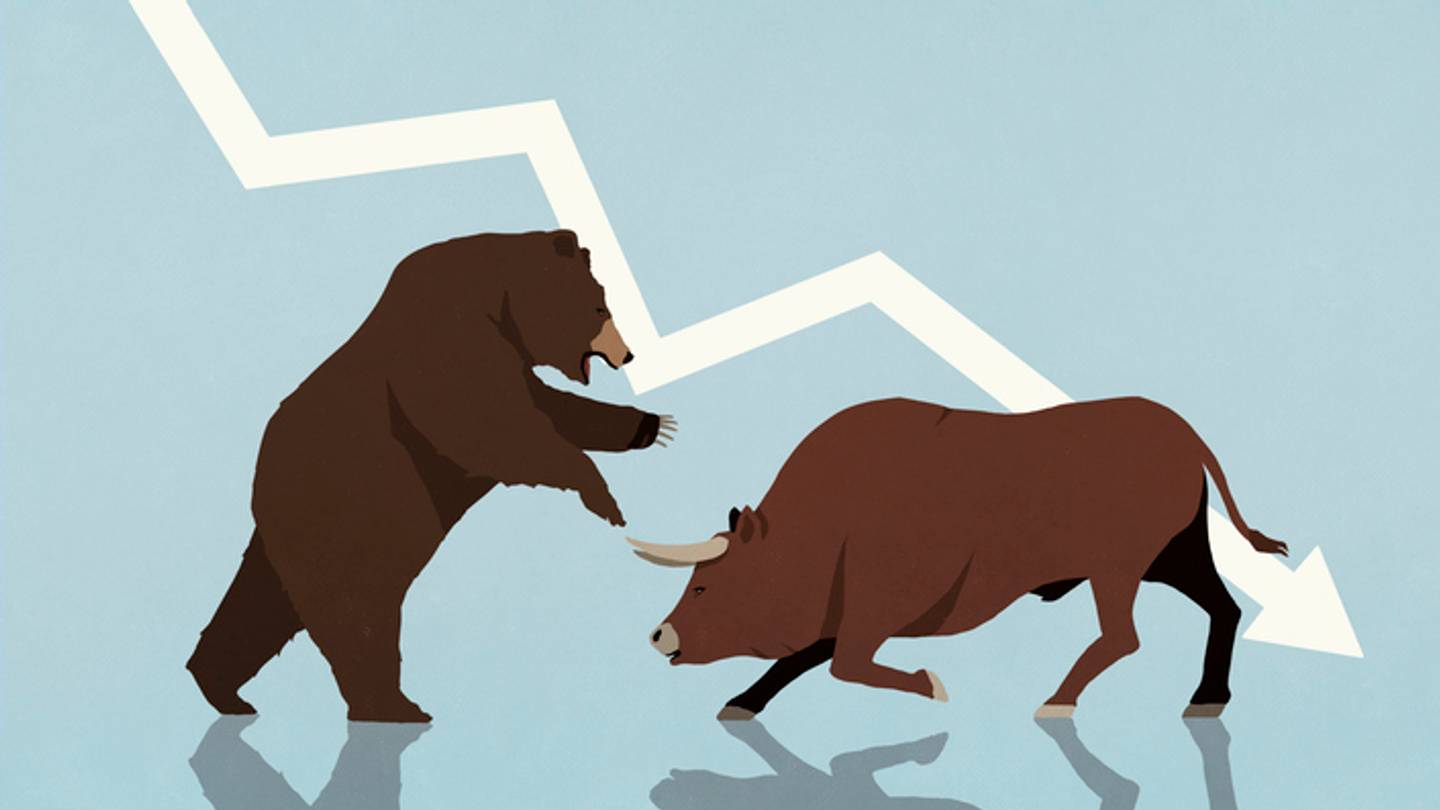
Wall Street has an impressive talent for turning serious financial concepts into a wildlife documentary. When prices rise, bulls charge through the headlines. When stocks tumble, bears lumber onto television screens while commentators adopt the facial expressions of people who have just discovered a raccoon in the kitchen.
Behind the colorful language is an important distinction. A bull market describes a sustained period of rising investment prices and growing optimism, while a bear market describes a prolonged decline accompanied by fear or pessimism. Knowing the difference can help investors interpret market news, manage risk, and avoid making expensive decisions based on whichever animal is currently making the most noise.
Bull Market vs. Bear Market: The Basic Difference
The simplest way to remember the difference is direction. Bulls represent markets moving upward. Bears represent markets moving downward.
Under a widely used convention, a broad stock index enters a bull market after gaining at least 20% from a recent low. A bear market is generally recognized after an index falls at least 20% from a recent high. Investor.gov adds a time element to its general definitions, describing bull and bear markets as moves of 20% or more over at least two months.
These thresholds are conventions rather than laws of financial physics. Nothing magical happens when an index changes from a 19.9% decline to a 20% decline. No bell rings, no bear receives an employee badge, and investors do not suddenly gain perfect knowledge of what happens next. The labels simply provide a common way to describe major market trends.
Quick Comparison
| Characteristic | Bull Market | Bear Market |
|---|---|---|
| General direction | Prices trend higher | Prices trend lower |
| Common threshold | Rise of at least 20% from a recent low | Decline of at least 20% from a recent high |
| Investor mood | Optimistic and confident | Fearful and pessimistic |
| Economic expectations | Improving growth and profits | Slowing growth and weaker profits |
| Typical behavior | More buying and risk-taking | More selling and demand for safety |
| Common danger | Overconfidence and excessive valuations | Panic selling and abandoning long-term plans |
What Is a Bull Market?
A bull market is an extended period during which prices across a broad financial market generally rise. The term is most often applied to stocks, but investors may also describe bull markets in bonds, commodities, real estate, or cryptocurrencies.
Rising prices alone do not tell the entire story. Bull markets are usually supported by improving expectations. Investors may anticipate stronger corporate earnings, higher consumer spending, lower interest rates, technological innovation, or faster economic growth. As confidence builds, more buyers enter the market, helping prices climb further.
Common Signs of a Bull Market
- Major stock indexes establish higher highs and higher lows.
- Corporate revenue and earnings expectations improve.
- Initial public offerings and business investment become more active.
- Investors become more willing to purchase growth stocks and other risky assets.
- Market volatility may decrease as confidence strengthens.
- Positive financial news receives more attention than potential warning signs.
Bull markets often last longer than bear markets, although their length varies dramatically. A rising cycle may continue through corrections, temporary sell-offs, political disputes, and gloomy headlines. A 10% decline does not automatically end a bull market if the broader upward trend eventually resumes. Historical comparisons from Fidelity, Schwab, Vanguard, and J.P. Morgan consistently show that sustained market advances have generally been longer and more powerful than major declines, although the exact averages depend on the dates and methodology used.
Why Bull Markets Can Become Dangerous
A bull market sounds delightful because portfolios rise and investment statements become considerably less frightening. However, extended optimism can produce careless behavior.
Investors may assume that recent winners will keep winning indefinitely. They may concentrate their portfolios in fashionable sectors, use borrowed money, ignore valuation measures, or buy businesses they do not understand. Rising prices can make risky decisions look brilliant for a while, much as a favorable tide can make every boat captain appear unusually talented.
The late stage of a bull market may feature elevated valuations, speculative enthusiasm, aggressive forecasts, and widespread fear of missing out. None of these conditions can identify a market top with precision, but they can indicate that investors should review their risk exposure rather than increasing it simply because prices have been climbing.
What Is a Bear Market?
A bear market occurs when a broad market falls at least 20% from a recent peak and remains under meaningful selling pressure. Bear markets are associated with pessimism, declining confidence, and expectations that economic or corporate conditions may deteriorate.
Potential causes include recessions, banking crises, rapidly rising interest rates, inflation shocks, wars, pandemics, excessive valuations, collapsing asset bubbles, or unexpected changes in government policy. Frequently, several pressures arrive at once, because financial markets apparently dislike creating problems one at a time.
Common Signs of a Bear Market
- Major indexes form lower highs and lower lows.
- Investors reduce exposure to stocks and other risky assets.
- Volatility rises as prices move sharply in both directions.
- Corporate earnings estimates are revised downward.
- Defensive investments receive more attention.
- News coverage becomes dominated by layoffs, inflation, debt, or recession fears.
A Bear Market Is Not the Same as a Correction
A market correction generally refers to a decline of at least 10% but less than 20% from a recent high. Corrections are uncomfortable but relatively common. A bear market is deeper and may last longer, although even a bear market can end sooner than investors expect.
A crash is different again. The term usually describes an unusually rapid and severe fall rather than a specific percentage decline. A crash can push a market into bear territory, but a bear market can also develop gradually over many months.
Bear Market Rallies Can Be Misleading
Prices do not fall in a straight line during a bear market. Powerful short-term rallies can occur when investors cover bearish positions, bargain hunters begin buying, or economic news is less terrible than expected.
These rebounds may look like the beginning of a new bull market before prices fall again. That is why identifying a market bottom in real time is extraordinarily difficult. The bottom becomes obvious only afterward, when everyone can point at a chart and behave as though it should have been obvious all along.
How Bull and Bear Markets Relate to the Economy
The stock market and the economy are connected, but they are not identical. The market measures what investors are willing to pay for financial assets. The economy includes employment, production, consumer spending, wages, inflation, and thousands of other activities.
Because stock prices reflect expectations about future profits, markets often move before economic data confirms a change. Stocks may begin falling while employment and spending still look healthy. Likewise, a new bull market may begin while the economy remains weak and newspaper headlines remain thoroughly depressing.
A recession can contribute to a bear market, but the two terms are not interchangeable. A recession is a broad contraction in economic activity. A bear market is a decline in asset prices. Some bear markets occur without a recession, and some economic downturns produce only modest stock-market declines. Research and historical data also show that market fluctuations can interact with employment, consumption, investment, and business confidence in complex ways rather than through a simple one-direction relationship.
Historical Examples of Bull and Bear Markets
The 2009–2020 Bull Market
After the global financial crisis, U.S. stocks began a historic advance in March 2009. The expansion continued for nearly 11 years, supported at different times by economic recovery, low interest rates, rising corporate profits, technological growth, and strong investor demand.
The period included several corrections and frightening episodes, but the broad upward trend survived until the COVID-19 shock in early 2020. This example shows that bull markets can experience substantial turbulence without immediately ending.
The 2020 Pandemic Bear Market
The arrival of COVID-19 produced one of the fastest major declines in modern U.S. market history. From its February 19, 2020 high to its March 23 low, the S&P 500 fell almost 34% in only 23 trading days.
The recovery was also unusually rapid. The index surpassed its previous closing high in August 2020, demonstrating why waiting for reassuring news can cause investors to miss a significant portion of a rebound. By the time the economic outlook feels comfortable, markets may already have moved considerably higher.
The 2022 Bear Market
In 2022, inflation, aggressive interest-rate increases, geopolitical uncertainty, and concerns about slowing growth weighed heavily on stocks. S&P Dow Jones Indices calculated that the S&P 500 declined approximately 23% from its January peak to its October trough.
Technology and other growth-oriented companies were particularly vulnerable because higher interest rates reduced the present value investors assigned to profits expected far in the future. The episode illustrated how a change in inflation and monetary policy can rapidly alter market leadership and valuations.
How Investors Commonly Behave in Each Market
Behavior During a Bull Market
As account balances rise, investors often feel wealthier, smarter, and more tolerant of risk. New investors enter the market, financial media emphasize success stories, and speculative assets attract attention. The danger is assuming that a favorable environment has eliminated risk.
A disciplined investor may respond by rebalancing. When stocks rise faster than bonds or cash, equities can become a larger percentage of a portfolio than originally intended. Selling a portion of the outperforming assets and restoring the target allocation can reduce risk without requiring a prediction about when the bull market will end.
Behavior During a Bear Market
Bear markets produce the opposite emotional response. Investors may obsessively check their accounts, abandon diversified funds, or sell after a large decline to prevent further pain. Unfortunately, selling after prices have already fallen can convert a temporary paper loss into a permanent one.
Investors with emergency savings, diversified portfolios, manageable debt, and appropriate asset allocations are generally better prepared to tolerate downturns. Investor.gov emphasizes that asset allocation, diversification, and periodic rebalancing can help manage portfolio risk, although none of these techniques guarantees against losses.
How to Invest Through Bull and Bear Markets
1. Start With Your Time Horizon
Money needed within the next few years generally should not depend heavily on volatile stocks. Funds intended for retirement decades away may have more time to recover from bear markets. Your investment mix should reflect when the money will be needed, not whether television commentators look cheerful this week.
2. Build a Diversified Portfolio
Diversification spreads money among companies, industries, geographic regions, and asset classes. It cannot prevent every loss, but it reduces the danger that one failed company or collapsing sector will devastate the entire portfolio.
3. Rebalance Instead of Chasing Performance
During bull markets, rebalancing may involve trimming assets that have become overweight. During bear markets, it may involve purchasing assets that have fallen below their target allocation. This disciplined process encourages investors to sell relatively high and buy relatively low without pretending to predict exact market turning points.
4. Consider Dollar-Cost Averaging
Dollar-cost averaging means investing a fixed amount at regular intervals. When prices are high, the contribution purchases fewer shares. When prices are low, it purchases more. The strategy does not guarantee a profit, but it reduces the temptation to make one enormous, emotionally charged market-timing decision.
5. Keep an Emergency Fund
Emergency savings can prevent an investor from being forced to sell stocks during a downturn to cover rent, medical expenses, or car repairs. A portfolio is easier to leave alone when the washing machine breaks and there is actual cash available to deal with its dramatic final performance.
6. Avoid Excessive Leverage
Borrowed money magnifies gains in a bull market and losses in a bear market. Margin calls may force investors to sell precisely when prices are depressed. A strategy that works only when markets rise is less of a strategy and more of a request for favorable weather.
7. Remember the Mathematics of Losses
A 20% loss requires a 25% gain to recover. A 50% loss requires a 100% gain. This uneven math is one reason risk management matters. The goal is not to avoid every decline; that is impossible. The goal is to avoid losses so severe that recovery becomes financially or emotionally unrealistic.
Can You Predict When a Bull or Bear Market Will Begin?
Investors watch interest rates, inflation, unemployment, corporate earnings, credit conditions, market valuations, investor sentiment, and technical trends. These indicators can provide useful context, but none consistently identifies market turning points in advance.
A market can remain expensive for years. It can continue falling after valuations appear attractive. Good economic news can hurt stocks if it causes investors to expect higher interest rates, while weak economic news can lift stocks if it suggests monetary policy will become more supportive.
Market timing requires two correct decisions: when to get out and when to return. Missing either decision can damage long-term results. Vanguard notes that some of the strongest market days occur near periods of extreme weakness, making prolonged absence especially risky. A financial plan based on goals, diversification, and risk tolerance is usually more durable than a plan based on guessing next month’s headlines.
Frequently Asked Questions
Does a 20% decline always mean stocks will continue falling?
No. The 20% level identifies what has already happened; it does not predict what comes next. A market may recover quickly, move sideways, or decline further.
Can one stock be bullish while the market is bearish?
Yes. Individual companies, industries, and asset classes can move differently from the broad market. Energy stocks might rise while technology stocks fall, for example. Investors can also be bullish on one company and bearish on another.
Should beginners stop investing during a bear market?
Not necessarily. Investors with stable finances, long time horizons, diversified portfolios, and regular contribution plans may continue investing. Anyone who needs the money soon or cannot tolerate further losses may require a more conservative allocation.
Is cash always best during a bear market?
Cash provides stability and liquidity, but holding too much cash for too long creates inflation risk and the possibility of missing a recovery. The appropriate amount depends on short-term needs, emergency reserves, and personal risk tolerance.
Are bull markets always good for every investor?
No. Investors entering late may pay high prices, while conservative savers may receive lower yields if interest rates are reduced. A broad bull market also does not guarantee that every stock will rise.
Conclusion
The central difference between a bull and a bear market is the direction of the broader trend. Bull markets feature sustained price increases and optimism. Bear markets involve declines of at least 20% from recent highs and widespread pessimism.
Both are normal parts of investing. Bull markets reward participation but can encourage overconfidence. Bear markets create losses and anxiety but may also offer lower valuations and opportunities for patient investors. Neither phase lasts forever, and identifying the exact transition between them is far easier in hindsight than in real time.
A resilient investor does not need to wrestle either animal. A clear financial plan, adequate emergency savings, appropriate diversification, periodic rebalancing, and a realistic time horizon can make both environments easier to navigate.
Experience-Based Lessons From Living Through Market Cycles
Reading the definition of a bear market is easy. Watching a portfolio lose thousands of dollars while every headline predicts additional disaster is a completely different educational program. Market cycles teach lessons that rarely feel important during calm periods but become unforgettable when real money is moving.
The First Major Decline Feels Worse Than the Statistics Suggest
A beginner may understand intellectually that stocks sometimes fall 20%, 30%, or more. Yet a percentage on a historical chart feels abstract. Seeing a retirement balance decline month after month feels personal.
Many investors initially believe they have a high tolerance for risk because they completed a questionnaire during a bull market. Their answers change when prices fall. The practical lesson is that risk tolerance should be evaluated in dollars as well as percentages. A hypothetical 30% decline sounds manageable until someone calculates exactly what it would remove from a $200,000 portfolio.
Good Companies Can Fall With Bad Markets
During a broad sell-off, profitable and financially healthy companies may decline alongside speculative businesses. Investors who expect every price movement to reflect a company’s immediate quality can become confused.
Market prices are influenced by liquidity, interest rates, investor positioning, and changing expectations. A strong business can become temporarily unpopular, while a weak business can rise during speculative enthusiasm. Experience teaches investors to separate the company from the stock price without ignoring the possibility that falling prices may reveal genuine business problems.
Bull Markets Make Nearly Everyone Feel Like a Genius
After several years of gains, investors may begin crediting themselves for results largely produced by a favorable environment. They increase position sizes, trade more frequently, and assume that every temporary dip is an effortless buying opportunity.
The most useful habit during a strong bull market is maintaining humility. Reviewing the original investment thesis, trimming oversized positions, and preserving diversification may feel unnecessarily cautious while everything is rising. Those actions become much more attractive after the cycle changes.
The Market Often Recovers Before Confidence Does
One of the strangest bear-market experiences is watching prices rise while the news remains terrible. Unemployment may still be elevated, profits may still be falling, and experts may still be debating the severity of the downturn. Nevertheless, markets can begin recovering because prices reflect expectations rather than current conditions.
Investors waiting for complete certainty may return only after a large portion of the rebound has passed. Experience does not make the bottom easy to identify. It simply teaches that certainty is usually unavailable at the moment when attractive opportunities appear.
A Written Plan Is More Useful Than a Confident Prediction
Predictions are exciting. Plans are effective. A written investment policy can specify the target asset allocation, contribution schedule, rebalancing rules, emergency reserve, and circumstances under which investments may be sold.
During a bull market, the plan limits reckless enthusiasm. During a bear market, it provides instructions when fear makes improvisation dangerous. Instead of asking whether the market will rise tomorrow, an investor can ask whether the portfolio still matches the goal.
The deepest lesson from repeated market cycles is not that investors should become fearless. Fear is a natural response to uncertainty and financial loss. The goal is to build a process that continues functioning while fear is present. Bulls, bears, recessions, recoveries, bubbles, and corrections will keep arriving under different names. Discipline remains useful in every season.