Note: This article is written for public, educational, and SEO publishing purposes. It discusses U.S. spy satellites and Russian satellites using open-source information, without revealing classified technical details or operational instructions.
Introduction: The Quietest Race Happening Over Our Heads
Most people look up at the night sky and see stars, planets, maybe a plane blinking lazily across the darkness. Governments, however, see something else: a crowded orbital neighborhood where satellites watch Earth, watch each other, relay military data, warn of missile launches, monitor oceans, support troops, and occasionally behave like the nosy neighbor with binoculars. Welcome to the world of US spy satellites and Russian satellites, where the drama is silent, the stakes are enormous, and nobody can exactly say, “I was just passing by.”
The United States and Russia have been involved in space-based intelligence since the Cold War. Back then, spy satellites were the ultimate high-tech answer to a terrifying question: what is the other side doing? Today, the question has expanded. It is no longer only about missile silos, military bases, submarines, or troop movements. It is also about who controls access to orbit, who can protect their satellites, who can interfere with someone else’s, and who can keep operating when space becomes congested, contested, and politically spicy enough to make a diplomat reach for antacids.
This article explores the difference between American reconnaissance satellites and Russian military satellites, why both countries care so much about orbit, how modern satellite rivalry has changed, and what the next chapter of space competition may look like. No Hollywood laser cannons requiredthough, frankly, orbit already has enough tension without adding dramatic theme music.
What Are Spy Satellites?
A spy satellite, more formally known as a reconnaissance satellite, is a spacecraft designed to collect information from orbit. It may capture images, detect electronic signals, monitor missile launches, map terrain, track ships, observe military activity, or help decision-makers understand events on Earth. In plain English, it is a very expensive eye in the sky with a security clearance.
Not all intelligence satellites do the same job. Some specialize in imagery intelligence, often called IMINT. Others collect signals intelligence, known as SIGINT. Some detect infrared signatures from missile launches. Others support communications, navigation, targeting, weather analysis, or space surveillance. The word “spy satellite” sounds simple, but the actual ecosystem is more like a team of orbiting specialistsless James Bond, more highly classified office with solar panels.
Why Satellites Matter So Much
Satellites give governments something that aircraft and ground sensors cannot always provide: broad coverage, repeat access, and a vantage point above borders. A reconnaissance satellite can observe remote regions, monitor crisis zones, support treaty verification, help track military movements, and provide warning of threats before they become surprises.
For the United States, satellites are central to national security. They support military operations, intelligence analysis, disaster response, maritime awareness, missile warning, and communications. For Russia, satellites also play a major role in military planning, nuclear deterrence, battlefield awareness, and strategic signaling. In modern conflict, space is not a luxury layer sitting politely above the action. It is part of the nervous system.
The U.S. Spy Satellite Network: From Giant Eyes to Proliferated Constellations
The United States has one of the most advanced space intelligence systems in the world. The National Reconnaissance Office, commonly known as the NRO, develops, launches, and operates many of America’s intelligence satellites. Its public mission language emphasizes using advanced space capabilities to provide intelligence to U.S. policymakers, the intelligence community, and the Department of Defense.
Historically, U.S. reconnaissance satellites were often associated with a small number of large, powerful, highly classified spacecraft. These systems were expensive, sophisticated, and capable of extraordinary performance. The famous Keyhole family of imaging satellites, for example, became part of the public vocabulary even though many details remain classified. The basic idea was simple: build extremely capable satellites that could collect high-value intelligence from orbit.
But the model is changing. The United States is increasingly investing in proliferated satellite architecture: larger numbers of smaller satellites working together. This approach can improve revisit rates, add resilience, and make it harder for an adversary to disable a whole capability by threatening only a few big spacecraft. In other words, instead of putting all the eggs in one golden orbital basket, the strategy spreads the eggs aroundand gives the basket a software update.
Why Proliferated Architecture Matters
The NRO’s newer proliferated architecture is designed to increase coverage, speed, and survivability. A larger constellation can observe more places more often. It can also reduce dependence on a handful of exquisite satellites. This shift reflects a broader trend in national security space: resilience matters as much as raw capability.
Commercial space companies have helped accelerate this transformation. Reusable rockets, smaller satellite buses, mass production, and commercial launch capacity have changed the economics of orbit. Space is still not cheapnobody is buying satellites with couch changebut it is more flexible than it used to be. The result is a U.S. intelligence posture that increasingly blends government systems, commercial partnerships, rapid launches, and distributed constellations.
Russian Satellites: Legacy Strength, Military Focus, and Counterspace Ambition
Russia inherited deep space expertise from the Soviet Union, which launched the first artificial satellite, Sputnik, in 1957, and sent Yuri Gagarin into space in 1961. That legacy still matters. Russia remains a major space power with military satellites, communications systems, navigation assets, early-warning spacecraft, and intelligence platforms.
However, Russia’s current space program faces serious pressures. Budget constraints, sanctions, industrial bottlenecks, and the long-term effects of geopolitical isolation have complicated its ability to modernize at the same pace as the United States or China. Even so, Russia continues to invest in military space capabilities, including systems intended to support operations on Earth and systems that may threaten satellites in orbit.
Russian Reconnaissance and Military Satellites
Russian military satellites support several missions. Some collect imagery. Others gather electronic intelligence, support secure communications, or provide missile warning. Russia also operates GLONASS, its satellite navigation system, which plays a role similar to GPS for positioning, navigation, and timing.
Russia’s military use of space has become especially visible during the war in Ukraine. Space-based communications, commercial satellite imagery, electronic warfare, and satellite-enabled targeting have all shaped the conflict. Russia has also seen how commercial satellite networks can support an opponent’s military communications and battlefield awareness. That lesson has likely intensified Moscow’s interest in counterspace capabilities.
Counterspace Capabilities: The New Space Chessboard
Counterspace capabilities are tools designed to disrupt, degrade, deceive, damage, or destroy space systems. They can include jamming, cyberattacks, dazzling sensors, direct-ascent anti-satellite missiles, co-orbital systems, and other methods. Some are reversible, meaning the satellite may recover after the interference stops. Others are destructive, meaning they can create debris and long-term hazards for everyone in orbit.
This is where the U.S.-Russia satellite rivalry becomes more than a competition over who has the better camera. It becomes a debate over how countries behave in space, what counts as responsible activity, and whether orbit remains usable for military, commercial, scientific, and civilian purposes.
The 2021 Russian Anti-Satellite Test
One of the clearest modern examples came in November 2021, when Russia conducted a destructive anti-satellite missile test against one of its own satellites. The test created debris, which raised global concern because orbital debris does not politely stay in one lane. A destroyed satellite can generate thousands of fragments moving at extremely high speeds. Even small pieces can threaten spacecraft, including crewed missions and commercial satellites.
The United States condemned the test, and many space experts saw it as a dangerous example of why destructive anti-satellite weapons are a problem for everyone. Space debris is the ultimate “you broke it, everyone deals with it” situation.
Russian Satellites Near U.S. Satellites
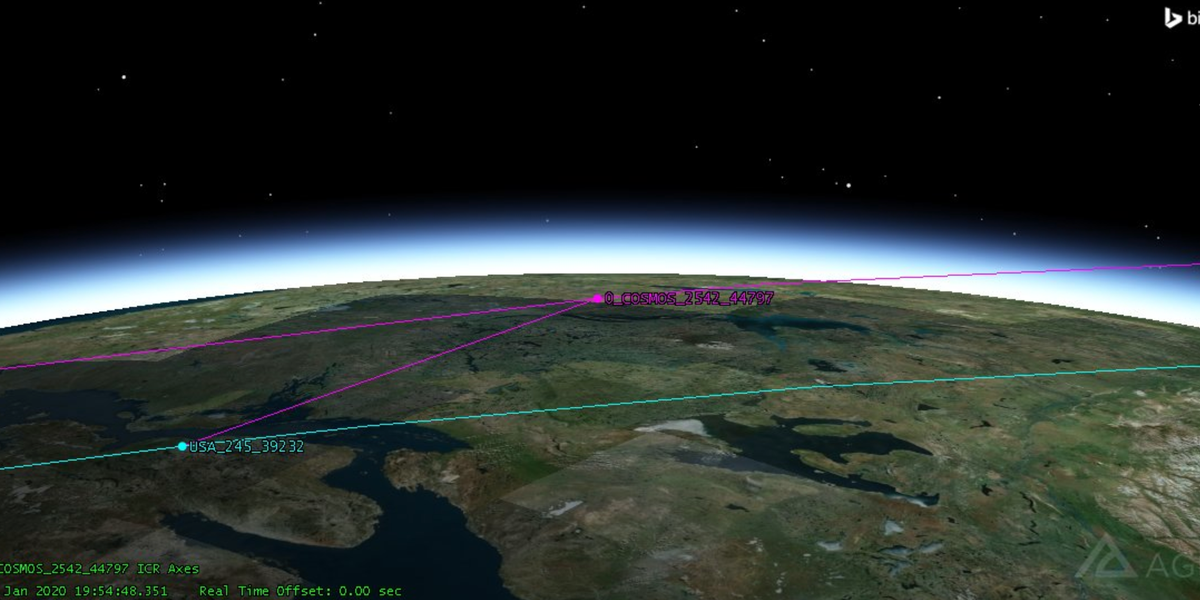
U.S. officials have also raised concerns about Russian satellites operating in ways that appear suspiciously close to U.S. government satellites. In public comments, the Pentagon has said Russia launched a satellite into low Earth orbit in May 2024 that the U.S. assessed as likely being a counterspace weapon and placed it in the same orbit as a U.S. government satellite.
This kind of activity matters because satellites in similar orbits can observe, inspect, shadow, or potentially threaten each other. Not every close orbital relationship is hostile; proximity operations can also support inspection, servicing, and debris removal. But when a military satellite behaves like it is tailgating another satellite in the world’s most expensive traffic lane, analysts pay attention.
U.S. Space Domain Awareness: Watching the Watchers
The United States invests heavily in space domain awareness, which means tracking, identifying, and understanding objects and activities in space. This includes satellites, debris, rocket bodies, and unusual maneuvers. If reconnaissance satellites are eyes looking down at Earth, space domain awareness systems are eyes looking around orbit.
The U.S. Space Force operates systems such as the Geosynchronous Space Situational Awareness Program, known as GSSAP. These satellites operate near geosynchronous orbit and help track and characterize objects in that region. The goal is not only to avoid collisions but also to understand behavior. Who is maneuvering? What changed orbit? Which object is behaving normally, and which one is acting like it has a secret agenda and a fake mustache?
Why Geosynchronous Orbit Is So Important
Geosynchronous orbit is valuable because satellites there can remain positioned over roughly the same area of Earth. This makes it useful for communications, missile warning, weather monitoring, and strategic missions. Losing awareness in that region would be like turning off the security cameras in a very expensive neighborhood.
Because geosynchronous satellites are high above Earth and often mission-critical, countries want to know what else is nearby. Space domain awareness helps the United States protect its assets, warn satellite operators, support collision avoidance, and detect potentially threatening behavior.
How U.S. and Russian Satellite Strategies Differ
The U.S. and Russian approaches to military space reflect different budgets, industrial bases, strategic cultures, and political goals.
1. Scale and Commercial Integration
The United States has a major advantage in commercial space. American companies provide launch services, satellite manufacturing, data analytics, communications, and Earth observation. This commercial ecosystem allows U.S. agencies to move faster and experiment with new architectures. The growth of commercial launch providers has made it easier to deploy constellations more frequently.
Russia, by contrast, has a more state-centered space sector and has faced constraints from sanctions and limited access to Western components. It still has skilled engineers and historic expertise, but its space industrial base is not operating with the same commercial momentum as the U.S. space economy.
2. Resilience Versus Vulnerability
The U.S. is increasingly focused on resilience through distribution. More satellites, more orbits, more partnerships, and more redundancy make it harder for an adversary to create a single point of failure. This does not make U.S. space systems invincible. It does, however, complicate an opponent’s planning.
Russia appears to place significant emphasis on counterspace options designed to offset U.S. advantages. If the United States depends heavily on satellites for precision warfare, communications, navigation, and intelligence, then threatening those satellites becomes an attractive strategy for Moscow.
3. Public Messaging
U.S. agencies have become more open about discussing threats in space. Officials now publicly refer to counterspace weapons, irresponsible behavior, and the need for responsible norms. Russia, meanwhile, often denies hostile intent and frames its space activities as defensive, scientific, or legally justified. This creates a messaging contest as much as a technical one.
The Nuclear Anti-Satellite Concern
One of the most serious concerns raised by U.S. officials involves Russia’s reported development of a nuclear counterspace capability. The issue is not simply one satellite threatening another. A nuclear weapon in space, if ever deployed or used, could have wide and indiscriminate effects on many satellites across multiple countries and companies. It would also raise major legal and strategic concerns under longstanding international space agreements.
Russia has denied that it is developing such a weapon. Still, U.S. intelligence leaders have described the possibility as a major threat to the world’s space architecture. That phrase matters because modern life depends on space far more than most people realize. GPS timing supports banking, logistics, telecommunications, power grids, aviation, shipping, agriculture, emergency response, and the tiny miracle of your phone knowing where the nearest taco place is.
Why This Rivalry Affects Ordinary People
It is easy to think of spy satellites as a distant military issue. But space security affects everyday life. Satellites support weather forecasts, disaster mapping, internet connectivity, navigation apps, shipping routes, financial transactions, television broadcasts, farming, wildfire monitoring, and emergency response. If space becomes unstable, crowded with debris, or increasingly weaponized, the consequences do not stay neatly inside defense agencies.
A conflict in space could disrupt services people depend on without ever seeing the cause. A satellite failure might look like a navigation problem, a communications outage, a weather data gap, or a military crisis moving faster than leaders can understand. The more society depends on space, the more important responsible behavior becomes.
Specific Examples That Define the U.S.-Russia Satellite Contest
Example 1: NRO’s Proliferated Reconnaissance Architecture
The NRO’s newer constellation strategy shows how the United States is adapting to a contested environment. By launching many smaller satellites, the U.S. can improve revisit rates and build redundancy. This approach also reflects lessons from commercial mega-constellations: quantity, speed, software, and networked operations can be just as powerful as one ultra-capable spacecraft.
Example 2: GSSAP and Space Surveillance
The Space Force’s GSSAP satellites demonstrate the importance of watching objects in geosynchronous orbit. These satellites help identify and characterize other objects, supporting both safety and defense. In an era when satellites can maneuver, inspect, or shadow other satellites, awareness is not optional. It is the orbital version of checking your mirrors before changing lanes.
Example 3: Russia’s 2021 Destructive ASAT Test
Russia’s destructive anti-satellite test in 2021 remains a major example of irresponsible space behavior because debris can threaten many spacecraft long after the test is over. In space, cleanup is not as simple as sending a truck and a guy named Dave with a broom. Debris can remain dangerous for years.
Example 4: Russian Counterspace Satellite Activity
Public U.S. statements about Russian satellites placed near U.S. government satellites show how close-proximity space operations have become strategically sensitive. These incidents highlight the need for transparency, norms, and better communication between space powers.
Experience-Based Perspective: What It Feels Like to Follow the Satellite Race
For anyone who studies the subject of US spy satellites and Russian satellites, the first experience is usually surprise. The public conversation about space often focuses on astronauts, Mars, rockets, and dramatic launch footage. Then you start reading about reconnaissance satellites, space domain awareness, anti-satellite weapons, orbital debris, and classified payloads, and suddenly space feels less like a science museum and more like a geopolitical chessboard with no gravity and very expensive pieces.
One practical experience from following this topic is learning how much can be understood from open sources without crossing into classified territory. Launch notices, government press releases, satellite catalogs, congressional testimony, commercial tracking data, defense reporting, and think-tank analysis can reveal broad trends. You may not know exactly what a classified satellite can see, but you can understand that a country is changing its architecture, launching more frequently, or reacting to threats in a new way.
Another experience is realizing that space security is not just about dramatic weapons. The quiet stuff matters. Jamming, cyber risks, supply chains, ground stations, launch cadence, satellite replacement speed, and data processing may be less cinematic than exploding satellites, but they often matter more. A satellite is not useful simply because it is in orbit. It must communicate, process data, survive interference, and deliver information fast enough to matter.
There is also a strange emotional contrast in this field. On one hand, satellite technology is genuinely impressive. Humans built machines that travel thousands of miles above Earth, survive radiation, collect data, and help prevent surprise attacks. That is remarkable. On the other hand, the reason these systems exist is often fear, mistrust, and preparation for conflict. It is amazing engineering with a serious face.
Following U.S. and Russian satellite developments also teaches patience. Space events are rarely explained instantly. A launch may be classified. A maneuver may look suspicious but remain ambiguous. A government statement may reveal only enough to signal concern. Analysts have to compare orbit data, official language, timing, and historical patterns. It is less like watching a sports game and more like solving a puzzle where half the pieces are painted black.
The most important experience is understanding that stability in space depends on behavior, not just technology. Satellites can help reduce uncertainty by allowing countries to monitor threats and verify events. But satellites can also become targets, tools of pressure, or sources of escalation. The same orbit that supports weather forecasts and disaster relief also supports nuclear warning and military targeting. That dual-use reality makes space policy difficult and incredibly important.
For readers new to the topic, the best takeaway is simple: space is no longer a distant frontier. It is infrastructure. It is strategy. It is economics. It is national security. And yes, it is still beautiful. But behind the beauty is a competitive environment where the United States, Russia, China, commercial companies, and allied nations are all shaping the rules of the next era.
Conclusion: The Satellite Rivalry Is Just Getting Started
The contest between US spy satellites and Russian satellites is not a Cold War rerun with newer graphics. It is a modern competition shaped by commercial launch, proliferated constellations, cyber threats, electronic warfare, orbital surveillance, and concerns about counterspace weapons. The United States is moving toward larger, more resilient networks supported by a powerful commercial space sector. Russia remains a serious space actor, especially because of its counterspace capabilities and willingness to challenge U.S. advantages.
The future of this rivalry will depend on more than technology. It will depend on norms, diplomacy, deterrence, transparency, and crisis management. Space can remain a domain that supports life on Earth, or it can become a place where irresponsible actions create long-term danger for everyone. The satellites above us may be silent, but the message is loud enough: whoever understands space understands power in the modern world.