Some weeks produce historic breakthroughs, inspiring acts of courage, and important discoveries. The week ending June 5, 2020, also produced a suspected spy pigeon, dueling alligators, a liter of rapidly consumed lemon juice, and a plate of “carbonara” that may still be wanted for crimes against Italy.
To be fair, June 2020 was not an easy time. The COVID-19 pandemic dominated daily life, protests filled streets across the United States, and news audiences were exhausted. Against that serious background, strange news stories offered brief moments of disbelief, nervous laughter, and the comforting realization that human beings remained spectacularly capable of making unusual decisions.
The following ridiculous things that happened that week were based on real reports, court proceedings, police statements, viral posts, and record attempts. Some incidents occurred earlier but entered the news cycle during the week. Others were later clarified, making them even more entertaining in hindsight.
10. Monkeys Stole COVID-19 Blood Samples in India
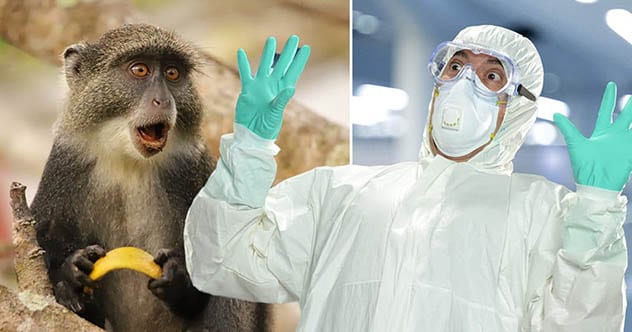
A medical worker near Meerut Medical College in northern India reportedly encountered a gang of monkeys that attacked him and escaped with blood samples taken from patients receiving treatment for COVID-19. It was the kind of headline that sounded less like journalism and more like the opening scene of a science-fiction movie whose budget had been spent entirely on bananas.
Initial reports caused concern that damaged samples might create a contamination risk. Medical officials later said the containers were recovered and remained intact, reducing fears of additional virus transmission. The affected patients simply had to provide new samples.
The episode demonstrated a practical problem in areas where monkeys regularly interact with people: the animals are fast, fearless, intelligent, and not particularly interested in respecting laboratory protocols. Fortunately, the event ended without the monkeys establishing their own research department or demanding peer-review privileges.
9. Three Boys Tried to Become Spider-Man
Three brothers in Bolivia, ages 8, 10, and 12, reportedly discovered a black widow spider while tending goats. Remembering that Peter Parker received his powers from a spider bite, the boys poked the spider with a stick until it bit each of them.
There were two major weaknesses in this plan. First, the spider that bit Peter Parker was fictional and radioactive. Second, black widow venom provides intense pain and dangerous medical symptoms rather than wall-crawling abilities, enhanced strength, or a profitable movie franchise.
The brothers became ill and were taken for medical treatment. They eventually recovered, but their experience provided a memorable public-safety lesson about separating comic-book origin stories from practical career planning. Admiring superheroes can encourage bravery and responsibility. It should not encourage children to negotiate directly with venomous wildlife.
8. An Airline Passenger Tried to Warm Pizza With a Reading Light
A photograph shared again by the Passenger Shaming social-media account showed an airline passenger holding a slice of pizza beneath the overhead reading light. The apparent goal was to transform cold leftovers into a warm in-flight meal.
The image was described as a throwback post, so the pizza experiment itself did not necessarily occur during the week of June 5. It did, however, return to viral circulation at exactly the right moment to remind everyone that technological optimism has limits.
Modern aircraft reading lights, particularly LEDs, are designed to provide illumination without producing enough heat to operate as tiny pizza ovens. Even an older bulb would be a slow, inefficient, and questionable food-warming device. The passenger’s commitment deserves recognition, though. Plenty of people complain about airline food; this man apparently attempted to establish an independent catering operation in Row 17.
7. A Man Drank a Liter of Lemon Juice in 16.53 Seconds
Serial record-breaker David Rush consumed one liter of pure lemon juice through a straw in 16.53 seconds, beating the previous mark of 17.12 seconds. Rush has pursued numerous Guinness World Records while promoting science, technology, engineering, and mathematics education.
Drinking a liter of lemonade would already be impressive. Drinking undiluted lemon juice is an entirely different eventone that asks the mouth, stomach, and human survival instinct to temporarily stop communicating.
Rush completed the attempt but later described significant discomfort. That detail should surprise nobody who has ever squeezed too much lemon onto a paper cut, much less poured an entire bottle into their digestive system at competitive speed.
The stunt was ridiculous, but it also required preparation, concentration, and an unusual tolerance for sourness. It proved that world records exist for nearly every measurable activity, including activities most people wisely abandon before finishing the sentence, “Wouldn’t it be interesting if I drank this?”
6. Camouflage Failed to Hide an Illegal Barbecue
Police in Dorset, England, discovered a vehicle and cooking setup hidden beneath camouflage netting in the protected Studland area. The disguise might have reduced visibility, but it could not conceal the smell of breakfast cooking on a stove.
Officers reportedly noticed the food aroma while driving past. They investigated and found the concealed car, occupants, and cooking equipment. Fires, barbecues, and similar devices were prohibited in the environmentally sensitive location because of the risk of wildfires and damage to surrounding heathland.
The incident offered a valuable lesson in criminal strategy: camouflage works primarily on eyesight. Bacon has a separate communications network.
It was a surprisingly elaborate attempt to cook breakfast somewhere cooking was forbidden. The group brought netting, concealed a vehicle, and apparently considered the visual dimensions of the operation. They simply forgot that breakfast announces itself through the air like a delicious emergency broadcast.
5. A Father Reportedly Wanted to Name His Baby “Cube”
A pregnant Reddit user claimed that her husband wanted to name their unborn son Cube. According to the viral account, the suggested name reflected the husband’s interest in mathematics and was compared with a Rubik’s Cube.
Because the story originated from an anonymous online post, it should be treated as an unverified family anecdote rather than established news. Nevertheless, it inspired widespread discussion because baby names are permanent, emotionally charged, and traditionally expected to sound less like options from a geometry worksheet.
Commenters overwhelmingly supported the mother’s objection. The internet also produced the inevitable collection of jokes about blockheads, dimensions, and the possibility of a future sibling named Sphere.
Unusual names can be meaningful and beautiful, but successful naming generally requires agreement from both parents. If one person hears “innovative tribute to mathematics” while the other hears “lifetime of explaining playground jokes,” the brainstorming session probably needs another round.
4. A Carbonara Photo Made the Internet Lose Its Appetite
A social-media user submitted a dish to the Rate My Plate community and reportedly called it carbonara. The plate appeared to contain canned spaghetti, pieces of hot dog, and a slice of American cheese laid across the top with the confidence of a blanket hiding a household accident.
Traditional Roman carbonara relies on pasta, eggs, cured pork, hard cheese, black pepper, and careful technique. Recipes vary outside Italy, but canned spaghetti and processed cheese move the dish so far from Rome that a passport may be required.
Online commenters reacted with theatrical horror. Some treated the meal as an insult to Italian culture; others admired the creator’s courage in submitting photographic evidence.
Food taste is personal, and inexpensive ingredients can produce satisfying meals. The real comic mistake was not necessarily eating canned spaghetti with hot dogs. It was labeling the combination “carbonara” and presenting it to an online rating communitya digital environment famous for tenderness, restraint, and respectful disagreement.
3. Two Alligators Fought on a Florida Doorstep
A Fort Myers resident was awakened by pounding near her front door and discovered two large alligators fighting directly outside the house. Video showed the reptiles snapping, pushing, and striking the entrance as they battled in the confined space.
The alligators were reportedly around seven feet long. They remained near the property for several minutes before separating and leaving. No human participants were required, which was fortunate because “breaking up an alligator fight” rarely appears on sensible morning schedules.
Florida wildlife officials explained that alligators become especially active during warmer months and mating season. The incident was therefore unusual but not inexplicable.
Still, hearing a knock and finding two armored reptiles engaged in territorial negotiations is an extremely Florida experience. The homeowners made the correct decision by observing from indoors. There are moments when hospitality should be suspended, and two alligators using the porch as a wrestling arena certainly qualify.
2. India Detained a Suspected Pakistani “Spy” Pigeon
Villagers near the India-Pakistan border captured a pigeon with a colored marking and a numbered ring attached to its leg. Because the bird had crossed one of the world’s most heavily militarized borders, some officials initially investigated whether the numbers represented a coded message.
The headline immediately transformed an ordinary pigeon into a feathered intelligence operative. However, the investigation produced a less dramatic explanation. A Pakistani fisherman said the bird belonged to him, had participated in pigeon racing, and wore a ring displaying his mobile phone number.
Indian police eventually cleared and released the pigeon. The supposed code was therefore closer to a lost-pet contact tag than an espionage system.
The suspicion was not completely detached from history. Carrier pigeons have transported military messages for centuries, and birds have previously raised security concerns in the region. In this case, however, the alleged agent appeared guilty only of unauthorized border crossing and looking suspicious while being a pigeon.
1. Men With Machetes Entered the Wrong House for a Paid Fantasy
The week’s most extraordinary story emerged from an Australian court case. Two men had been hired to enter a client’s home, tie him up while he was wearing underwear, and stroke him with a broom. The client reportedly offered substantial payment if the performance was especially convincing.
Unfortunately, the men went to an outdated address. At approximately 6:15 a.m., an uninvolved resident turned on his bedroom light and discovered two strangers standing near his bed with machetes, which were intended as props.
After repeatedly checking whether the resident was their client, the men realized the mistake, apologized, shook his hand, and left. Police were contacted afterward. One participant was later acquitted because the court accepted that he had entered the wrong property unintentionally and lacked the required intent to intimidate.
The original incident occurred in 2019, but the court ruling brought it into international headlines in late May 2020. It remains a powerful argument for confirming addresses, updating customer records, and perhaps including a password before beginning any appointment involving masks, machetes, or household cleaning tools.
Why These Weird News Stories Captured So Much Attention
The most ridiculous news of June 2020 succeeded because each story combined familiarity with one impossible detail. People understand laboratory samples, airline meals, baby names, cooking, wildlife, and wrong addresses. Add monkeys, spy accusations, alligators, camouflage netting, or a broom-based commercial arrangement, and an ordinary situation becomes unforgettable.
These stories also arrived during a relentlessly serious news cycle. Humor did not erase the genuine crises unfolding around the world, but it gave readers a brief emotional pause. Absurd headlines provided a way to experience surprise without immediately confronting another disaster.
They also demonstrated why updates and context matter. The pizza photograph was a resurfaced image. The pigeon was cleared. The machete incident occurred before the court decision that made it news. The Cube story and carbonara plate originated online and were not equivalent to independently verified police reports. Ridiculous news becomes more interestingnot lesswhen the distinction between confirmed fact, viral anecdote, and later clarification is clearly explained.
The Experience of Reading a Ridiculous News Week
Reading a roundup like this feels like walking through ten doors without knowing whether the next room contains a laboratory, an airplane, an Italian kitchen, or two alligators arguing about property rights. The experience is entertaining because every story begins with something recognizable and then takes one sharp turn away from common sense.
The monkey story, for example, starts with medical testing during a pandemica subject associated with strict procedures and controlled environments. Then a troop of monkeys enters the plot and carries off the samples. The contrast is so dramatic that the headline initially sounds invented. Once the samples are recovered safely, anxiety gives way to relief, and relief makes room for humor.
The Spider-Man incident creates a different reaction. It is easy to laugh at the logic, but the boys were children who required hospital care. The experience of reading the story includes both disbelief and concern. Good humorous writing should recognize that balance. The decision was absurd; the danger was real. Laughing at the gap between comic-book physics and actual biology is fairer than mocking injured children.
The alligator video provides pure visual tension. Most people recognize a knock at the door as a routine domestic sound. Replacing a delivery driver with two fighting reptiles turns the safest part of daily lifethe front entranceinto a wildlife documentary. The homeowners’ decision to remain behind the door also gives readers the satisfaction of seeing common sense win at least once.
Other stories reveal the unusual power of labels. Canned spaghetti with hot dogs may be an acceptable emergency dinner. Call it carbonara, however, and thousands of strangers suddenly become unpaid representatives of the Italian government. A numbered ring on a racing pigeon is ordinary until somebody calls it a coded message. A strange baby name is a private disagreement until it reaches Reddit, where the entire planet becomes an advisory committee.
The experience also encourages healthier skepticism. A ridiculous headline should prompt two questions: “Did this really happen?” and “What happened next?” The pigeon’s release changes the meaning of the original report. The throwback status of the pizza photo changes its timing. The court ruling explains why an older home-entry incident appeared in that week’s news.
Finally, these stories are memorable because they provide small narratives with clear beginnings, conflicts, and endings. The disguise fails because breakfast has a smell. The record is broken, but the lemon juice fights back. The wrong house is entered, an identity is checked, and an apology follows. Each report is a miniature comedy assembled by reality without consulting a screenwriter.
Looking back, the week of June 5, 2020, reminds us that strange news is more than disposable entertainment. It records the improvisation, confusion, ambition, creativity, and occasional spectacular misjudgment of ordinary life. History remembers major events, but it also has room for the morning when two alligators knocked on a door and the afternoon when a pigeon briefly became an international suspect.
Conclusion
The top ridiculous things that happened during the week of June 5, 2020, ranged from harmless culinary experiments to incidents requiring doctors, police officers, wildlife officials, and a judge. Together, they created a snapshot of a world that was frightened, exhausted, and still remarkably weird.
The stories remain funny because their central details are difficult to improve through exaggeration. Monkeys really did take medical samples. Boys really did seek Spider-Man powers. A pigeon really did face espionage suspicions. Two men really did arrive at the wrong bedroom for one of the most specialized appointments in modern history.
Reality had already written the punch lines. The rest of us merely had to confirm the addresses.