Poland is often introduced to travelers as the land of Gothic cathedrals, roadside Marian shrines, and Catholic feast days that can rearrange traffic with the confidence of a royal parade. That introduction is not wrong, but it is incomplete. Look east, especially toward Podlasie, Białystok, the Bug River, and the Carpathian foothills, and another Poland appears: a Poland of onion domes, iconostases, candlelit faces of saints, wooden tserkvas, deep choral singing, and pilgrims carrying crosses up a forested hill.
The Orthodox churches in Poland are not a decorative footnote. They are living houses of worship, historic witnesses, minority institutions, architectural treasures, and cultural bridges between Latin and Byzantine Christianity. They tell stories of border changes, local identity, migration, persecution, rebuilding, and stubborn beauty. In short, they are the kind of places that make history professors reach for a map and travelers reach for a camerathough ideally not during the liturgy, unless they enjoy the icy stare of a grandmother with excellent aim.
This guide explores the Polish Orthodox Church, its most important churches and monasteries, its architecture, its role in modern Polish life, and the experience of visiting these sacred places respectfully. Whether you are interested in Orthodox Christianity in Poland, religious heritage, Polish architecture, or a spiritual travel route that feels far from the usual postcard trail, this is a fascinating doorway into a quieter but deeply meaningful side of the country.
What Is the Polish Orthodox Church?
The main Orthodox body in Poland is the Polish Autocephalous Orthodox Church, usually called the Polish Orthodox Church. “Autocephalous” means self-governing, which is a wonderfully serious church word that basically says, “We manage our own household.” It is part of the wider Eastern Orthodox communion and follows the Byzantine Rite, with services shaped by icons, chant, incense, processions, fasting traditions, and a liturgical rhythm that can make modern life feel like it has finally stopped checking its phone.
Polish Orthodoxy has deep roots in the eastern borderlands of historical Poland-Lithuania, where Orthodox Christians included Belarusians, Ukrainians, Rusyns, Lemkos, and local Polish-speaking communities. After Poland regained independence following World War I, the new state included large eastern territories with millions of Orthodox Christians. The Polish Orthodox Church received autocephaly from the Ecumenical Patriarchate in 1924, while recognition from Moscow came later, in 1948. Those dates matter because they show how church history in Poland is inseparable from geopolitics, national borders, and the long conversation between East and West.
Today, Orthodox Christians are a small minority in Poland, a country still strongly associated with Roman Catholicism. Yet small does not mean insignificant. The Orthodox Church operates parishes, monasteries, seminaries, charities, cultural institutions, and publishing efforts. Its presence is especially visible in eastern Poland, where Orthodox churches are part of the everyday landscape rather than rare curiosities.
Why Orthodox Churches Matter in Poland’s Religious Landscape
Poland’s religious identity is often described in Catholic terms, but the Orthodox churches in Poland complicate that picture in the best possible way. They remind us that Polish history was never a single-lane road. For centuries, the region included Latin Catholics, Orthodox Christians, Greek Catholics, Jews, Protestants, Muslims, and other communities. The Polish-Lithuanian Commonwealth was a vast, multilingual, multi-faith world, and Orthodoxy was one of its essential voices.
The Union of Brest in 1596, which brought many Orthodox bishops in the Polish-Lithuanian Commonwealth into communion with Rome while preserving the Byzantine Rite, created the Greek Catholic tradition and changed the religious map of Eastern Europe. Not everyone accepted the union, and Orthodox communities continued to preserve their identity, liturgy, and church life. That history still echoes in the wooden churches of southeastern Poland, where some buildings were used by Orthodox and Greek Catholic communities at different moments in time.
Modern Polish Orthodoxy also carries the memory of the 20th century. Interwar tensions, wartime destruction, border shifts after World War II, forced resettlements, communist-era pressures, and post-1989 religious freedom all shaped the church. Many Orthodox believers found themselves on one side of a new border while their ancestral lands, cemeteries, and family networks were on another. Churches became more than buildings; they became anchors.
Where Orthodox Christianity Is Most Visible in Poland
If you want to understand Orthodox Christianity in Poland, start in Podlasie. This northeastern region, close to Belarus and Lithuania, is one of the most culturally layered areas in the country. Villages may have both Catholic and Orthodox churches. Roadside crosses change shape. Cemeteries tell multilingual stories. In Białystok, Hajnówka, Bielsk Podlaski, Siemiatycze, and surrounding villages, Orthodoxy is not hidden behind museum glass; it is part of community life.
Białystok is often considered the informal capital of Polish Orthodoxy. It has several major Orthodox churches, a strong Orthodox population, and a cultural atmosphere shaped by Polish, Belarusian, Jewish, Russian, and other influences. The region also hosts church music festivals, pilgrimages, and local traditions that make it one of the richest places to explore Eastern Christian heritage in Poland.
Another important area is southeastern Poland, especially the Carpathian region. Here, visitors find historic wooden tserkvasEastern Christian churches built of timber, often with shingled roofs, domes, and bell towers. Some are now Orthodox, some Greek Catholic, some Roman Catholic, and some preserved as heritage sites. Together they show how architecture can remember communities even when history has moved people elsewhere.
Key Orthodox Churches and Sacred Sites in Poland
St. Mary Magdalene Cathedral in Warsaw
The Metropolitan Cathedral of St. Mary Magdalene in Warsaw’s Praga district is one of the most important Orthodox churches in Poland. Built in the 19th century, it stands near a major urban artery, looking both grand and slightly unexpected, like a Byzantine guest who arrived at a Polish dinner party and somehow became the most memorable person in the room.
The cathedral survived while other Orthodox churches in Warsaw were demolished or repurposed, particularly after Poland regained independence. Its domes, iconostasis, and richly decorated interior make it a powerful symbol of continuity. It is not only a tourist landmark but also a functioning cathedral and the seat of the Metropolitan of Warsaw and All Poland.
St. Nicholas Orthodox Cathedral in Białystok
The Cathedral of St. Nicholas in Białystok is another essential site. Built in the 1840s, it became the cathedral of the Białystok-Gdańsk diocese in the 20th century. Located on Lipowa Street, one of the city’s central streets, it is easy to visit and hard to ignore. Its classical form reflects the architectural language of the Russian Empire, while its role today belongs firmly to Polish Orthodox life.
Inside, the cathedral offers what many Orthodox churches do best: a sense of vertical stillness. Icons look back at the viewer. Gold surfaces catch candlelight. The space encourages silence, even from visitors who normally narrate their vacations as if recording a podcast no one requested.
The Holy Spirit Church in Białystok
For a more modern example of Orthodox architecture, the Holy Spirit Church in Białystok is remarkable. Built in the late 20th century, it departs from the older imperial and wooden styles. Its dynamic form, sweeping roofs, and monumental scale show that Orthodox design in Poland is not frozen in the past. It can be contemporary, experimental, and still deeply rooted in tradition.
This church also reflects the influence of Jerzy Nowosielski, one of Poland’s most important modern artists associated with sacred art and Orthodox visual language. His work helped renew interest in icons not merely as religious objects but as profound artistic and theological statements.
Holy Mount Grabarka
Holy Mount Grabarka is often called the most important Orthodox pilgrimage site in Poland. Located in Podlasie, it is famous for thousands of crosses left by pilgrims. Some are large and carefully carved; others are simple wooden offerings. Together they create a forest of prayer that feels humble, dramatic, and emotionally direct.
The main pilgrimage is connected with the Feast of the Transfiguration. Pilgrims come to pray, carry crosses, drink from the spring, attend services, and participate in a tradition that blends devotion, memory, and endurance. Local tradition links Grabarka’s fame to miraculous healing during a cholera epidemic in the early 18th century. Whether one approaches the story as faith, folklore, or cultural memory, the place itself is unforgettable.
Supraśl Monastery
The Monastery of the Annunciation in Supraśl is one of the great Orthodox heritage sites of northeastern Poland. Founded centuries ago, damaged during war, and later rebuilt, it represents the resilience of Orthodox monastic life in the region. Supraśl is also known for its cultural institutions and the Museum of Icons, making it an excellent destination for anyone interested in sacred art.
Visiting Supraśl can feel like stepping into a conversation between forest, history, and theology. It is quieter than a major city cathedral and more layered than a simple village church. It rewards slow attention, which is mildly inconvenient for modern tourists but very good for the soul.
Jabłeczna Monastery
The Monastery of St. Onuphrius in Jabłeczna, near the Bug River, is another major Orthodox monastery in Poland. It has long been a spiritual center for Orthodox believers in the region. Its location near historical borderlands gives it a special atmosphere: part sanctuary, part frontier memory, part living reminder that rivers and borders often change more quickly than prayer traditions.
Wooden Tserkvas: Poland’s Eastern Christian Masterpieces
Among the most beautiful Orthodox-related sites in Poland are the wooden tserkvas of the Carpathian region. These churches, built between the 16th and 19th centuries by Eastern Orthodox and Greek Catholic communities, are masterpieces of timber architecture. Several are included in the UNESCO World Heritage listing shared by Poland and Ukraine.
What makes them special is not only their age but their design. Built of horizontal logs, often with domed roofs, shingled surfaces, separate bell towers, and carefully organized interiors, these churches show how local craftsmanship served sacred purpose. They were built without the swagger of stone cathedrals, yet many have more personality than buildings ten times their size. A wooden tserkva does not shout. It sings in a low voice.
Notable Polish examples include churches in places such as Radruż, Chotyniec, Smolnik, Turzańsk, Powroźnik, Brunary Wyżne, Kwiatoń, and Owczary. Some are associated with Lemko or Ukrainian communities, and many have complex histories due to population transfers and changes in religious use. They are essential for understanding the shared Orthodox and Greek Catholic heritage of southeastern Poland.
Architecture, Icons, and the Orthodox Atmosphere
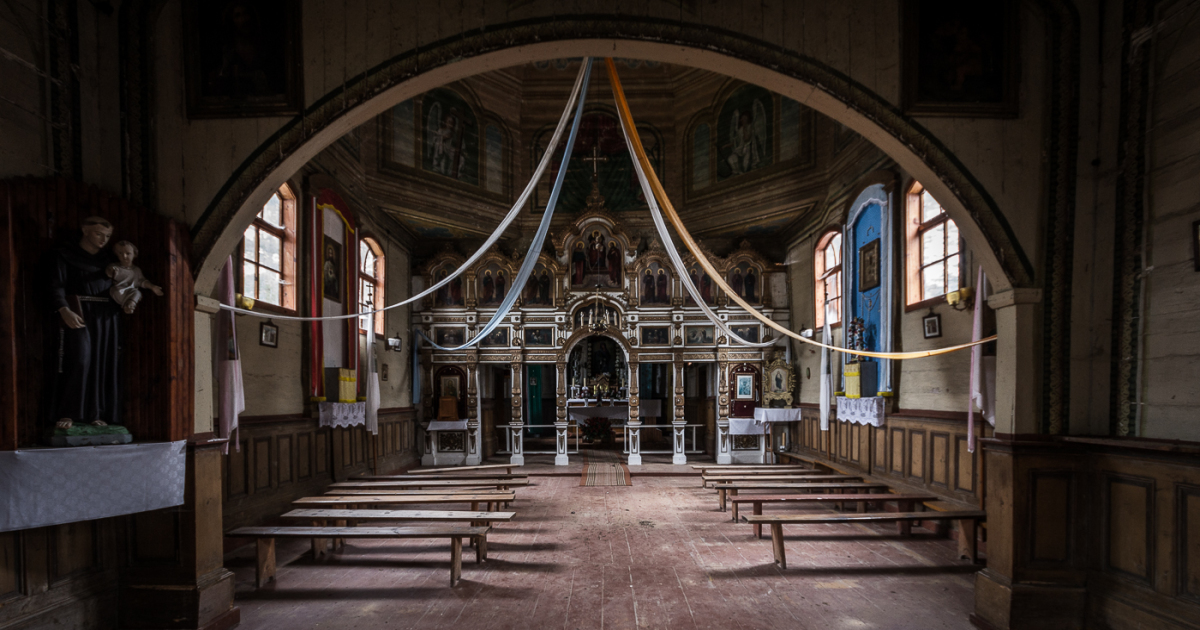
Orthodox churches in Poland are visually distinctive because they follow a theological language expressed through architecture and art. The iconostasis, a screen covered with icons, separates the sanctuary from the nave while also connecting heaven and earth symbolically. Icons are not decorations in the ordinary sense. They are windows into sacred reality, painted according to traditions that emphasize spiritual presence over realistic portraiture.
The domes often symbolize the heavens. Candles represent prayer. Incense turns the air into something visible. Chant replaces instrumental music in most services, creating a soundscape that feels ancient even when the people singing are wearing winter jackets and checking tram schedules afterward. The effect can be deeply moving, even for visitors who do not share the faith.
Polish Orthodox churches vary widely in style. Some reflect Russian Revival architecture. Some are wooden Carpathian tserkvas. Some are modern concrete structures. Some small village churches are modest and intimate, while major cathedrals are elaborate and monumental. Together, they show that Orthodoxy in Poland is not a single aesthetic but a family of traditions shaped by region, history, and community.
Orthodox Poland Today: Minority, Memory, and Renewal
In contemporary Poland, the Orthodox Church remains a minority church, but it is increasingly visible in public discussions about heritage, multicultural history, and migration. The arrival of many Ukrainians after Russia’s full-scale invasion of Ukraine in 2022 brought new attention to Eastern Christian traditions. Orthodox Easter services in Warsaw and other cities drew larger crowds, and Polish society became more aware of the diversity within Ukrainian religious life, including Orthodox and Greek Catholic communities.
At the same time, Polish Orthodoxy should not be reduced to recent migration. It is an indigenous part of Poland’s religious landscape, especially in the east. Many Orthodox families have lived in Polish lands for generations. Their identity may be Polish, Belarusian, Ukrainian, Lemko, Rusyn, or mixed in ways that resist simple labels. That complexity is not a problem to solve; it is the point.
The Polish Orthodox Church also participates in education, charity, publishing, chaplaincy, and cultural preservation. Its churches are places of baptism, marriage, funerals, confession, fasting seasons, feast days, and ordinary Sunday worship. For believers, the most important thing about these churches is not that they are photogenic. It is that they are alive.
How to Visit Orthodox Churches in Poland Respectfully
Visitors are usually welcome in many Orthodox churches, but a little etiquette goes a long way. Dress modestly, especially in monasteries and during services. Speak quietly. Avoid walking into restricted areas, particularly behind the iconostasis. Do not use flash photography, and always check whether photography is allowed. If a service is underway, stand toward the back and observe without turning the moment into a documentary starring you.
In many Orthodox churches, worshippers stand for much of the service. Visitors may also stand, though no one expects a newcomer to understand every movement. You may see people lighting candles, kissing icons, making the sign of the cross, bowing, or venerating relics. These gestures are acts of devotion, not tourist choreography. Watch respectfully and avoid blocking worshippers.
For travelers, the best approach is to combine major sites with smaller villages. Warsaw and Białystok give you cathedral-scale Orthodoxy. Grabarka gives you pilgrimage. Supraśl and Jabłeczna give you monastic depth. The Carpathian tserkvas give you wooden architecture and borderland memory. Together, they form a route through a Poland many visitors never expect to find.
Why The Orthodox Churches In Poland Deserve More Attention
The Orthodox churches in Poland deserve attention because they expand the story of Poland itself. They show that the country’s religious heritage is not monochrome. They preserve the memory of communities that lived between languages, states, and empires. They offer some of the most beautiful sacred architecture in Central and Eastern Europe. They also remain active spiritual homes for people whose faith has survived political storms with remarkable patience.
For SEO purposes, the topic may look niche. For human purposes, it is anything but. These churches connect art, politics, migration, theology, architecture, and local identity. They help explain why Podlasie feels different from Kraków, why wooden churches in the Carpathians matter globally, and why a cathedral in Warsaw’s Praga district can carry more history than its walls seem able to hold.
To visit them is to discover that Poland’s past has many doors. Some are Gothic. Some are baroque. Some are wooden and smell faintly of resin. Some are crowned with domes and filled with icons. Open one, step inside, and the country becomes larger.
Experiences Related to The Orthodox Churches In Poland
A meaningful journey through the Orthodox churches in Poland often begins with a surprise: they do not feel like attractions designed for visitors. They feel like places that were already busy being themselves before you arrived. In Warsaw, St. Mary Magdalene Cathedral rises above Praga with urban confidence, surrounded by traffic, apartment blocks, and city noise. Step inside, however, and the temperature of the day seems to change. The gold of the iconostasis, the dark glow of painted saints, the smell of wax, and the soft movement of worshippers create a world that feels both public and intensely private.
In Białystok, the experience becomes more local. St. Nicholas Cathedral sits in the city center, but the atmosphere is not that of a monument waiting for applause. People come in to pray, light candles, make the sign of the cross, and leave quietly. A visitor quickly learns that Orthodox sacred space is not consumed in a hurry. You do not “do” an Orthodox church the way you might “do” a museum room. You slow down, even if your itinerary is tapping its foot impatiently outside.
Holy Mount Grabarka offers a completely different emotional landscape. The crosses left by pilgrims are impossible to forget. They cover the hill like a physical archive of human hope: illness, gratitude, grief, repentance, family prayers, private fears, and public faith. Some crosses lean. Some are new. Some are weathered into softness. Walking among them, it becomes difficult to treat religion as an abstract subject. The place is too personal for that. Even a non-Orthodox visitor can sense that thousands of people have brought something heavy there and left something behind.
The wooden tserkvas of southeastern Poland create yet another kind of experience. Their beauty is quieter and more rural. A timber church in a Carpathian village does not compete with the landscape; it seems to grow from it. The shingles, logs, towers, and surrounding cemeteries make the building feel almost organic. In these places, architecture and memory are closely bound. You may find yourself thinking not only about builders and priests, but about families who baptized children there, celebrated weddings there, buried grandparents there, and then sometimes disappeared from the region because history is not always polite enough to leave people where they belong.
The best experience is not simply visual. It is cultural. Orthodox churches in Poland invite visitors to listento languages, chants, silences, and local stories. They also ask for humility. Many of these places belong to minority communities that have had to preserve identity carefully. A respectful traveler should arrive with curiosity, not with the attitude of someone collecting exotic architecture like souvenir magnets.
A good route might start in Warsaw, continue to Białystok, move toward Supraśl and Grabarka, and later extend south to the wooden tserkvas of the Carpathian region. Along the way, leave room for small discoveries: a village cemetery with Cyrillic inscriptions, a roadside Orthodox cross, a local bakery after a long visit, or a conversation with someone who explains why a feast day matters. That is where the topic becomes real. The Orthodox churches in Poland are not only about domes, icons, or old borders. They are about continuitythe quiet, persistent kind that survives because people keep showing up, lighting candles, singing, repairing roofs, teaching children, and remembering.
Conclusion
The Orthodox churches in Poland reveal a rich and often overlooked side of Polish history. From the Metropolitan Cathedral of St. Mary Magdalene in Warsaw to the pilgrimage hill of Grabarka, from Białystok’s living Orthodox community to the wooden tserkvas of the Carpathians, these sacred places show how diverse Poland’s spiritual landscape truly is. They are beautiful, yes, but their real power lies in their endurance. They carry centuries of prayer, art, borderland identity, and cultural memory.
For travelers, they offer a deeper way to understand Poland beyond the most familiar routes. For history lovers, they open a door into the complex relationship between Catholic, Orthodox, Greek Catholic, Belarusian, Ukrainian, Lemko, Rusyn, and Polish traditions. For anyone interested in sacred architecture, they provide some of the most atmospheric churches in Europe. And for the casually curious? They prove that sometimes the most fascinating Poland is the one hiding just east of the obvious itinerary, waiting under a dome, behind an icon, or up a hill covered in crosses.
Editorial note: This article is written for web publication and summarizes reputable historical, cultural, religious, and travel information in original language without source-link clutter.