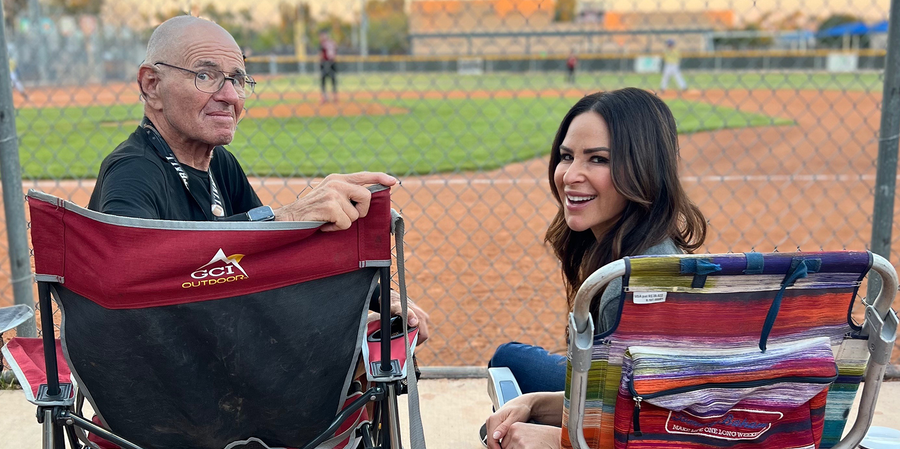
Grief has a way of turning ordinary rooms into echo chambers. The kitchen gets too quiet. The couch remembers too much. Even the grocery store becomes emotionally suspicious, especially when you pass the cereal aisle and realize the person you lost had wildly strong opinions about bran flakes. When my grief first arrived, I assumed healing would happen in the expected places: a therapist’s office, a church basement, a circle of folding chairs, maybe a box of tissues placed gently in the center like a sad little campfire.
Instead, I found my most reliable grief group at a baseball field.
Not a formal group. No sign-up sheet. No facilitator in soft shoes asking, “And how did that make you feel?” There were no name tags, unless you count jerseys. There was no opening meditation, unless the national anthem counts. There was only the crack of a bat, the smell of hot dogs, the low murmur of strangers becoming neighbors for nine innings, and the strange comfort of a game that refuses to rush.
Baseball did not cure my grief. That would be a ridiculous claim, and grief would immediately file a complaint. But baseball gave my sorrow somewhere to sit. It gave my mind a scoreboard, my body a routine, and my heart a crowd that did not demand a perfect explanation. Somehow, between foul balls, seventh-inning stretches, and the emotional whiplash of bullpen decisions, I began to breathe again.
Why Grief Needs More Than Silence
Grief is not simply sadness wearing a black coat. It can show up as fatigue, brain fog, irritability, sleeplessness, appetite changes, guilt, anger, nostalgia, numbness, and the sudden urge to reorganize a junk drawer at 2:13 a.m. Many grief experts describe mourning as a process that touches the body, mind, relationships, and daily routines. That is why “just give it time” is both partly true and wildly incomplete.
Time matters, yes. But time alone can become an empty hallway. What helps many people move through loss is support: trusted friends, healthy habits, meaningful activities, professional care when needed, and communities where the bereaved person does not have to pretend to be “over it.” A grief support group works because it offers connection and permission. It says, “You are not the only one carrying something heavy.”
Baseball, oddly enough, did that for me. Not because everyone in section 114 knew my story. Most of them were too busy debating whether the umpire needed an eye exam and possibly a career change. But the ballpark provided a place where grief could exist without taking over the entire room. I could be sad and still clap. I could miss someone and still laugh at the mascot losing a race to a child half its height. I could feel broken and still participate in a ritual larger than myself.
The Ballpark as an Accidental Support Group
The first game I attended after my loss felt like a mistake. I remember standing at the entrance, ticket in hand, thinking, “This is too normal.” People were smiling. Vendors were yelling. Kids were wearing gloves bigger than their faces. Life had apparently continued without asking my permission, which felt rude.
But then I sat down. The field opened in front of me, impossibly green, carefully lined, and calm in the way only a baseball diamond can be calm. Baseball has a geometry that suggests order: bases ninety feet apart, innings counted, outs recorded, every pitch beginning again from the same small hill of dirt. When grief had made my life feel shapeless, the game offered structure. Not answers. Structure.
Routine Becomes a Handrail
One of the hardest parts of grief is that it breaks the rhythm of ordinary life. You wake up and realize the old schedule no longer fits. Calls do not come. Chairs stay empty. The day has too much space in it. Baseball helped because it came with a calendar. Games happened whether I felt ready or not. First pitch at 7:05. Sunday afternoon at 1:10. Rain delay, perhaps, because even the sky enjoys drama.
That schedule became a handrail. I did not have to decide how to fix my life. I only had to decide whether to go to the game, watch it on television, listen on the radio, or check the box score in the morning like a Victorian gentleman reading market reports. Tiny decisions are underrated when grief has stolen your ability to make big ones.
Baseball Leaves Room for Memory
Some sports demand constant adrenaline. Baseball allows wandering. Between pitches, your mind has space to drift. You remember the person you lost. You hear their voice. You imagine what they would have said about the left fielder’s haircut, the price of parking, or the manager’s baffling loyalty to a reliever with the emotional stability of a leaf blower.
At first, those memories hurt. Then, slowly, they became company. Baseball gave me pauses where memory could walk beside me instead of tackling me from behind. The game’s slow pace, often mocked by people who think peace and boredom are the same thing, became exactly what I needed.
Why Baseball and Grief Make Strange Sense Together
Baseball is built on loss. Even the best hitters fail most of the time. A team can play beautifully for eight innings and still lose because one baseball found one unlucky patch of grass. A season is 162 games long in the major leagues, which means no single defeat gets the final word. Baseball teaches repetition without sameness: show up, try again, adjust your grip, swing at better pitches, forgive yesterday’s error, and keep your head up when the ball takes a bad hop.
That is not a bad philosophy for mourning.
The Game Understands Failure Without Shame
In grief, bad days can feel like personal failure. You think you are doing better, and then a song, smell, birthday, anniversary, or random Tuesday sends you backward. Baseball helped me understand that backward is not the same as broken. Hitters slump. Pitchers lose command. Fielders make errors. Nobody says the season is meaningless because of one ugly inning.
Healing works like that. Some days I could talk about my loss with warmth. Other days I could barely say the person’s name. Baseball gave me a language for this unevenness. It reminded me that progress is not a straight line; it is more like a season: streaks, slumps, surprises, rainouts, and the occasional miracle comeback.
Rituals Give Grief a Shape
Human beings rely on ritual when words are too small. Funerals, memorial meals, candles, prayers, songs, anniversaries, and visits to meaningful places all help people mark loss and remain connected to love. Baseball is packed with rituals: keeping score, singing in the seventh inning, wearing lucky socks, refusing to mention a no-hitter, touching a cap brim, booing with civic responsibility.
My baseball rituals became grief rituals. I bought a scorebook. I brought the same old cap. I arrived early enough to watch warmups. I saved ticket stubs. I ordered the same snack even though it cost roughly the same as a minor appliance. These gestures were small, but they made grief less shapeless. They told my heart, “We are doing something now. We are carrying love in a way we can repeat.”
Community Without Pressure
Traditional grief groups can be powerful because they create a safe space to share pain. But not everyone is ready to speak. Some people need connection before conversation. Baseball gave me a version of togetherness that did not require an emotional opening statement.
At the ballpark, I could sit among people without explaining why my chest felt heavy. I could be part of the wave, though I maintain the wave should be used responsibly and never during a crucial at-bat. I could high-five a stranger after a home run and then return to silence. I could belong lightly, which was exactly the level of belonging I could handle.
Strangers Can Be Gentle Witnesses
One evening, after a late-inning double, the man next to me turned and said, “That’s the kind of hit my dad would’ve loved.” I nodded and said, “Mine too.” That was the whole conversation. No dramatic music. No trembling confession. Just two people watching a game and letting the dead be present for a second.
That is one of baseball’s quiet gifts: it connects generations. Parents teach children to keep score. Grandparents explain why a sacrifice bunt is either noble strategy or emotional sabotage. Families inherit teams like recipes. Even when the person is gone, the game can keep part of the relationship moving. You still know who they would cheer for. You still know which rival they considered a moral failing. You still hear them during extra innings muttering, “This team is trying to kill me.”
The Mental Health Lesson Hidden in the Dugout
It is important to say this clearly: baseball is not a substitute for therapy, medical care, or a real grief support group when someone needs deeper help. If grief becomes unbearable, isolating, or dangerous, professional support matters. Talking to a counselor, joining a bereavement group, or reaching out to a crisis support service can be life-saving.
But healing is rarely one thing. It is usually a toolbox. Therapy can be a tool. Friendship can be a tool. Sleep, movement, nutrition, journaling, faith, volunteering, and support groups can all be tools. For me, baseball became one of the tools I did not know I needed. It got me out of the house. It gave me fresh air. It connected me with people. It gave my mind something simple to follow when everything else felt impossible.
Movement Matters, Even When It Is Small
Grief can make the body feel heavy. Some days, walking from the bedroom to the mailbox deserves a standing ovation. Baseball encouraged movement without making it feel like “exercise,” a word that often arrives wearing judgmental sneakers. I walked from the parking lot. I climbed steps. I stood to cheer. I played catch again, badly at first, then less badly, though no scouts were harmed by interest in my fastball.
Physical activity can support mood, reduce stress, and help people reconnect with their bodies after loss. Baseball made that movement playful. It did not demand transformation. It simply invited participation.
How Baseball Helped Me Talk About Loss
Before baseball became my unorthodox grief group, I avoided conversations about my loss because I feared two outcomes: either I would fall apart, or the other person would panic and begin speaking in decorative clichés. You know the ones: “Everything happens for a reason,” “They’re in a better place,” or the all-time classic, “At least…” Nothing good ever follows “at least” in grief.
Baseball gave me safer openings. Instead of saying, “I am devastated,” I could say, “We used to watch this team together.” Instead of forcing a grand emotional speech, I could tell a funny story about the time we left a game early and missed a walk-off homer, a decision that should probably be mentioned in my permanent record.
Stories came easier when they had a scoreboard attached. The person I lost became more than the ending. They became the jokes, the routines, the shared snacks, the arguments about statistics, the radio broadcasts, the sunny afternoons, the terrible seats, the beautiful seats, and the games we swore we would never forget.
Specific Ways Baseball Can Support Healing
Not everyone needs baseball, of course. Some people heal through gardening, hiking, quilting, church, music, cooking, books, volunteering, or watching home renovation shows where couples with impossible budgets demand “character.” The point is not that baseball is magic. The point is that grief often needs a place to go.
1. Attend a Game With Low Expectations
Do not demand joy from yourself. Just go. Sit in the stands. Notice the sky. Eat something unreasonable. Leave early if you need to. Staying for three innings still counts. Healing does not check the final score.
2. Keep Score as a Mindfulness Practice
Scorekeeping sounds old-fashioned, because it is, and that is part of its charm. Writing down each play keeps your attention gently anchored. It gives your hands something to do besides reaching for your phone or twisting a napkin into a tiny rope of anxiety.
3. Create a Memory Ritual
Wear the person’s team colors. Bring their cap. Order their favorite ballpark food. Listen to the radio broadcast they loved. Visit a field on an anniversary. Rituals do not erase loss, but they can turn pain into remembrance with edges you can hold.
4. Let the Game Connect You to People
Invite a friend. Join a recreational softball team. Volunteer with a youth league. Play catch with a neighbor. The best grief support is not always labeled “grief support.” Sometimes it is a person saying, “Want to throw for a few minutes?”
What Baseball Taught Me About Continuing
The most healing sentence baseball gave me was not “You will move on.” I dislike that phrase. It sounds like love is a parked car blocking traffic. The better sentence was, “The game continues.” That does not mean the loss becomes small. It means love finds a new way to travel.
In baseball, nobody gets to freeze the inning forever. The batter steps in. The pitcher comes set. The ball is thrown. Something happens. Then everyone adjusts. Grief is similar. You do not forget. You do not replace. You do not become the same person you were before. You step back into the box with a different stance.
Some days, I still cry during games. Usually not during the dramatic moments, because grief has weird timing. It waits until a father hands his daughter a foul ball, or an organist plays an old song, or the camera finds an elderly couple sharing peanuts like they have been doing it since the invention of dirt. But now the tears do not feel like proof that I am failing. They feel like evidence that love is still in the stadium.
Extra Reflections: My 500-Word Experience Inside Baseball’s Unofficial Grief Room
The deepest healing did not happen all at once. It arrived in baseball-sized portions, which is to say slowly, stubbornly, and with commercial breaks. The first few games after my loss, I barely watched. I stared at the field the way people stare at oceans, hoping the largeness of it might explain something. It did not explain anything. But it held my attention gently, and that was enough.
I remember one particular night when the home team was losing badly. Not tragic, mythic losing. Just regular baseball losing, the kind where every ground ball finds a hole and every pitching change feels like rearranging deck chairs on a very expensive ship. Around the sixth inning, I started laughing. Not because the game was funny, although it was developing a strong sitcom energy. I laughed because I realized I had gone almost twenty minutes without thinking directly about death. Then I felt guilty for laughing. Then I felt guilty for feeling guilty. Grief is very talented at creating paperwork.
But that laugh mattered. It was not betrayal. It was oxygen. Baseball gave me tiny permissions to feel something besides sorrow. A ridiculous mascot dance. A child shouting advice to a professional athlete. A fan in front of me keeping score with the seriousness of a Supreme Court clerk. These moments did not cancel grief; they loosened its grip.
Over time, the ballpark became a place where I could practice being alive again. I learned which concession stand had the shortest line. I learned that sitting on the third-base side gave me the best sunset. I learned that old men with scorecards are often philosophers disguised as retirees. I learned that strangers will lend you sunscreen, explain obscure rules, and celebrate with you as if you have known each other since kindergarten.
Most of all, I learned that grief changes when it is witnessed, even quietly. Nobody at the ballpark needed to know my whole story. Still, their presence helped. Their cheers rose around me. Their groans met mine. Their ordinary joy reminded me that the world was not mocking my pain by continuing; it was offering me a way back into the current.
There were also private rituals. After every game, I would pause before leaving my seat. I would look at the field and think of the person I had lost. Sometimes I said a sentence in my head: “You would have liked that one.” Sometimes I said, “You would have hated that call.” Both felt sacred in their own highly specific way. Love, I discovered, does not always speak in poetry. Sometimes it speaks in bullpen criticism.
Baseball helped me heal because it let grief be complicated. It made room for sadness and nachos, memory and statistics, tears and terrible umpiring. It gave me repetition when life felt chaotic, community when I felt alone, and laughter when I was afraid laughter had left for good. My grief group had no circle of chairs. It had foul poles, dugouts, scoreboards, and strangers singing off-key during the seventh-inning stretch. Unorthodox? Absolutely. But healing often arrives wearing the wrong uniform.
Conclusion: When the Game Becomes a Place to Grieve
Baseball did not ask me to be brave. It asked me to show up. That was the miracle. In a season when grief made everything feel too loud and too empty at the same time, the game offered rhythm, ritual, movement, memory, and community. It reminded me that healing is not a dramatic walk-off home run. More often, it is a single through the infield, a stolen breath, a small step, another inning.
The most unorthodox grief group I ever joined did not call itself a grief group. It called itself baseball. And somehow, sitting among strangers under stadium lights, I learned that love can remain, sorrow can soften, and life can continue without asking us to leave our memories behind.