If Tesla vehicles are the rock stars of the EV world, the battery is the band, the stage crew, and the tour bus. It does the real work while everybody stares at the singer. That is why any serious look at Tesla battery technology has to go beyond the usual “bigger battery, longer range” chatter. Tesla’s edge, such as it is, has never been about one magical chemistry bean hidden in a vault. It has been about stacking chemistry, cell design, pack engineering, software controls, thermal management, and manufacturing into one giant industrial puzzle.
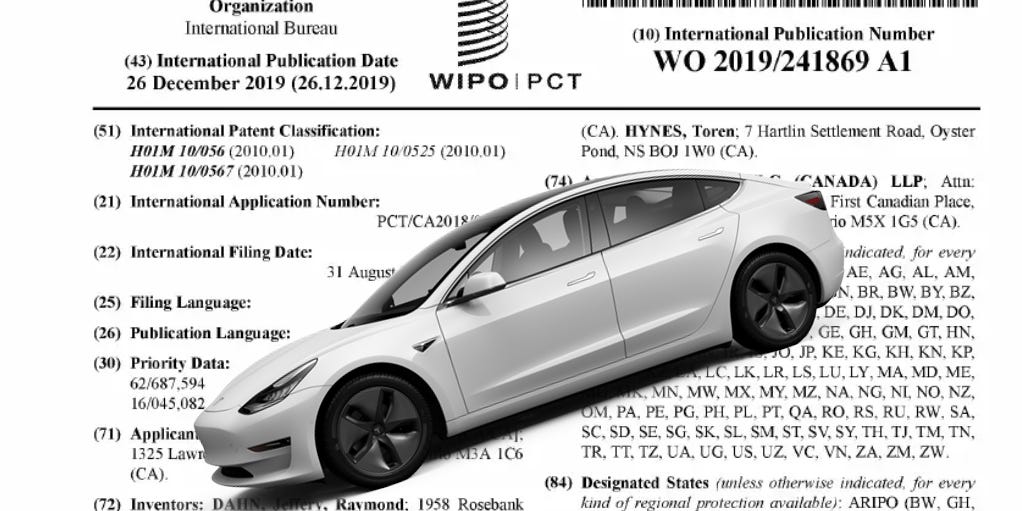
And yes, patents matter here. A lot. Tesla patents do not just reveal what the company wants to protect; they reveal what problems it thinks are worth solving. When you line up Tesla’s battery patents beside its public manufacturing updates, a clearer story appears: Tesla is trying to make batteries cheaper, easier to build at scale, safer under stress, and more tightly integrated with the vehicle itself. In plain English, the company is not chasing a better battery in isolation. It is chasing a better battery system.
This is why the conversation around the Tesla battery is so much bigger than one catchy term like “4680.” The real story lives in the details: dry electrodes, tabless cell architecture, structural battery packs, mixed chemistry strategy, and the less glamorous but very important world of cooling, charging, and safety controls. Exciting? Yes. Simple? Absolutely not. Batteries, as always, refuse to be boring and easy at the same time.
Why Tesla Battery Technology Gets So Much Attention
Tesla’s battery strategy gets extraordinary attention because batteries determine almost everything EV buyers care about: range, charging speed, performance, weight, durability, cost, and resale confidence. A battery is not just a fuel tank replacement. It is the largest cost center in many electric vehicles and the part most responsible for whether a car feels futuristic or frustrating.
Tesla also helped normalize the idea that software and battery management are just as important as the raw cell itself. That matters because two vehicles can use similar lithium-ion fundamentals and still feel completely different on the road. Battery preconditioning, thermal control, charging curves, energy buffering, and pack design can make one EV feel polished while another feels like it is constantly negotiating with physics.
What separates Tesla from the pack is not that it invented lithium-ion batteries. It did not. What Tesla did do was treat battery engineering as a full-stack problem. That full-stack mindset explains why the company talks about cells, cathodes, pack structure, factory design, refining, and even recycling in the same breath. It also explains why investors, competitors, engineers, and curious drivers keep peeking under the battery pack lid.
Tesla Does Not Use One Battery. It Uses a Battery Strategy.
One of the biggest misconceptions online is that there is a single “Tesla battery.” There is not. Tesla uses multiple battery chemistries because different jobs demand different tools. That is not inconsistency; it is practicality wearing a lab coat.
Nickel-Based Batteries: Energy Density First
Tesla has used nickel-based cathodes, including NCA and NMC families, where higher energy density is especially valuable. These chemistries are attractive when the goal is to squeeze more range and performance out of a limited space. If you want a battery to pull hard, store a lot of energy, and support premium vehicle performance, nickel-based chemistry is the fancy knife in the drawer.
The catch, of course, is that fancy knives are rarely cheap. Nickel-rich chemistries can be more expensive, more supply-chain sensitive, and more complex from a materials standpoint. They are powerful, but they do not come with free dessert.
LFP Batteries: Cost, Stability, and Endurance
Tesla has also leaned into iron-based LFP batteries. These packs typically give up some energy density, but they make a lot of sense where lower cost, durability, and thermal stability matter more than winning a spec-sheet arm wrestle. LFP also avoids cobalt in the cathode, which gives Tesla a materials and cost argument it is happy to make whenever the conversation turns to critical minerals.
That is why LFP fits so neatly into Tesla’s broader strategy. It is not the chemistry for every use case, but it is a strong option for high-volume, cost-sensitive products and stationary storage. In other words, Tesla’s chemistry mix says something important: battery technology is not a religion. It is a logistics plan.
From Conventional Cylindrical Cells to 4680: Bigger Than a Buzzword
The now-famous 4680 cell has become Tesla’s headline battery format, but the reason is more practical than mystical. A larger cylindrical cell can reduce the number of cells needed in a pack, simplify some assembly steps, and open up new ways to rethink the pack structure. That can mean lower cost, less complexity, and tighter packaging if the manufacturing actually behaves itself.
And there is the tiny little phrase doing Olympic-level work here: if the manufacturing actually behaves itself.
Tesla began delivering Model Y vehicles from Texas with Tesla-made 4680 cells and a structural battery pack in 2022. That was a meaningful step because it moved the 4680 from presentation slide territory into actual product territory. Later updates showed continued 4680 production gains, cost improvement, and validation work for dry-cathode 4680 cells in Cybertruck prototypes. More recently, Tesla said it had moved to dry-electrode production for both anode and cathode in Austin. That suggests the company has kept grinding on the factory side of the problem, which was always the harder half of the promise.
That is the key point with the 4680 format: it is not just a larger cell. It is the anchor for a manufacturing philosophy. Tesla wants the cell, the pack, and the factory to cooperate like a well-rehearsed pit crew. The 4680 only matters if that bigger system works.
The Real Technology Story: Dry Electrode Manufacturing
If the 4680 is the celebrity, dry electrode manufacturing is the method actor quietly carrying the whole film. Tesla’s dry-electrode push is one of the most important battery manufacturing stories tied to the company, largely because it aims to remove a messy, energy-intensive part of conventional battery production.
Traditional electrode manufacturing often uses a wet slurry process. That means coating electrode foil with a chemical slurry, drying it, handling solvents, and then continuing the assembly line. Reuters described Tesla’s dry-electrode effort as a potential way to shrink plant size, lower energy use, cut production time, and reduce cost. Tesla got much of this process know-how through its acquisition of Maxwell Technologies, which helps explain why dry-electrode language keeps appearing in patent families and manufacturing updates.
On paper, dry processing sounds like the kind of idea executives love to circle in red marker: fewer steps, less solvent handling, less factory footprint, faster throughput. In the real world, it has been difficult to industrialize. Reuters also reported that Tesla had more success with dry-coating the anode than the cathode during earlier scaling efforts, which is a useful reminder that battery innovation is often less like flipping a switch and more like wrestling an octopus in a clean room.
Still, this is where Tesla’s battery technology becomes genuinely interesting. A better chemistry can help. A better process can change the economics of the whole industry.
Tesla Patents Reveal the Company’s Battery Playbook
Patents are not perfect windows into a company’s future, but they are excellent clues. In Tesla’s case, they reveal an obsession with four themes: reducing resistance, simplifying manufacturing, turning the pack into a structural component, and managing thermal events before they become headline material.
1. The Tabless Electrode Patent
Tesla’s “Cell with a tabless electrode” patent family is one of the most discussed pieces of its battery IP. The basic idea is to reduce electrical resistance and simplify current flow by rethinking the way the electrode connects inside the cell. In standard language, it is about giving electricity a less annoying commute. Lower resistance can improve power performance, reduce heat, and support a more efficient cell design.
This patent matters because it shows Tesla attacking a real bottleneck inside cylindrical cells, not just making the can bigger and calling it innovation. The move from “battery tab” to “tabless-style current collection” may sound nerdy, but in battery land, nerdy is where the money is.
2. Dry Electrode Patents
Tesla’s patent trail also includes dry electrode fabrication and manufacturing systems. These patents describe forming electrode films from dry materials and using calendering and related methods instead of relying on conventional wet slurry processing. That aligns closely with Tesla’s public manufacturing narrative and with the Maxwell acquisition logic.
This is important because it shows that Tesla is not only patenting a battery outcome; it is patenting the factory workflow that could make that outcome economically viable. In modern battery competition, the winner is not always the company with the coolest chemistry. Sometimes it is the company that can make acceptable batteries faster, cheaper, and with less chaos.
3. Structural Battery Pack Patents
Tesla’s patent work around integrated or unitary energy storage systems points toward the structural battery pack concept. In this design philosophy, the pack does more than hold cells. It becomes part of the vehicle’s structure. That can reduce parts count, save mass, and change how the vehicle is assembled.
Done well, a structural pack can make the vehicle stiffer and the manufacturing line simpler. Done poorly, it can make repair shops mutter dark things into coffee. The engineering upside is real, but so is the tradeoff conversation.
4. Thermal Runaway and Safety Patents
Older Tesla battery patents show that safety engineering has long been part of the company’s thinking. Some patent families focus on controlled thermal runaway release, optical detection of thermal events, and barriers meant to limit propagation from one failing cell to the rest of the pack. That matters because high-performance batteries are wonderful right up until heat decides to become the main character.
The practical takeaway is that Tesla’s battery patents are not just about range and cost. They are also about keeping worst-case scenarios contained. Smart battery engineering is not only about how energy gets in and out. It is about what happens when something goes wrong at the worst possible time.
Why Fast Charging Is Harder Than It Looks
Everyone wants charging to feel like filling a gas tank, except with fewer fumes and more snacks. Physics, sadly, remains uncooperative. Research from NREL and Argonne shows why extreme fast charging is difficult: thicker, energy-dense electrodes can struggle with lithium transport during fast charge, which raises risks such as lithium plating, cracking, and excess heat. Thermal management becomes crucial because heat is the tax collector of battery performance. It always shows up.
This is why Tesla’s battery technology story cannot be reduced to chemistry alone. Fast charging depends on cell design, thermal controls, pack cooling, charge software, and real-time energy management. Tesla’s Supercharger experience often feels smooth not because the laws of chemistry took a holiday, but because the system is constantly preparing the pack, controlling temperature, and shaping the charging session around what the battery can safely tolerate.
That full-system approach is also why Tesla keeps investing in hardware, pack design, and software features around charging behavior. Battery performance is not just stored in the cell. It is orchestrated.
The Business Side: Supply Chains, Domestic Production, and Recycling
Battery technology is also a supply-chain story. Tesla has made it clear that chemistry choices are connected to material availability, geopolitical risk, and factory location. The company has said it is expanding Gigafactory Nevada with an LFP cell factory, and it has also discussed domestic cathode production and lithium refining in Texas. Those moves are not just patriotic wallpaper. They are attempts to reduce cost exposure, supply uncertainty, and dependence on far-flung material chains.
Recycling is part of this conversation too. EPA guidance underscores that lithium-ion batteries should not be tossed into household trash or recycling bins, and that end-of-life handling matters for both safety and material recovery. For Tesla and the wider EV sector, recycling is not a nice public-relations side quest. It is part of the long game for critical minerals, manufacturing scrap recovery, and the economic case for large-scale electrification.
In other words, the future of the Tesla battery is not only about making better cells. It is also about knowing where materials come from, how manufacturing scrap is handled, and what happens when millions of packs eventually retire from first life.
What Tesla Still Has to Prove
Tesla has strong ideas, a visible patent trail, and real progress in battery manufacturing. But the company still has to prove that its most ambitious battery concepts can scale cleanly, cheaply, and consistently. That includes dry-electrode yields, cost reductions at volume, durable pack performance, and a supply chain that stays resilient when trade, tariffs, and demand patterns shift.
It also has to prove that integration does not become over-integration. A structural pack can help manufacturing and vehicle performance, but the industry will keep asking hard questions about repairability, service economics, and lifecycle management. Those questions are fair. Batteries are too expensive and too central to modern EVs for anyone to wave away the details with a PowerPoint smile.
So, are Tesla patents and battery technology impressive? Yes. Are they enough on their own? No. In batteries, the patent is the promise. Manufacturing is the verdict.
Real-World Experiences: What Tesla Battery Technology Feels Like Outside the Patent Office
For drivers, battery technology does not show up as a white paper. It shows up as a feeling. It is the feeling that the car is ready on a cold morning, that the charge session does not turn into a coffee-shop hostage situation, and that the range estimate feels like an informed forecast instead of a motivational poster.
A Tesla owner’s experience with the battery often begins long before the charging cable clicks in. Preconditioning warms or cools the pack on the way to a Supercharger so the battery can accept power more efficiently. That sounds like a small software trick until you have used a car that does not manage temperature as intelligently. Then you realize the battery is not just a box of cells. It is a living system with preferences, moods, and an expensive dislike of thermal extremes.
Drivers of Tesla vehicles with LFP packs often notice a different rhythm than drivers with nickel-based packs. LFP is usually less dramatic about daily charging habits, which many owners appreciate. The downside is that in colder conditions, charging performance can feel fussier unless the pack is well prepared. Tesla’s battery heating updates and charging controls matter here because they smooth out an experience that chemistry alone cannot fully fix.
Performance drivers experience the battery differently. For them, the magic is not just in miles of range but in repeatability. Can the car still deliver strong acceleration after multiple hard runs? Can it fast-charge without feeling cooked afterward? Can the pack balance power, heat, and durability without turning the vehicle into a rolling science fair? Tesla’s battery management system does a lot of invisible work in these moments, and that invisible work is exactly the point.
There is also the ownership psychology of a Tesla battery. Buyers want reassurance that the pack will last, that the charging network will cooperate, and that “battery degradation” will remain a manageable reality rather than a financial jump scare. This is where Tesla’s combination of software controls, thermal management, and charging ecosystem often shapes the user experience more than any single patent title ever could.
Then there is the factory-side experience, even for people who never set foot in one. If Tesla succeeds with dry-electrode manufacturing, customers could eventually feel that progress through lower prices, better margins on lower-cost models, and more plentiful battery supply across cars and energy storage. When manufacturing gets better, the customer experience usually gets cheaper, faster, or both. In the battery business, that is about as romantic as it gets.
So the real-world experience of Tesla battery technology is not one dramatic moment. It is a stack of subtle wins: fewer charging headaches, more predictable road trips, stronger cold-weather behavior, lower long-term cost pressure, and a little more confidence that the most expensive part of the vehicle is being treated like the crown jewel it is. That may not sound flashy, but in daily life, boring reliability beats flashy promises every time.
Final Thoughts
The Tesla battery story is best understood as a marriage between chemistry and manufacturing. Tesla is working on better cells, yes, but also on better ways to build them, cool them, charge them, integrate them into vehicles, and eventually recover their materials. Its patents make that ambition visible. Its factory updates show how difficult that ambition really is.
So when people ask whether Tesla battery technology is all hype, the honest answer is no. But it is not all victory laps either. Tesla has done meaningful work in tabless architecture, dry electrodes, structural packs, and battery system integration. At the same time, the hardest part remains scale. A clever patent can impress engineers. A stable, low-cost, high-volume battery supply impresses the world.
That is why Tesla patents matter. They reveal the blueprint. The battery factories decide whether the blueprint becomes a building or just a very expensive sketch.