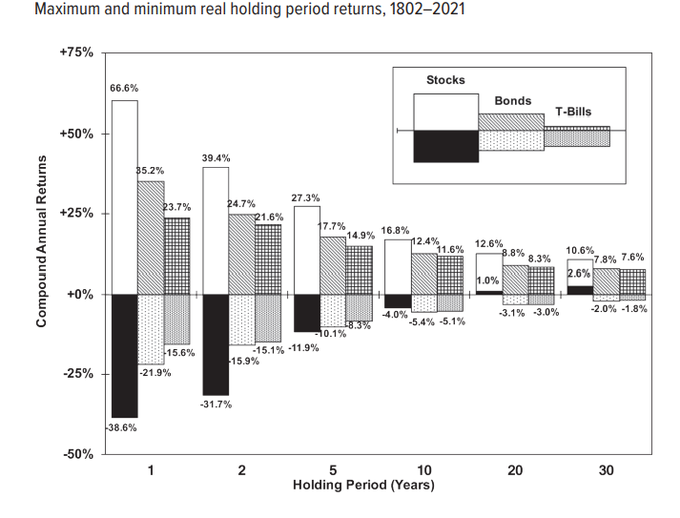
The stock market has a remarkable talent for making intelligent adults behave like contestants on a game show. Prices rise, everyone feels like a financial genius, and somebody starts explaining cryptocurrency at dinner. Prices fall, the same people consider selling everything and moving their savings into canned beans.
Long-term investing offers a less dramatic approach. Instead of trying to predict what stocks will do next Tuesday, investors focus on what productive businesses may accomplish over many years. They accept that markets will experience recessions, political shocks, bubbles, crashes, recoveries, and occasional periods when absolutely nobody seems to know what is happening.
The phrase stocks for the long run is closely associated with finance professor Jeremy Siegel and his influential book of the same name. First published in the 1990s and updated through multiple editions, the book helped popularize the argument that diversified equities have historically been one of the strongest tools for building wealth and preserving purchasing power over long periods.
That argument is persuasive, but it needs an important footnote: long-term stock investing is not a guarantee, a shortcut, or permission to buy any fashionable company and forget about it forever. It is a disciplined process built around diversification, reasonable costs, patience, risk management, and realistic expectations.
Book-history and thesis research basis:
What Does “Stocks for the Long Run” Really Mean?
Long-term investing generally means holding a portfolio for years or decades rather than trading in response to daily price movements. The exact period depends on the goal. Money needed for a home purchase in two years does not have the same time horizon as retirement savings that may remain invested for 30 years.
The basic idea is that a stock represents ownership in a business. When a company sells more products, improves efficiency, develops new technology, raises prices responsibly, or enters new markets, its profits can grow. Shareholders may benefit through higher stock prices, dividends, share repurchases, or some combination of the three.
A long-term investor is therefore not merely betting that a ticker symbol will move upward. The investor is participating in the future earnings of real businesses. That distinction matters. A stock chart can look like an electrocardiogram after three espressos, but underneath the chart are factories, software platforms, patents, employees, customers, cash flows, and management decisions.
Long-Term Investing Is Not Permanent Investing
“Buy and hold” is often misunderstood as “buy and never think again.” A sensible long-term investor still reviews the portfolio, checks whether the original thesis remains valid, rebalances when allocations drift, and sells when circumstances materially change.
An individual stock may deserve to be sold if the company takes on excessive debt, loses its competitive advantage, repeatedly misallocates capital, or develops serious governance problems. A diversified index fund may still be appropriate even when some companies inside it struggle because weak businesses are gradually reduced or removed while stronger businesses gain weight.
Patience is valuable. Blind loyalty is not. A stock certificate does not know how faithful you have been.
Why Stocks Have Rewarded Patient Investors
Stocks are risky because their future cash flows are uncertain. Investors demand the possibility of higher returns as compensation for accepting that uncertainty. This potential excess return over safer assets is commonly called the equity risk premium.
Historical results vary depending on the index, time period, inflation rate, valuation, and treatment of dividends. Investor.gov notes that some experts use a range of roughly 7% to 10% as a planning estimate for long-term diversified U.S. stock returns based on historical averages. That range is not a forecast, and future returns may be lower or higher. It simply helps illustrate why time matters so much.
Historical-return and time-horizon research basis:
Compounding Does the Heavy Lifting
Suppose $10,000 earns a hypothetical average return of 8% per year for 30 years. With gains reinvested, it would grow to approximately $100,600 before taxes and fees. The original investment increased tenfold without anyone needing to discover the next miracle stock.
Regular contributions can be even more powerful. Investing $500 at the end of every month for 30 years at the same hypothetical 8% return would produce approximately $745,000. The investor would have contributed $180,000, while the remaining growth would come from investment returns and compounding.
Real markets do not deliver a tidy 8% every year. One year might bring a 25% gain, another a 20% decline, and another an exciting return of approximately nothing. Compounding describes the long journey, not the scenery outside the window each afternoon.
Dividends Are Part of the Return
Investors sometimes focus entirely on price appreciation and overlook dividends. A dividend is a distribution of corporate earnings to shareholders. Reinvested dividends purchase additional shares, which may generate additional dividends, creating another layer of compounding.
Companies are not required to pay dividends, and dividends can be reduced or eliminated. Growth-oriented businesses may reasonably reinvest profits instead. The broader lesson is to evaluate total return, which combines price changes and income, rather than treating a rising share price as the only scoreboard that matters.
Businesses Can Adapt to Inflation
Inflation reduces the purchasing power of cash. Strong businesses may partially defend against inflation by raising prices, improving productivity, changing suppliers, or introducing higher-margin products. Not every company can do this successfully, and stocks can suffer during inflationary shocks. Over extended periods, however, ownership in productive companies has historically provided greater growth potential than holding idle cash.
The Biggest Advantage Is Often Behavioral
Investors devote enormous energy to finding the perfect stock, but behavior frequently determines whether a good strategy survives long enough to work. A diversified portfolio is not helpful if its owner sells during every frightening headline and buys again only after prices recover.
Market timing requires two correct decisions: when to exit and when to return. The second decision is often harder. Major gains can occur near major losses, meaning investors who wait for conditions to feel comfortable may miss a substantial part of the recovery.
Research from Vanguard and Charles Schwab has repeatedly emphasized the difficulty of timing markets and the cost of remaining uninvested while waiting for an ideal entry point. The perfect moment usually becomes obvious only after it has packed its bags and left.
Market-timing research basis:
How to Build a Long-Term Stock Strategy
1. Start With the Goal, Not the Stock
Before choosing investments, define what the money is supposed to accomplish. Retirement, financial independence, education expenses, and generational wealth may justify substantial stock exposure because they often have long time horizons. Emergency savings and near-term obligations generally require more stable and liquid assets.
A portfolio without a goal is vulnerable to every new idea that appears online. One week it owns technology stocks, the next week uranium miners, and by Friday it somehow contains a company selling artificial-intelligence-powered pet furniture.
2. Build a Diversified Core
Diversification spreads risk across companies, industries, market sizes, and geographic regions. It cannot prevent market losses, but it can reduce the damage caused by a single business failure or a severe downturn in one sector.
Broad index funds and exchange-traded funds can provide exposure to hundreds or thousands of stocks in a single investment. Investors who prefer individual companies can still benefit from maintaining a diversified core and limiting how much one stock can influence the entire portfolio.
The SEC and FINRA both emphasize that owning only a few stocks does not provide broad diversification. A portfolio containing five technology companies may have five ticker symbols, but economically it could still be one concentrated bet wearing different hats.
Diversification research basis:
3. Match the Allocation to Your Real Risk Tolerance
Risk tolerance is not how confidently someone discusses investing while the market is rising. It is the ability to follow the plan when the portfolio is down 20%, the news is gloomy, and a relative asks why you did not sell three months earlier.
An aggressive portfolio may hold a high percentage of stocks, while a more moderate portfolio may combine stocks with bonds and cash. The correct mix depends on the investor’s timeline, income stability, spending needs, and emotional tolerance for volatility.
Holding an emergency fund can also protect the investment plan. Investors who keep adequate cash reserves are less likely to be forced to sell stocks during a downturn to pay an unexpected bill.
4. Invest Consistently
Dollar-cost averaging means investing a fixed amount at regular intervals, such as with every paycheck. When prices are high, the fixed contribution purchases fewer shares. When prices are lower, it purchases more.
This approach does not guarantee a profit and may underperform an immediate lump-sum investment when markets rise steadily. Its practical strength is behavioral: automatic contributions reduce the temptation to pause investing whenever the financial news becomes unpleasant.
Consistency turns investing from an occasional prediction contest into a routine. That is much less exciting, which is often exactly why it works better.
Dollar-cost-averaging research basis:
5. Keep Costs Under Control
Investment fees are paid whether a fund has a brilliant year, an average year, or a year it would prefer not to discuss. Expense ratios, advisory charges, transaction costs, and taxes reduce the amount left to compound.
Imagine two hypothetical $100,000 portfolios earning 8% annually before expenses for 30 years. If one loses 0.1% per year to costs, it would grow to roughly $979,000. If the other loses 1% per year, it would grow to roughly $761,000. The apparently small annual difference produces a gap exceeding $200,000.
Low cost does not automatically make an investment good, but high cost creates a hurdle that must be overcome every year. FINRA specifically warns that even modest differences in fees can consume a meaningful portion of long-term returns.
Cost research basis:
6. Rebalance Instead of Predicting
Suppose an investor selects a portfolio containing 70% stocks and 30% bonds. After a strong stock market, the allocation might drift to 80% stocks and 20% bonds. Rebalancing restores the original mix by directing new contributions toward bonds or selling part of the stock allocation.
This process encourages investors to trim assets that have become overweight and add to those that have lagged. Rebalancing is not designed to identify the market’s top or bottom. It is designed to keep portfolio risk aligned with the original plan.
Index Funds Versus Individual Stocks
Individual stocks can produce extraordinary returns, but they can also suffer permanent losses. Choosing them requires evaluating financial statements, competitive advantages, management incentives, debt levels, valuation, industry economics, and potential disruption.
Index funds accept a simpler proposition: instead of identifying every future winner, own a broad collection of businesses and allow the index methodology to evolve over time. This does not remove market risk, but it reduces company-specific risk and usually keeps expenses relatively low.
The challenge of consistently outperforming broad benchmarks is substantial. S&P Dow Jones Indices reported that 79% of active large-cap U.S. equity funds underperformed the S&P 500 in 2025. Results vary by category and period, but the long-term SPIVA scorecards repeatedly show that selecting winning active managers in advance is difficult.
Active-versus-passive research basis:
That does not mean nobody should own individual stocks. It means investors should understand the difference between a diversified wealth-building plan and a concentrated attempt to beat the market. The two activities can coexist, but they should not be confused.
What Can Go Wrong Over the Long Run?
Time reduces some risks, but it does not erase them. Long-term investors still face several serious challenges.
Valuation Risk
Paying an extreme price for a wonderful business can lead to disappointing returns. A company may continue growing while its stock stagnates because the original valuation already assumed near-perfect results.
Concentration Risk
A portfolio dominated by one company, sector, country, or investing style may perform beautifully for years and then decline sharply. Recent winners naturally become larger portions of a portfolio, making periodic risk reviews essential.
Sequence-of-Returns Risk
A major market decline is especially dangerous when an investor begins withdrawing money. Selling assets during a downturn can leave fewer shares available to participate in the recovery. Retirees may manage this risk with bonds, cash reserves, flexible spending, and a carefully planned withdrawal strategy.
Behavioral Risk
Fear, greed, overconfidence, and performance chasing can destroy an otherwise reasonable strategy. Investors may buy after a popular asset has risen dramatically, then sell after the inevitable decline. The market does not charge an official emotional-decision fee, but it collects one anyway.
The Book Behind the Phraseand the Debate It Started
Jeremy Siegel’s Stocks for the Long Run assembled extensive historical evidence supporting equities as a powerful long-term investment. Its central message influenced generations of investors, financial advisers, and retirement planners.
The thesis has also received thoughtful criticism. Some researchers argue that early historical bond returns were underestimated, that U.S. market success may not be repeated everywhere, and that starting valuations can strongly influence returns over periods lasting 10, 20, or even 30 years.
A 2025 CFA Institute Research Foundation discussion revisited the evidence and emphasized that the debate is more nuanced than the slogan. Stocks have offered compelling historical returns, but the outcome depends on the country, period, valuation, inflation environment, and quality of the underlying data.
Long-run-thesis debate basis:
The practical conclusion is not that investors should abandon stocks. It is that history should guide expectations rather than become a guarantee. Long-term success still requires diversification, reasonable valuations, controlled costs, adequate liquidity, and the humility to admit that the future is not contractually obligated to resemble the past.
Warren Buffett has often described publicly traded stocks as ownership interests in businesses rather than pieces of paper to be traded. Berkshire Hathaway’s shareholder communications similarly emphasize long-term business performance, durable economics, and trustworthy management. This perspective is useful whether an investor owns individual companies or an index fund containing thousands of them.
Business-ownership research basis:
Experience Notes: What Long-Term Investing Feels Like in Real Life
The following experience is a composite of patterns commonly encountered by long-term investors rather than the personal financial history of the writer.
A new investor often begins during a rising market. The first purchases go up quickly, producing the dangerous conclusion that investing is easy. A few successful technology stocks create more profit in three months than a savings account produced in several years. Confidence rises. Diversification suddenly looks like something invented by people who dislike making money.
Then the market changes.
The portfolio falls 10%, recovers slightly, and falls again. The investor begins checking prices before breakfast, during lunch, and once more at night in case the market has secretly reopened. Every headline appears urgent. Commentators confidently predict opposite outcomes using the same economic data.
The first important lesson arrives: a portfolio can be financially appropriate but emotionally unbearable. The investor may have overestimated the ability to tolerate risk because risk had previously existed only as a sentence in a questionnaire.
A better plan emerges. Emergency savings are separated from long-term investments. The portfolio is reorganized around broad, low-cost funds, with individual stocks limited to an amount that will not destroy the overall strategy. Automatic monthly contributions continue regardless of whether the market is celebrating or sulking.
During the next decline, the portfolio still loses value. Diversification does not create an invisible force field. The difference is that the investor no longer needs to make an immediate decision. Bills can be paid from cash reserves, contributions continue, and rebalancing creates a structured response.
The second lesson appears several years later. A spectacular stock that seemed essential to own eventually disappoints, while several boring companies quietly compound. Excitement and return are not the same thing. The most entertaining investment in the portfolio may be the one most likely to interfere with sleep.
Another lesson concerns news. Elections, wars, inflation reports, interest-rate decisions, bank failures, and recessions all matter. Yet the investor discovers that knowing an event will occur is not enough. To profit from it, one must predict the event, the market’s expectations, the immediate reaction, the second reaction, and the correct time to exit. That is a rather crowded to-do list.
After a decade, the account statements begin to change character. Contributions still matter, but annual portfolio movements can become larger than the amount invested during the year. Compounding is finally visible. It spent the early years looking unimpressive, like a small snowball refusing to perform on command. Given enough time, it begins rolling under its own weight.
The experience also reveals that successful investing does not feel successful every day. There are years when the portfolio trails popular stocks, aggressive traders, or whichever asset currently dominates social media. A diversified strategy will always own something disappointing. That is partly the point. The investor is giving up the possibility of being perfectly positioned in exchange for reducing the probability of being catastrophically wrong.
Eventually, the main focus shifts from finding more investments to avoiding unnecessary mistakes. Costs are reduced. Taxes are considered before selling. Rebalancing happens on a schedule rather than in response to panic. Financial goals determine the portfolio instead of market predictions determining the goals.
The final lesson is almost annoyingly simple: long-term investing works best when life is organized so the investments can remain long term. Adequate savings, manageable debt, realistic spending, and stable contributions may be less glamorous than stock selection, but they provide the patience that a long-term strategy requires.
Conclusion
Stocks have historically been powerful wealth-building assets because they provide ownership in productive businesses. They offer the potential for earnings growth, dividend income, inflation protection, and decades of compounding. Those advantages explain why equities often form the core of retirement accounts and other long-term portfolios.
But “stocks for the long run” should never be translated as “stocks cannot lose over the long run.” Markets are unpredictable, valuations matter, businesses fail, and investors sometimes need their money at inconvenient moments. A resilient strategy combines stock ownership with diversification, low costs, suitable asset allocation, emergency reserves, periodic rebalancing, and enough discipline to survive uncomfortable markets.
The best long-term portfolio is not necessarily the one with the highest theoretical return. It is the one an investor can understand, afford, maintain, and hold through a full market cycle. Compounding needs time, but it also needs the investor to remain in the room.
Note: This article is intended for general educational purposes and does not provide personalized investment, tax, or legal advice. Investment returns are not guaranteed, and all examples are hypothetical.