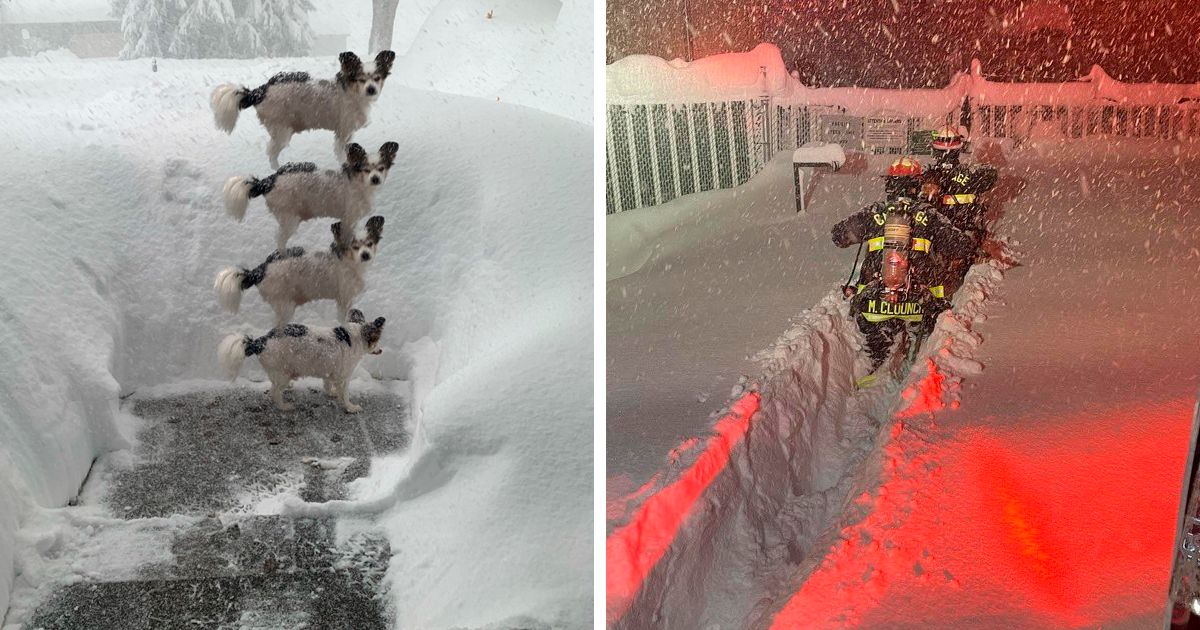
There are ordinary snow days, when schools close, children locate their sleds, and adults pretend shoveling counts as a complete fitness program. Then there are Buffalo snow days, when opening the garage reveals a nearly vertical wall of snow and finding the family car becomes an archaeological project.
That was the reality across parts of western New York during the historic lake-effect snowstorm of November 17–20, 2022. Communities south and east of Buffalo were buried beneath more than six feet of snow, producing photographs that looked less like weather coverage and more like deleted scenes from a disaster movie.
Residents posted images of cars swallowed whole, fences disappearing beneath drifts, doors blocked by compacted snow, and neighborhoods transformed into enormous white mazes. Some pictures were funny. Others were frightening. Together, they showed what happens when a narrow band of lake-effect snow parks over the same communities and simply refuses to leave.
Yes, Parts of the Buffalo Area Really Received More Than Six Feet of Snow
The phrase “six feet of snow” sounds like internet exaggeration, especially when it appears beside a photograph of someone standing next to a suspiciously perfect snowbank. In this case, however, official measurements were even more astonishing.
According to federal storm records, Hamburg received 81.2 inches, Orchard Park recorded 80 inches, and Blasdell measured 76 inches. The Buffalo Niagara International Airport recorded 36.6 inches, illustrating how dramatically totals varied across relatively short distances. The heaviest accumulations were concentrated in Buffalo’s southern suburbs rather than spread evenly across the entire city.
That geographic detail matters. A person in one neighborhood could be digging through a modest accumulation while someone several miles away was staring at a drift taller than an NBA player. Lake-effect snow does not believe in equal distribution. It prefers meteorological chaos with extremely specific ZIP codes.
The storm developed early on November 17, but the most intense band arrived Thursday evening and continued into Friday. State officials reported snowfall rates of several inches per hour, with peak rates reaching approximately six inches per hour in the hardest-hit locations. At that pace, a freshly cleared driveway could begin disappearing again before the shovel operator had finished complaining about the first pass.
The Wild Buffalo Snow Photos That Took Over Social Media
Weather statistics explain the scale of the storm, but the photographs made it understandable. Seventy or eighty inches is an abstract number until a familiar object provides perspective.
Doors Opened Into Solid Walls of Snow
Some of the most widely shared images showed residents carefully opening exterior or garage doors only to discover compacted snow filling nearly the entire doorway. Instead of a path outside, they found something resembling a frozen construction wall.
These scenes also revealed an important safety problem. When heavy snow blocks the main entrance, people must identify another exit before digging begins. A beautiful wall of fresh powder is significantly less charming when it is preventing everyone from leaving the house.
Cars Became Mysterious White Humps
Vehicles vanished under smooth layers of snow, leaving only mirrors, antennas, or vague rooflines visible. Residents frequently had to determine where one vehicle ended and the surrounding snowbank began before using a shovel or snowblower.
Photographs from Orchard Park and surrounding communities showed people clearing vehicles, roofs, sidewalks, and narrow trenches through drifts that reached chest or shoulder height. In several areas, driving was nearly impossible because roads were blocked by heavy accumulation, stranded vehicles, and continuously blowing snow.
Fences, Playgrounds, and Patios Disappeared
Ordinary objects became accidental measuring tools. A four-foot fence might show only its upper rail. Patio furniture looked like a collection of unusually shaped marshmallows. Backyard play equipment disappeared almost completely.
One especially memorable social-media trend involved using pets for scale. A photograph of a dog standing beside a towering drift could communicate the storm’s depth faster than a full meteorological report. The dog probably preferred that assignment to being asked to locate the buried driveway.
Highmark Stadium Looked Like a Giant Snow Bowl
Orchard Park is also home to Highmark Stadium, where the Buffalo Bills play. Images from the stadium showed seating areas and playing surfaces overwhelmed by snow. The NFL moved the Bills’ scheduled game against the Cleveland Browns to Detroit because of the dangerous conditions and the resources required to manage the storm.
Meanwhile, members of the famously dedicated Bills Mafia used shovels and snowblowers to help neighbors, including Bills players, clear their properties. Few fan bases can turn emergency snow removal into a team-building exercise, but Buffalo has considerable experience in this department.
Why Lake-Effect Snow Can Become So Extreme
The November 2022 Buffalo snowstorm was driven by lake-effect snow, a process that occurs when cold air travels over comparatively warm, unfrozen lake water.
As the cold air crosses Lake Erie, it gains heat and moisture near the surface. That air rises, cools, and forms clouds. When the wind aligns along a long stretch of open water, the resulting snow band can become narrow, persistent, and extremely intense.
The word “band” is important. Lake-effect snow may concentrate over one corridor while areas nearby receive dramatically less. A small change in wind direction can shift the heaviest snowfall from one community to another, making precise forecasts difficult even when meteorologists know that a major event is developing.
Snowfall rates inside an intense band commonly reach two or three inches per hour and can climb higher during exceptional events. Thundersnow may also occur when the atmosphere becomes unstable enough to produce lightning and thunder inside the snow band. During the November event, satellite observations captured powerful bands extending from the Great Lakes into western and northern New York.
In simpler terms, Lake Erie became a giant atmospheric snow machine, and several communities remained under the output chute for far too long.
Digging Out Required More Than a Few Snow Shovels
Once the snow began slowing, residents faced the enormous job of restoring basic movement. Clearing a normal driveway can be tiring. Clearing six feet of snow requires planning, suitable equipment, frequent breaks, and sometimes assistance from people operating machines large enough to have their own theme music.
Travel Bans Protected Roads and Emergency Access
Erie County and the City of Buffalo implemented travel restrictions as roads became unsafe. Officials warned that unnecessary vehicles could become stranded, block plows, and prevent ambulances or other emergency responders from reaching people who needed help.
This is one reason dramatic storm photographs should not be treated as invitations to go sightseeing. A person driving out to collect impressive footage can quickly become another obstacle that emergency crews must rescue or navigate around.
State Crews and the National Guard Joined the Response
New York activated emergency operations before the storm and deployed transportation crews, state police, emergency-management personnel, and National Guard members. Guard teams assisted with vehicle recovery, route clearance, transportation, and support for local responders.
After several days of work, the state began demobilizing resources as highways reopened and local conditions improved. The response involved multiple agencies because removing that much snow is not merely a sanitation task. It affects medical access, utilities, food deliveries, schools, businesses, and nearly every part of community life.
Removing Snow Created a Second Logistics Problem
A plow does not make snow disappear. It moves snow somewhere else. When accumulation reaches several feet, roadside storage space vanishes quickly, intersections become difficult to see around, and tall banks can block pedestrians and drivers from spotting each other.
Large loaders and dump trucks may be needed to carry snow to designated collection areas. Crews must also uncover fire hydrants, storm drains, sidewalks, and access points. In other words, the snow may stop falling, but the storm keeps assigning homework.
The Photos Were Funny, but the Storm Was Dangerous
The internet naturally focused on the strangest images: snow walls, buried cars, heroic dogs, and residents standing on drifts near second-story windows. Humor helped people cope, and it allowed outsiders to appreciate the scale of the event.
However, the November storm also caused deaths, including cardiac emergencies associated with clearing snow. Heavy, repetitive shoveling can sharply increase the strain on the heart, especially among people who are not accustomed to intense physical activity or who have existing cardiovascular risk factors. Contemporary reports attributed at least three deaths in New York to the storm.
Deep snow can create other hazards. Blocked furnace or dryer vents may allow carbon monoxide to accumulate indoors. Tailpipes must be cleared before vehicles are started. Roofs can be damaged by excessive weight, particularly when snow becomes wet and dense. Snowblowers can also cause serious injuries when users attempt to clear clogged machinery without shutting it down properly.
Residents therefore had to balance urgency with patience. The goal was not to remove every snowflake before lunch. It was to establish safe exits, uncover essential vents, clear access for emergencies, and avoid becoming the reason another ambulance was needed.
What Happened When the Snow Began to Melt?
After an extreme snowstorm, warming temperatures can introduce a new concern: flooding. Six feet of fluffy snow does not become six feet of water, but a large snowpack can still hold a significant amount of liquid.
NOAA aircraft surveyed the western New York snowpack following the November storm to measure its water content and help assess the risk associated with rapid melting. Those measurements supported forecasting for possible flooding, river flow, and drainage problems.
At the neighborhood level, residents could help by clearing storm drains only when it was safe to do so. Water trapped by snowbanks may flow toward basements, low-lying streets, and foundations. The transition from “Where did my car go?” to “Why is there a pond in my driveway?” can happen surprisingly quickly.
Social Media Documented the Stormand Occasionally Confused It
The flood of photos served an important purpose. Residents showed relatives that they were safe, demonstrated why travel restrictions were necessary, highlighted streets needing attention, and shared practical information about neighbors who required assistance.
But major weather events also attract recycled or mislabeled images. At least one photograph widely shared as part of the November 2022 storm was traced to Buffalo’s November 2014 snowstorm. The image showed genuine Buffalo snow, but not from the event described in the accompanying caption.
Before sharing a dramatic storm image, it helps to check the original posting date, photographer, landmarks, weather conditions, and whether reliable local outlets have published the same scene. Snow may be difficult to fingerprint, but metadata and reverse-image searches are less easily buried.
Why Buffalo’s Community Response Stood Out
The photographs did more than show a city buried in snow. They showed neighbors clearing one another’s driveways, residents checking on older adults, volunteers bringing supplies, and equipment owners using snowblowers or loaders to help people who had only hand tools.
That local cooperation was not merely heartwarming content. During an extreme snow event, a functioning neighborhood network can solve urgent problems before formal assistance reaches every street. Someone may need medication, a furnace vent cleared, a ride after restrictions are lifted, or help creating an emergency exit.
Buffalo’s familiarity with winter weather did not make six feet of snow easy. It did, however, give many residents a practical understanding of what mattered: stay off restricted roads, check on neighbors, pace the physical work, and never underestimate the value of the person down the street who owns a powerful snowblower.
Experience: What Digging Out From Six Feet of Snow Can Feel Like
The following is an illustrative, ground-level account based on conditions and experiences documented across the Buffalo area during the November 2022 lake-effect snowstorm.
The Morning Begins With an Unusual Silence
The first thing a resident might notice is not the height of the snow but the quiet. Deep snow absorbs sound, and travel bans remove the familiar background noise of traffic. The neighborhood feels padded, still, and slightly unreal.
Then comes the first inspection. A curtain is pulled aside, revealing that the porch steps no longer exist as separate objects. The driveway is a smooth white slope. Parked cars have become anonymous mounds. The mailbox is missing, although everyone assumes it remains somewhere beneath the landscape, reconsidering its career choices.
Opening a door requires caution. Snow packed against it can fall inward, and forcing the door may damage it. Before anyone begins digging, the household checks another exit, confirms that heating vents are open, charges phones, and reviews which neighbors may need assistance.
The First Path Is About Safety, Not Appearance
The initial objective is rarely a perfectly clean driveway. Residents first create a narrow route from the house to the street or another safe area. They uncover furnace vents, dryer outlets, gas meters, and fire hydrants. Snow is removed in layers because attempting to lift an entire deep section at once is exhausting and dangerous.
Every shovel full creates a new question: where should the snow go? Banks already rise above shoulder level. Throwing snow onto the top becomes increasingly difficult, while piling it near the road may reduce visibility or interfere with plows.
After twenty minutes, gloves are damp, shoulders are burning, and the visible progress seems insultingly small. The correct response is a breaknot a dramatic attempt to defeat winter through personal determination. Warm drinks, dry clothing, and steady pacing matter more than finishing quickly.
Neighbors Turn Separate Driveways Into a Shared Project
Eventually, the sound of a snowblower appears from another property. It moves slowly down the block like a mechanical rescue animal. Neighbors with larger equipment begin opening paths for households with older residents, health concerns, or no suitable machinery.
Someone checks whether a nearby family has enough food. Another person clears around a fire hydrant. A resident posts local updates online, while someone else helps identify which roads remain closed. Progress becomes easier when the neighborhood treats the storm as one shared problem rather than twenty isolated driveways.
The Car Is Found, but the Journey Is Not Over
After hours of digging, a vehicle finally reappears. Its roof must be cleared, along with the windows, lights, and exhaust pipe. Even then, travel restrictions and unplowed roads may make driving impossible.
The wisest decision may be to leave the car exactly where it is. A freshly uncovered vehicle is not a magic permission slip. Roads must be officially opened, intersections must be visible, and emergency crews must have room to operate.
Normal Life Returns One Narrow Path at a Time
Digging out after six feet of snow is not a single dramatic moment. It is a long sequence of small victories: an exterior door opens, a vent is uncovered, a neighbor receives medication, a plow reaches the block, and eventually the buried mailbox returns from its frozen sabbatical.
The viral photographs captured the impossible scale of the storm, but the deeper story was persistence. Buffalo did not emerge because one heroic person shoveled an entire city. It emerged because residents, public employees, emergency responders, equipment operators, volunteers, and neighbors kept clearing the next essential path.
Conclusion
The November 2022 Buffalo lake-effect snowstorm produced some of the wildest winter photographs ever shared online. Yet the images of buried cars, blocked doors, vanished fences, and overwhelmed stadium seats represented more than internet spectacle.
They documented a highly localized weather event that dropped more than six feet of snow on parts of western New York, disrupted transportation, required a major emergency response, and tested the physical and social resilience of entire communities.
The photographs were astonishing because they placed familiar objects inside an unfamiliar world. A driveway became a tunnel. A garage became a snow cave. A car became a rumor. And a neighborhood snowblower became the most popular machine on the block.
Buffalo eventually dug out, as Buffalo tends to donot by pretending the storm was ordinary, but by combining experience, preparation, heavy equipment, public coordination, neighborly help, and a sense of humor sturdy enough to survive an 80-inch forecast.
Note: This article covers the lake-effect snowstorm of November 17–20, 2022. It should not be confused with the separate and deadlier Buffalo blizzard that occurred during the Christmas holiday in December 2022.