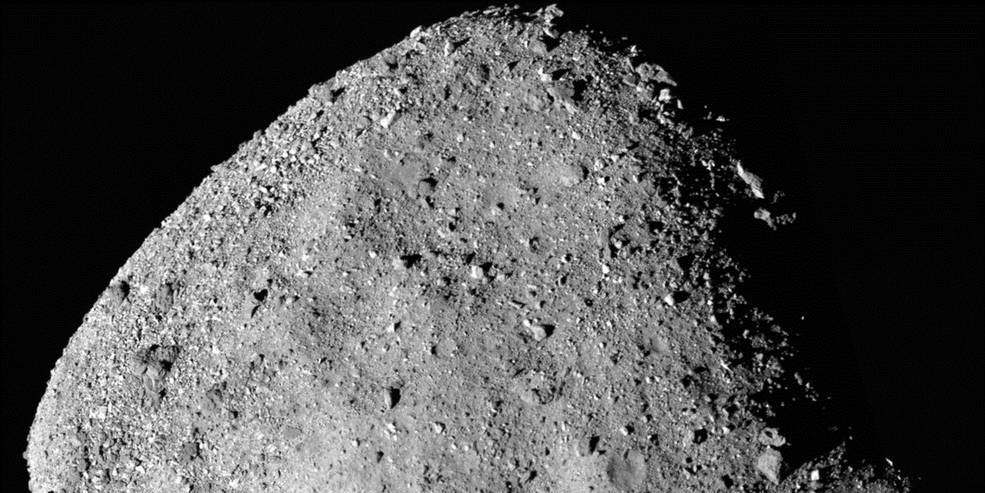
Asteroid Bennu looks like a charcoal briquette that lost an argument with gravity. It is dark, rocky, loosely assembled, and roughly 1,600 feet wide. Yet beneath that less-than-glamorous exterior, NASA’s OSIRIS-REx mission found evidence of something extraordinarily important: water preserved within ancient minerals.
The discovery did not mean that Bennu had lakes, waterfalls, or tiny alien pool parties. Instead, spacecraft instruments detected hydroxyl molecules bonded inside clay minerals across the asteroid’s surface. These water-bearing minerals revealed that Bennu’s material had once interacted extensively with liquid water inside a much larger parent asteroid.
Years later, samples returned to Earth strengthened that conclusion. Scientists found hydrated clays, carbonates, phosphates, salts, organic compounds, and mineral evidence of ancient brines. Together, these discoveries are helping researchers investigate how water and the chemical ingredients associated with life traveled through the early solar system.
What Did OSIRIS-REx Actually Discover on Bennu?
NASA announced the initial water-related discovery in December 2018, shortly after OSIRIS-REx reached Bennu. Two onboard spectrometers detected signatures consistent with hydroxyl groups, which consist of hydrogen and oxygen atoms bonded together.
The hydroxyl was not floating freely as liquid water. It was locked into the molecular structures of hydrated clay minerals. When scientists describe Bennu as a “water-rich” asteroid, they are usually referring to these chemically bound components and to geological evidence that water once circulated through Bennu’s ancestral world.
This distinction matters. Present-day Bennu is far too small to maintain the pressure and internal conditions required for long-lived bodies of liquid water. Its weak gravity would not politely ask an ocean to stay put. The evidence instead points to liquid water existing inside Bennu’s much larger parent asteroid billions of years ago.
Hydrated Minerals Were Found Across the Surface
The spectral signatures appeared broadly distributed rather than concentrated in one unusual patch. That suggested water-altered minerals were an intrinsic part of Bennu’s composition, not debris recently deposited by a collision with another object.
Researchers compared Bennu’s spectrum with carbonaceous chondrite meteorites, especially primitive types known to contain minerals altered by water. The resemblance supported the mission team’s prediction that Bennu preserved chemically ancient material from the solar system’s earliest period.
In other words, OSIRIS-REx had selected the right cosmic time capsule. It was just a time capsule covered in enough boulders to make landing on it resemble parallel parking during an earthquake.
How OSIRIS-REx Detected Water-Bearing Minerals
The discovery relied primarily on two complementary instruments: the OSIRIS-REx Visible and Infrared Spectrometer, known as OVIRS, and the OSIRIS-REx Thermal Emission Spectrometer, or OTES.
OVIRS Examined Reflected Sunlight
OVIRS measured visible and infrared sunlight reflected from Bennu. Different molecules absorb specific wavelengths, leaving recognizable dips in a spectrum. Scientists found a strong absorption feature near 2.7 micrometers, a region associated with hydroxyl-bearing minerals.
A spectrum functions somewhat like a chemical barcode. Bennu did not print “contains ancient wet rocks” across its equator, so researchers examined how its surface absorbed and reflected energy instead.
OTES Measured Thermal Radiation
OTES studied infrared energy emitted by Bennu as the asteroid warmed in sunlight and cooled in darkness. Thermal infrared measurements provided additional information about mineral structures, particle sizes, and surface composition.
The agreement between the instruments was especially valuable. OVIRS and OTES approached the problem through different wavelength ranges, yet both produced evidence compatible with hydrated, aqueously altered minerals. The resulting research described abundant hydrated material across Bennu and noted similarities to primitive carbon-rich meteorites.
How Could Bennu’s Rocks Have Been Wet?
Bennu is believed to be a rubble-pile asteroid assembled from fragments of a larger object destroyed by collisions. That parent body formed during the early history of the solar system from dust, rock, organic compounds, and ice.
Heat generated by the radioactive decay of short-lived elements may have melted some of the internal ice. The resulting water moved through pores and fractures, reacting with previously dry minerals. This process, called aqueous alteration, produced clays, magnetite, carbonates, and other minerals now preserved in Bennu’s fragments.
Carbonate Veins Strengthened the Case
Later observations revealed bright carbonate veins inside some of Bennu’s boulders. On Earth, carbonate minerals often precipitate when water containing dissolved carbon dioxide circulates through rock.
Some of Bennu’s veins extended much farther than similar features commonly seen in meteorites. Their size suggested that the parent asteroid once supported a substantial hydrothermal system, with liquid moving through cracks and depositing minerals over time. This was not merely a damp grain of dust. Bennu’s ancestor appears to have experienced meaningful, widespread water-rock chemistry.
From Remote Detection to a Sample on Earth
OSIRIS-REx launched on September 8, 2016, and arrived at Bennu in late 2018. The spacecraft spent nearly two years mapping the asteroid, studying its composition, measuring its gravity, tracking particle ejections, and searching for a safe collection site.
The original mission plans assumed Bennu would contain relatively broad areas of fine material. Close-up images revealed a far more rugged surface filled with enormous boulders. Engineers therefore developed a precision navigation system that allowed the spacecraft to recognize surface landmarks and steer toward a much smaller target.
The Touch-and-Go Collection
On October 20, 2020, OSIRIS-REx descended to a site called Nightingale. Its Touch-and-Go Sample Acquisition Mechanism, or TAGSAM, briefly contacted the surface and released pressurized nitrogen gas. The burst stirred loose rocks and dust into a circular collector.
The surface was so loosely packed that the sampling head penetrated more deeply than engineers had expected. Images later showed the collector overflowing, with a few particles escaping into space. It was the rare scientific emergency in which the problem was essentially, “We collected too much asteroid.”
The spacecraft departed Bennu in 2021. On September 24, 2023, it released its sample capsule near Earth, and the capsule landed safely in Utah. Scientists ultimately measured 121.6 grams, or 4.29 ounces, of Bennu materialmore than twice the mission’s minimum requirement.
Returned Bennu Samples Confirm a Watery Past
Remote sensing had already indicated that Bennu contained hydrated clays. Laboratory analysis allowed scientists to examine those minerals directly at microscopic and atomic scales while protecting the sample from contamination.
Initial studies confirmed abundant carbon and water-bearing minerals. The rocks were dominated by clay minerals, including serpentine, showing that much of the original material had been transformed through reactions with liquid water.
A Surprise Discovery of Phosphate
Researchers also identified magnesium-sodium phosphate. The purity and relatively large grains of this mineral were unexpected because the spacecraft’s remote instruments had not clearly detected it.
Phosphorus is essential to known life. It helps form DNA, RNA, cell membranes, and molecules involved in storing energy. Finding phosphate on Bennu does not prove that life existed there, but it shows that important biochemical ingredients were available in primitive asteroid environments.
Mineral Evidence of Ancient Brine
More detailed work identified a sequence of salts produced as water containing dissolved minerals evaporated. Scientists reported sodium-rich carbonates, phosphates, sulfates, chlorides, and fluorides, among other phases.
The minerals resemble evaporites left behind when salty water disappears from terrestrial lakes or basins. Their arrangement allowed researchers to reconstruct chemical changes in a brine on Bennu’s parent body. The findings transformed the story from “these rocks once touched water” into a much richer picture involving prolonged water-rock reactions, dissolved salts, concentration, and evaporation.
What Bennu’s Water Means for the Origin of Life
Water alone does not create life. A kitchen contains water, carbon, salt, and a questionable container of leftovers, but it does not automatically produce a new species. Life requires complicated chemical organization, suitable conditions, energy sources, and enough time for increasingly complex reactions.
Bennu is important because its samples contain both water-altered minerals and a diverse inventory of organic compounds. Scientists have identified amino acids, ammonia, nitrogen-rich molecules, and all five nucleobases used in DNA and RNA. These substances are building materials, not evidence of organisms.
The combination of organic molecules and ancient brines creates an intriguing chemical setting. Liquid water could dissolve compounds, transport them through rock, concentrate them in certain locations, and allow reactions that would be difficult in dry material.
Did Asteroids Deliver Earth’s Water?
Earth likely acquired its water from more than one source. Some water may have been incorporated during the planet’s formation, while additional water and volatile compounds may have arrived through impacts involving asteroids and other small bodies.
Bennu cannot settle the entire debate by itself. Its samples do, however, provide direct evidence that primitive asteroids carried water-bearing minerals and organic chemistry. Similar bodies striking the young Earth could have delivered useful ingredients to environments where life later emerged.
The scientific value lies in the sample’s pristine condition. Meteorites collected on Earth have passed through the atmosphere and spent time in terrestrial environments, where water, microbes, soil, and human handling can complicate chemical analysis. OSIRIS-REx delivered material directly from an asteroid into carefully controlled curation facilities.
Why the Discovery Matters Beyond Astrobiology
Better Planetary Defense
Bennu is classified as a potentially hazardous near-Earth asteroid, although the probability of a future collision remains low. Studying its density, internal structure, surface strength, thermal behavior, and mineral composition improves models of how similar objects move and how they might respond to a deflection attempt.
A dense metallic asteroid and a porous rubble pile cannot be treated as identical targets. One might react to an impact like a bell; another might react like a cosmic beanbag. Successful planetary defense requires knowing which one is approaching.
Resources for Future Exploration
Water-bearing minerals could also become useful resources during long-duration space exploration. Extracted water could support astronauts, provide oxygen, or be separated into hydrogen and oxygen for propulsion.
Bennu does not automatically become a profitable interplanetary gas station. Mining, processing, transportation, ownership, and safety remain enormous challenges. Still, OSIRIS-REx demonstrated how remote instruments can evaluate asteroid resources and how spacecraft can collect material from extremely small worlds.
What the Bennu Discovery Does Not Prove
The results are exciting, but several exaggerated interpretations should be parked outside the laboratory.
- OSIRIS-REx did not discover an existing ocean beneath Bennu’s surface.
- The mission did not find fossils, cells, DNA, or extraterrestrial organisms.
- Organic compounds are not automatically biological; many form through nonliving chemical processes.
- Bennu does not prove that all of Earth’s water came from asteroids.
- The presence of life’s ingredients does not reveal exactly how life began.
What the mission provides is something more scientifically useful than a dramatic headline: carefully preserved physical evidence that water, salts, carbon-rich compounds, and prebiotic ingredients interacted inside an ancient asteroid parent body.
The Experience of Following the OSIRIS-REx Water Story
Following the OSIRIS-REx mission offers a useful lesson in how scientific discovery actually unfolds. It rarely arrives as one perfect movie moment accompanied by orchestral music. Instead, evidence accumulates in stages, with each stage answering one question and inventing several new ones before lunch.
First Came the Spectral Clue
The 2018 announcement was exciting because scientists had barely begun exploring Bennu from close range. The asteroid had been selected partly because telescopic observations suggested it might resemble water-altered carbonaceous meteorites. When the first spacecraft spectra revealed widespread hydrated minerals, a carefully developed hypothesis suddenly gained direct observational support.
For anyone learning about planetary science, this is a satisfying example of prediction meeting evidence. Researchers did not choose a random asteroid and become lucky. They studied Bennu from Earth, designed instruments around specific scientific questions, traveled for more than two years, and then tested their expectations at close range.
Then Bennu Refused to Cooperate
The next part of the experience was less tidy. Bennu’s surface was far rockier than expected. The broad sampling zones imagined during mission planning were nowhere to be found. Engineers had to improve navigation methods and guide the spacecraft toward a site surrounded by hazards.
This difficulty made the sample collection more meaningful. OSIRIS-REx was operating hundreds of millions of miles from Earth, where commands could not function like real-time joystick instructions. Every maneuver required planning, simulation, autonomous navigation, and trust in systems that could not be repaired by sending someone outside with a wrench.
The Sample Collection Felt Almost Impossibly Delicate
The Touch-and-Go event lasted only seconds, but it represented years of work. The spacecraft descended, contacted the surface, released nitrogen gas, captured loose material, and backed away. When images revealed an overflowing collector, relief mixed with concern because precious grains were escaping.
The team adjusted its plans and stored the sample early. That decision illustrates an underappreciated part of exploration: success often depends on recognizing when the original checklist no longer fits reality.
The Return to Earth Changed the Quality of the Evidence
Watching a capsule return from deep space and descend under a parachute is impressive. Scientifically, however, the most powerful moment came afterward, when laboratory instruments began examining individual particles.
Remote spectra had shown water-bearing minerals. The sample revealed their textures, compositions, chemical relationships, and microscopic histories. Researchers could identify clays formed through aqueous alteration, phosphate grains, carbonate veins, and salts deposited from evaporating brine. A distant spectral signal had become a physical geological record that scientists could measure repeatedly.
The Story Remains Open
Perhaps the best experience associated with OSIRIS-REx is realizing that the mission did not end when the capsule landed. Much of the Bennu material is being preserved for future researchers. Scientists decades from now may examine it with tools that have not yet been invented.
That long-term approach turns 121.6 grams of black asteroid material into a multigenerational scientific library. Each grain may preserve overlapping chapters involving interstellar dust, ice, radioactive heating, flowing water, organic chemistry, catastrophic collisions, and exposure to space.
Bennu teaches patience. A mission conceived years before launch traveled to an asteroid, studied it, touched it for seconds, returned home, and began a laboratory investigation that may continue for generations. The asteroid is small, but the questions packed inside it are definitely carry-on luggage violations.
Conclusion: Bennu Preserves a Record of Ancient Water
OSIRIS-REx discovered water on asteroid Bennu in the form of hydroxyl-bearing clay minerals and geological evidence of ancient aqueous activity. The returned samples went further, confirming extensive water-rock reactions and revealing phosphates, carbonates, organic compounds, and salts left by ancient brine.
These findings do not prove that Bennu hosted life. They demonstrate that primitive asteroid environments contained water and many of the chemical ingredients needed for increasingly complex prebiotic chemistry. Asteroids like Bennu may therefore have helped distribute water and organic material throughout the young solar system, including to early Earth.
For a loosely assembled pile of dark rocks, Bennu has turned out to be remarkably good at preserving receipts from the dawn of planetary history.