Note: This article is based on verified scientific information from NASA, NOAA Space Weather Prediction Center, U.S. space-weather research, geomagnetic-storm studies, and published reporting on NASA’s DAGGER model. It is written as original web content in standard American English.
Introduction: A Half-Hour Heads-Up From the Sun
The Sun is wonderful. It gives us daylight, helps plants grow, powers solar panels, and makes beach vacations look much better in photos. It also occasionally throws energetic tantrums that can rattle satellites, disturb GPS, stress power grids, disrupt radio communications, and make auroras appear so far south that people start checking whether the sky has downloaded a new filter.
That is where NASA’s AI-powered solar storm warning model enters the story. Known as DAGGER, short for Deep Learning Geomagnetic Perturbation, this model was developed to forecast dangerous geomagnetic disturbances around the world about 30 minutes before they happen. In normal life, 30 minutes is barely enough time to find matching socks. In space-weather operations, however, it can be enough time for grid operators, satellite controllers, aviation planners, communication networks, and emergency teams to take protective action.
The main keyword here is simple: NASA AI model solar storms. But the bigger topic is more exciting than a keyword. This is about using artificial intelligence, satellite data, and space-weather science to protect modern technology from events that begin 93 million miles away.
What Are Solar Storms?
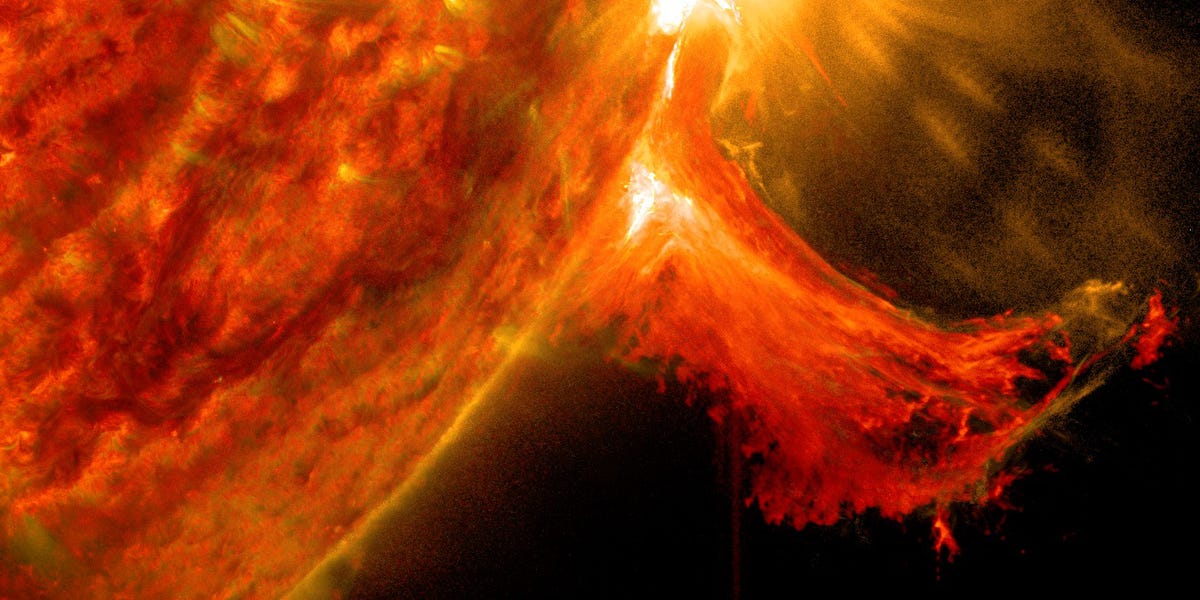
A solar storm is not a thunderstorm with better branding. It is a burst of energy or charged particles from the Sun that can affect Earth’s space environment. The Sun constantly releases solar wind, a stream of charged particles flowing outward through the solar system. Most of the time, Earth’s magnetic field handles this stream like a cosmic umbrella. But when the Sun releases stronger eruptions, the effects can become serious.
Solar Flares
Solar flares are intense bursts of electromagnetic radiation from the Sun. They can disturb the upper atmosphere and interfere with high-frequency radio signals, especially on the sunlit side of Earth. In severe cases, radio blackouts can affect aviation, maritime communication, and emergency services.
Coronal Mass Ejections
Coronal mass ejections, or CMEs, are huge clouds of plasma and magnetic field launched from the Sun. If a CME is directed toward Earth, it may take from less than a day to several days to arrive. When it reaches Earth and interacts strongly with the magnetosphere, it can trigger a geomagnetic storm.
Geomagnetic Storms
Geomagnetic storms occur when solar material transfers energy into Earth’s magnetic environment. These storms can produce beautiful auroras, but they can also create geomagnetically induced currents in power lines, cause satellite charging problems, increase atmospheric drag on low-Earth-orbit spacecraft, disturb GPS accuracy, and interfere with radio communication.
Why a 30-Minute Solar Storm Warning Matters
Thirty minutes may not sound dramatic. Hollywood prefers countdowns with red lights, loud sirens, and someone yelling, “We’ve lost main power!” But in real operations, a half-hour warning can be extremely valuable.
Power grid operators may use advance warning to adjust system loads, monitor transformers, delay maintenance work, or prepare for voltage-control issues. Satellite operators may pause sensitive maneuvers, switch instruments into safe modes, delay uplinks, or prepare for increased drag and orientation problems. Airlines on polar routes may review communication and radiation conditions. Emergency managers may coordinate with infrastructure partners before the storm peaks.
Space weather is not science fiction. In 1989, a geomagnetic storm contributed to a major blackout in Quebec. In 2003, the Halloween storms disrupted satellites, communications, and aviation systems. In May 2024, Earth experienced the strongest geomagnetic storm in more than two decades, producing auroras across unusually low latitudes and reminding everyone that the Sun has excellent aim when it feels like making a point.
Meet DAGGER: NASA’s AI Solar Storm Warning Model
DAGGER stands for Deep Learning Geomagnetic Perturbation. It combines artificial intelligence with NASA-linked heliophysics data to predict where geomagnetic disturbances may strike across the globe. Instead of giving only a broad warning that “space weather is coming,” the model is designed to estimate how the storm may affect different locations on Earth.
The model uses solar wind measurements from spacecraft and connects them with geomagnetic disturbance data observed by ground stations. In simple terms, DAGGER studies what the solar wind is doing before it hits Earth and learns how similar patterns have affected Earth’s magnetic field in the past.
That is where deep learning earns its paycheck. Deep learning models are good at finding complex patterns in large datasets. Space weather is full of patterns, but those patterns can be messy, fast-moving, and inconveniently invisible to anyone who forgot to bring a magnetometer to lunch. DAGGER helps translate those data streams into practical forecasts.
How NASA’s AI Model Works
DAGGER uses measurements of the solar wind from spacecraft positioned to observe conditions before they fully affect Earth. The model analyzes recent solar wind behavior and forecasts geomagnetic perturbations about 30 minutes ahead. According to NASA’s explanation of the system, the model can generate predictions very quickly and update them frequently, which is crucial because space weather does not politely wait for office hours.
Step 1: Collect Solar Wind Data
Spacecraft observe solar wind speed, density, and magnetic field conditions. These measurements help scientists understand whether incoming solar material has the right characteristics to trigger a geomagnetic storm. A southward magnetic field orientation, for example, can connect more effectively with Earth’s magnetic field and transfer energy into the magnetosphere.
Step 2: Compare With Historical Storms
The model is trained on previous examples of solar wind conditions and their effects on Earth. It learns from relationships between upstream measurements in space and geomagnetic changes recorded by ground-based observatories.
Step 3: Forecast Global Magnetic Disturbances
Instead of producing only one general storm score, DAGGER aims to forecast geomagnetic disturbances worldwide. That matters because a storm does not affect every region equally. Local geology, latitude, grid design, ground conductivity, and storm dynamics can all influence risk.
Step 4: Update Rapidly
Space-weather conditions can change quickly. A forecast that updates often is more useful than one that arrives late wearing a “sorry, traffic was bad” badge. DAGGER is designed for rapid prediction, which could make it valuable for operational warning systems in the future.
What Makes DAGGER Different From Older Forecasting Tools?
Traditional space-weather forecasting relies on physics-based models, solar observations, spacecraft measurements, and human expert interpretation. These methods remain essential. DAGGER does not replace expert forecasters; it gives them another tool. Think of it as a very fast assistant that never asks for coffee and is unusually interested in magnetic perturbations.
Earlier models often focused on either local predictions or broader global patterns with slower update times. NASA has highlighted DAGGER because it combines rapid artificial intelligence analysis with measurements from space and ground-based data to produce global, frequently updated forecasts.
This combination is important. A local forecast may help one region, but infrastructure is connected. Satellites orbit globally. Power grids interconnect across long distances. Aviation routes cross polar regions. GPS-dependent systems support farming, shipping, finance, logistics, and emergency response. A global view helps decision-makers understand the bigger picture.
Solar Maximum: Why Timing Matters
The Sun follows an approximately 11-year activity cycle. During solar maximum, sunspots, solar flares, and coronal mass ejections become more frequent. NASA and NOAA announced that the Sun had reached the solar maximum phase of Solar Cycle 25 in 2024, meaning space-weather activity was elevated and likely to remain important for planning.
Solar maximum does not mean the Sun flips a switch and immediately produces disaster. It means the chances of active regions, strong flares, and Earth-directed CMEs increase. In other words, solar maximum is the season when the Sun is more likely to send “urgent notifications” to Earth’s magnetosphere.
That makes AI-based warning systems especially useful. When solar activity rises, forecasters must process more data, more alerts, and more uncertainty. Artificial intelligence can help scan patterns quickly and support faster decision-making.
Real-World Systems That Could Benefit
Power Grids
Geomagnetic storms can induce quasi-direct currents in long transmission lines. These geomagnetically induced currents may cause transformer heating, voltage instability, false trips, and other grid problems. A 30-minute warning could help operators prepare equipment, improve situational awareness, and reduce the chance of cascading failures.
Satellites
Satellites face several risks during solar storms. Charged particles can interfere with electronics, affect sensors, and cause surface charging. Geomagnetic storms can also heat and expand the upper atmosphere, increasing drag on low-Earth-orbit satellites. More drag means orbital predictions become harder, and spacecraft may need corrections.
GPS and Navigation
Solar storms can disturb the ionosphere, the atmospheric layer that radio signals pass through. GPS signals may become less accurate or temporarily unreliable. This matters for aviation, shipping, agriculture, construction, emergency services, and any driver who already suspects their navigation app has a personal grudge.
Radio Communication
High-frequency radio communication can degrade during solar events, especially near polar regions. Aviation and maritime operations still rely on radio systems in places where satellite communication may be limited or expensive.
Astronaut Safety
Radiation storms can pose risks to astronauts, especially outside Earth’s protective atmosphere. Better forecasting helps mission teams plan activities, shelter procedures, and spacecraft operations.
Is 30 Minutes Enough?
The honest answer is: it depends. For rebuilding a transformer, no. For alerting operators, changing satellite modes, delaying sensitive operations, adjusting grid procedures, or preparing communication teams, yes, it can help.
Space-weather preparedness works best in layers. Long-range solar monitoring identifies active regions on the Sun. CME models estimate arrival times. NOAA alerts and watches communicate expected storm levels. Ground and space sensors track real-time conditions. AI models like DAGGER can add fast, location-aware forecasts close to impact time.
No single system is a magic shield. But combined systems can reduce risk. A 30-minute warning is not the whole emergency plan; it is the alarm bell that tells trained people to start the plan faster.
Common Myths About Solar Storms
Myth 1: Solar Storms Will Destroy Earth
No. Solar storms are not planet-destroying fireballs. Earth’s atmosphere and magnetic field protect life on the ground. The main concern is technology, especially systems connected to electricity, radio signals, satellites, and navigation.
Myth 2: Solar Flares and CMEs Are the Same Thing
They are related but different. A solar flare is a burst of radiation. A coronal mass ejection is a massive cloud of charged particles and magnetic field. A flare can cause radio issues quickly, while a CME may trigger a geomagnetic storm after traveling through space.
Myth 3: AI Can Predict Everything Perfectly
Not even close. AI is powerful, but space weather is complicated. Forecasting depends on data quality, model design, storm complexity, and how well past examples represent future events. DAGGER is promising because it improves speed and global coverage, not because it turns the Sun into a scheduled bus route.
What This Means for the Future of Space Weather Forecasting
NASA’s AI solar storm warning model points toward a future where space-weather forecasting becomes more automated, localized, and operationally useful. The long-term goal is not just to know that a storm is coming, but to know where it may hit hardest, when impacts may peak, and which systems should act first.
In the future, power companies could receive region-specific alerts. Satellite operators could integrate forecasts directly into mission control dashboards. Aviation planners could combine radiation and communication forecasts with route decisions. Emergency managers could treat severe space weather more like terrestrial weather: not panic, not guesswork, but preparation.
The best version of this future would feel almost boring. A solar storm warning arrives. Systems respond. Satellites protect themselves. Grid operators monitor vulnerable equipment. GPS users experience minor errors instead of major disruption. The aurora puts on a show. Everyone goes home impressed, not terrified. That is the dream: make extreme space weather less dramatic by preparing for it intelligently.
Practical Experiences and Lessons From Solar Storm Preparedness
When people hear about NASA’s AI model giving a 30-minute warning before solar storms, the first reaction is often a mix of amazement and mild disappointment. Amazement because predicting invisible magnetic disturbances from space sounds like something from a very expensive superhero movie. Disappointment because 30 minutes feels short. But in operational environments, short warnings can be surprisingly useful when teams already know what to do.
Imagine a satellite control center during a strong geomagnetic storm watch. The team is already monitoring solar wind conditions, NOAA alerts, spacecraft health, and orbital data. A 30-minute location-aware warning from a model like DAGGER would not arrive in isolation. It would act as a final nudge: pause a nonessential command, postpone a maneuver, increase monitoring, or prepare for drag changes. The warning is valuable because the playbook already exists.
The same lesson applies to power grids. A warning model is not a magic button that says “save grid.” It is more like a smoke alarm for magnetic weather. The smoke alarm does not put out the fire, but it gives people time to act before the situation gets worse. Grid operators can review voltage conditions, prepare response teams, monitor transformer behavior, and coordinate with reliability organizations. The better the preparation, the more useful the warning becomes.
For everyday people, the experience is different. Most of us will not receive a DAGGER alert and sprint heroically toward a transformer station. We may notice aurora forecasts, GPS quirks, radio disruptions, or news about solar activity. The practical takeaway is not to fear the Sun. It is to understand that modern life depends on invisible systems: satellites, timing signals, communication networks, and electrical infrastructure. Space weather reminds us that “the cloud” still lives under a real sky.
One useful habit is to treat major solar storm news the way you treat severe weather news: calmly, with curiosity, and without turning every headline into a disaster movie. Check reliable sources. Understand the difference between a watch and an actual impact. Remember that agencies and operators prepare for these events. A strong aurora alert may be a great reason to go outside with a camera, not a reason to wrap your router in aluminum foil like a baked potato.
The most important experience-related lesson is that warning time becomes powerful only when paired with planning. A 30-minute alert can help if satellite operators have safe-mode procedures, if grid teams have geomagnetic disturbance plans, if airlines understand polar communication risks, and if emergency managers know which partners to contact. AI improves the speed of awareness, but humans still decide how to respond.
That is why NASA’s DAGGER model matters. It represents a shift from simply observing space weather to making it actionable. The Sun will continue to flare, erupt, and behave like a giant nuclear furnace with no public relations department. But with better data, smarter models, and practical response plans, Earth can become less vulnerable to those outbursts. A 30-minute warning may sound small, but in the right hands, it can be the difference between being surprised and being ready.
Conclusion
NASA’s AI model for solar storm warnings is an important step toward faster, smarter space-weather forecasting. DAGGER uses deep learning, solar wind measurements, and geomagnetic data to forecast disturbances around the world about 30 minutes before they occur. That half-hour may not stop the Sun from erupting, but it can help people protect satellites, power grids, communication systems, GPS-dependent services, and other critical infrastructure.
The real story is not that artificial intelligence has “solved” solar storms. It has not. The real story is that AI can help experts act faster in a world where space weather increasingly affects daily life. As the Sun moves through active phases of its cycle, tools like DAGGER may become part of a larger warning network that keeps technology safer and gives humanity a better chance to dodge the worst effects of solar storms.