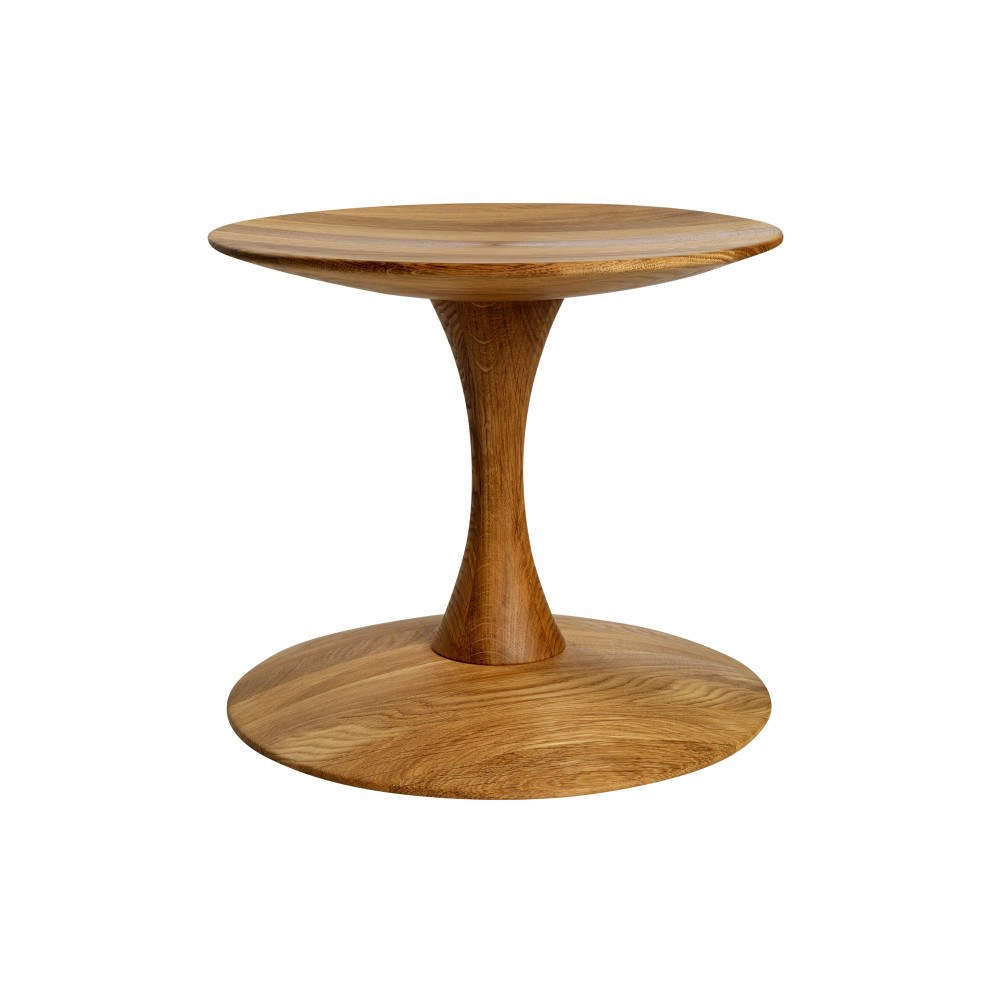
The Nanna Ditzel Toadstool is the rare piece of furniture that can behave like a stool, side table, toy, sculpture, and highly civilized wooden wheelall without looking as though it is trying too hard. Designed in the early 1960s, this cheerful Danish object captures Ditzel’s talent for turning serious design questions into forms that feel natural, playful, and slightly mischievous.
Also known as the Trisse or Toad Stool, the design was created after Ditzel observed how children actually used furniture. They climbed over chairs, pushed tables, tipped things sideways, and generally ignored the polite instructions adults had assigned to each object. Instead of fighting that behavior, she designed for it. The result could be turned, rolled, stacked, sat upon, or used as a small table. In other words, it was adaptable furniture decades before “multifunctional living” became a phrase used to sell extremely expensive studio apartments.
What Is the Nanna Ditzel Toadstool?
The Nanna Ditzel Toadstool is a compact wooden furniture design with a rounded, spool-like profile. Its circular top and base are connected by an open central structure, giving it a recognizable silhouette that is geometric without feeling rigid. Upright, it works as a low seat or occasional table. On its side, it can be rolled. Multiple pieces can also be grouped or stacked to create changing arrangements.
Ditzel’s official design archive dates the Toadstool to 1962 and identifies Kold’s Savværk in Kerteminde, Denmark, as the original producer. Some auction records date particular Toadstool table-and-stool sets to 1961, so collectors may encounter both years in listings and catalogs. The safest interpretation is that the concept emerged around 1961–1962, with 1962 serving as the commonly recognized official design date.
Why Is It Called Trisse?
The design is sometimes called Trisse or Trissen, a Danish name associated with a spool or reel. That description makes immediate visual sense: the round upper and lower sections create a compact form that looks ready to roll across the room. “Toadstool,” meanwhile, emphasizes its mushroom-like personality. One name sounds mechanical; the other sounds as though a woodland creature might use it for afternoon tea. Both are strangely accurate.
Nanna Ditzel’s Playful Approach to Danish Design
Nanna Ditzel was born in Copenhagen in 1923 and trained as a cabinetmaker before studying furniture design. She worked across furniture, textiles, jewelry, tableware, and interiors, first collaborating with her husband, Jørgen Ditzel, and later building a major independent career. Her background in cabinetmaking gave her a practical understanding of wood and construction, but her work rarely remained trapped inside conventional furniture categories.
That combination of craftsmanship and experimentation is essential to understanding the Toadstool. Midcentury Danish furniture is often associated with disciplined joinery, restrained materials, and beautifully resolved chairs that appear ready for a very tasteful dinner party. Ditzel respected craftsmanship but was less interested in furniture that behaved like a museum guard. She wanted the body to move, recline, turn, play, and discover new positions.
Her broader career included the Hanging Egg Chair, the Trinidad Chair, the Bench for Two, jewelry for Georg Jensen, and the Hallingdal textile introduced in the 1960s. American design institutions recognized her work early: Nanna and Jørgen Ditzel appeared in the Museum of Modern Art’s 1953 Good Design program, while her work was later included in MoMA’s 2012 exhibition Century of the Child: Growing by Design, 1900–2000.
The Child-Centered Idea Behind the Toadstool
The most charming part of the Toadstool’s history is that it began with observation rather than decoration. Ditzel noticed that children climbed over tables and chairs and often knocked them down. Traditional furniture treated that behavior as misuse. Her response was essentially: perhaps the furniture should loosen up.
She created a piece that invited physical interaction. It could change position without losing its identity. It did not demand that a child sit straight, keep still, and admire the joinery from a respectful distance. It acknowledged that children explore objects through motion, touch, repetition, and imaginative play.
Furniture That Does Not Dictate a Single Activity
A conventional chair announces its job immediately. The Toadstool is more ambiguous. Is it a seat? A table? A building block? A rolling object? A pedestal for a favorite toy? The user decides, and that openness is one reason the design has remained relevant.
The Danish Architecture Center has described Ditzel’s work in terms of movement and furniture that could help liberate the body. The Toadstool fits that philosophy neatly: instead of forcing one approved posture or function, it supports a range of everyday actions.
Why the Nanna Ditzel Toadstool Still Looks Modern
Simple Geometry
The design relies on circles, curves, open space, and balanced proportions. There is very little visual clutter, which helps the piece mix with different interiors. It can sit beside a midcentury sofa, a contemporary modular sectional, a child’s bed, or a minimalist reading chair without causing a stylistic argument.
Visible Craft Without Visual Fuss
The Toadstool feels crafted, but it does not overwhelm the room with decorative detail. Early examples were commonly made in beech, while other vintage pieces appear in oak, pine, or related wood finishes. Current versions reintroduced by Fredericia are made in solid oak at the company’s Danish joinery, using a turned base and top with carefully resolved construction.
A Shape That Suggests Movement
Even when standing still, the Nanna Ditzel Toadstool looks mobile. The rounded profile suggests that it can be tipped, moved, or rearranged. That visual energy prevents it from becoming another solemn block of wood parked beside the sofa.
Useful at More Than One Age
Although originally conceived as children’s furniture, the Toadstool and its accompanying table proved useful for adults as well. A low version can serve as a footrest, plant stand, bedside surface, or occasional seat. Taller interpretations work as side tables or compact pedestals. The design does not become obsolete when the children grow up; it simply gets promoted to another department.
Materials, Dimensions, and Different Editions
Vintage Nanna Ditzel Toadstools vary in size, wood species, finish, and production period. One documented early pair manufactured by Kolds Savværk measured approximately 11 inches high and 12.6 inches in diameter. Another vintage example listed as a stool or small table measured about 15.75 inches high with a base diameter of roughly 16.5 inches. These differences underline an important point: “Toadstool” can describe related pieces in a broader furniture family rather than one universally sized object.
A documented table-and-four-stool set attributed to Poul Kold Møbler included a table approximately 25.5 inches in diameter and 18.25 inches high. The accompanying stools measured about 12.25 inches in diameter and 10.5 inches high. Those proportions created a compact children’s setting while retaining enough sculptural presence to appeal to adult collectors.
In 2026, Fredericia reintroduced Trisse as a broader family of flexible solid-oak objects, including stools and several table formats. The relaunch reinforces the idea that Ditzel’s original concept was not merely one cute children’s stool but a system of forms that could organize a room at different heights and scales.
How to Style a Nanna Ditzel Toadstool
Use It as a Sculptural Side Table
Place a medium-height Toadstool beside a lounge chair and let its curved profile contrast with the chair’s upholstery. It works especially well near furniture with clean lines because the rounded shape softens an otherwise boxy arrangement.
Create a Flexible Living-Room Cluster
Two or three Toadstools can replace a single large coffee table. Separate them when guests need individual surfaces, then gather them when the room should feel more structured. This arrangement also makes circulation easier in smaller spaces.
Add Warmth to a Minimal Interior
Natural oak or beech introduces texture without adding excessive ornament. In a white, gray, or neutral room, the grain provides enough warmth to keep the space from resembling a highly organized refrigerator.
Give Children Furniture That Adults Do Not Hate
Many children’s furnishings appear to have been designed during a disagreement between three primary colors. The Toadstool offers another route: it feels playful to children but visually sophisticated enough for a shared living area.
Use a Vintage Example as a Focal Point
An aged finish, gentle wear, or visible patina can emphasize the object’s history. Let a vintage Toadstool stand alone rather than surrounding it with too many collectible pieces. Good design appreciates company, but it also enjoys a little elbow room.
Collecting an Original Nanna Ditzel Toadstool
Collectors should distinguish between early Kolds Savværk or Poul Kold Møbler production, later licensed editions, and current reissues. Listings may use variations of the names Toadstool, Toad Stool, Trisse, Trissen, or Trisserne. They may also describe the same basic form as a children’s stool, side table, occasional table, or stacking object.
Useful evidence can include manufacturer labels, branded marks, documented provenance, construction details, wood species, dimensions, and comparison with verified examples. A missing signature does not automatically indicate a reproduction; a Wright and Artsy auction record for a 1961 table-and-stool set described the work as unsigned while identifying Poul Kold Møbler as the manufacturer.
Auction results demonstrate collector interest but should not be treated as fixed retail values. In May 2019, Wright offered a Toadstool table with four stools at an estimate of $2,000 to $3,000, and the set reportedly sold for $4,063. Condition, completeness, edition, wood, provenance, location, and buyer competition can all change the price significantly.
Questions to Ask Before Buying
- Who manufactured the piece, and during which production period?
- Are the dimensions consistent with documented examples from that edition?
- Has the wood been refinished, repaired, painted, or structurally altered?
- Does the seller provide photographs of the underside, joints, labels, and wear?
- Is the piece being sold as an authenticated original, a licensed reissue, or merely “in the style of” Nanna Ditzel?
Everyday Experience: What Living With a Toadstool Is Really Like
The ownership experience begins with scale. Photographs can make the Nanna Ditzel Toadstool look larger and heavier than it is, especially when it is isolated against a gallery wall. In a real room, the smaller versions feel compact, low, and easy to reposition. That is excellent for flexible living, though anyone expecting a full-size adult dining stool may be surprised. Checking the exact measurements before purchasing is not boring paperwork; it is how you avoid receiving a beautiful object that reaches only halfway up your shin.
As a side table, the round top is practical for a drink, book, phone, or small lamp. It is less suitable for a sprawling arrangement of laptops, chargers, dinner plates, and the mysterious collection of receipts that develops beside many sofas. Its strength is supporting a few intentional objects rather than becoming a substitute storage unit.
The curved surfaces make it pleasant to move and touch. Solid wood gives the piece physical presence, while the open structure prevents it from feeling bulky. When placed beside upholstered furniture, the hard, smooth material creates an appealing contrast with fabric, leather, or wool. The object feels decorative even when empty, which is useful because there will inevitably be moments when someone carries away the coffee cup and leaves the table with nothing to do.
In a family room, the Toadstool’s ambiguity becomes its biggest advantage. A child may use it as a seat in the morning, roll it during playtime, and turn it into a stage for toys in the afternoon. Later, an adult can place it beside a chair with a mug and a magazine. Few pieces shift between generations so comfortably. Still, movable furniture should be used with sensible supervision around very young children, particularly on stairs, uneven flooring, or hard surfaces where enthusiastic rolling could become an unscheduled physics demonstration.
Several Toadstools create a more dynamic experience than one. A pair can flank a sofa, form separate drink tables, or gather near the center of a room. Different heights make the composition feel like a small landscape rather than a matching furniture set. This was central to Ditzel’s broader interest in environments that encouraged movement rather than prescribing a single fixed arrangement.
Maintenance depends on the edition and finish. A modern oiled-oak version generally benefits from gentle dusting, quick attention to spills, and care appropriate to the manufacturer’s specified finish. Vintage beech or painted examples may require a more conservative approach. Aggressive sanding can erase patina, labels, and evidence valued by collectors. When restoration is necessary, preserving original material is usually preferable to making a 60-year-old stool look as though it arrived yesterday wearing a fake mustache.
The Toadstool is not ideal for every purpose. Its round top offers limited surface area, low versions may be uncomfortable for prolonged adult seating, and collectible examples can be too valuable for carefree play. Yet those limitations are part of its identity. This is not a conventional chair attempting to win an endurance contest. It is an adaptable object designed to move through different roles quickly.
The most satisfying experience comes from resisting the urge to assign it one permanent job. Use it beside a bed for a month, move it near the sofa, let it hold a plant, or bring it out when guests arrive. The more often it changes roles, the more clearly Ditzel’s original idea comes into focus: furniture can be functional without being bossy.
Why the Nanna Ditzel Toadstool Matters
The Toadstool matters because its playfulness is not superficial. Its unusual form grew from careful observation of human behavior, especially the active way children encounter physical space. Ditzel transformed that observation into an object that remains visually memorable, useful across age groups, and adaptable to changing interiors.
It also complicates the familiar image of Danish modern furniture as quiet, restrained, and exclusively adult. The Nanna Ditzel Toadstool is beautifully made, but it also rolls. It respects woodcraft, but it refuses to remain politely in one place. It can appear in a design collection and still look ready to join a game.
That mixture of discipline and freedom explains why the design continues to attract museums, manufacturers, collectors, parents, and interior designers. More than six decades after its creation, the Toadstool still feels like an invitation: sit here, place something here, turn me over, move me around, and please stop assuming furniture can have only one job.