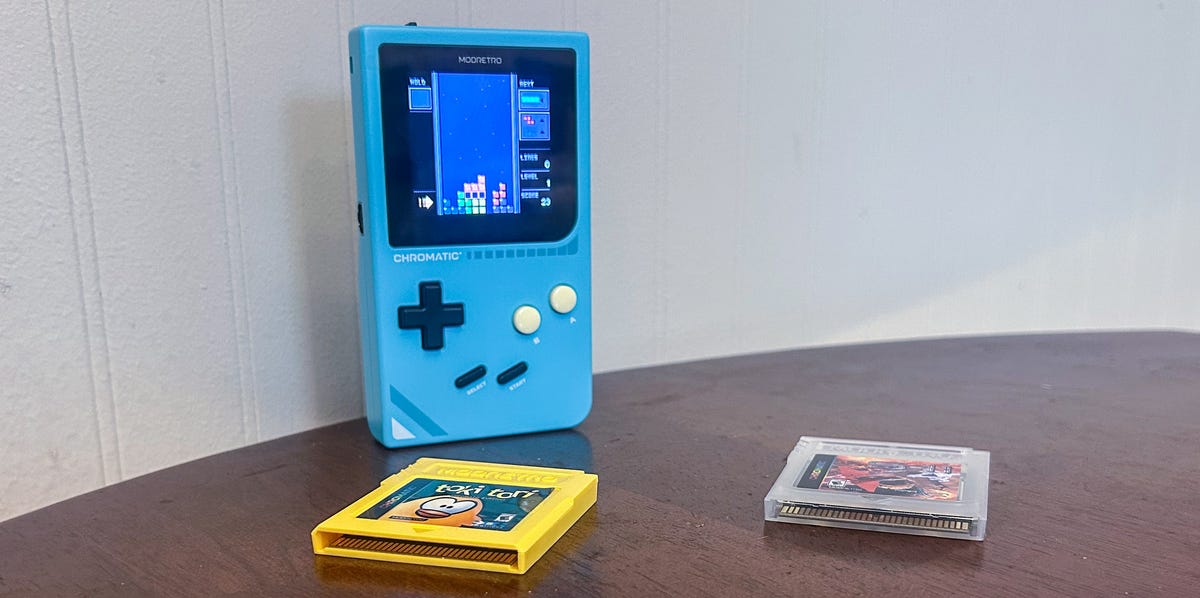
If 2025 proved anything, it is that handheld gaming no longer lives in one neat little box. Some players want a portable PC that can brute-force modern blockbusters. Some want a sleek hybrid for Nintendo exclusives. And some of us, perhaps after staring at too many 100GB installs and one too many launcher updates, just want to hear a cartridge click into place and get on with our lives. That is exactly where the ModRetro Chromatic enters the chat, looking like a Game Boy that got a luxury gym membership and excellent dental coverage.
The ModRetro Chromatic is not trying to be everything. It is not trying to emulate half of gaming history, replace your Steam Deck, or convince you that fiddling with ten settings menus is part of the fun. Instead, it does something much harder: it commits. This handheld is laser-focused on delivering a premium, authentic Game Boy and Game Boy Color experience with modern materials, a pixel-accurate display, and enough thoughtful upgrades to make old-school gaming feel less dusty and more timeless.
That focus is what makes the Chromatic one of the most interesting handheld game consoles of 2025. It may not be the most powerful portable on the market, but power is not the point. The point is feel. The point is authenticity. The point is picking up a machine, sliding in Tetris or Pokémon, and immediately understanding why people still care about this format decades later.
What Is the ModRetro Chromatic?
The Chromatic is a cartridge-based handheld built for Game Boy and Game Boy Color games, along with ModRetro’s own cartridges. It uses FPGA-based architecture instead of the kind of software emulation that often introduces little quirks, timing oddities, or compatibility headaches. In plain English, that means it is designed to behave much more like real hardware than a generic “retro console” loaded with a thousand mystery ROMs and a prayer.
That single-minded approach shapes the whole device. The screen sticks to the classic 160 x 144 resolution that original developers built for. The form factor stays close to the Game Boy Color. The power options include old-school AA batteries, because ModRetro clearly understood that nostalgia without at least one mildly inconvenient design choice would feel suspiciously efficient. There is also a rechargeable battery option for people who enjoy the future and electricity through USB-C.
What you do not get is just as important. There is no SD card slot for loading random ROMs. No broad all-in-one compatibility with a pile of other cartridge systems. No save-state-heavy “I am technically preserving history while absolutely cheesing this boss fight” energy. The Chromatic is disciplined, and that discipline is a big reason so many reviewers found it compelling.
Design and Build Quality: A Game Boy Wearing a Tailored Suit
The first thing most people notice about the Chromatic is that it feels expensive in the hand. That is not marketing fluff. This handheld uses a magnesium alloy shell, PBT buttons, and either Gorilla Glass or sapphire display protection depending on the model. Those are not the sort of materials you expect from a device designed to play games made when dial-up internet still sounded like a robot losing an argument.
And yet the premium build makes perfect sense here. The Chromatic is built for players who love the Game Boy enough to want the grown-up version of it. It does not feel like a toy, and it definitely does not feel flimsy. The shell has a cool-touch sturdiness that makes many plastic retro handhelds seem a little bargain-bin by comparison. Reviewers consistently praised the durability, heft, and craftsmanship, and that praise is easy to understand. This thing looks and feels like it was made by people who obsess over the details.
Better still, the details are not just cosmetic. The button feel matters on a retro handheld more than almost anything else. Platformers, puzzle games, shooters, and RPG menus all live or die by the D-pad and face buttons. The Chromatic gets this right. It feels tactile, crisp, and deliberate. It is not trying to reinterpret the Game Boy. It is trying to preserve its soul while fixing its bad habits.
The handheld is also repair-friendly in a way that feels increasingly rare. That matters more than it might seem. A retro-inspired device built like a tank is great, but a retro-inspired device you can actually maintain over time is even better. In a market full of sealed-up gadgets that behave like they are allergic to screwdrivers, the Chromatic earns points for respecting ownership.
The Screen: Where the Chromatic Really Wins
Let’s be honest: old handheld screens were part miracle, part nonsense. We loved them, but we also spent half our childhood angling them toward a lamp like we were trying to decode a secret message from the sun. The Chromatic fixes that without ruining the original look.
Its 2.56-inch IPS backlit LCD keeps the original 160 x 144 resolution and pixel structure instead of scaling everything up into a cleaner-but-less-authentic modern presentation. That is the magic trick. Games look sharp, readable, and vivid, but still feel like Game Boy games. The display is also bright enough for outdoor play, which sounds like a small perk until you realize how many retro handhelds look wonderful indoors and then give up the second daylight enters the room.
This is why the Chromatic keeps earning descriptions like “pixel-perfect,” “authentic,” and “the best way to play Game Boy games.” On a technical level, the display is impressive. On an emotional level, it feels right. Sprites have punch. Colors look rich without feeling overcooked. Motion is clean. Menus remain readable. The whole presentation preserves the charm of the original without dragging along its famous visibility issues like unwanted emotional baggage.
Performance and Everyday Use
Because the Chromatic is not trying to run modern PC games or emulate everything from Atari to Dreamcast before lunch, performance is refreshingly simple: it boots fast, plays cartridges well, and stays out of your way. That sounds obvious, but it is not. One of the most attractive things about dedicated retro hardware is how immediate it feels. Switch on. Game starts. Brain happy.
The speaker is strong, the physical controls are excellent, and the handheld includes a classic 3.5mm headphone jack for anyone who prefers their chiptunes a little more private. There is also a backward-compatible link cable port and IR support, which helps the Chromatic feel less like a tribute object and more like a real continuation of the Game Boy era.
Then there is the quietly sneaky modern feature set. The Chromatic supports USB-C and even offers lagless video out to PC, Mac, or Oculus Quest. That means it can bridge retro play and modern content creation better than you might expect from a machine so deeply committed to old-school purity. It is a funny contradiction, but a useful one: the Chromatic wants you to play like it is 1999 while still acknowledging that 2025 gamers sometimes stream their Tetris runs to friends at midnight.
Battery Life: Old School, New School, and Practical School
Battery life on the Chromatic is part nostalgia trip, part common sense. The standard setup includes three AA batteries, and that choice is more than a gimmick. Replaceable batteries are convenient, travel-friendly, and weirdly reassuring. If you are deep into a weekend trip or a power outage, AAs still feel like the prepper snack of handheld gaming.
At the same time, ModRetro offers a rechargeable Power Core that charges via USB-C and promises up to 16 hours of playtime. That gives buyers a choice instead of forcing one ideology. Want to go full vintage? Use AAs. Want modern convenience? Snap in the rechargeable pack. Want both? Congratulations, you are now the sort of person who probably alphabetizes game cartridges for fun.
This flexibility matters because handhelds live and die by convenience. A console can be beautiful, accurate, and beautifully accurate, but if it is annoying to keep powered, it turns into shelf décor. The Chromatic avoids that trap.
Where the Chromatic Fits Among the Best Handheld Game Consoles of 2025
Now for the important question: is the ModRetro Chromatic actually one of the best handheld game consoles of 2025? Yes, but with an asterisk the size of a Game Boy cartridge.
If you want a handheld for modern AAA games, a SteamOS machine or a Windows handheld makes more sense. The Steam Deck OLED remains a dominant all-rounder for portable PC play, while higher-powered options such as the Asus ROG Ally X and other performance-focused rivals appeal to players who want more horsepower. Nintendo’s newer portable lineup continues to own the exclusive-console side of handheld gaming. In other words, if your dream vacation is taking Elden Ring, Mario Kart, and a cloud library onto a plane, the Chromatic is not trying to steal that boarding pass.
Where it absolutely shines is retro specialization. Against multi-purpose handhelds, the Chromatic wins on authenticity. Against many cheaper retro emulation devices, it wins on build quality, accuracy, and sheer tactile satisfaction. Against the Analogue Pocket, it becomes more of a philosophy fight. The Pocket is broader, more flexible, and more feature-rich. The Chromatic is narrower, more deliberate, and more emotionally faithful to the original Game Boy experience.
That is why calling it “one of the best” is accurate, while calling it “the best for everyone” would be nonsense. It is one of the best because it understands its niche so completely that it turns the niche into a virtue.
What the Chromatic Gets Right
1. It respects the original games
By keeping the native resolution and original cartridge focus, the Chromatic makes classic games feel like themselves instead of museum pieces being filtered through too much modern cleverness.
2. It feels premium without feeling gimmicky
The magnesium shell, sturdy screen protection, and excellent controls are real upgrades you notice every time you pick it up.
3. It balances nostalgia with practicality
AA power, USB-C options, video output, and repairability make this more than a sentimental toy.
4. It creates a lower-friction gaming experience
No launcher clutter. No endless updates. No accidental hour-long detour into settings menus. Just cartridge in, power on, play.
What Might Hold It Back
The Chromatic is not built for everyone, and that is okay. Some buyers will see the lack of save states, ROM loading, and wider cartridge support as a feature. Others will see it as a dealbreaker wrapped in very nice magnesium. If you want one device that can do everything, the Chromatic is not your soulmate.
There is also the price. Starting around $199.99, it lives firmly in premium-retro territory. That is not outrageous considering the materials and engineering, but it does mean you are paying for craftsmanship and focus, not sheer feature count.
And yes, some shoppers will care about the company baggage and founder controversy around the brand. That factor has come up repeatedly in coverage, and it is part of the buying conversation whether fans like it or not. A fair review should mention it because real-world buying decisions are rarely made in a vacuum.
Who Should Buy the ModRetro Chromatic?
Buy it if you have original Game Boy or Game Boy Color cartridges, care deeply about accurate presentation, and want a handheld that feels like a premium forever device rather than a temporary toy. Buy it if you love the idea of a focused retro handheld more than a Swiss-army-knife emulation machine. Buy it if your idea of a good Friday night is playing Tetris until your brain goes pleasantly smooth.
Skip it if you want a do-it-all retro device, a portable PC, or a broader all-in-one console. Skip it if you mainly want Game Boy Advance support or modern convenience features like save states and ROM loading. Skip it if you are likely to resent paying premium money for a specialized experience, no matter how polished it is.
Extended Experience: Living With the Chromatic for the Long Haul
What really separates the Chromatic from a lot of modern handhelds is how it changes your pace. Most current gaming hardware encourages abundance. Too many games, too many storefronts, too many things installed halfway and forgotten. The Chromatic does the opposite. It narrows your world in a way that feels oddly luxurious. You are not scrolling through a digital backlog the size of a grocery receipt. You are choosing a cartridge, inserting it, and committing to a mood.
That shift becomes more meaningful the longer you use the device. A five-minute test session tells you the hardware is nice. A week with it tells you why people get attached. The startup ritual matters. The tactile click of the cartridge matters. The power switch matters. Even changing batteries, which on paper sounds inconvenient, ends up feeling like part of the machine’s character rather than a flaw. The Chromatic invites you to slow down and actually inhabit the game you are playing instead of bouncing away the second your attention span spots a shinier icon.
It also highlights how smart classic game design could be. On the Chromatic, puzzle games feel sharper, RPGs feel cozier, and arcade-style sessions feel more intentional. You stop expecting every game to deliver a cinematic event and start appreciating systems that were built around clarity and immediacy. A quick round of Tetris becomes a proper palate cleanser. A Pokémon session becomes a charming little appointment with your younger self. Even menu sounds and simple sprite animation hit differently when the hardware presentation feels this considered.
There is also a social side to the experience that newer handhelds sometimes miss. Showing a Steam Deck to someone often starts a conversation about specs. Showing the Chromatic to someone usually starts a conversation about memories. People instantly talk about what they used to play, which color shell they had, which game drained entire summers, or how they once had to sit by a window to see the screen. The Chromatic taps into a kind of cultural memory that goes beyond pure hardware appreciation. It is not just a device; it is a surprisingly effective nostalgia delivery system.
At the same time, it does not feel trapped in the past. The premium materials, bright screen, repair-friendly design, and USB-C conveniences keep it from becoming a museum piece. That balance is the secret sauce. Too much nostalgia and it becomes cosplay hardware. Too much modernization and it loses the soul it is trying to preserve. The Chromatic walks that line better than most retro handhelds.
Maybe the best compliment you can give it is this: it makes old games feel important again. Not in a fake, overdramatic “gaming history matters” speech sort of way, but in a very direct, hands-on, actual-use way. You pick it up expecting a novelty and keep playing because the experience is genuinely good. In a market crowded with handhelds chasing power, versatility, and giant spec sheets, the Chromatic wins by remembering that joy is a feature too.
Final Verdict
The ModRetro Chromatic earns its place among the best handheld game consoles of 2025 not by trying to dominate every category, but by absolutely nailing one. It is a premium retro handheld with a brilliant screen, outstanding build quality, thoughtful hardware choices, and a crystal-clear identity. It knows exactly what it wants to be, which in consumer tech is rarer than it should be.
No, it is not the only handheld worth buying. No, it is not the right fit for every kind of player. But if your favorite phrase in gaming is “I still have my old cartridges somewhere,” the Chromatic may be the most satisfying answer 2025 gave you. It is part tribute, part restoration, part luxury object, and part reminder that simple gaming still has serious power. In a handheld market full of devices trying to do more, the Chromatic stands out by doing less, better.