A bathroom can look peaceful for approximately eleven minutes after it has been cleaned. Then the shampoo bottles form a small skyline, a washcloth appears on the faucet, and someone balances a razor where no razor has any business balancing. The Mercer Bath Storage System was designed for precisely this familiar domestic drama.
Originally offered as part of Pottery Barn’s Mercer Bath Fixture Collection, the system combined traditional bathroom hardware with practical, wall-mounted shower organization. Rather than dangling from a showerhead or relying on suction cups with questionable long-term ambition, it used a fixed horizontal rail, hanging caddies, and hooks to move everyday supplies off tub ledges and countertops.
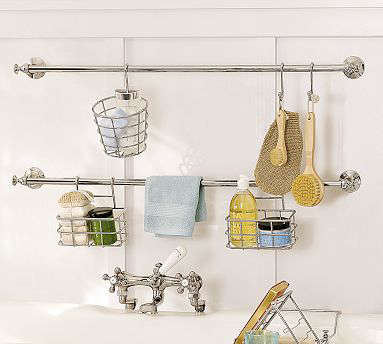
The original configuration documented by Remodelista featured a 36-inch bar, three hooks, and two movable caddiesone round and one rectangular. Its polished nickel finish, ridged circular mounting plates, and lacquered surface gave it the appearance of permanent bath hardware rather than a temporary organizer.
What Is the Mercer Bath Storage System?
The Mercer Bath Storage System is best understood as a modular wall organizer for the tub or shower area. Its long metal rail creates a foundation from which baskets and hooks can hang. Bottles sit inside the caddies, while washcloths, bath brushes, exfoliating gloves, and sponges can be suspended from the hooks.
This arrangement solves several problems at once. It keeps containers within reach, opens space around the edge of the tub, and prevents wet accessories from being piled together in a damp heap. It also replaces the visual clutter of several unrelated organizers with one coordinated system.
Although the original shower-storage configuration is associated with an earlier version of the Mercer collection, Pottery Barn continues to use the Mercer name for coordinated bathroom hardware. Current Mercer pieces have included towel bars, rings, hooks, toilet paper holders, shelves, and train racks. The broader collection has been produced in finishes such as polished nickel, chrome, brass, bronze, satin nickel, and matte black, although individual finish availability changes over time.
Key Design Characteristics
- A wall-mounted horizontal storage rail
- Two differently shaped hanging caddies
- Three hooks for washable bath accessories
- Traditional round mounting plates with ridged detailing
- A polished nickel appearance with a protective lacquer
- A coordinated look compatible with other Mercer bathroom hardware
Why the Mercer System Still Feels Relevant
Bathroom storage has changed, but the basic problem has not. Families may now own more skin-care products, larger pump bottles, electric grooming devices, and enough specialty conditioner to open a modest salon. Floor space, meanwhile, has not magically expanded.
The Mercer design remains appealing because it uses vertical wall space. Home-improvement and interior-design experts routinely recommend wall-mounted shelves, hooks, racks, and cabinets for small bathrooms because they add usable storage without occupying valuable floor area.
It Keeps Daily Products Visible
Open caddies make it easy to see what is available. You can tell when the shampoo is almost empty without discovering the problem halfway through a shower. Frequently used items remain accessible, while backups and rarely used products can stay in a vanity or linen cabinet.
It Creates Flexible Storage Zones
The two basket shapes naturally support different categories. A rectangular caddy can hold tall shampoo, conditioner, and body-wash bottles. A round basket is convenient for soap, smaller jars, razors, or a facial cleanser. Hooks below or between the baskets provide separate drying points for accessories.
It Looks More Permanent Than a Typical Shower Caddy
Many shower organizers are designed to disappear visually. The Mercer system takes the opposite approach. It treats storage as part of the room’s hardware, much like a towel bar or faucet. The polished finish and decorative mounting plates help the organizer feel intentional rather than improvised.
Is It a Good Choice for a Small Bathroom?
A rail-based organizer can be particularly useful in a compact bathroom because it consolidates several functions on one section of wall. Instead of adding a corner shelf, separate hooks, a soap dish, and a hanging basket, one coordinated system handles most of the shower’s everyday storage.
That does not mean every small bathroom should immediately receive a 36-inch metal rail. Measure first. A narrow shower stall may not provide sufficient uninterrupted wall space, and a rail installed too close to the user can turn an innocent bottle basket into an elbow obstacle.
Before installation, confirm that the baskets will not interfere with faucets, shower controls, grab bars, doors, or the path used to enter and exit the tub. In a shared bathroom, place products where both shorter and taller users can reach them safely.
Planning the Installation
The original product instructions emphasized using mounting hardware appropriate for the wall type. That detail is important. A shower wall may be made from ceramic tile, porcelain tile, natural stone, fiberglass, acrylic, drywall, cement board, or a layered combination of materials.
Wall studs provide the strongest attachment point for many wall-mounted shelves and organizers. When studs are not available in the required locations, properly selected anchors may be necessary. Lowe’s installation guidance likewise recommends securing shelves to studs whenever possible and matching anchors to the wall material and expected load.
Preinstallation Checklist
- Measure the available wall width and confirm that the rail will fit.
- Place the largest bottles in a temporary basket to estimate the required height.
- Check the location of plumbing pipes before drilling.
- Identify studs or choose anchors rated for the wall material.
- Verify that the organizer will not block shower controls or doors.
- Use a level so bottles do not slowly migrate toward one end.
- Seal drilled openings appropriately in wet areas.
- Follow the manufacturer’s instructions or hire a qualified installer when uncertain.
Drilling through tile demands patience and the correct tools. The installation should not be treated like hanging a lightweight picture frame. Cracked tile, damaged waterproofing, or a punctured plumbing line can transform a storage upgrade into a very expensive afternoon.
How to Organize the Mercer Bath Storage System
The secret is not filling every available inch. Open storage looks best and works best when it contains a controlled selection of products. If each basket becomes a crowded convention of half-empty bottles, the system will still hold everything, but it will no longer feel particularly organized.
Reserve the Rectangular Caddy for Tall Bottles
Place shampoo, conditioner, body wash, and pump bottles in the larger basket. Keep the tallest items toward the back so shorter containers remain visible. Avoid stacking one bottle on top of another; showers are slippery enough without adding a game of toiletry Jenga.
Use the Round Caddy for Small Essentials
The round basket can hold bar soap, face wash, razors, bath salts, or compact jars. A draining soap dish or small removable tray can help prevent residue from collecting around loose bars.
Give Every Hook a Job
Assign one hook to a washcloth, one to a bath brush, and one to a loofah or exfoliating glove. This prevents accessories from overlapping and allows air to circulate around them. Apartment Therapy similarly recommends hooks and hanging bath accessories as an efficient way to use awkward bathroom wall space.
Store Only Shower-Safe Products
Do not use an in-shower organizer for medications, paper packaging, electrical grooming tools, or products that should remain cool and dry. Keep those items in closed storage outside the direct wet zone.
Style and Finish Considerations
Polished nickel has a warmer tone than highly reflective chrome, making it suitable for traditional, transitional, and hotel-inspired bathrooms. It pairs naturally with white subway tile, marble, soft gray stone, dark blue walls, and warm wood cabinetry.
Matching every metal finish in a bathroom is not mandatory, but repetition creates cohesion. A Mercer-style storage rail will look most intentional when its finish relates to at least two other details, such as the faucet, towel ring, mirror frame, shower trim, or cabinet hardware.
In a contemporary room, keep the surrounding accessories simple. Clear or neutral bottles, white towels, and minimal countertop decoration let the metalwork stand out. In a traditional bath, glass canisters, framed mirrors, ceramic soap dishes, and classic sconces can reinforce the collection’s decorative character.
Advantages of the Mercer Bath Storage System
- Efficient use of wall space: It adds storage without using the floor or tub rim.
- Convenient access: Daily products remain visible and easy to reach.
- Flexible organization: Separate baskets and hooks create distinct product zones.
- Coordinated appearance: The organizer resembles permanent bathroom hardware.
- Improved drying: Hanging washcloths and tools separately helps them dry more evenly.
- Reduced countertop clutter: Shower products stay where they are actually used.
- Durable visual style: Traditional metal hardware ages more gracefully than many plastic organizers.
Potential Drawbacks
The most obvious limitation is installation. Unlike a tension pole or showerhead caddy, a wall-mounted rail usually requires drilling. This may be unsuitable for renters, newly tiled showers, or households that prefer reversible upgrades.
Open baskets also require regular cleaning. Soap residue, mineral deposits, and product drips remain visible on polished metal. The more beautiful the finish, the more enthusiastically it may announce every water spot.
Capacity is another consideration. The original two-caddy layout is appropriate for a curated selection of daily products, not an enormous collection of family-size bottles. A household with four people and four unrelated hair-care philosophies may need supplemental storage.
Cleaning and Maintenance
Current care instructions for Mercer bathroom hardware recommend wiping the finish with a soft, dry cloth and avoiding abrasive cleaners and metal polishes. The hardware is made from plated brass and sealed with a protective lacquer, so harsh products can damage the surface rather than improve it.
For routine shower cleaning, remove bottles and accessories before wiping the rail and baskets. Use a damp microfiber cloth with a small amount of mild soap when necessary, then rinse the cloth and wipe away residue. Dry the metal promptly to reduce water spotting.
Clean the bottoms of bottles before returning them. This tiny habit prevents rings of conditioner, soap, and mysterious blue gel from immediately undoing your work. Once a month, inspect mounting points for movement, damaged sealant, corrosion, or loose hardware.
Alternatives to Consider
A Mercer-style rail is not the only practical solution. The best alternative depends on the bathroom, budget, wall construction, and willingness to drill.
- Recessed shower niches: Excellent for a remodeled shower but more expensive to add afterward.
- Tension-pole organizers: Require no drilling and provide several adjustable shelves.
- Over-the-showerhead caddies: Easy to install, although they may crowd controls or shift during use.
- Adhesive baskets: Suitable for lighter products when approved for the wall surface and wet conditions.
- Corner shelves: Use otherwise wasted space but may require permanent attachment.
- Train racks: Better for folded towels and items stored outside the direct shower spray.
- Wall cabinets: Provide concealed storage for products that should remain dry.
Design sources generally recommend combining open storage for attractive, frequently used essentials with closed storage for backups, cleaning products, and visual clutter. That approach keeps the bathroom functional without placing the complete contents of a drugstore on public display.
Who Will Appreciate This Storage System Most?
The Mercer Bath Storage System is especially well suited to homeowners who value traditional hardware, coordinated finishes, and permanent organization. It works best for households with a modest number of daily shower products and enough wall width for comfortable installation.
It may also appeal to anyone restoring a period-inspired bathroom. The ridged mounting plates and polished metal finish offer more decorative detail than a minimalist wire rack, yet the underlying function remains straightforward.
Renters, frequent remodelers, or people who regularly change their bathroom layout may prefer a removable organizer. The system’s strengthits permanent, built-in appearanceis also what makes it less flexible than a tension-mounted or freestanding alternative.
Real-World Experience With a Mercer-Style Bath Storage System
The first noticeable difference after installing a rail-based bath organizer is not the extra storage. It is the newly empty tub ledge. That narrow strip of porcelain or tile suddenly stops functioning as a crowded parking lot for bottles. Cleaning becomes faster because there is no need to lift eight containers, wipe beneath them, and place them back in exactly the same damp circles.
During daily use, the rectangular basket naturally becomes the workhorse. It comfortably groups the tall products used during nearly every shower. The round basket tends to collect smaller items, which is convenient until it becomes the household’s unofficial lost-and-found department. A simple ruleonly products used at least once a week remain in the showerkeeps the smaller caddy from filling with forgotten sample tubes and razors that should have retired months ago.
The hooks are more useful than they initially appear. A washcloth hung separately dries more effectively than one folded over a bottle or abandoned on the faucet. Bath brushes and loofahs are also easier to identify and reach. In a shared bathroom, assigning a hook to each person creates a surprisingly effective boundary. Apparently, civilization can be maintained with three hooks and a modest amount of diplomacy.
The polished finish contributes strongly to the system’s appeal, but it also encourages better cleaning habits. Water spots show quickly under bright bathroom lighting. A fast wipe with a microfiber cloth once or twice a week is easier than waiting for residue to harden. Removing the baskets for a deeper cleaning, when the design permits, also helps prevent soap buildup around joints and lower wires.
Placement determines whether the system feels elegant or annoying. Mounted too high, it forces shorter users to stretch for heavy bottles. Mounted too low, the caddies can interfere with bathing or receive constant direct spray. The most comfortable position generally keeps bottle labels near chest or shoulder height for the primary users while leaving controls, grab bars, and movement paths unobstructed.
The system is most satisfying when it is treated as daily-use storage rather than maximum-capacity storage. Leaving a little open space makes products easier to remove and return. It also prevents the metal rail from disappearing behind a wall of packaging. Families with many products can store refills in a vanity and replenish the shower baskets as needed.
Over time, the strongest benefit is consistency. Hooks do not slide down the wall, suction cups do not release during the night, and a properly installed rail does not swing when a bottle is removed. The organizer becomes part of the bathroom rather than an accessory temporarily negotiating with gravity.
The main inconvenience is commitment. Once holes have been drilled through tile, moving the system is not a casual weekend experiment. Careful measuring before installation is therefore more important than enthusiastic measuring after the first hole. When properly positioned, however, a Mercer-style organizer offers a pleasing balance of accessibility, durability, and classic design.
Conclusion
The Mercer Bath Storage System turns shower organization into a deliberate part of bathroom design. Its original combination of a 36-inch rail, two hanging caddies, three hooks, polished nickel, and decorative mounting plates offered a more refined alternative to temporary plastic racks and unreliable suction-cup baskets.
Its greatest strengths are vertical efficiency, convenient access, and a coordinated appearance. Its main trade-offs are permanent installation, limited capacity, and the need to clean polished metal regularly. For the right bathroom, those are reasonable compromises. After all, a wall-mounted organizer cannot reduce the number of products a household buys, but it can at least persuade them to stand in an orderly line.
Research was synthesized from archived and current information published by Remodelista, Pottery Barn, Lowe’s, The Home Depot, This Old House, Better Homes & Gardens, Martha Stewart, Architectural Digest, Apartment Therapy, and Real Simple.