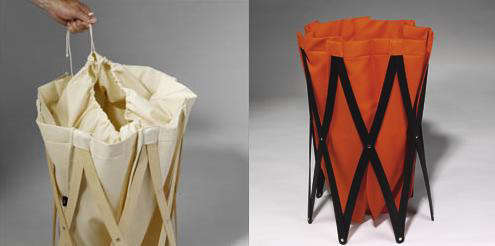
The average laundry hamper has one job: stand in a corner and quietly accumulate socks until someone admits that laundry day has arrived. The Marie Pi Laundry Hamper takes a more ambitious approach. It expands, contracts, changes shape with its contents, and looks more like a small kinetic sculpture than a container for yesterday’s T-shirts.
Designed by Frankfurt-based designer Sabine Wald, Marie Pi combines a circular plywood scissor frame with a removable fabric bag. As clothes are added, the frame widens while maintaining its round footprint. When the hamper is nearly empty, it becomes remarkably slim. When laundry starts multiplyingas laundry tends to doit expands to accommodate the growing load. Product descriptions commonly list a capacity of up to 9 kilograms, a height of approximately 74 centimeters, and an adjustable diameter ranging from roughly 15 to 50 centimeters.
What Is the Marie Pi Laundry Hamper?
The Marie Pi Laundry Hamper is an expanding designer laundry basket originally associated with Klein & More and Swid Design. Its defining feature is a lattice-like wooden frame constructed as a flexible scissor grid. Instead of remaining rigid, the frame responds to the volume of clothing inside the bag.
A Laundry Basket Inspired by Mathematics
The “Pi” in the name is not merely there to make laundry sound more intellectual. The frame retains a broadly circular shape as it changes diameter, referencing the mathematical constant used to describe circles. That connection gives the product a memorable identity while also explaining its engineering in a delightfully nerdy way.
The result is a hamper that visually communicates how full it is. A narrow Marie Pi says, “You have time.” A wide Marie Pi says, “Cancel your plans; the towels have organized a rebellion.”
Materials and Construction
The supporting structure is made from lightweight plywood, offered in finishes that have included natural wood, dark wood or walnut-like tones, and black. The suspended laundry bag has appeared in neutral colors such as beige, anthracite, and black. Detailed retailer specifications commonly describe the bag as washable polyester fabric that can be removed from the frame and cleaned at approximately 40 degrees Celsius, or 104 degrees Fahrenheit.
At around 1.4 kilograms in some listings, the structure is relatively light for a freestanding wooden hamper. Its visual delicacy is part of its appeal: the slim strips of plywood create structure without producing the heavy, blocky appearance of a cabinet-style laundry bin.
Why the Expanding Design Works
It Uses Only the Space It Needs
Traditional hampers occupy their full footprint whether they contain one sock or three weeks of clothing. Marie Pi behaves differently. Its diameter shrinks when the load is small and expands as more laundry is added. An early description in Elle Decor noted that the hamper could collapse to approximately the proportions of a thick umbrella, illustrating how dramatically its footprint can change.
This makes the design particularly attractive for apartments, multipurpose bathrooms, guest rooms, and laundry areas where every square inch must earn its keep. Small-space design guides consistently recommend collapsible, folding, vertical, or otherwise adaptable storage because fixed containers can dominate limited floor space.
The Frame Becomes a Built-In Load Indicator
Because the hamper becomes wider as it fills, owners do not need to lift a lid or dig through the bag to estimate the size of the load. Its silhouette provides an immediate visual clue. That can encourage more regular washing and reduce the familiar surprise of discovering that a seemingly innocent hamper contains two comforters, fourteen towels, and every shirt you have ever owned.
The expanding structure also avoids some of the wasted volume found in oversized rigid bins. It begins compactly and grows only as required, making the object feel responsive rather than passive.
Its Open Structure Encourages Airflow
The frame is not a sealed shell, and the fabric bag remains exposed around much of its surface. That openness can support better air movement than a tightly closed plastic box. Laundry experts routinely recommend ventilation when choosing a hamper because trapped moisture and odors can become more noticeable in containers that remain fully sealed.
Ventilation does not make it safe to bury soaking-wet towels in the bag, however. Damp towels, swimsuits, cleaning cloths, and workout gear should be allowed to dry before they are stored for several days. Moist textiles compressed in a hamper can develop persistent musty odors and create favorable conditions for mildew.
A Designer Hamper That Does Not Need to Be Hidden
Most people purchase a hamper because they want dirty clothes to disappear from view. Marie Pi takes a different position: the storage object itself can become part of the room.
The repeating wooden lattice creates rhythm and texture, while the soft bag gives the design a relaxed appearance. It can sit beside a wardrobe, beneath open shelving, or in the corner of a bedroom without looking like a temporary utility container. Retailer documentation has credited the design with a Red Dot product design award, reflecting the way it combines practical behavior with a distinctive form.
This decorative quality matters in homes without dedicated laundry rooms. Design publications increasingly treat hampers as visible furnishings rather than objects that must automatically be locked behind cabinet doors. Stylish fabric, woven, wood, and metal hampers are often selected to complement bedrooms and bathrooms while still handling everyday clutter.
How Practical Is the Marie Pi Laundry Hamper?
Capacity
A listed maximum of approximately 9 kilograms gives Marie Pi enough room for a substantial household load, although the real volume will depend on what is placed inside. Nine kilograms of jeans occupies space differently from nine kilograms of lightweight shirts, and bedding can make the hamper appear full long before its weight limit is approached.
The expandable design is best suited to clothing, linens, and other flexible textiles. Heavy shoes, bottles, toys, or sharp hardware could place unnecessary stress on the fabric or wooden lattice.
Transporting the Laundry
The bag can be detached from the wooden frame and closed for carrying, allowing the user to leave the structure in place. This is convenient when the washing machine is in another room or on another floor. It also avoids carrying the full frame through narrow hallways.
However, people who regularly walk several blocks to a laundromat may prefer a backpack hamper, rolling cart, or bag with reinforced shoulder straps. Marie Pi is primarily a beautiful home-based collection system, not an expedition pack for transporting a week’s worth of laundry across town.
Sorting Clothes
Marie Pi is a single-compartment hamper. That simplicity preserves its sculptural shape, but it does not automatically separate whites, dark colors, towels, or delicate garments. Households that sort clothes as they are discarded may need two hampers, small companion bags, or a separate sorting station near the washer.
Sorting by color, fabric type, soil level, and care instructions can reduce dye transfer, lint problems, and fabric damage. The American Cleaning Institute, Whirlpool, Martha Stewart, and other laundry-care authorities all recommend checking care labels and separating items according to their washing requirements.
Marie Pi Compared With Other Hamper Styles
Versus a Rigid Plastic Hamper
Plastic hampers are inexpensive, easy to wipe clean, and often perforated for ventilation. They are also usually light enough to carry with one hand. Their weakness is visual: even an empty plastic hamper occupies its full volume and may look out of place in a carefully decorated bedroom.
Marie Pi offers a warmer material palette, a changing footprint, and a stronger furniture-like presence. Plastic remains the more practical choice for wet environments or rough daily handling, while Marie Pi is the more expressive option for visible living spaces.
Versus a Pop-Up or Collapsible Basket
Pop-up mesh and folding plastic baskets can collapse almost completely, making them excellent for dorm rooms, recreational vehicles, or temporary use. Marie Pi does not disappear quite as completely, but it provides more structure and visual sophistication. Its contraction also happens automatically as the amount of laundry changes rather than requiring the user to fold and unfold the entire container.
Versus a Multi-Bin Laundry Sorter
A wheeled three-bin sorter is better for a large family that wants to divide loads immediately. It can save time on wash day, but it requires a wide permanent footprint. Marie Pi is more appropriate for one person, a couple, a guest room, or a household that sorts clothes near the washer instead of in the bedroom.
Versus a Built-In Hamper
Built-in tilt-out or pull-out hampers create a clean architectural appearance and keep laundry hidden. They also require cabinetry, installation work, and a permanent location. Home-design publications often recommend dedicated hamper niches and built-in storage for streamlined laundry rooms, but those solutions are difficult for renters to adopt.
Marie Pi provides some of the visual refinement of custom storage without construction. It can move when the room changes, the household relocates, or the owner finally admits the hamper looks better beside the closet than beside the bathtub.
Who Is the Marie Pi Laundry Hamper Best For?
This designer laundry basket is especially well suited to people who value objects that solve ordinary problems in unusual ways. It may be a strong choice for:
- Apartment residents who need a space-saving laundry hamper.
- Design enthusiasts who prefer household tools that can remain visible.
- Renters who cannot install built-in laundry storage.
- Single adults or couples who do not require multiple sorting compartments.
- Bedrooms, closets, guest rooms, and low-humidity bathrooms.
- Homes with modern, Scandinavian, minimalist, or natural-material interiors.
It may be less appropriate for large households that need separate bins, homes where children regularly climb on household objects, or laundry routines involving consistently damp clothing. The moving lattice also deserves more thoughtful handling than a molded plastic basket that can survive being dropped down the stairs.
What to Check Before Buying
Confirm the Dimensions
Measure for both the compressed and expanded diameter. A narrow corner may accommodate the hamper when empty but block a door or cabinet once the bag fills. Allow additional clearance around the wooden lattice so it can expand without scraping walls or nearby furniture.
Inspect the Frame and Joints
On a pre-owned model, check the plywood strips for cracks, separation, warping, or excessive wear around the pivot points. The scissor mechanism should expand evenly without catching or twisting.
Verify That the Bag Is Included
Some listings may offer a replacement laundry bag rather than a complete hamper. Confirm that both the frame and removable bag are included. Also check the bag’s color, care instructions, closure, and attachment points.
Research Availability Carefully
Availability has varied by retailer and country. Remodelista’s archived product page identifies its Emmo Home listing as discontinued, while several European design retailers have continued to display Marie Pi products or replacement bags. Buyers may therefore encounter new old stock, regional inventory, or secondhand examples rather than consistent mainstream availability.
Experience Notes: Living With an Expanding Laundry Hamper
The most noticeable part of using a Marie Pi-style hamper is not its capacity. It is the way the object changes the visual rhythm of a room. At the beginning of the week, the frame may stand narrow and quiet beside a wardrobe. It uses little floor space, and the wooden lattice reads almost like a decorative screen. A conventional hamper would still look like a large empty barrel. Marie Pi appears lighter and less permanent.
As clothing is added, the frame begins to open. The process is gradual enough that it does not feel mechanical. A sweatshirt pushes the fabric outward. A pair of jeans widens the base a little more. By the time towels and bedding join the collection, the hamper has become a much fuller circle. There is no digital sensor, flashing light, or smartphone notification. The shape itself says that wash day is approaching.
That visible expansion can subtly improve laundry habits. With an opaque cabinet hamper, it is easy to forget how much clothing has accumulated. Marie Pi makes the volume difficult to ignore without putting individual garments on display. The fabric bag conceals most of the mess, while the widening frame provides an honest progress report.
The removable bag is another practical advantage. On laundry day, the user can close or gather the top, lift the bag away from the frame, and carry it to the washing machine. The wooden structure remains in the room, avoiding the awkward experience of steering a rigid basket around doorframes. After the clothing is removed, the empty bag can be rehung and the frame contracts again.
The experience is less convenient when laundry must be pre-sorted. A household that separates dark clothing, light clothing, towels, athletic wear, and delicates may find one large bag too simple. A workable routine is to use Marie Pi for everyday washable clothing while keeping smaller labeled bags for delicates and dry-clean-only garments. Another approach is to sort everything directly beside the washer.
Placement also changes the experience. In a bedroom, the wooden frame and neutral fabric can blend naturally with dressers, flooring, and closet doors. In a small bathroom, its adjustable width is useful, but humidity requires discipline. Wet towels should be hung until dry rather than pushed into the hamper. The design promotes airflow, but it cannot perform magic on a soaked bath sheet folded into a damp ball.
Cleaning the bag periodically is important, especially when it holds workout clothes or heavily worn garments. Following the specific care label is safer than assuming every replacement bag has identical washing instructions. The wooden frame can generally be dusted and gently wiped, but it should not be saturated with water or aggressive cleaner.
Over time, the feature that may remain most satisfying is the visual transformation. Marie Pi does not merely store laundry; it reflects the household’s routine. Narrow means the work is finished. Wide means the weekend has plans for you. Few storage products communicate so clearly while looking so composed.
Final Verdict
The Marie Pi Laundry Hamper demonstrates how thoughtful product design can improve even the least glamorous household chore. Its circular scissor-grid frame expands with the laundry load, contracts when emptied, supports airflow, and gives the user an immediate sense of capacity. The removable fabric bag makes transportation easier, while the plywood construction allows the hamper to function as part of the room’s decor.
It is not the ideal solution for every household. Large families may need several compartments, laundromat users may prefer a backpack or wheeled cart, and consistently damp laundry requires a different storage routine. Yet for design-conscious homeowners and renters seeking a collapsible laundry basket that does not look temporary or utilitarian, Marie Pi remains an unusually clever option.
Most hampers merely contain a mess. Marie Pi gives the mess geometry.