Note: This feature celebrates imaginative special-effects artistry. It discusses spooky visual design without graphic detail and is not a step-by-step makeup tutorial.
Most people use makeup to look a little more awake, a little more polished, or slightly less like they negotiated with a pillow all night. Sammy Staines uses it to make the mirror look back and quietly reconsider its career choices.
The Dorset, England, makeup artist became widely known for transforming her own face into eerie, otherworldly characters. Her creations feature strange silhouettes, unsettling expressions, dramatic shadows, and enough imagination to make an ordinary bathroom mirror feel mildly underqualified for the job.
Her work is memorable because it is not based on a simple “before and after” trick. Staines treats her face as a stage, a sculpture, and a tiny independent horror movie all at once. A brow can become a jagged ridge. A smile can become an unfamiliar shape. Hair, posture, color, and camera angle help turn one recognizable person into a character that seems to have wandered in from a much stranger universe.
The Artist Behind the Uneasy Double Take
Staines attracted international attention in 2017 for a series of self-created monster looks that were playful, unnerving, and clearly rooted in a love of creature design. One of her creations was titled Brain Melt, which is refreshingly honest branding. No mysterious French perfume name. No vague “Midnight Velvet.” Just a title that tells you exactly what kind of visual adventure you are about to experience.
What makes her work stand out is the combination of technical control and personality. The monsters are not random layers of color. Each one feels like it has a backstory. Some appear ancient and animal-like; others seem like curious visitors from an invented world. Even when the design is bizarre, the composition remains intentional. Every shadow, line, and color shift guides the viewer’s eye.
Why Nightmare Monster Makeup Works So Well
It Begins With a Face We Think We Understand
People are naturally good at reading faces. We notice an uneven eye, a raised brow, a strange grin, or a shadow in the wrong place almost instantly. Monster makeup takes advantage of that instinct and then mischievously rearranges the furniture.
A convincing creature design does not always hide every human feature. Instead, it changes a few visual rules at a time. The eyes may appear unusually distant. The cheekbones may look sharper than expected. The mouth may become the main focus when it normally would not be. These small visual shifts create an uncanny effect: familiar enough to be believable, but unusual enough to make the viewer lean closer.
Texture Gives the Character a Past
Texture is one of the biggest reasons monster makeup feels alive. Flat color can create a strong graphic illusion, but layered color, clever shadows, and sculptural details give a character a sense of history. A cracked surface may suggest age. Uneven coloring can imply weather, dust, moss, smoke, or an unfamiliar biology.
Professional special-effects artists use a mix of cosmetic color, sculpted appliances, hair work, and controlled lighting to create believable surfaces. Online transformation artists can achieve a similarly eerie emotional effect through optical illusion, contrast, perspective, and sharp photography. The tools may differ, but the goal is the same: make the viewer believe the impossible before the brain has time to object.
Lighting Is the Monster’s Best Publicist
Even inventive makeup can lose its mystery under bright overhead lighting that makes everyone look like they are waiting at the DMV. Monster transformations depend on shadows, controlled angles, and an intentional visual frame. A dim background can make a pale face seem to float. Side lighting can exaggerate forms. A direct stare can transform a creative look from “interesting art project” into “please do not follow me down that hallway.”
The photograph is part of the artwork, not merely proof that the artwork happened. The camera decides what the audience sees first, what stays hidden, and how close the viewer feels to the character.
More Than Halloween Paint: The Art Behind the Transformation
Calling this kind of work “Halloween makeup” is not wrong, but it is incomplete. Halloween is the most obvious party guest at the table; special-effects makeup is the whole banquet. The field can include fantasy characters, historical aging, creature concepts, body painting, editorial illusion, and beauty looks that intentionally bend reality.
Classic movie makeup helped audiences believe in famous monsters long before digital tools became standard. Artists such as Jack Pierce, Dick Smith, and Rick Baker demonstrated that handmade transformations could feel surprisingly real on screen. Modern productions often blend practical artistry with digital refinement, but the tactile core remains powerful: a face is studied, a character is designed, and hundreds of small decisions create the illusion of another being.
That legacy helps explain why Staines’s work feels larger than a casual costume. She borrows the visual language of creature effects while working on an intensely personal canvas. Instead of an actor sitting in a makeup trailer with a full crew, the artist becomes designer, model, stylist, photographer, and director. It is a one-person production studio with considerably fewer parking spaces.
From a Wild Idea to a Finished Monster Portrait
Great special-effects looks begin long before the first photo appears online. The artist must decide what the character is, what mood it carries, and what separates it from every other spooky face on the internet. “Scary” is not a complete creative brief.
Is the character ancient, mischievous, elegant, mechanical, animal-inspired, sorrowful, or strangely cheerful? A monster without personality is just a collection of ingredients having a disagreement. The strongest designs make viewers imagine an entire story after seeing only one image.
Then comes composition. Where should the strongest contrast sit? Which feature should dominate the image? Does the design need asymmetry to keep the viewer slightly off balance? The best transformation artists think like painters as much as makeup artists. They use color theory, negative space, proportion, and focal points to direct attention.
Patience is also essential. Fine details need time. Edges must look intentional. Colors need to transition smoothly. The final photo may appear effortless, but the illusion usually depends on a long sequence of small corrections. This is why a person who says “It is only makeup” has accidentally said something true while wildly underestimating the art form.
The Power of Turning Yourself Into the Character
There is a special kind of creativity in using your own face as the canvas. An artist who transforms herself is not only inventing a character; she is working with her own bone structure, expressions, proportions, and limitations. Every look becomes a collaboration between imagination and anatomy.
Self-transformation also creates an unusual emotional twist for the audience. We are not seeing a distant actor beneath a studio budget. We watch the same person appear and disappear beneath different identities. The result can feel intimate, almost like watching a magician reveal the deck of cards and still find a way to surprise you.
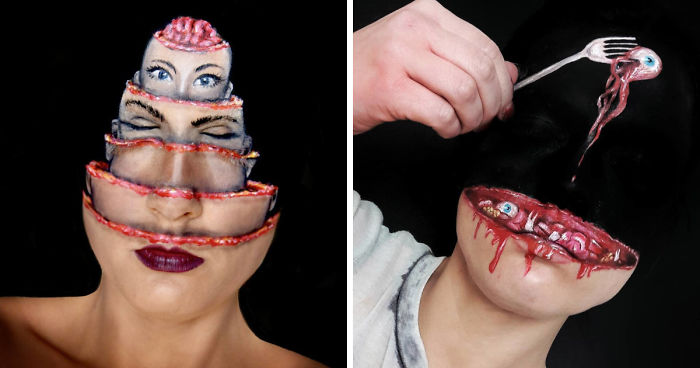
Artists such as Mimi Choi have shown how powerful this approach can be with optical-illusion makeup, using perspective and shading to create altered facial planes and visual puzzles that seem impossible at first glance. Staines’s creature work belongs to the same broader tradition of using the body not as a limitation, but as a launch pad for imagination.
Why Social Media Could Not Look Away
Monster transformations are tailor-made for the scroll. They reward viewers instantly with surprise, then reward a second look with craftsmanship. A successful reveal contains a tiny story: here is the familiar face, here is the impossible character, and here is the moment your brain catches up.
But viral attention is not just about shock value. The most memorable looks have a visual signature. A viewer can recognize an artist’s choices through color, detail, humor, or the way a creature meets the camera. That recognizable voice turns a one-time viral image into an artistic identity.
Creature makeup also gives unusual ideas a seat at the main table. Beauty trends often reward symmetry, softness, and predictability. Monster art can reward a strange silhouette, an unexpected palette, or an expression that looks like it knows a secret. Sometimes the odd ideas bring dessert, too.
Practical Effects Still Have a Place in a Digital World
Digital effects can do astonishing things, but practical artistry has a particular charm. When a transformation is built with real color, texture, and performance, it changes with movement and light. The camera must respond to what is actually there.
Major film and television productions still rely heavily on practical creature work. The design of Vecna in Stranger Things, for example, involved a complex prosthetic build and lengthy makeup applications. High-budget projects may have teams, casts, molds, schedules, and enough planning to make a calendar cry, but the central goal is similar to Staines’s: make an invented character feel like it belongs in the room.
For viewers, practical monster makeup creates a satisfying question: “How did a human face become that?” The answer is rarely one trick. It is visual planning, material knowledge, artistic judgment, lighting, and a willingness to keep refining the illusion.
Creativity Needs a Safety Footnote
Ambitious looks should be approached with the same respect as any other art practice involving products used on the skin. Professional artists pay attention to product labels, hygiene, removal instructions, and the intended use of colors and adhesives.
The U.S. Food and Drug Administration notes that a color approved for one cosmetic use is not automatically approved for every area of the body, particularly around the eyes. The smart goal is simple: create the illusion, protect the real person underneath it, and save the genuinely frightening surprises for the camera.
What Sammy Staines’s Monsters Teach Us About Art
Sammy Staines’s work reminds us that makeup can be more than a finishing touch. It can be visual storytelling, temporary sculpture, character design, and a wonderfully strange form of self-portraiture. Her monsters are effective because they are carefully imagined rather than merely loud.
The larger lesson is encouraging for anyone who creates. You do not need an enormous studio to make something feel cinematic. You need a strong concept, patience with detail, an understanding of how people see, and the courage to let unusual ideas become visible. A face may be a small canvas, but it can still hold an entire universe.
Experience: When the Monster in the Photo Is Clearly the Artist
Seeing a self-made monster transformation for the first time is a peculiar little emotional ride. You may begin by appreciating the colors, the precision, or the confidence it takes to post an image that looks nothing like a conventional beauty portrait. Then your brain notices the human clues: the familiar eyes, the recognizable angle of the jaw, the hint of personality beneath the character. That is when the image becomes more than a costume. It becomes a performance.
The first reaction is often laughternot because the work is silly, but because surprise has nowhere else to go. A face that seemed ordinary a moment ago now appears to belong to an imaginary creature with an entire backstory. You begin inventing one without realizing it. Perhaps this being lives in a foggy forest. Perhaps it runs a suspiciously organized underground library. Perhaps it only appears at night to judge people’s choice of throw pillows.
The best monster makeup gives the viewer enough information to start imagining and enough mystery to keep going. The longer you look, the more the details reveal themselves. A shadow is not merely dark; it redirects the face. A line near the mouth changes the expression. A touch of color around the eyes creates distance, fatigue, wonder, or mischief. The artist has not replaced her identity. She has choreographed your perception of it.
There is also a strange sense of trust in the image. The artist is willing to become temporarily unrecognizable in public. That takes technical skill, but it also takes creative bravery. Many people worry about appearing imperfect in a photograph. A transformation artist treats “perfect” as a tiny box to decorate, fold up, and send to another planet.
Watching a reveal video or a sequence of photos can feel almost meditative. A character emerges in stages: an idea becomes a sketch in color, the sketch gains structure, the structure gains mood, and suddenly the face in front of you belongs to someoneor somethingnew. It is a reminder that art can alter perception without changing reality. The artist remains herself, even when the final image seems to whisper otherwise.
That may be why these transformations linger. The monster is not just spooky; it is evidence of possibility. It proves that ordinary materials, used with imagination, can turn a familiar face into a doorway to a new story. After the initial shiver, the lasting feeling is not fear. It is curiosity: What could this artist dream up next, and how on earth will she make us believe it?
Conclusion
Sammy Staines turns nightmare monsters into memorable visual stories by combining special-effects sensibility with the intimacy of a self-portrait. Her transformations work because they are carefully designed, emotionally readable, and never content to settle for “just spooky.” They invite viewers to marvel at the creative process hiding in plain sight: one artist, one face, and an imagination that clearly does not believe in taking the ordinary route home.