Some people walk into a crowded room and immediately collect five new friends, three phone numbcate the nearest quiet corner, and begin calculating how soon leaving would still count as “making an effort.”
That does not mean introverts dislike people. Many of us enjoy meaningful conversations, close friendships, teamwork, parties, and spontaneous adventures. We simply tend to prefer manageable doses of stimulation, followed by enough quiet time to hear our own thoughts again.
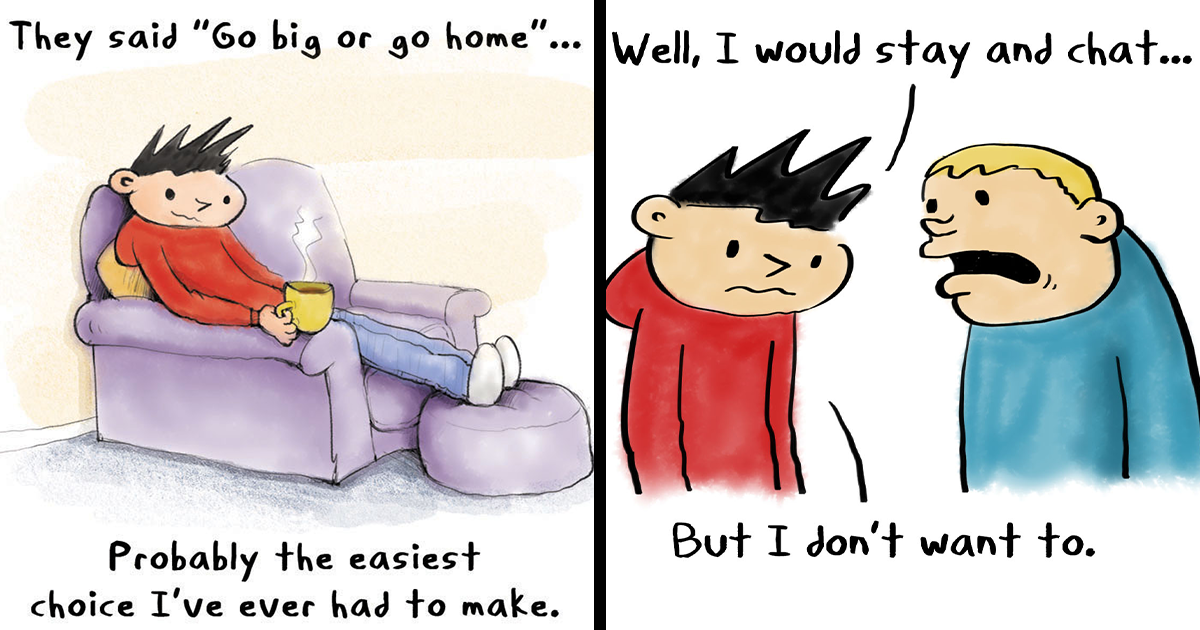
This collection of 30 comics turns familiar introvert struggles into small, humorous scenes: rehearsing a food order, hiding from an unexpected visitor, surviving office small talk, and celebrating canceled plans with suspicious enthusiasm. Behind the jokes is a larger message. Quiet people are not defective extroverts. We simply navigate social life with a different battery, operating system, and definition of an exciting Friday night.
What Living as an Introvert Really Means
Introversion is generally understood as a personality tendency involving greater comfort with internal reflection, lower-stimulation environments, and smaller or more selective social settings. It exists on a spectrum rather than dividing humanity into two rigid teams. Many people fall somewhere between strongly introverted and strongly extroverted, changing their behavior according to the situation. sion is also not the same as shyness or social anxiety. A shy person may want interaction but feel nervous about approaching it. Social anxiety disorder involves significant fear of scrutiny, humiliation, rejection, or negative judgment that interferes with daily life. An introvert, by contrast, may be perfectly confident while simply preferring dinner with two friends over karaoke with 200 strangers and one dangerously enthusiastic tambourine player. solitude can provide space for rest, reflection, creativity, and emotional regulation. However, enjoying time alone does not eliminate the human need for supportive relationships. The goal is not permanent isolation; it is finding a sustainable balance between meaningful connection and restorative privacy.
My 30 Comics About Introvert Social Struggles
1. The Invitation Loading Screen
In the first panel, a friend texts, “Want to hang out tonight?” In the second, the introvert stares at the message as if it contains a complicated legal contract. The final panel shows 14 imaginary browser tabs labeled “Who will be there?” “How late?” and “Can I wear comfortable pants?”
2. The Joy of Canceled Plans
The character is dressed and technically ready to leave. Then the cancellation message arrives. Heavenly light fills the room, birds sing, and the uncomfortable jeans are replaced by pajamas at record-breaking speed. Concern for the friend remains genuine; the relief is simply Olympic-level.
3. Arriving Exactly on Time
Being early could mean standing alone and making conversation with the host. Being late could attract attention. The introvert therefore circles the block twice and enters at the mathematically perfect moment when enough guests have arrived to provide camouflage.
4. The Party Bathroom Retreat
This comic shows a crowded party outside and one peaceful bathroom inside. The introvert is not using the facilities. They are staring at a hand-soap bottle and enjoying three magnificent minutes during which nobody asks what they do for work.
5. The Irish Goodbye Debate
The character wants to leave but realizes that saying goodbye may trigger seven additional conversations. After performing a risk assessment worthy of a space launch, they quietly disappear, then spend the ride home wondering whether everyone now believes they were kidnapped.
6. Small Talk: The Tutorial Level
“Crazy weather today,” says a stranger. The introvert’s mind produces several responses, rejects all of them, and finally delivers, “Yes, weather exists.” The stranger nods politely. The introvert remembers the exchange at 2:00 a.m. for the next six years.
7. The Accidental Deep Conversation
Small talk may feel like conversational paperwork, but mention consciousness, childhood dreams, or whether time is real, and the quiet character suddenly has a 45-minute presentation prepared. Introverts are not always unwilling to talk. Sometimes we are waiting for the conversation to acquire a plot.
8. Rehearsing a Restaurant Order
Before the server arrives, the introvert silently practices: “I’ll have the grilled chicken, please.” The server approaches. Reality bends. The character announces, “You too,” even though nobody has said “Enjoy your meal” yet.
9. The Name Memory Emergency
A new person introduces themselves. The introvert concentrates so intensely on appearing friendly that the name immediately evaporates. For the rest of the evening, the person becomes “Hey,” “My friend,” or “You with the extremely memorable face.”
10. Meeting Someone in the Grocery Store
The character spots an acquaintance near the cereal aisle. Rather than initiate an unexpected conversation, they reverse the shopping cart, abandon breakfast, and begin a new life among the canned vegetables. This is not hostility. It is tactical social energy conservation.
11. The Open-Office Survival Kit
The comic presents headphones, a water bottle, a strategically positioned monitor, and an expression that says, “I am focusing very hard.” In reality, the character is trying to recover from hearing three nearby conversations, two notification sounds, and someone eating a crunchy apple.
12. “Let’s Go Around the Room”
Few sentences generate faster internal panic. While the first person speaks, the introvert writes a perfect introduction. While the second speaks, they revise it. By their turn, they have forgotten their name and would like to be identified simply as “pass.”
13. The Meeting After the Meeting
During the official meeting, the character listens, analyzes, and says little. Twenty minutes later, they send a beautifully organized message containing the solution everyone needed. Some introverts process ideas internally before presenting them, which may make delayed contributions more thoughtful than spontaneous ones.
14. The Group Project Personality Lottery
The teacher says, “Choose your own groups.” Chairs scrape. Friendships activate. The introvert remains seated while everyone forms teams at supernatural speed. Eventually, they are adopted by a group like a quiet office plant that also knows how to format the presentation.
15. The Surprise Video Call
A coworker calls without warning. The computer rings like an emergency alarm. The introvert freezes, checks their reflection, closes 17 unrelated tabs, and waits three seconds before answering so it does not appear that they were staring directly at the screenwhich they were.
16. Texting Is My Natural Habitat
In person, the character needs time to find the right sentence. In a text message, they are witty, articulate, and capable of using punctuation with emotional precision. The only danger is editing a four-word reply until it resembles a diplomatic statement between neighboring countries.
17. The Phone Call Without Context
A loved one sends, “Can I call you?” The introvert immediately assumes someone is injured, the economy has collapsed, or they accidentally agreed to organize a wedding. A follow-up such as “Nothing serious” could prevent several unnecessary internal funerals.
18. Typing, Deleting, Typing Again
The message begins as “Sure!” Then it becomes “Sure, that sounds great.” Then “Sounds good.” Then “Okay.” After eight revisions, the introvert returns to “Sure!” and worries that the exclamation point appears aggressive.
19. The Group Chat Avalanche
The character checks their phone after lunch and discovers 184 unread messages. Rather than begin at the top, they close the app and promise to return later. Three days pass. The group has planned a vacation, adopted a mascot, and changed its name twice.
20. The Online Status Problem
The introvert wants to browse quietly but notices that the app displays a glowing green “available” symbol. The comic transforms that dot into a lighthouse announcing, “This person is awake and can therefore provide emotional labor immediately.” Offline mode becomes a cozy digital blanket.
21. The Two-Friend Sweet Spot
One-on-one conversation feels intimate. Three people can feel lively. Add eight more, and the introvert slowly becomes a background character holding a drink. The love for each friend remains intact; the available processing bandwidth does not.
22. Adopting an Extrovert
The extroverted friend handles introductions, starts conversations, and asks the waiter for the missing sauce. The introvert remembers birthdays, listens carefully, and sends the thoughtful message afterward. Together, they form one socially functional adult.
23. “Why Are You So Quiet?”
This question rarely creates more speech. In the comic, a spotlight appears, every conversation stops, and the introvert is handed a microphone. Their answer bubble contains only, “I wasn’t aware a minimum word count had been assigned.”
24. The Host Who Keeps Refilling the Evening
The introvert announces that they should leave. The host offers dessert. Another guest begins a story. Someone opens a board game. Two hours later, the character is still wearing their coat, aging visibly beside the front door.
25. Loving People From a Comfortable Distance
The character genuinely misses a friend but does not initiate contact because the week has been draining. The friend assumes disinterest. The comic reveals the truth: affection can remain strong even when communication becomes quiet. Relationships improve when both people discuss expectations instead of interpreting silence as rejection.
26. The Social Battery Warning
A battery icon floats above the introvert throughout an event. It begins at 82%, drops to 40% after introductions, reaches 12% during a group photo, and enters emergency mode when someone says, “We should all go somewhere else after this.”
27. Recovery Day
After a busy weekend, the character schedules nothing. An outside observer sees inactivity. The introvert sees essential maintenance: reading, cooking, walking, reorganizing a drawer, and not explaining why they are reorganizing a drawer.
28. Overthinking the Good Conversation
The interaction went well. Everyone laughed. Nobody was offended. Naturally, the introvert spends the evening replaying one slightly unusual hand gesture and wondering whether it permanently altered the friendship.
29. Discovering the Word “No”
The character once accepted every invitation to avoid disappointing people. The comic shows them gradually learning phrases such as “I can’t make it,” “I need a quiet evening,” and “Thank you for asking.” No dramatic excuse, imaginary illness, or fictional overseas relative is required.
30. Quiet Confidence
The final comic abandons the idea that the introvert must transform into the loudest person in the room. Instead, the character speaks when they have something meaningful to contribute, protects their energy, maintains close relationships, and goes home before the karaoke machine becomes legally dangerous.
Why These Introvert Comics Feel So Relatable
Humor works because it turns private discomfort into shared recognition. A reader may believe they are the only person who rehearses phone calls or needs an evening to recover from a crowded event. Seeing the behavior in a comic changes the thought from “Something is wrong with me” to “Apparently, this is a whole genre.”
The jokes also reveal a conflict between internal needs and social expectations. Many environments reward quick responses, visible enthusiasm, frequent networking, and constant availability. Introverts may contribute through preparation, observation, careful listening, written communication, or smaller conversationsstrengths that are easy to miss when participation is measured primarily by airtime.
That does not mean avoiding every uncomfortable interaction is ideal. Research suggests that people lower in extraversion sometimes expect social experiences to be less enjoyable than they actually become. Even brief conversations can produce more positive feelings than anticipated. The practical lesson is not “force yourself to become extroverted,” but “do not automatically trust every gloomy prediction your brain makes before an event.”
Experiences Behind the Comics: Learning to Live Socially Without Performing
For a long time, the narrator of these comics treated introversion as a problem requiring correction. At parties, the goal was to appear energetic until the performance became convincing. At work, silence felt dangerous because louder colleagues seemed more visible. Invitations were accepted automatically, even when the calendar was already crowded, because declining appeared rude. The result was predictable: social events became associated with exhaustion, resentment, and elaborate fantasies about moving to a cabin where the nearest neighbor lived in another time zone.
The turning point was recognizing that energy has limits. Social capacity is not a moral score. One person may enjoy six hours of conversation and leave refreshed; another may have a wonderful two-hour dinner and still need a quiet morning afterward. Neither response proves greater kindness or maturity. Once the narrator stopped treating recovery as laziness, scheduling became more realistic. Busy days were followed by lighter ones. Large gatherings were balanced with smaller meetings. The calendar finally began resembling a life rather than an obstacle course designed by an enthusiastic cruise director.
Communication also improved. Friends cannot read an introvert’s battery level from across the room, especially when the introvert has spent years smiling through exhaustion. Saying, “I’m glad I came, but I’m running out of energy,” proved more useful than disappearing and hoping nobody noticed. Similarly, telling close friends that slow replies were usually about bandwidthnot affectionprevented unnecessary misunderstandings. Good relationships became less dependent on constant contact and more dependent on consistency, honesty, and mutual respect.
Work required another adjustment. Remaining silent until every idea was perfect often meant that the discussion moved on before the narrator contributed. The solution was not becoming the loudest person in meetings. It was preparing one or two points in advance, sending written notes when appropriate, and asking for agendas before complex discussions. These small changes made participation easier without demanding an entirely different personality. Quiet preparation became an advantage rather than an excuse to remain invisible.
There were awkward experiments. Some networking events still felt like speed dating for business cards. A few attempts at small talk ended with both people studying the carpet. Yet social confidence grew through manageable practice: greeting one person, asking one genuine question, staying for a predetermined period, and leaving without writing a fictional emergency. The objective changed from “be impressive” to “be present.” That smaller goal produced better conversations and far less emotional theater.
The most important experience was learning the difference between a preference and a prison. Choosing a quiet night because it feels restorative is healthy. Avoiding every relationship, opportunity, or necessary conversation because fear feels overwhelming may signal something else. Persistent anxiety about judgment that disrupts work, school, relationships, or ordinary activities deserves support from a qualified mental health professional. Introversion itself does not need treatment, but distress and impairment should not be dismissed as merely having a low social battery. he narrator still rehearses restaurant orders, prefers texts to surprise calls, and celebrates canceled plans a little too enthusiastically. The difference is that these habits no longer inspire shame. Some can be laughed at, some can be challenged, and some can simply be accommodated. Living well as an introvert is not about escaping humanity. It is about building a social life spacious enough for connection, honesty, meaningful work, and the occasional glorious evening in which nobody asks you to introduce yourself to the room.
Conclusion: There Is More Than One Way to Be Social
These 30 comics celebrate the strange negotiations that often accompany introvert life: wanting friendship but avoiding the phone, enjoying an event while dreaming of home, and having excellent ideas approximately 20 minutes after the meeting ends.
The humor matters, but so does the message underneath it. Introverts do not need to apologize for preferring depth over volume, preparation over improvisation, or a quiet evening over a packed calendar. With clear boundaries, supportive relationships, and a willingness to stretch when it matters, quiet people can participate fully without pretending to be someone else.