Liam Neeson has spent much of his modern screen career tracking kidnappers, confronting assassins, surviving frozen wildernesses, and informing nervous criminals that he possesses an unusually specific collection of professional abilities. Yet one of his boldest creative decisions involved neither a firearm nor an international conspiracy. It concerned the length of a plaid skirt.
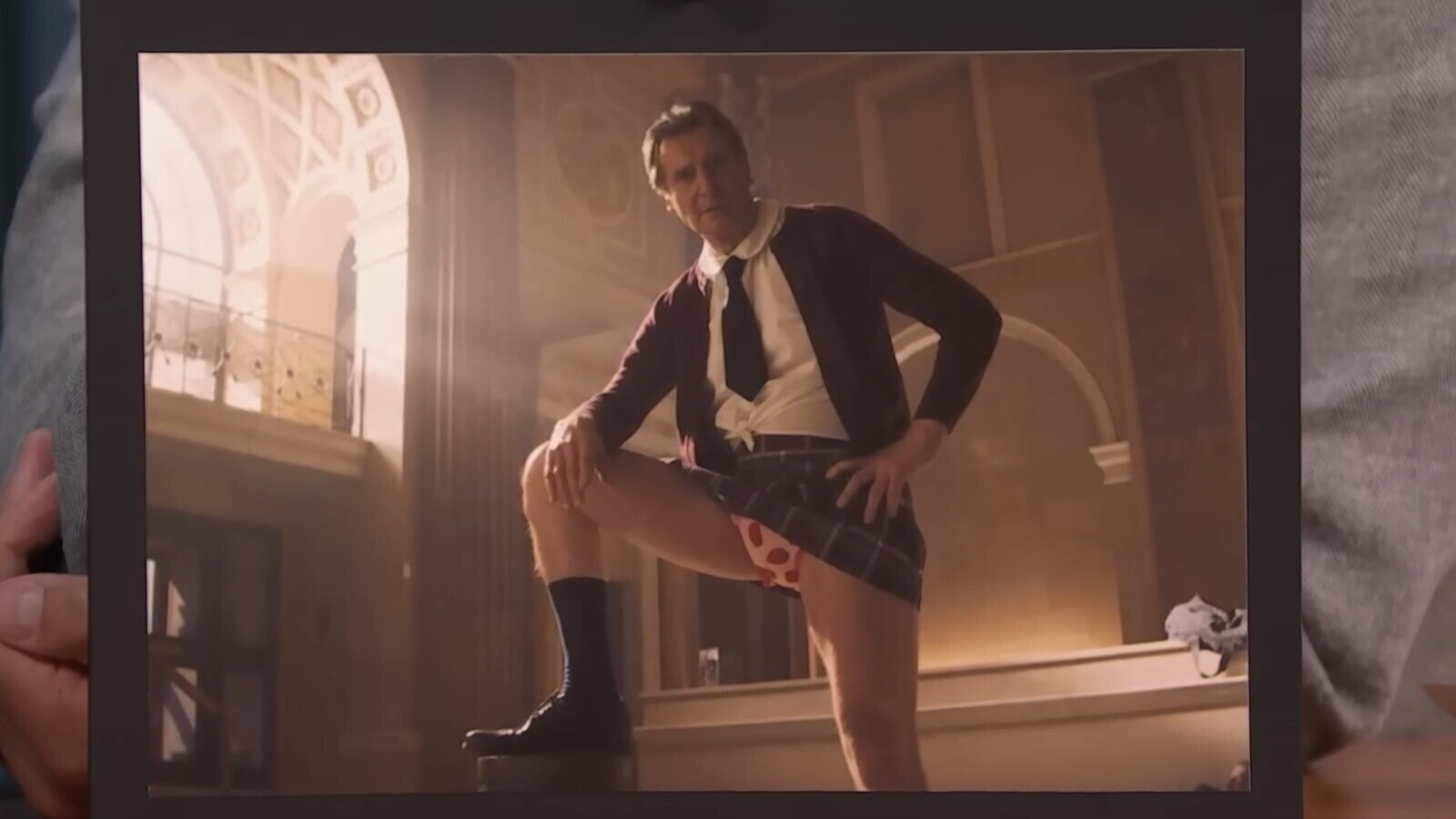
While filming The Naked Gun, Neeson appears in a schoolgirl costume during an outrageous bank-robbery sequence. The outfit was already designed to be ridiculous, but the actor believed it needed one important adjustment: the skirt should be shorter. Much shorter. In his view, a conservative hemline would weaken the visual joke.
That wardrobe request may sound like a small behind-the-scenes anecdote, but it reveals a great deal about Neeson’s commitment to comedy, the mechanics of visual humor, and the creative philosophy behind the 2025 revival of a beloved spoof franchise.
The Story Behind Liam Neeson’s Short Schoolgirl Skirt
During promotional interviews for The Naked Gun, Neeson explained that he personally asked for the schoolgirl skirt to be shortened. The request was especially unexpected because the actor has also admitted that he feels self-conscious about showing his legs.
That contradiction makes the decision even funnier. Neeson did not request the alteration because he wanted to look glamorous or fashionable. He wanted the costume to communicate the joke immediately. A longer skirt might have looked merely unusual. A very short skirt, paired with knee-high socks and the actor’s imposing physical presence, created a deliberately absurd silhouette.
In other words, Neeson accepted personal discomfort because the gag needed a stronger punch line. That is the kind of commitment slapstick comedy demands. The performer cannot stand outside the joke, politely pointing at it. He has to walk directly into it, preferably while wearing plaid.
A Costume Designed for Immediate Impact
The schoolgirl disguise appears during the movie’s opening bank sequence. Frank Drebin Jr., played by Neeson, infiltrates a robbery dressed as a young student before revealing himself and attacking the criminals.
The sequence combines several recognizable action-movie ideas. There is the hero entering enemy territory in disguise, the dramatic removal of a mask, and the sudden transformation from apparently harmless bystander to unstoppable fighter. The filmmakers then sabotage those familiar conventions by placing a towering, gravel-voiced action star in an outfit that could not look less suited to tactical combat.
The skirt’s length matters because visual comedy is often processed before dialogue. Viewers see the outfit, understand the contrast, and begin laughing before Drebin throws a punch. The costume therefore performs narrative work. It tells the audience that this is an action scene, but it also warns them that normal cinematic logic has been escorted from the building.
Why a Shorter Skirt Made the Joke Funnier
Comedy frequently depends on exaggeration. A slightly strange costume can produce a smile, but a confidently ridiculous costume can define an entire scene. Neeson’s wardrobe note pushed the visual concept beyond ordinary disguise humor and into unmistakable farce.
A longer skirt might have softened the contrast between the outfit and the actor wearing it. By shortening it, the production emphasized everything that made the image funny: Neeson’s height, his serious expression, his muscular action-hero posture, and his total refusal to behave as though anything about the situation was unusual.
The Power of Visual Contradiction
The basic formula is beautifully simple. Audiences know Liam Neeson as a severe, intimidating screen presence. They expect dark coats, controlled movements, dangerous phone calls, and menacing speeches. The schoolgirl costume replaces those familiar elements with plaid fabric, visible underwear, socks, and a childlike disguise.
The wider the distance between expectation and reality, the stronger the comic effect becomes. Neeson does not wink at the camera, apologize for the outfit, or perform embarrassment. He treats the mission with the same deadly seriousness he might bring to an airport hostage situation.
That seriousness protects the joke. Had Neeson behaved as though he were trying to be funny, the scene could have become forced. Instead, he allows the costume to generate the absurdity while his expression remains focused on the imaginary threat.
Comedy Requires Precision
People sometimes describe slapstick as random silliness, but successful physical comedy is highly technical. The length of a skirt, the timing of a reveal, the angle of a camera, and the pause before an attack can determine whether a scene produces laughter or uncomfortable silence.
Neeson’s wardrobe request shows that he understood this precision. He recognized that the costume was not merely clothing; it was part of the joke’s structure. Shortening it was comparable to trimming a line of dialogue or delaying a reaction by half a second. The alteration sharpened the punch line.
Liam Neeson Was an Inspired Choice for Frank Drebin Jr.
When plans for a new Naked Gun movie emerged, the filmmakers faced an intimidating challenge. Leslie Nielsen’s performance as Frank Drebin remains one of the defining achievements of deadpan screen comedy. Simply asking another actor to imitate him would have invited an unfavorable comparison from the opening scene.
Director Akiva Schaffer and writers Dan Gregor and Doug Mand found a smarter solution. Instead of creating another version of the original Frank Drebin, they made Neeson’s character his son. Frank Drebin Jr. could honor the franchise while possessing a distinct personality built around Neeson’s own cinematic history.
Neeson brought decades of dramatic authority to the role. After acclaimed performances in serious films, he became a remarkably durable action star through projects such as Taken, The Grey, and The Commuter. His reputation made him ideal for parodying the modern action thriller.
Playing the Nonsense Completely Straight
Producer Seth MacFarlane has praised Neeson’s ability to appear larger than life while remaining emotionally sincere. That combination is essential to the Naked Gun style. Frank Drebin cannot know that he is in a comedy. He must believe that every ridiculous clue, romantic misunderstanding, and exploding object belongs in a serious police investigation.
Neeson’s low voice and intense concentration create authority even when the screenplay gives him something profoundly foolish to do. The audience sees a man behaving like the hero of a high-stakes thriller while the surrounding world operates according to cartoon logic.
The schoolgirl disguise may be the clearest example. Neeson approaches the scene as an infiltration mission rather than a sketch. His commitment allows the costume to become funnier with every serious movement.
How the Scene Parodies Decades of Action Movies
The opening bank sequence does more than place Liam Neeson in a short skirt. It compresses several decades of action filmmaking into a fast-moving parody.
The writers have explained that the infiltration concept drew inspiration from the kind of sequence found in Neeson’s own action films. The mask removal also recalls the elaborate disguises associated with the Mission: Impossible franchise. Instead of rejecting modern action cinema, The Naked Gun studies its habits and then bends them until something snaps.
The Heroic Disguise Becomes the Punch Line
Traditional action movies ask viewers to admire a hero who enters a dangerous location unnoticed. The disguise demonstrates intelligence, preparation, and tactical discipline. Frank Drebin Jr.’s disguise demonstrates that someone in the wardrobe department owns plaid.
The funny part is that the tactic works. The criminals fail to recognize a very tall adult man dressed as a schoolgirl because the universe of The Naked Gun rewards confidence more than plausibility.
That approach is central to spoof comedy. The filmmakers do not merely mention an action cliché; they reconstruct it with professional cinematography, committed performances, and a completely unreasonable visual idea. The production looks polished enough to support a real thriller, which makes the nonsense taking place inside the frame more effective.
Respecting Leslie Nielsen Without Copying Him
Leslie Nielsen’s transformation from dramatic actor to comedy legend provides the historical blueprint for Neeson’s casting. Before Airplane! and Police Squad!, Nielsen was generally associated with serious roles. His ability to deliver absurd dialogue with complete sincerity became his comic superpower.
Neeson follows a comparable path, but the new movie wisely avoids turning him into a Nielsen impersonator. His Frank Drebin Jr. is heavier, more physically intimidating, and shaped by contemporary action cinema. He is not an innocent man wandering through chaos in quite the same manner as his fictional father. He resembles a seasoned action hero whose confidence has survived despite his brain repeatedly taking unauthorized lunch breaks.
Critical responses to the film varied, particularly when comparing Neeson with Nielsen. Some reviewers felt that the original star’s peculiar innocence remained impossible to duplicate. Others praised Neeson’s grave delivery and willingness to make himself look ridiculous. That disagreement is understandable because Nielsen created an almost untouchable character.
What matters is that the revival did not pretend the past could be reproduced exactly. It found humor in Neeson’s existing persona and allowed him to bring a different kind of deadpan energy to the franchise.
The Schoolgirl Costume Proved Neeson Was Fully Committed
Actors entering comedy from serious drama sometimes appear cautious. They may protect their dignity, soften embarrassing moments, or signal that they understand the joke. Neeson did the opposite. Asking for a shorter skirt demonstrated that he was willing to sacrifice vanity for the scene.
That willingness is more important than an actor’s ability to tell jokes. In visual comedy, hesitation is visible. An audience can sense when a performer wants credit for being brave without fully embracing the embarrassing material.
Neeson did not simply agree to wear the costume. He evaluated it, decided it was not ridiculous enough, and requested an upgrade. Somewhere, a costume designer probably heard one of cinema’s most intimidating voices asking for less fabric.
Self-Consciousness Made the Decision More Meaningful
Neeson has said that he has long disliked showing his legs, tracing some of that insecurity to his younger boxing days. That detail gives the anecdote an unexpectedly human dimension.
Confidence does not always mean feeling comfortable. Sometimes it means recognizing what a scene requires and doing it despite discomfort. Neeson’s choice illustrates the difference between protecting one’s image and serving the project.
For a star whose career has been built partly on controlled masculinity, the costume also functions as self-parody. It dismantles the visual mythology of the unstoppable Neeson action hero while preserving the intensity that made that mythology entertaining.
Pamela Anderson and the Supporting Cast Joined the Absurdity
Although Neeson dominates the schoolgirl sequence, The Naked Gun is not a one-man comedy experiment. Pamela Anderson plays Beth Davenport, a mysterious woman who approaches Drebin while he investigates her brother’s death. Paul Walter Hauser appears as Capt. Ed Hocken Jr., while Danny Huston, CCH Pounder, Kevin Durand, Liza Koshy, and other performers populate the movie’s strange police universe.
Anderson’s role requires the same straight-faced discipline as Neeson’s. She must deliver absurd dialogue as though she were starring in an elegant crime thriller. Her chemistry with Neeson adds warmth without slowing the movie’s barrage of puns, sight gags, romantic misunderstandings, and action parodies.
Reports from the film’s promotional tour also described a friendly relationship between the stars. Anderson baked bread and cookies for Neeson during production, while Neeson publicly praised her warmth and professionalism. That relaxed connection likely helped both performers commit to scenes that could have felt awkward without mutual trust.
Why the Costume Became a Perfect Marketing Image
A successful trailer needs a moment that communicates a movie’s identity almost instantly. Liam Neeson fighting criminals in a tiny schoolgirl skirt accomplishes that job with impressive efficiency.
The image tells longtime fans that the reboot intends to preserve the franchise’s shameless visual humor. It also introduces younger viewers to the central joke of Neeson’s casting: the man best known for punishing villains is now punishing them while dressed for the least convincing school day in history.
Unlike a dialogue-heavy joke, the costume works in trailers, screenshots, posters, social media clips, and reaction videos. It requires almost no explanation. Viewers understand the contradiction immediately, which makes the scene valuable not only as comedy but also as marketing.
The moment also reassured skeptical fans that the filmmakers were prepared to embrace silliness. Legacy sequels sometimes become overly respectful, carefully polishing familiar characters until all spontaneity disappears. A very short plaid skirt is not careful. It is a declaration of comic intent.
What the Scene Says About the Return of Big-Screen Comedy
The release of The Naked Gun arrived during renewed discussion about whether broad theatrical comedy could regain its place at the box office. For years, major studios prioritized superhero spectacles, action franchises, horror films, and recognizable intellectual property. Many comedies migrated to streaming, where they could be watched privately instead of with a laughing crowd.
Schaffer’s film presented an unusual combination: a recognizable franchise, polished action filmmaking, an established dramatic star, and unapologetically foolish jokes. Its humor was not hidden inside an adventure movie. Comedy was the main attraction.
The schoolgirl scene embodies that confidence. It is broad, physical, immediate, and designed to create a communal reaction. A packed theater does not need to debate the symbolism of Neeson’s plaid skirt. Everyone can simply laugh at the same ridiculous image.
That shared response is one reason slapstick remains valuable. Visual humor can cross differences in age, background, and familiarity with the franchise. Viewers who understand the action-movie references receive an additional layer, but the basic sight gag remains accessible to almost anyone.
Experiences and Creative Lessons Inspired by Neeson’s Costume Choice
The story of Liam Neeson’s shortened skirt offers useful lessons beyond the production of The Naked Gun. Performers, writers, designers, marketers, and even ordinary people preparing a presentation can learn something from his decision to make the visual idea clearer, bolder, and less comfortable.
Experience One: Commit Past the Point of Mild Embarrassment
Creative work often becomes memorable only after someone moves beyond the safest version of an idea. A performer may agree to an unusual costume but unconsciously try to preserve dignity. A writer may develop an eccentric joke and then weaken it out of fear that readers will reject it. A designer may choose an interesting concept before sanding away every distinctive edge.
Neeson’s experience demonstrates the opposite approach. Once he accepted the schoolgirl disguise, he considered what would make it function better. He did not stop at being willing to look silly. He asked how the silliness could become more precise.
The lesson is not that every project needs a shorter skirt. Human resources departments everywhere can relax. The lesson is that half-commitment is frequently more uncomfortable than full commitment. When performers visibly protect themselves, audiences feel the hesitation. When they confidently inhabit the moment, embarrassment can transform into entertainment.
Experience Two: Small Details Can Control the Entire Reaction
A costume hem may seem minor compared with acting, directing, or stunt choreography. Yet in this scene, the hemline helps determine how quickly viewers understand the joke. It changes Neeson’s silhouette, increases the contrast between actor and disguise, and strengthens the reveal.
Similar details shape experiences in other creative fields. The length of a pause can rescue a speech. A single headline can determine whether an article is opened. One sound effect can make a video feel polished or cheap. A product photograph can influence buyers before they read a single specification.
People often search for large solutions when the real problem is a small detail that has not been pushed far enough. Neeson’s costume note is a reminder to inspect the element that audiences encounter first.
Experience Three: Use Existing Expectations Instead of Fighting Them
The filmmakers did not ask viewers to forget Neeson’s action career. They built the comedy around it. His reputation for intensity became raw material rather than an obstacle.
This strategy can be applied to public speaking, branding, storytelling, and performance. A person with a formal reputation may become surprisingly funny by maintaining that formality while discussing an absurd topic. A familiar product can feel fresh when its most recognizable feature is placed in an unexpected context. Contrast is more effective when the audience already understands both sides.
Neeson wearing a schoolgirl costume is funny because audiences know what Liam Neeson usually looks like. Without that history, the image would still be strange, but it would lose an important layer.
Experience Four: Trust Makes Ridiculous Work Possible
Actors can only commit to vulnerable comedy when they trust the director, costume team, scene partners, and editors. They need confidence that the production is laughing with the performance rather than carelessly exposing the performer.
The friendly working relationship described by Neeson and Anderson suggests an environment in which both stars felt safe enough to attempt broad material. That principle applies to any collaborative project. People take creative risks when criticism is specific, intentions are clear, and embarrassment is shared rather than weaponized.
A team that mocks every imperfect attempt will soon receive only cautious ideas. A team that treats experimentation seriously can produce something as confidently foolish as an action hero attacking bank robbers in visible underwear.
Experience Five: The Funniest Choice May Also Be the Most Honest
Neeson’s request was funny partly because it acknowledged what the scene really needed. Pretending that a restrained costume was sufficient would have protected the actor but weakened the premise.
Honest creative decisions are not always tasteful, subtle, or dignified. Sometimes the concept promises absurdity, and the production must deliver absurdity without apology. The audience can tell when a movie advertises wild comedy but provides only carefully approved quirkiness.
The Naked Gun understood that its title carries a specific promise. Viewers expect puns, slapstick, sight gags, background jokes, and characters who remain serious while the universe collapses around them. Neeson’s shortened skirt fulfills that promise before the main investigation has properly begun.
Conclusion: The Short Skirt Was a Serious Comedy Decision
Liam Neeson’s schoolgirl costume could easily have become a disposable visual gag. Instead, his request for a shorter skirt turned it into a revealing example of how comedy is constructed.
The moment succeeds because it combines precise costume design, Neeson’s established action persona, disciplined deadpan acting, recognizable genre conventions, and complete commitment to the ridiculous premise. Every element supports the same reaction.
It also confirms that Neeson did not approach The Naked Gun as a respected dramatic actor temporarily visiting comedy. He approached it as a performer determined to make each joke workeven when that meant exposing the legs he would normally prefer to keep hidden.
Frank Drebin Jr. may not possess flawless judgment, but the actor playing him understood one important rule: when a towering action hero infiltrates a bank in a schoolgirl outfit, subtlety has already left the scene. At that point, the only responsible artistic choice is to shorten the skirt.