Most designers try to make everyday objects easier, safer, and more pleasant to use. Katerina Kamprani looked at that sensible tradition and apparently thought, “Where is the chaos?” Her ongoing project, The Uncomfortable, redesigns familiar household objects so they remain recognizable while becoming awkward, frustrating, or gloriously impractical.
A fork bends when you need it to stay firm. Rain boots expose exactly the part of your feet that should remain dry. A watering can directs water back toward itself, completing the world’s least productive irrigation cycle. These uncomfortable objects are funny at first glance, but their appeal runs deeper than a visual joke. They expose the invisible decisions that allow ordinary products to work.
“`
Who Is Katerina Kamprani?
Katerina Kamprani is an Athens-based architect and designer whose work combines conceptual art, industrial design, visual humor, and a healthy suspicion of convenience. She studied architecture before exploring product and interaction design, where she encountered the principles of usability and user experience.
Instead of obediently creating objects that solved problems, Kamprani began asking what would happen if a designer deliberately sabotaged one essential interaction. The result became The Uncomfortable, a collection developed through sketches, digital 3D visualizations, prototypes, sculptures, and animations.
Her method is more precise than simply making random bad products. She examines how a person recognizes, holds, operates, and completes a task with an object. She then interferes with one crucial step while preserving the item’s familiar visual identity. The viewer instantly understands what the object should doand immediately realizes why it will not cooperate.
Why Deliberately Bad Design Can Be Brilliant
Good product design often disappears. A well-made mug does not demand a meeting before allowing you to drink coffee. A doorknob does not usually require emotional preparation. Because these objects perform reliably, people rarely consider the countless decisions behind their proportions, materials, balance, grip, and placement.
Kamprani reverses that invisibility. By breaking a familiar design rule, she makes the rule visible. The joke works because viewers already possess an internal instruction manual for forks, chairs, glasses, keys, and umbrellas. Her altered versions violate those expectations just enough to trigger laughter, irritation, and a powerful urge to explain how the object should have been made.
25 Uncomfortable Objects That Turn Usability Upside Down
1. Chain Fork
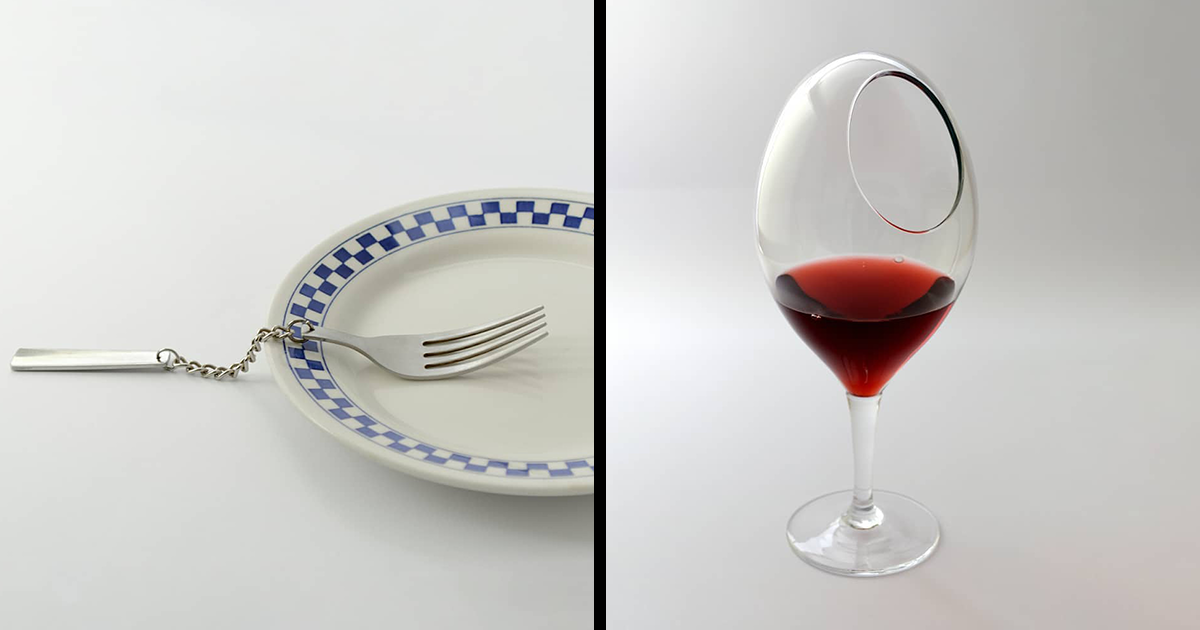
A normal fork depends on a rigid handle that transfers the movement of your hand to the food. The Chain Fork replaces part of that handle with flexible links. Stab a potato and the utensil may fold like it has suddenly remembered an urgent appointment elsewhere.
2. Ball Glasses
Eyeglasses are supposed to position clear lenses steadily in front of the eyes. Ball Glasses introduce spherical forms that disrupt that calm relationship. They look playful and sculptural, but wearing them would turn simple vision into an experimental sport.
3. The Uncomfortable Rain Boots
These bright boots resemble dependable waterproof footwear until you notice their open toes. The design protects the ankle and calf while allowing puddles direct access to the front of the foot. They are rain boots designed with the strategic planning of a screen door on a submarine.
4. Owl Glasses
Owl Glasses exaggerate the position and direction of the lenses, giving the wearer an alert, birdlike appearance while challenging normal sight lines. The frames remain recognizable as eyewear, yet their geometry makes comfortable forward vision far less certain.
5. Long Mug
The Long Mug stretches a compact drinking vessel into an elongated ceramic container. Its handle still suggests that the object should be lifted like an ordinary cup, but its unusual length changes the balance and makes sipping from it an awkward negotiation.
6. The Uncomfortable Wine Glass
A carefully shaped glass normally leaves room for the drinker’s nose while allowing the rim to reach the lips. Kamprani’s version interrupts that relationship with a rounded barrier. The wine remains temptingly visible, but reaching it requires an undignified amount of facial problem-solving.
7. The Uncomfortable Key
A key needs enough leverage to rotate inside a lock. This redesigned key alters the grip and orientation, making the turning motion unnecessarily difficult. It would be especially delightful during heavy rain while carrying groceries and slowly reconsidering every decision that led to your front porch.
8. Thick Button
The Thick Button enlarges a familiar clothing fastener into a chunky cylinder. Although its holes and circular form remain recognizable, its proportions make passing it through a normal buttonhole nearly impossible. It is a button that has achieved confidence but abandoned its professional responsibilities.
9. Side Eye Glasses
These glasses shift visual attention away from the straightforward direction expected of eyewear. Their sideways orientation turns a tool for seeing ahead into an accessory better suited to observing suspicious activity beside youor avoiding eye contact at a very specific angle.
10. The Uncomfortable Chair
Chairs quietly coordinate seat height, back support, balance, and body weight. Kamprani’s chair preserves the outline of familiar furniture while changing the geometry that makes sitting feel secure. The result looks elegant from across the room and deeply untrustworthy from three feet away.
11. The Uncomfortable Ruler
A ruler promises a stable reference for straight lines and consistent measurement. This version disrupts that certainty through an impractical form that makes alignment difficult. It is ideal for anyone who believes geometry has become too predictable.
12. Hourglass Salt and Pepper Shakers
These shakers borrow the shape and visual logic of an hourglass. Seasoning must travel through a narrow internal passage, encouraging diners to wait patiently while their fries grow cold. The design turns a quick shake of pepper into a tiny meditation on time.
13. The Uncomfortable Teapot
A functional teapot separates the handle, lid, and spout so hot liquid can be poured safely. Kamprani rearranges this relationship, creating a vessel that appears refined but threatens spills, scorched fingers, or tea arriving everywhere except the cup.
14. The Uncomfortable Watering Can
One of the project’s most memorable designs points the spout back toward the can. Water poured through it returns to the container instead of reaching a plant. It is a beautifully engineered closed loop of effort, failure, and extremely thirsty basil.
15. The Slingshot Needle
A sewing needle is valuable because it concentrates force into a controlled point. The Slingshot Needle widens and splits the structure, replacing precision with a shape better suited to launching a tiny pebble than repairing a shirt.
16. Forking Fork
The Forking Fork multiplies or redirects the fork’s working ends, complicating a tool that usually asks only one question: “Which bite would you like?” It resembles cutlery from a parallel universe where dinner requires a permit and advanced training.
17. Concrete Umbrella
An umbrella must be light enough to carry and broad enough to shield its user. Making one from concrete technically emphasizes protection while completely destroying portability. It may resist the weather, but first someone must persuade it to leave the house.
18. Hoop Chair
The Hoop Chair replaces dependable support with circular or open structural elements. It retains the visual vocabulary of seating but makes the body wonder where, exactly, it is expected to go. The chair looks like a proposal submitted by someone unfamiliar with sitting.
19. Slipper Spoon
The Slipper Spoon covers or reshapes the bowl of the utensil, making it resemble a miniature shoe. The form is charming until soup enters the discussion. Scooping food becomes difficult, and cleaning the enclosed area could require diplomacy, patience, and specialized equipment.
20. The Uncomfortable Double Mug
Two connected drinking spaces create twice the visual interest and considerably more logistical trouble. Tilting one side may cause liquid in the other to move unpredictably. It is perfect for people who have always felt that drinking one beverage was suspiciously easy.
21. The Uncomfortable Briki
A briki is traditionally used to prepare Greek coffee, with a form designed for heating and controlled pouring. Kamprani modifies its proportions and handle arrangement, disrupting the careful motions needed to manage hot coffee and its distinctive foam.
22. Inflatable Doorknob
A doorknob works because it is solid enough to grip and rotate. Replacing that firmness with an inflatable surface means the knob compresses when squeezed. Opening a door becomes less like operating hardware and more like arguing with a balloon.
23. The Uncomfortable Toothbrush
A toothbrush requires a handle and bristle arrangement that can reach the teeth without attacking the rest of the face. This altered design interferes with those familiar angles, transforming a two-minute hygiene routine into an oral obstacle course.
24. The Uncomfortable Peg
A clothespin or peg relies on a simple pinch mechanism and practical proportions. Kamprani exaggerates or obstructs those elements, leaving an object that looks prepared to secure fabric but resists the fingers trying to operate it.
25. The Uncomfortable Champagne Glasses
Champagne glasses are typically individual, balanced, and easy to raise for a toast. Kamprani’s connected glasses interfere with independent movement, forcing two drinking vessels into an awkward partnership. Celebrating with them would require teamwork and excellent liability insurance.
What These Impractical Objects Teach Us About Design
Familiarity Creates Expectations
People do not approach a mug as an unexplained ceramic mystery. Its shape communicates where to hold it, where to place the mouth, and what kind of motion will deliver the drink. Kamprani preserves enough of that visual language to activate expectations before violating them.
Usability Depends on Small Details
The difference between a comfortable object and an infuriating one may be a few degrees of angle, several inches of length, an unsuitable material, or a misplaced handle. These pieces demonstrate that usability is not a decorative extra. It emerges from an entire system of carefully coordinated decisions.
Failure Can Be a Creative Tool
In commercial product development, failure is usually corrected before an item reaches consumers. In The Uncomfortable, failure is the main feature. It becomes a method for revealing assumptions, generating humor, and studying how objects communicate their purpose.
Humor Makes Design Criticism Accessible
A lengthy lecture on ergonomics might struggle to attract a general audience. A chain-handled fork explains the importance of structural rigidity in roughly half a second. Kamprani’s absurd objects allow serious observations about user experience to arrive disguised as jokes.
The Experience of Encountering The Uncomfortable
Seeing one of Kamprani’s objects often produces a reaction before conscious analysis begins. The viewer recognizes the category immediately: that is a fork, a mug, a chair, or a pair of boots. A fraction of a second later, the brain detects the sabotage. Recognition becomes confusion, and confusion frequently turns into laughter.
The experience is unusually physical even when the object exists only as a digital rendering. Looking at the Chain Fork, viewers can almost feel the handle collapsing between their fingers. The Uncomfortable Wine Glass encourages an imaginary rehearsal in which the nose meets the curved glass before the wine reaches the mouth. The concrete umbrella makes the shoulder feel tired without anyone lifting a thing.
This imagined use is what makes the collection more powerful than a group of random surreal sculptures. Each object invites the audience to simulate an ordinary action. People mentally pour, grip, sit, turn, brush, button, measure, and drink. When the simulation fails, the body seems to understand the joke before language catches up.
In an exhibition setting, physical prototypes can intensify the effect. A beautifully finished ceramic mug or polished metal utensil carries the authority of a manufactured product. It appears complete and legitimate, as though it belongs in a store. That professional finish makes its dysfunction even funnier. The object is not broken through neglect; it has been carefully, confidently, and expensively designed to betray you.
The pieces also generate conversation with remarkable efficiency. One person may insist that the Long Mug could still work if held with both hands. Another may propose using a straw with the wine glass. Someone will inevitably claim that the watering can could become a planter. The audience begins redesigning the objects aloud, accidentally participating in a lesson about problem-solving and user-centered design.
There is also a more uncomfortable interpretation hiding beneath the comedy. Not every product works equally well for every body. An object that feels effortless to one person may be difficult for someone with limited mobility, reduced grip strength, impaired vision, or another physical constraint. Kamprani’s work is not presented as an accessibility simulation, but it can remind viewers that “normal” usability is never entirely universal.
After spending time with the collection, ordinary products may appear slightly different. A comfortable handle suddenly seems clever. The curve of a spoon looks purposeful. The distance between a cup’s rim and handle feels thoughtfully negotiated. The greatest trick of The Uncomfortable is that it makes functional design visible by temporarily taking function away.
The experience therefore ends somewhere between irritation and gratitude. The viewer may still want to throw the Chain Fork across the room, although the flexible handle would probably ruin the throw. Yet the collection leaves behind a renewed appreciation for the quiet competence of everyday objects that simply do their jobs.
Why Katerina Kamprani’s Objects Remain So Shareable
The collection translates instantly across languages and cultures because it relies on widely understood household objects. A person does not need a design degree to recognize the problem with open-toed rain boots or an inward-facing watering can.
Each image also contains a complete visual story. There is a recognizable object, an unexpected modification, an imagined consequence, and often a punchline. That structure works perfectly for social media, design publications, classroom discussions, and exhibitions. Viewers can understand the idea quickly, yet continue thinking about it long afterward.
Conclusion
Katerina Kamprani’s 25 uncomfortable objects occupy a strange and delightful territory between industrial design, conceptual art, satire, and visual comedy. They annoy us because their failures are easy to imagine. They fascinate us because those failures reveal how much intelligence is hidden inside ordinary, functional products.
From the Chain Fork and open-toed rain boots to the concrete umbrella and self-defeating watering can, every piece asks viewers to reconsider an action they normally perform without thought. The collection proves that bad designwhen created intentionally and intelligentlycan teach us a surprising amount about good design.
“`
Note: This article is an original editorial synthesis based on publicly documented information about Katerina Kamprani, her creative process, exhibitions, prototypes, and The Uncomfortable project.
“`