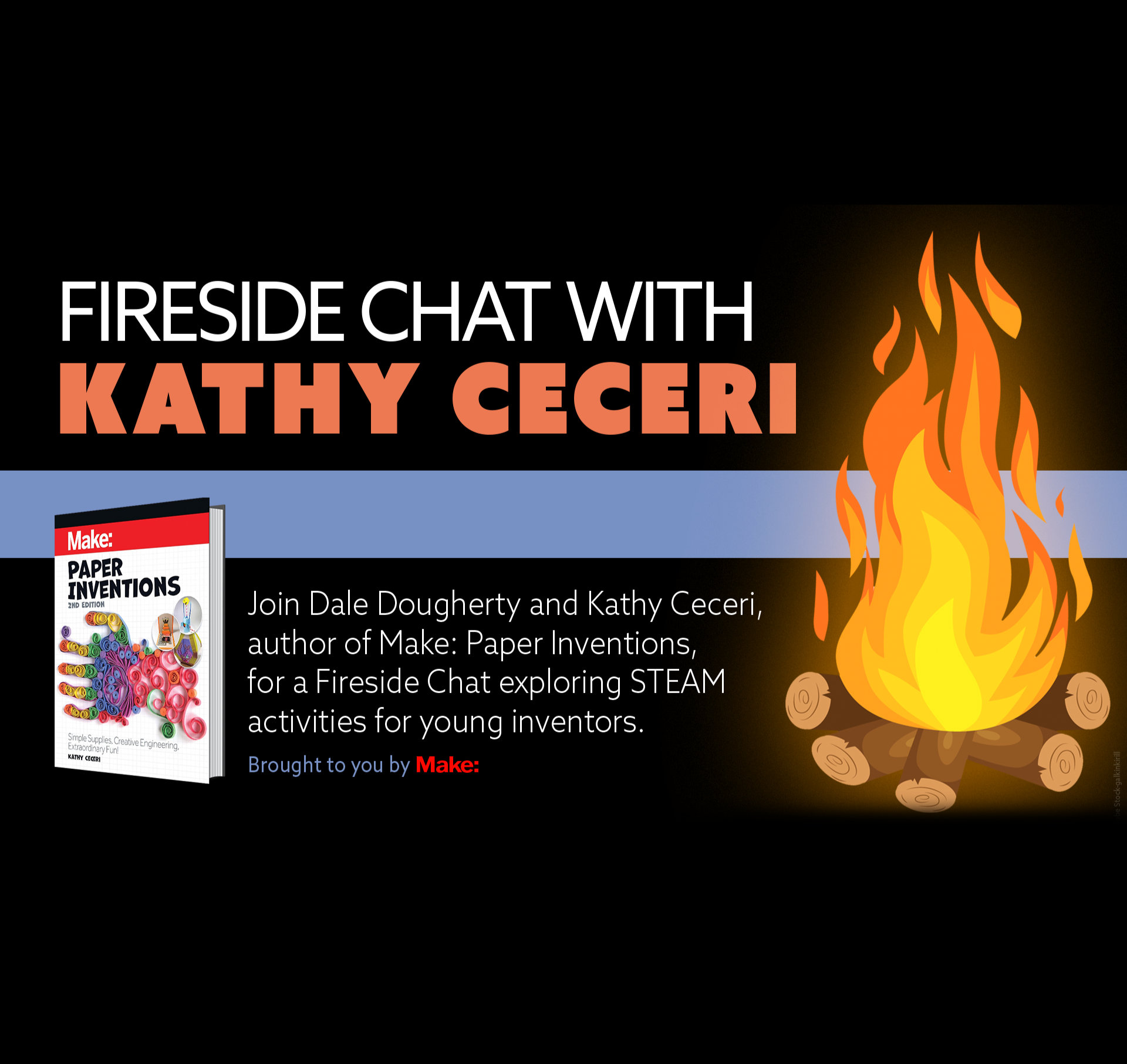
Some inventions arrive with a roar: rockets, robots, espresso machines that require a user manual and mild emotional courage. Others arrive quietly, folded into your hand, made from a sheet of paper, a strip of conductive tape, a battery, and the dangerous thought: “What happens if I try this?” That is exactly the delightful territory explored in Make:’s fireside chat with Kathy Ceceri, the author and educator behind Make: Paper Inventions.
This conversation is more than a casual author event. It is a celebration of paper as a serious material for play, engineering, art, math, and creative problem-solving. In the updated and revised edition of Paper Inventions, Ceceri turns humble supplies into moving machines, glowing drawings, programmable paper circuits, geometric puzzles, wearables, structures, and hands-on STEAM lessons that do not require a laboratory, a grant proposal, or a garage full of mysterious cables.
For makers, parents, teachers, homeschoolers, librarians, after-school leaders, and curious adults who still believe scissors are underrated technology, this fireside chat offers a warm doorway into the maker mindset. It reminds us that invention does not always begin with expensive tools. Sometimes it begins with a crease.
Why This Make: Fireside Chat Matters
Make: has long championed the idea that people learn deeply when they build, test, break, repair, and improve things with their own hands. That philosophy fits beautifully with Kathy Ceceri’s work. Her projects are not “crafts” in the throwaway sense of the word. They are small, approachable engineering experiences disguised as fun. Sneaky? A little. Effective? Absolutely.
The fireside chat brings Ceceri together with Dale Dougherty, a central voice in the modern maker movement and the founder of Make: magazine and Maker Faire. That pairing matters because both Make: and Ceceri’s books share a belief that creativity and technical learning should not be locked behind intimidating jargon. A paper circuit can teach electricity. A folded structure can teach geometry. A moving paper machine can teach cause and effect. A light-up greeting card can teach design thinking while also making someone say, “Wait, you made that?” which is one of the finest sentences in the English language.
The chat focuses on the revised edition of Make: Paper Inventions, a book built around more than 30 projects and variations. The range is wonderfully odd in the best maker tradition: paper circuits, switches, sensors, interactive art, geometric models, paper machines, foldable structures, programmable paper games, and even projects that move, spin, glow, or compute. In other words, it is the book equivalent of a table covered in supplies where every pile says, “Go ahead, poke me.”
Who Is Kathy Ceceri?
Kathy Ceceri is an author, educator, artist, and Maker known for hands-on STEAM activities that connect science, technology, engineering, art, and math. Her work often uses everyday materials such as paper, cardboard, tape, glue, simple electronics, and craft supplies. That choice is not accidental. It lowers the barrier to entry. Instead of asking learners to begin with fear, it invites them to begin with familiarity.
Ceceri has written more than a dozen activity books for young makers and families, including titles related to robots, musical inventions, edible inventions, fiber projects, coding, and paper engineering. She has also created learning materials and workshops for schools, museums, libraries, after-school programs, and organizations focused on creative technology. Her teaching style is practical, colorful, and refreshingly humane: try something, observe what happens, improve the design, and do not panic when the first version looks like it was assembled by a raccoon with ambition.
That is one reason her paper projects work so well. They make abstract ideas visible. Electricity becomes a path of copper tape. Geometry becomes a fold. Engineering becomes a structure that either stands up proudly or collapses in a dramatic little sigh. Both outcomes teach something.
What Is Make: Paper Inventions?
Make: Paper Inventions is a project-based guide that explores paper as a material for science, technology, engineering, art, and math. It includes illustrated instructions, supply lists, templates, and challenges that encourage readers to follow the steps or branch out into their own designs. That second part is important. A good maker book does not only tell you what to do; it gives you enough confidence to ask, “What else could this become?”
The book’s updated edition expands the idea of what paper can do. Readers can explore paper science, learn how papermaking works, build circuits, create light-up artwork, experiment with sensors, fold mathematical shapes, design structures, make simple machines, and test playful models. It treats paper as both an ancient invention and a modern prototyping tool. That is a neat trick for something you can usually find hiding beside the printer.
Paper as a STEAM Supermaterial
Paper is cheap, flexible, lightweight, easy to cut, easy to fold, and surprisingly strong when shaped well. Those properties make it ideal for STEAM learning. A flat sheet can become a bridge, a lantern, a hinge, a spring, a gear-like mechanism, a pop-up sculpture, or the base for an electrical circuit. Students can see how form changes function in real time.
When learners fold a strip into a Möbius loop, they meet topology without needing a graduate seminar. When they create a hexaflexagon, they touch mathematical surprise. When they build a paper cam sampler, they observe how circular motion can become up-and-down motion. When they tape an LED into a circuit, they discover that electrons are not just textbook ghosts; they can make a paper cat’s eyes glow. The cat, naturally, remains unimpressed. Cats are like that.
Highlights From the Fireside Chat Theme
The Make: fireside chat is built around Ceceri’s creative process, the revised book, and the broader value of hands-on STEAM. It is the kind of conversation that appeals to educators and makers because it is not only about finished projects. It is about how projects are imagined, tested, simplified, and turned into activities that other people can actually complete.
1. The Creative Process Behind Paper Inventions
One of the most useful parts of Ceceri’s approach is her emphasis on prototyping. She often begins with a goal: make a creature light up, make a model move, make a folded form behave in a surprising way, or make a concept easier to understand. Then comes the test version. It may be rough. It may be crooked. It may require tape in places where tape has no business being. But it reveals what works and what needs fixing.
This mirrors the engineering design process: ask, imagine, plan, create, test, improve. Paper makes that cycle fast and forgiving. If a design fails, you have not wasted a thousand-dollar part. You have wasted half a sheet of cardstock and possibly some dignity, both recoverable resources.
2. Projects That Fold, Pop, Spin, Glow, and Compute
The phrase “paper invention” may sound simple until you realize how broad the category becomes. Paper can form structures, carry circuits, hide switches, create motion, support sensors, and become part of a programmable interaction. Ceceri’s projects include traditional paper arts, math oddities, construction challenges, motorized designs, and programmable paper circuits.
That range is useful because learners do not all enter STEAM through the same door. Some love drawing. Some love gadgets. Some love puzzles. Some love making things that move. Some only show up because snacks were promised. A strong paper invention activity gives each learner a starting point and then quietly introduces new concepts along the way.
3. Making STEM Less Intimidating
Many people hear “electronics” and immediately picture soldering irons, confusing diagrams, and a drawer full of parts named by someone who clearly enjoyed abbreviations too much. Paper circuits soften that first step. A simple circuit made with copper tape, an LED, and a coin cell battery can show the same basic principle as a more formal breadboard setup, but it feels friendlier and more creative.
That is the genius of combining art and STEM. Learners are not merely assembling components. They are making a glowing poem, an interactive map, a pop-up card, a paper creature, or a tiny illuminated scene. The science is still there, but it is wrapped in expression. It is the educational equivalent of hiding vegetables in lasagna, except the vegetables are voltage.
Why Paper Inventions Belong in Classrooms, Libraries, and Makerspaces
Paper invention activities are perfect for environments where time, money, storage, and skill levels vary. A teacher can run a simple fold-and-test challenge with copy paper. A librarian can host a paper circuit workshop with a modest supply kit. A makerspace can turn paper mechanisms into a gateway toward robotics, coding, and fabrication. A parent can turn a rainy afternoon into a design lab at the kitchen table, assuming the table has not already been conquered by laundry.
These projects also encourage iteration. Learners can revise their models quickly. They can compare designs, test variables, and discuss why one structure held weight while another performed a slow-motion pancake impression. That conversation is where learning gets sticky. It moves from “I followed directions” to “I understand why this happened.”
For Teachers
Teachers can use paper inventions to connect science standards with creativity. A paper bridge can introduce compression, tension, and load distribution. A light-up card can introduce circuits, polarity, switches, and troubleshooting. A folded fractal can introduce patterns and mathematical recursion. Because the materials are accessible, the focus stays on thinking, testing, and explaining.
For Parents and Homeschoolers
Parents and homeschoolers can use the projects as flexible learning modules. One project can become a science lesson, an art session, a writing prompt, and a problem-solving challenge. After building a paper automaton, a child might write a story about the character it moves. After making recycled paper, they might research sustainability and material science. The project becomes a launchpad, not a worksheet with better lighting.
For Makerspaces and After-School Programs
Makerspaces often attract learners with different ages and abilities. Paper inventions are ideal because they scale. Beginners can cut, fold, and decorate. Advanced learners can add circuits, sensors, motors, or microcontrollers. Everyone can participate at a meaningful level, and the final results are easy to display. A wall full of glowing paper projects has a magical effect, like a science fair decided to wear a party hat.
Paper Circuits: Where Art Meets Electricity
Paper circuits deserve special attention because they transform electronics from a hidden system into a visible path. Conductive tape shows where electricity travels. LEDs reveal whether the circuit is complete. Switches can be made from folded tabs, flaps, sliders, or pressure points. Suddenly, a greeting card is not just a greeting card. It is an interface.
This matters because students often struggle to understand circuits when everything is abstract. Paper circuits let them trace the path with their eyes and fingers. They can see where the circuit opens, where it closes, where polarity matters, and why a short circuit causes disappointment instead of sparkle. That kind of visible troubleshooting builds confidence.
It also opens a door to coding and interaction. Once learners understand a simple light-up circuit, they can explore sensors, programmable boards, and responsive designs. A paper city might light up at night. A paper game might react to a player’s choice. A folded model might become a controller. Paper becomes a bridge between craft and computation.
The Maker Mindset: Try, Test, Tinker, Repeat
The most valuable lesson in a fireside chat like this may not be any single project. It is the maker mindset itself. Making teaches that mistakes are information. A failed fold tells you about geometry. A dark LED tells you about circuit continuity. A collapsing tower tells you about structural design and perhaps your overconfidence in tape.
This mindset helps learners become more resilient. Instead of asking, “Did I get it right?” they begin asking, “What can I change?” That shift is powerful. It turns frustration into investigation. It also makes learning more joyful, because the process becomes part of the reward.
How to Get the Most From a Kathy Ceceri Paper Inventions Session
If you are attending, watching, or recreating the spirit of the Make: fireside chat, bring curiosity more than perfection. You do not need to be an engineer. You do not need to be an artist. You need a willingness to fold the wrong side once, laugh about it, and keep going.
Start with simple supplies: paper, cardstock, scissors, tape, glue, markers, paper clips, straws, LEDs, coin cell batteries, and conductive tape if you are exploring circuits. Keep the first project small. A successful tiny invention is better than an ambitious half-finished contraption that slowly becomes part of the furniture.
Then ask good maker questions: What moves? What lights up? What changes when I fold it differently? Can this hold more weight? Can I make the switch easier to press? Can I turn this model into a game? Can I explain how it works to someone else?
The explanation step is especially important. When learners describe their design choices, they turn activity into understanding. They practice communication, reasoning, and reflection. Also, they get to say, “Behold my invention,” which everyone should be allowed to say at least once.
Experience Notes: What a Paper Invention Workshop Feels Like
A good paper invention session has a very specific sound. It begins with the shuffle of paper, the snip of scissors, and the soft rip of tape being pulled by someone who definitely cut more tape than needed. Then comes the first wave of quiet concentration. Heads tilt. Fingers press creases flat. Someone asks whether the shiny side of the conductive tape matters. Someone else discovers that LEDs have a positive and negative leg and reacts as if the LED has been keeping secrets.
The room changes when the first project works. A tiny light turns on, a folded mechanism pops open, a paper structure stands taller than expected, and suddenly the energy shifts. People lean over to see. A learner who was nervous five minutes earlier says, “Mine worked!” with the kind of pride usually reserved for launching a satellite. The project may be made of paper, tape, and a battery, but the confidence is very real.
In my experience observing and designing hands-on learning activities, paper projects are powerful because they are low-pressure. Nobody expects a sheet of paper to behave like a polished product, so learners are more willing to experiment. That freedom is educational gold. A student may try three bridge designs in ten minutes. A parent may build a circuit beside a child and discover that both of them are beginners, which is secretly one of the best family learning moments. A teacher may watch a quiet student become the class expert because they figured out how to make a better switch.
Paper also invites personalization. A circuit can become a glowing dragon, a city skyline, a constellation map, or a birthday card. A folded structure can become a sculpture, a math model, or a tiny stage set. A paper machine can become a robot, a rover, a dancing creature, or whatever odd little character the maker decides has been waiting inside the cardstock. This personal layer matters because learners care more when the project feels like theirs.
Of course, things go wrong. Batteries flip backward. Tape tears. Folds wander off course like tourists without GPS. Glue appears where no glue was requested. But those small failures are not interruptions; they are the lesson. Troubleshooting teaches patience, observation, and creative recovery. It also teaches that “messy” and “smart” can occupy the same table.
That is why a fireside chat with Kathy Ceceri feels relevant beyond the book itself. It is not just about making paper objects. It is about making learners braver. It is about giving people permission to start with simple materials and build toward complex ideas. It is about showing that engineering can be colorful, math can be foldable, electronics can be friendly, and invention can begin before anyone finds the fancy tools.
By the end of a paper invention experience, the table is usually chaotic. There are scraps everywhere. Someone has lost the good scissors. A few projects glow. A few do not. But the room feels alive with questions, and that is the real success. Paper may be thin, but as a doorway into making, it is remarkably strong.
Why This Topic Still Has Strong SEO Value
The title “Join Us Our Fireside Chat With Paper Inventions Author Kathy Ceceri! – Make:” combines several search-friendly ideas: Make:, Kathy Ceceri, Paper Inventions, fireside chat, STEAM activities, paper circuits, and hands-on maker education. These are not empty keywords. They describe a real intersection of interests: families searching for creative projects, teachers searching for classroom STEAM ideas, librarians planning maker programs, and DIY enthusiasts looking for low-cost invention activities.
Search engines increasingly reward helpful content that answers real user intent. An article on this topic should do more than repeat event details. It should explain why the chat matters, who Kathy Ceceri is, what the book offers, how paper inventions support STEAM learning, and how readers can apply the ideas at home or in educational spaces. That makes the content useful long after the live event date has passed.
Final Thoughts: A Fireside Chat Worth Folding Into Your Maker Life
The Make: fireside chat with Kathy Ceceri is a reminder that invention does not need to begin with a big budget or a specialized lab. It can begin with paper, curiosity, and a willingness to test one more version. Make: Paper Inventions celebrates that spirit by turning familiar materials into vehicles for science, engineering, math, art, and playful discovery.
For educators, the book offers structured, creative projects that can fit classrooms, libraries, camps, and makerspaces. For parents, it offers screen-light alternatives that still feel modern and smart. For young makers, it offers permission to explore. For adults, it offers a cheerful warning: you may think you are helping a child make a paper circuit, but there is a strong chance you will end up making three of your own.
That is the charm of paper invention. It starts small. It folds outward. And before long, a simple sheet becomes a machine, a sculpture, a circuit, a puzzle, or a bright little proof that making things is still one of the best ways to understand the world.