There are two kinds of movie fans in the world: people who can explain a film with emotional intelligence, theme analysis, and a respectful nod to cinematographyand people who can summarize Titanic as “a woman survives a cruise and keeps the jewelry.” The second group is obviously more fun at parties.
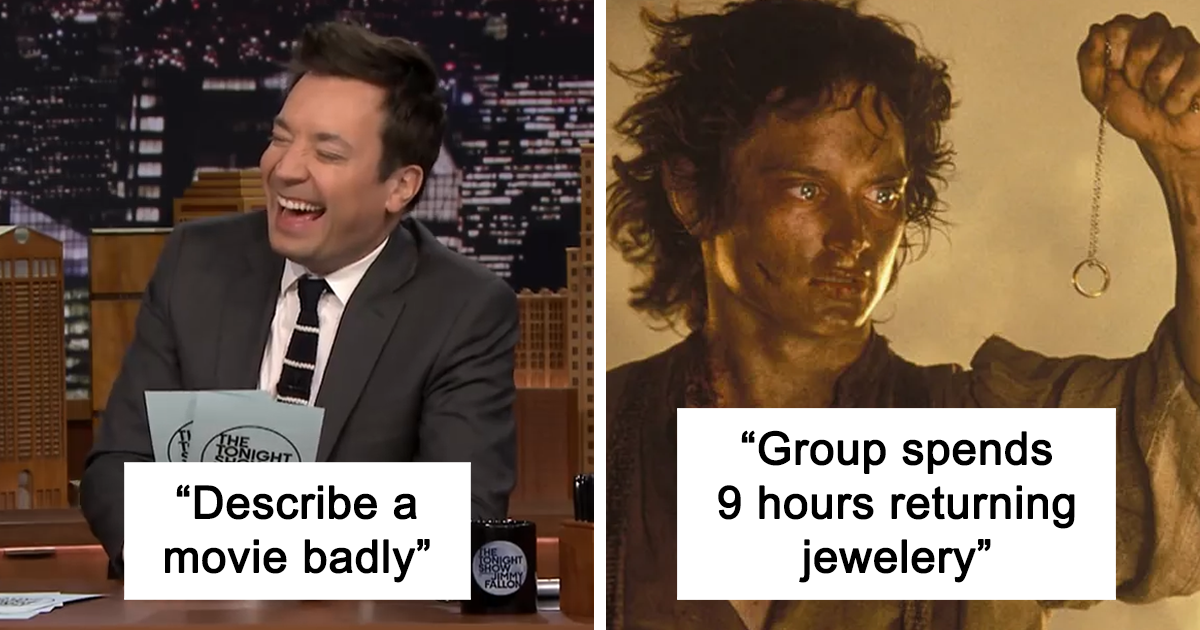
That is why Jimmy Fallon’s “describe a movie badly” challenge hit the internet right in its popcorn bucket. As part of his long-running “Tonight Show Hashtags” style of audience participation, Fallon has often invited viewers to answer a simple prompt with the funniest, weirdest, most painfully accurate responses they can fit into a short post. This time, the mission was deliciously simple: take a famous movie and explain it as badly as possible.
The result was a flood of movie plot descriptions that were technically correct, emotionally chaotic, and funny enough to make you rethink films you have watched a dozen times. Suddenly, beloved classics became workplace disasters, superhero epics became family therapy sessions with lasers, and romantic dramas turned into customer-service complaints with better lighting.
Why “Describe A Movie Badly” Is So Funny
The joke works because it takes something grand and makes it painfully ordinary. Movies are designed to sweep us away. They use music, editing, lighting, and dramatic close-ups to convince us that what we are watching is important. A bad movie description does the opposite. It walks into the theater, turns on the fluorescent lights, and says, “Actually, this is just about a guy who refuses to throw away jewelry.”
That sudden drop from epic to ridiculous is the comedy. The Lord of the Rings becomes a long hiking trip with a suspicious ring. Jaws becomes a local government failure involving a beach and one very committed fish. Jurassic Park becomes a billionaire’s unsafe petting zoo. The worse the description, the better the jokeespecially when it is still accurate enough that fans can guess the title.
It also works because movie fans love recognition. Half the fun is solving the riddle before the answer is revealed. The other half is realizing that your favorite film can be reduced to one absurd sentence without technically being wrong. That is the magic formula: familiar story, unexpected angle, and just enough disrespect to make cinephiles laugh instead of call security.
The Internet Turned Movie Summaries Into A Comedy Sport
Badly describing movies is not just a random joke format; it has become a full-blown internet pastime. The idea overlaps with popular hashtag games like “explain a film plot badly,” where users deliberately summarize movies in the most misleading, literal, or morally questionable way possible. The best entries sound like they came from someone who watched the movie while folding laundry in another room.
Fallon’s version gave the trend a late-night shine. His audience already knows the rhythm: a prompt goes out, people compete to be the funniest, and the most shareable responses become part of the show’s comedy loop. It is a clever format because it lets everyday viewers write the punchlines. In a way, it turns social media into a giant writers’ roommessy, unpredictable, and full of people who should probably not be trusted with studio notes.
40 Hilarious Ways To Describe Famous Movies Badly
Below are 40 rewritten, original-style examples that capture the spirit of the challenge: recognizable movies explained with maximum nonsense and minimum dignity.
- Titanic: A rich woman has a stressful boat trip, loses a necklace, and remembers the whole thing very dramatically.
- Finding Nemo: An anxious father crosses the ocean because his son ignored one very basic safety rule.
- Jurassic Park: A billionaire opens a zoo before checking whether the guests are on the menu.
- Jaws: A small town learns that tourism and marine biology should not be managed by the same committee.
- Home Alone: A family forgets a child, and the child responds with domestic terrorism for beginners.
- The Wizard of Oz: A girl travels with strangers to meet a fraud, then discovers footwear was the solution.
- Star Wars: A farm boy gets dragged into a family argument that somehow involves planets exploding.
- The Lord of the Rings: A group of friends takes the longest possible route to return one piece of jewelry.
- Harry Potter: A boy attends a school where the safety plan is mostly “good luck, children.”
- Frozen: A kingdom shuts down because one sister has feelings and the other has no coat.
- Mean Girls: A new student discovers high school is a wildlife documentary with lip gloss.
- The Matrix: A man chooses the wrong pill and immediately gets a much harder job.
- Batman Begins: A billionaire copes with childhood trauma by dressing like a cave animal.
- Spider-Man: A teenager gets bitten, skips medical attention, and becomes responsible for New York traffic incidents.
- Avengers: Endgame: A group project becomes complicated after half the class disappears.
- The Lion King: A prince runs away after family drama and later returns with backup dancers.
- Beauty and the Beast: A woman improves a castle’s emotional climate by reading books and tolerating furniture.
- Cinderella: A girl attends one party and causes a kingdom-wide shoe investigation.
- Shrek: A swamp owner complains about neighbors and accidentally finds love.
- Toy Story: Toys experience workplace jealousy every time a child gets a birthday present.
- Up: An elderly man weaponizes balloons to avoid real estate pressure.
- Ratatouille: A restaurant succeeds after violating every health code in France.
- The Hunger Games: A government turns teen trauma into prime-time entertainment.
- Twilight: A girl moves to a rainy town and falls for a very old man with excellent cheekbones.
- Forrest Gump: A man accidentally becomes involved in every history lesson.
- Back to the Future: A teenager travels through time and nearly deletes himself by being socially awkward.
- Mission: Impossible: A man keeps accepting jobs that are clearly described as impossible.
- Top Gun: Pilots compete to see who can wear sunglasses with the most emotional intensity.
- Cast Away: A delivery worker forms a deep bond with sporting equipment.
- The Notebook: Two attractive people argue in the rain for several decades.
- Pretty Woman: A businessman improves his personality after shopping with someone more interesting.
- Rocky: A man gets punched repeatedly and calls it personal growth.
- Black Panther: A king’s workplace promotion is interrupted by family history and excellent costume design.
- Doctor Strange: A surgeon hurts his hands and becomes a wizard with a cape problem.
- Indiana Jones: A professor steals artifacts slightly faster than everyone else.
- Pirates of the Caribbean: A pirate, a blacksmith, and a governor’s daughter create major scheduling problems at sea.
- Alien: A workplace inspection goes badly after an employee brings an unauthorized organism on board.
- Scream: A town discovers that caller ID would have solved several problems.
- Die Hard: A holiday office party becomes a barefoot security training seminar.
- La La Land: Two talented people sing beautifully while making questionable relationship decisions in traffic.
What The Best Responses Have In Common
The funniest bad descriptions usually share three ingredients. First, they are specific enough that fans can identify the movie. A vague joke like “people run around and scream” could describe almost every blockbuster since 1975. But “a delivery worker befriends a volleyball” points straight to Cast Away.
Second, they reframe the hero’s journey as something embarrassingly normal. Instead of “a chosen one rises against evil,” the joke becomes “a student repeatedly violates school rules while adults look confused.” That small change makes the story feel both silly and strangely honest.
Third, the best descriptions sound like they were written by someone who has no interest in respecting genre conventions. Romance becomes poor communication. Adventure becomes bad travel planning. Horror becomes a failure to leave the house. Superhero movies become HR problems with capes. That is why the format never runs out of steam: every movie, no matter how serious, has a goofy skeleton underneath.
Why Jimmy Fallon’s Hashtag Challenges Keep Working
Fallon’s hashtag games work because they ask for participation, not perfection. Viewers do not need to be professional comedians. They only need one funny thought, one clever twist, or one painfully literal observation. That low barrier makes the format feel welcoming. Anyone can play, and the reward is simple: maybe your joke gets noticed, shared, or read aloud.
It also fits the way people consume entertainment now. A late-night segment no longer lives only on television. It becomes a clip, a post, a reaction, a list, and a conversation. The best hashtag prompts are easy to understand in one second and fun to answer in under a minute. “Describe a movie badly” is perfect because almost everyone has a movie they love, hate, or remember incorrectly with great confidence.
There is also a friendly chaos to the format. Unlike a scripted monologue, audience responses are unpredictable. Some jokes are clever. Some are strange. Some sound like they were written by a person who watched the movie through a neighbor’s window. That unpredictability gives the challenge its charm.
The Secret Genius Of Bad Summaries
Bad movie summaries are not just jokes; they are tiny acts of criticism. They reveal how weird stories become when stripped of music, emotion, and cinematic polish. Jurassic Park is a thrilling science-fiction adventure, but it is also a corporate safety disaster. The Little Mermaid is a fairy tale about love and identity, but it is also a story about a teenager making a risky contract with a sea witch after seeing one handsome stranger.
That is why the meme appeals to both casual viewers and film nerds. Casual viewers enjoy the punchline. Film nerds enjoy the compression. To write a great bad description, you have to understand the movie well enough to distort it accurately. It is satire with a snackable serving size.
How To Write Your Own Bad Movie Description
If you want to play the game, start by removing the genre. Do not call Mission: Impossible an action movie; call it a recurring workplace hazard. Do not call Beauty and the Beast a romance; call it a home renovation story with emotional furniture. Once the genre disappears, the absurdity appears.
Next, focus on the most literal version of the plot. What actually happens? Who makes the worst decision? What would the movie sound like if it were explained by a bored insurance adjuster? The duller the wording, the funnier the contrast.
Finally, avoid making the description too long. The best versions are short, sharp, and slightly rude. You want readers to laugh, guess the title, and immediately think of five more examples. That instant “I can do one better” reaction is exactly how a hashtag challenge turns into a viral game.
Experiences: Why This Topic Makes Movie Night More Fun
The best thing about the “describe a movie badly” challenge is that it does not have to stay online. It is a perfect movie-night game, especially when the group cannot decide what to watch and everyone has already spent 25 minutes scrolling through streaming apps like archaeologists searching for meaning.
One fun way to play is to write movie titles on slips of paper, drop them into a bowl, and let each person pull one. They have thirty seconds to describe the movie as badly as possible while everyone else guesses. The description cannot use character names, actor names, or famous quotes. That rule keeps people from saying, “It is the one with Batman,” which is not a joke; it is surrender.
The game gets even better when people describe movies they barely remember. Someone who saw Inception once in 2010 might confidently explain it as “a man takes naps professionally and ruins everyone else’s sleep schedule.” Is that complete? No. Is it spiritually correct? Absolutely.
Families can play it too, though the results may expose generational chaos. A parent might describe Frozen as “the snowman one,” while a child explains Star Wars as “space people with glowing sticks and daddy issues.” Both are valid. Neither should be used on a film school exam.
This kind of humor also helps people reconnect with movies they know too well. We often talk about films in polished language: masterpiece, classic, blockbuster, award-worthy, unforgettable. Bad descriptions knock that language off its pedestal. They remind us that even the most legendary stories can sound ridiculous when summarized from the wrong angle.
There is something refreshing about that. It makes movie culture feel less serious and more social. You do not need to know box-office numbers, director trivia, or the complete timeline of a cinematic universe. You just need to notice that Home Alone is basically a child turning a house into a medieval defense system.
For writers, the game is also a surprisingly good creativity exercise. It teaches compression, misdirection, and point of view. A normal summary explains what a story is about. A bad summary reveals what else it could be about if you squint, tilt your head, and remove all emotional context. That is a useful skill for comedy writing, headline writing, and social media captions.
For friends, it is simply an excuse to laugh. The best movie conversations are not always the serious ones about symbolism and character arcs. Sometimes they are the ones where someone says, “Wait, isn’t Finding Nemo just a dad chasing a kid who touched a boat?” and the entire room loses focus for five minutes.
Conclusion
Jimmy Fallon’s “describe a movie badly” prompt worked because it gave the internet exactly what it loves: a simple rule, a familiar topic, and endless room for clever nonsense. The funniest responses do not destroy movies; they make us love them in a new, slightly more chaotic way.
Whether it is a superhero epic reduced to a family argument, a romance reframed as poor communication, or a beloved animated classic described like a legal complaint, the format proves that every great story has a ridiculous version hiding underneath. And honestly, that version might be the one we quote the most.