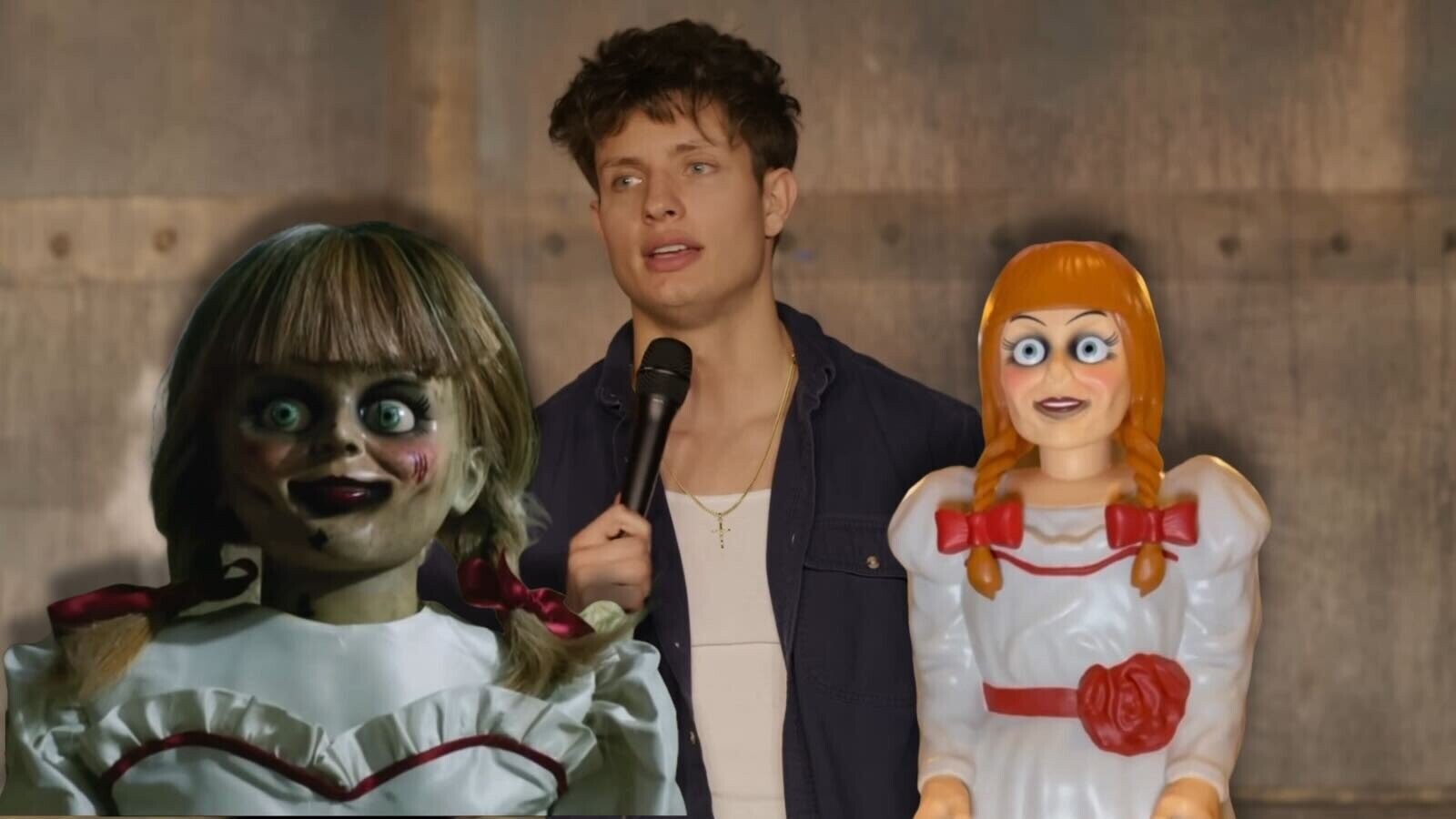
When a comedian becomes the temporary caretaker of the most famous allegedly haunted doll in America, the internet is not going to respond with calm, measured thoughts and a nice cup of chamomile. It is going to scream, make memes, imagine demonic brand partnerships, and ask the obvious question: is Matt Rife already turning Annabelle into a money machine?
The answer is yes, but not in the cartoon-villain way the headline might suggest. There is no obvious evidence that Rife has turned his regular comedy merch store into an Annabelle gift shop full of cursed crop tops and haunted hoodies. But there is strong evidence that the broader Warren museum ecosystem is already being monetized through overnight stays, paid museum experiences, related collectibles, and plans for a bigger public attraction. In other words, this is less “buy my spooky T-shirt” and more “welcome to the haunted experience economy.”
That distinction matters. It changes the story from a cheap celebrity side hustle into something more layered: part paranormal fandom, part horror tourism, part influencer-era spectacle, and part genuine business strategy. And because Annabelle is not just any creepy doll but a pop-culture artifact linked to the Warren mythology, the stakes feel larger, stranger, and, naturally, a little tackier.
The Short Answer: Yes, but With a Big Asterisk
If by “cashing in” you mean using his connection to Annabelle and the Warren collection to help sell tickets, experiences, access, and collectibles, then yes, that appears to be happening already. If by “cashing in” you mean Matt Rife personally slapping Annabelle on his mainstream comedy brand and selling it directly to fans through his standard merch pipeline, the case is much weaker.
That nuance is the whole story. Rife and Elton Castee publicly framed the deal around being caretakers and legal guardians of the collection for a limited period rather than permanent owners of the artifacts themselves. So the money angle is not about owning a horror icon outright. It is about operating the house, building a museum business around the Warren legacy, and packaging access to that world in a way horror fans are clearly willing to pay for.
And in fairness, horror tourism has always been a business. Haunted houses, ghost tours, cursed-object exhibits, paranormal conventions, and “sleep where something weird happened” packages are not new. What feels new here is the celebrity layer. When a high-profile comic with a massive online following steps into the story, the haunted doll stops being just a paranormal object and becomes a headline-generating entertainment asset.
What Matt Rife Actually Has, and What He Does Not
Before the internet invents a legal contract written in ectoplasm, it helps to get the arrangement straight. Rife and Castee announced that they had acquired Ed and Lorraine Warren’s former home and museum property and had become caretakers or legal guardians of the famous collection, including Annabelle. But the artifacts were still described publicly as remaining under the ownership of the Warren family, with Rife and Castee operating under a time-limited agreement.
That is a major difference. Full ownership would suggest total control over the collection’s long-term future. Caretaking and guardianship suggest operational control, publicity control, and business opportunity, but not total personal possession in the forever-and-ever sense. Think less “I bought the crown jewels” and more “I got the keys to the very weird castle for a while.”
Why does that matter for the money question? Because it shows the monetization is tied to the experience business around the artifacts rather than a clean celebrity merchandise play. The house, the story, the access, the timed entry, the overnight booking, the guided viewing, the VIP add-ons, the photo opportunities, the future museum rolloutthat is where the action is.
Where the Money Seems to Be Coming From
1. Overnight Stays
One of the most obvious revenue streams is the overnight-stay model tied to the Warren house. That is not subtle. It is a premium horror experience sold directly to people who want a brush with the paranormal, the pop culture of The Conjuring, or just a story that will dominate every group chat they are in for six months.
This model works because it sells atmosphere, exclusivity, and bragging rights all at once. You are not simply renting a room. You are buying a narrative: “I spent the night at the Warren house.” For horror fans, that sentence is a souvenir in itself. The actual bed is almost secondary. No one tells their friends, “The pillows were fine, and the spectral dread was well ventilated.”
From a business perspective, it is clever. The location already has cultural value. The Warren name already has audience recognition. Annabelle already has instant headline power. Put those elements together and you do not need to invent demand from scratch. You just need to organize it, price it, and make it feel exclusive enough to justify the premium.
2. Paid Museum Experiences
The monetization does not stop with overnight guests. There are also paid museum experiences and higher-tier VIP options tied to Warren artifacts and Annabelle-related access. That is where the business starts to look especially modern: timed entry, guided presentation, limited groups, special-photo moments, add-on value, and language that makes the event feel curated rather than merely crowded.
This is the same basic playbook used by immersive exhibits, fan conventions, live attractions, and pop-up entertainment spaces across the country. Horror is particularly well suited to it because fear, mystery, and scarcity are excellent salespeople. If people think an item is legendary, dangerous, or just creepy enough to make them laugh nervously, they will often pay for the privilege of seeing it in person.
And yes, when Annabelle is part of the pitch, the public interest gets a lot stronger. Annabelle is not obscure lore. She is arguably the most recognizable haunted doll in American pop culture. Once her name is attached to a ticketed event, the event no longer needs much explaining.
3. Related Collectibles and Signed Items
This is where the phrase “cashing in” starts sounding less metaphorical. Official sales connected to the Warren operation include collectible items related to Raggedy Ann and Andy dolls, marketed through the haunted-house business and linked to the museum story. That may not be a literal “Annabelle action figure” situation, but it is still a form of monetization built from the same haunted-aura economy.
And because some of those items are signed by Rife and Castee, the celebrity angle is no longer hiding in the shadows like a polite Victorian ghost. It is right there on the certificate of authenticity. The pitch is not only “this object is connected to the museum.” It is also “this object is connected to the current public faces of the museum.” That is branding. Spooky branding, but branding all the same.
4. The Bigger Museum Plan
The most telling sign that this is already a businessnot just a hobby with unusually haunted paperworkis the push toward a more permanent public museum concept. Reports about a proposed Salem location suggest a ticketed, timed-entry attraction with a broader operating model and a bigger commercial vision.
That matters because Salem is not some random pin on a map. It is one of the most recognizable destinations in America for spooky tourism, witch-trial fascination, paranormal retail, and gothic curiosity. Opening a Warren-branded attraction there would not be an accidental side quest. It would be a serious attempt to scale the business.
So when people ask whether Matt Rife is already cashing in, the fairest answer is this: the project around Annabelle is already moving like a commercial entertainment brand. Whether you find that smart, opportunistic, cringey, fun, or all four before breakfast is a separate question.
Why Annabelle Is So Marketable in the First Place
Annabelle works as a business asset because she sits at the crossroads of folklore, horror cinema, tabloid curiosity, and museum-style display. She is not just a doll. She is a symbol. Mention her name and people instantly summon a bundle of associations: the Warrens, demonic stories, glass cases, supernatural warnings, movie franchises, and the timeless human instinct to pay money to be frightened in a controlled environment.
That is why the Annabelle connection matters more than the average haunted-object story. If someone announces they are the keeper of “an allegedly cursed ceramic rooster from a basement in New Jersey,” that may interest twelve people and one deeply committed podcast host. Annabelle, meanwhile, is instantly legible to mainstream audiences.
Matt Rife also brings his own built-in audience. He already understands social attention, ticketed live entertainment, viral clips, and fan engagement. Even if his interest in horror is completely sincere, he is still someone with the exact modern skill set needed to transform niche fascination into consumer demand. That does not automatically make the project cynical. It just means the project has someone attached to it who knows how to make people look.
Why the Timing Makes People Side-Eye the Whole Thing
Part of the reason the monetization question feels sharp is timing. Annabelle stayed in the news because of public fascination, the ongoing Warren mythology, and the death of paranormal investigator Dan Rivera in 2025 while the doll was on tour. Later reporting said his death was cardiac-related and not evidence of any supernatural event. But once a story like that enters public conversation, it deepens the aura around the object whether skeptics like it or not.
So when a celebrity then steps in, announces guardianship, and a monetized attraction ecosystem quickly expands, people naturally start asking whether this is reverence, fandom, entrepreneurship, or a highly polished blend of all three. The answer is probably the blend. Most modern entertainment ventures are.
There is also the simple optics problem. The Warrens and their collection occupy a strange place in American culture. For believers, this material is serious and spiritually dangerous. For skeptics, it is sensational storytelling with good marketing. For movie fans, it is beloved horror lore. Trying to build a business around that territory means you inherit every argument attached to it. You do not just get the doll. You get the baggage, the mythology, and the side-eyes.
So, Is Matt Rife Already Cashing In?
Yesif we use the phrase carefully. He does not appear to be monetizing Annabelle primarily through his standard comedy storefront. But he is part of a broader operation that is already monetizing access to the Warren property, Annabelle-adjacent experiences, VIP events, signed collectibles, and a future public museum concept. That is not hypothetical. That is the business model taking shape in real time.
At the same time, “cashing in” can sound like a cheap stunt with zero substance behind it. The reality looks more sophisticated than that. This is a horror-tourism business built on a famous paranormal archive, now supercharged by celebrity visibility and social-media savvy. It is a monetized myth machine, yes, but also a logical evolution of how American entertainment packages lore in 2026.
So the cleanest conclusion is this: Matt Rife is not just sitting beside Annabelle and hoping the doll starts Venmoing him. He is attached to an expanding haunted-experience brand that clearly sees the commercial value of the Warren legacy. Whether that counts as brilliant entrepreneurship or tasteful nonsense with excellent timing depends on how much patience you have for cursed dolls and modern marketing existing in the same sentence.
Experiences Related to the Topic: What the Annabelle Economy Feels Like on the Ground
If you want to understand why people believe Matt Rife is already cashing in, do not start with internet jokes. Start with the experience being sold. The haunted-house model around the Warren brand is built to turn a famous object into a live event. That means a visitor is not just reading about Annabelle online or seeing a photo in an article. They are moving through a structured, timed, emotionally loaded environment designed to make the story feel immediate.
Imagine arriving for one of these experiences. You are not walking into a dusty little roadside museum where someone lazily points at a shelf and says, “Yep, that one’s cursed.” You are entering a managed attraction with rules, scheduling, limitations, protection language, and a clear sense that access itself is the product. There are waivers. There are restrictions. There are staff. There is often a strong emphasis on respecting the space, respecting the artifacts, and not treating the visit like a free-for-all content farm.
That structure matters because it adds psychological value. The more controlled the environment feels, the more meaningful the audience assumes the artifacts must be. If guests are told when they may enter, how long they may stay, where they can take photos, where they cannot film, and how close they can get to Annabelle, the item begins to feel less like a prop and more like a ritualized object. Even skeptics can be affected by that framing. Atmosphere is powerful. Horror has known that forever.
Then there is the social layer. Visitors are not just buying access to a creepy room. They are buying a story they can retell. They can say they signed a waiver, saw the famous doll, walked through the Warren setting, and took part in something that felt halfway between a museum exhibit and a paranormal challenge. That combination is catnip for horror fans, curiosity seekers, and people whose ideal vacation memory includes the phrase, “You are not going to believe what we did this weekend.”
There is also an emotional split in the audience that makes the experience even more marketable. Some guests arrive as true believers. Others arrive as playful skeptics. Others just want a weird memory and a photo. The attraction works for all three groups because it does not require universal belief. It only requires fascination. Annabelle can function simultaneously as sacred threat, campy icon, and premium entertainment object. That is a rare kind of cultural flexibility, and it is excellent for business.
In that sense, the “experience” is the real product, not merely the doll. Annabelle is the anchor, the headline, the magnet. But what people are ultimately paying for is controlled proximity to a legend. That is why the question of whether Matt Rife is cashing in keeps getting louder. Because the business around the doll does not depend on proving anything supernatural. It only depends on making the public feel that getting close to the legend is worth the price of admission. So far, plenty of people seem to agree.
Final Takeaway
Matt Rife appears to be doing what modern entertainers, creators, and attraction operators do best: turning attention into an experience and experience into revenue. Annabelle just happens to be the world’s creepiest brand ambassador. The result is a haunted-business model that is already far beyond rumor, yet still weird enough to make every sentence about it sound like it was generated during a thunderstorm.
So yes, he is already cashing inbut mostly through a growing paranormal hospitality and museum venture, not through a simple celebrity-merch grab. The doll is famous. The Warren name is powerful. The audience is curious. And in America, curiosity plus timed entry plus VIP access almost always equals one thing: somebody is selling tickets.