Note: Source links intentionally omitted as requested.
For a lot of makers, multicolor 3D printing used to feel like a magic trick performed by somebody else’s printer. You would watch clean color swaps, tidy spool handling, and polished slicer workflows on social media, then turn back to your own machine and whisper, “Cool. Mine still argues with a single spool of PLA.” That gap between dream and reality is exactly why BoxTurtle has people paying attention.
In today’s 3D printing world, “AMS” has become shorthand for the kind of automated material system that stores filament, feeds it automatically, and switches colors or materials without requiring a human to babysit the machine every few minutes. Closed ecosystems made that experience mainstream. Open-source users, especially Klipper and Voron enthusiasts, have been waiting for something that offers similar convenience without forcing them into a locked-down hardware universe. BoxTurtle is one of the clearest answers yet.
So, is BoxTurtle really the open-source AMS we’ve been waiting for? The honest answer is: maybe yes, but only if you understand what “waiting for” actually means. If you want a polished, plug-and-print appliance that behaves like a toaster with better hobbies, BoxTurtle is not that. If you want a highly capable, community-driven, repairable, configurable, and genuinely ambitious open-source filament-changing platform for Klipper machines, then BoxTurtle starts looking very special.
What BoxTurtle Actually Is
BoxTurtle is best described as an open-source, AMS-style filament changer designed for Klipper-based 3D printers. That description matters because it tells you two things right away. First, this is not just a random spool rack with delusions of grandeur. Second, it is aimed squarely at users who want automation layered onto an open machine, not users who want to buy a closed printer and never think about what happens behind the touchscreen.
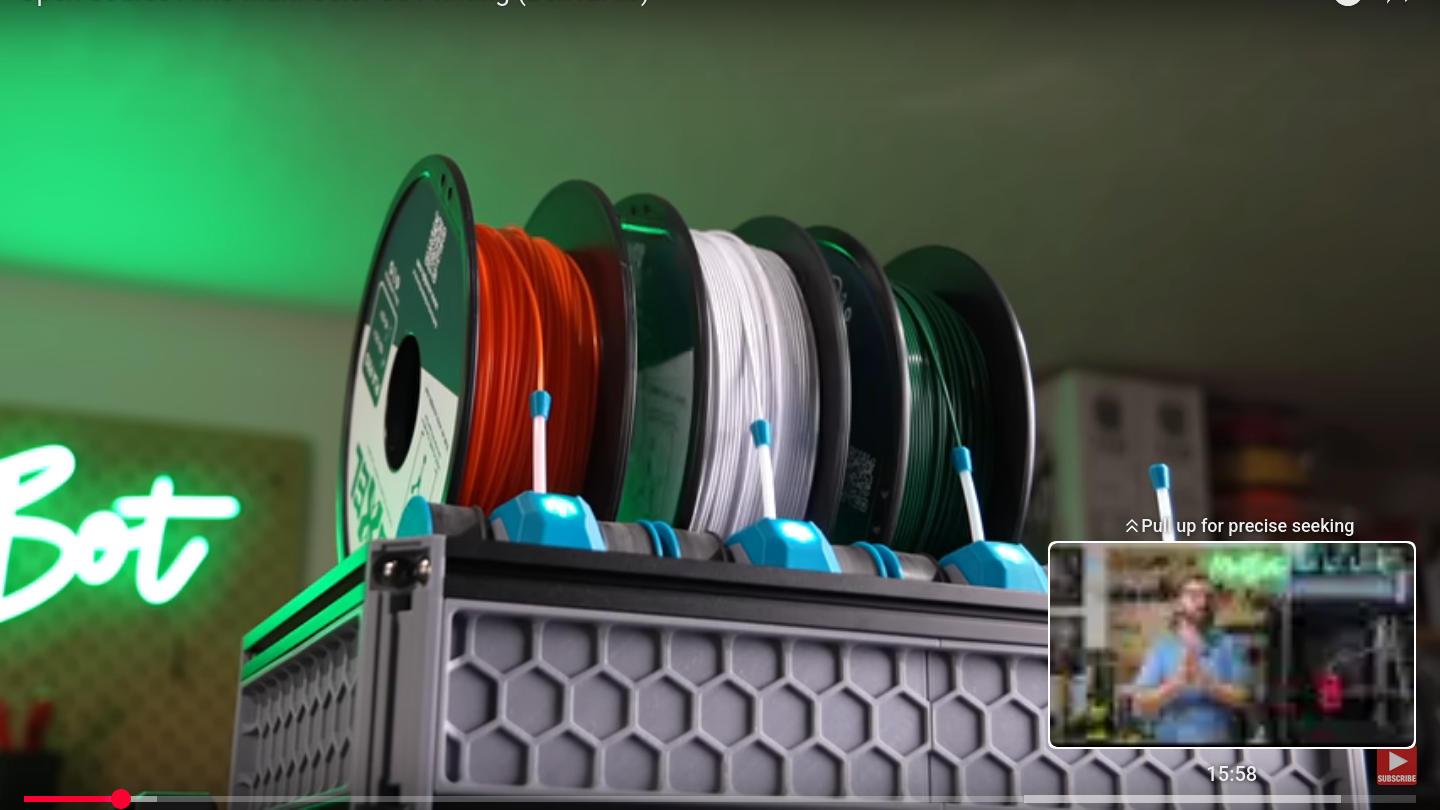
The design philosophy is surprisingly practical. BoxTurtle uses a lane-based setup, where each lane gets its own dedicated extruder to move filament to and from the toolhead. Filament from those lanes merges into a hub or combiner with sensing along the way, and spool handling is supported by top-fed electric respoolers. In plain English: each filament path has its own job, the machine tries to keep the spaghetti under control, and the system is built to automate the annoying part of color swapping instead of pretending tangled filament is a personality trait.
Why That Design Matters
Older DIY multi-material systems often asked users to accept a trade: low cost and open design in exchange for fussy loading, awkward rewinding, and enough calibration sessions to make a grown hobbyist stare blankly into the middle distance. BoxTurtle tries to move past that compromise. Its architecture is modular, purpose-built, and paired with the AFC-Klipper add-on, which gives the software side more structure than many earlier DIY setups ever had.
That software layer is a big deal. Hardware is only half the story in automated filament changing. If your machine cannot reliably detect movement, loading, jams, or toolhead state, then the whole project turns into an expensive sculpture with stepper motors. BoxTurtle’s ecosystem is clearly trying to solve both the physical mechanics and the workflow logic at the same time.
Why Makers Have Been Waiting for an Open-Source AMS
Let’s give credit where it is due: closed-system printers changed expectations. Bambu Lab did not invent multicolor printing, but it helped turn the AMS concept into something ordinary users could understand and trust. That shifted the market. Suddenly, people were not just asking whether multicolor printing was possible. They were asking why it could not also be easy.
That question put open-source makers in an awkward position. Open hardware has always been better at experimentation, customization, and repairability. Closed systems, meanwhile, got better at polished user experience. So while open-source users could build incredible machines, they still had to admit that convenience was winning the popularity contest.
This is the hole BoxTurtle tries to fill. It promises an experience closer to what users now expect from an AMS-style workflow, but without requiring them to give up Klipper, modding freedom, or community-driven iteration. For Voron builders and other tinkerers, that is a very attractive pitch.
The BoxTurtle Advantage Over “Classic DIY Pain”
The strongest argument for BoxTurtle is not that it is open source. Open source alone is not a feature if the result is miserable to build, harder to tune, and less reliable than a shoebox full of regret. The stronger argument is that BoxTurtle feels like an open-source project that understands the lessons of commercial success.
It is modular. It is documentation-heavy. It has a defined software companion. It supports structured installation paths. It is not just a cool prototype posted online with a “good luck, everybody” energy. That alone puts it ahead of a lot of hobby projects that are brilliant in spirit and catastrophic in onboarding.
Where BoxTurtle Looks Better Than Earlier Open Solutions
1. It Feels Like a System, Not a Puzzle Hunt
One of the most encouraging things about BoxTurtle is that it behaves like a real platform. There are manuals, startup guides, configuration paths, and lane options that reflect actual use cases. It is not merely “open files on GitHub.” It is an ecosystem trying to become usable by more than the original builder and three friends on Discord.
That matters because open-source hardware often fails at the exact moment a new user asks, “Okay, but how do I actually make this work?” BoxTurtle appears to take onboarding seriously, which is one of the biggest differences between an exciting project and a lasting one.
2. The Klipper Angle Is a Huge Win
Klipper users are a particular breed. They like control, flexibility, logs, macros, and occasionally turning a simple print into a graduate seminar on motion systems. For that crowd, BoxTurtle makes sense. Klipper already supports the kinds of sensors and configuration depth that advanced filament-changing workflows need. BoxTurtle is not trying to bolt itself onto a platform that hates being modified. It is growing inside an ecosystem that practically expects you to modify everything, including your expectations.
That gives BoxTurtle a major long-term advantage. A closed-system AMS can be easier today, but an open-system AMS tied into Klipper has more room to evolve tomorrow. That is catnip for serious makers.
3. It Takes Filament Handling Seriously
If you have ever looked at a multi-material setup and thought, “The switching part seems manageable, but what about the giant pile of retracted filament trying to become modern art?” then congratulations, you understand the real problem. BoxTurtle’s respooler-and-buffer logic is not glamourous, but it addresses the unsexy truth of filament changing: loading is easy, rewinding cleanly is hard.
Earlier projects such as ERCF helped prove the value of scalable filament changing, but they also highlighted how much of the challenge lives in managing tension, retraction, routing, and recovery. BoxTurtle builds on that broader lesson rather than pretending mechanics are optional.
But No, It Is Not Perfect
1. The Build Complexity Is Still Real
This is the part where hype puts down the energy drink and sits quietly for a moment. BoxTurtle may be more polished than many DIY alternatives, but it is still a builder’s project. You are not buying a turnkey consumer appliance. You are assembling, wiring, configuring, calibrating, and then troubleshooting a multi-part mechanical and software system.
For some users, that sounds fun. For others, it sounds like a weekend disappearing into a wiring guide while whispering threats at a filament sensor. Both reactions are valid.
The point is simple: BoxTurtle lowers the barrier compared with older open-source filament changers, but it does not eliminate the barrier. If your tolerance for setup pain is near zero, a commercial AMS still has the edge.
2. Shared-Nozzle Reality Still Means Waste
Here is the dirty little secret of a lot of multicolor printing: your printer can be making beautiful things while also generating little mountains of purge waste. Shared-nozzle systems typically need purge blocks, prime towers, or other tricks to clear the old filament before the new color looks clean.
That is not a BoxTurtle problem alone. It is a category problem. Commercial systems wrestle with it too, and some reviewers have found that careless multicolor workflows can waste as much filament as the part itself. Tool changers and more advanced nozzle-swapping systems can reduce that waste, but those designs bring their own complexity and cost.
So if you expected BoxTurtle to arrive riding a white horse and abolish purge waste forever, I regret to inform you that thermoplastics remain stubbornly subject to physics.
3. Open Source Still Means Open Responsibility
Open source is wonderful right up until you want a single company to answer every support ticket, guarantee every part pairing, and rescue you from every bad assumption. BoxTurtle benefits from community energy, fast iteration, and repairable design. But it also inherits the usual open-source burden: the user is part of the support stack.
That is not necessarily bad. In fact, many makers prefer it. But it does mean BoxTurtle is best for users who value transparency and control more than white-glove convenience.
Who Should Seriously Consider BoxTurtle?
BoxTurtle makes the most sense for three groups.
First, Voron and Klipper enthusiasts. If you already enjoy tuning macros, modifying hardware, and squeezing more capability out of your printer, BoxTurtle fits your mindset.
Second, makers who want commercial-style multicolor convenience without joining a closed ecosystem. This is probably the sweet spot. BoxTurtle exists because this user kept saying, “I want the feature, not the lock-in.”
Third, repairability-first users. If you care about documentation, printable parts, community fixes, and the ability to understand what your machine is doing, BoxTurtle is more appealing than many sealed commercial alternatives.
Who should skip it? Beginners who just want reliable color printing with minimal thought. Print-farm operators who need appliance-level consistency right now. And anyone whose favorite phrase is, “I do not want to tinker.” BoxTurtle is many things, but it is not anti-tinker.
So, Is BoxTurtle the Open-Source AMS We’ve Been Waiting For?
In spirit, yes. In practice, mostly. In marketing language, absolutely. In real-world maker language, the answer is more nuanced and more interesting.
BoxTurtle is probably not the final form of open-source automated filament management. But it may be the clearest sign yet that open-source multicolor printing is growing up. It blends mechanical ambition with real documentation, pairs hardware with software, and chases a user experience that people actually want rather than one that merely looks clever on a forum thread.
Most importantly, BoxTurtle does not ask the community to settle for “good enough for DIY.” It aims higher. It wants to feel modern. It wants to feel convenient. It wants to feel like open source can compete on experience, not just ideology.
That is why it matters.
If you judge it by consumer-appliance standards, BoxTurtle still has rough edges. If you judge it by open-source hardware standards, it looks like one of the most promising AMS-style projects in the current 3D-printing landscape. And if you have been waiting for an open system that narrows the convenience gap without throwing away freedom, repairability, and community innovation, then yes, BoxTurtle may be the one you have been waiting for.
Maker Experience: What Living With a Project Like BoxTurtle Actually Feels Like
The real BoxTurtle experience is not just about printing a cute panda in four colors and posting victory photos online. It is about what happens before that moment, during that moment, and after the machine decides to humble you because one spool suddenly developed the personality of a wet noodle.
For many makers, the first experience is equal parts excitement and logistical comedy. You begin with optimism. There are printed parts to make, hardware to sort, wires to route, and documentation tabs multiplying across your browser like rabbits with engineering degrees. At this stage, BoxTurtle feels less like a product and more like a pact. You are telling your printer, “I believe in us,” and your printer is replying, “Bold move.”
Then comes assembly, which is where the project starts separating the casually curious from the deeply committed. A well-designed open-source build can be satisfying in a way that closed products rarely are. You are not just consuming a tool; you are understanding it. Every lane, sensor, extruder, and respooler starts to make sense as part of a bigger machine logic. That sense of ownership is powerful. When the system works, it feels earned.
Commissioning is where emotions become more layered. The first successful loading routine can feel absurdly triumphant for something that is, on paper, just filament moving through tubes. But that is the charm of serious maker projects: tiny mechanical victories feel like moon landings. The first clean tool change, the first properly formed tip, the first print that survives multiple swaps without a jam; these are the moments that convince users they did not just build a complicated shelf for spools.
Of course, the less glamorous side shows up too. A misaligned path, inconsistent filament diameter, too much drag, a finicky sensor, or a macro that almost works can turn a “smart” system into a very expensive lesson in patience. That is part of the lived reality. Open-source AMS-style printing is rewarding, but it is not passive. It asks the user to observe, adjust, and learn. Some people hate that. Others love it because every fix makes the system feel more personal and more theirs.
Once dialed in, though, the day-to-day experience can be genuinely exciting. Suddenly, multi-color jobs feel possible instead of theatrical. More important, practical workflow improvements start to matter just as much as the pretty prints. Automatic loading, cleaner spool management, less manual intervention, and better recovery behavior can make a custom printer feel dramatically more modern.
That is why BoxTurtle is resonating. The experience is not frictionless, but it is meaningful. It offers the kind of hands-on complexity that many enthusiasts actually enjoy, while promising a payoff that feels contemporary rather than purely experimental. In the end, living with BoxTurtle is a little like restoring a classic car and then adding autopilot. It is still a builder’s machine, but now it is aiming for convenience too. And for a lot of makers, that combination is exactly the point.
Conclusion
BoxTurtle is not magic, and it is not the easiest route into multicolor printing. But it may be one of the most important open-source answers to a question the hobby could no longer ignore: can open hardware deliver an AMS-style experience people actually want to use? Right now, the evidence says yes, with an asterisk shaped like a wiring harness.
It is ambitious, thoughtful, and more mature than many DIY multi-material projects before it. It borrows the right lessons from commercial systems without surrendering the values that make open-source 3D printing worth caring about in the first place. That alone makes it worth watching. If the project continues to mature, BoxTurtle may not just be the open-source AMS we have been waiting for. It may be the project that proves open source can compete on usability, not just freedom.