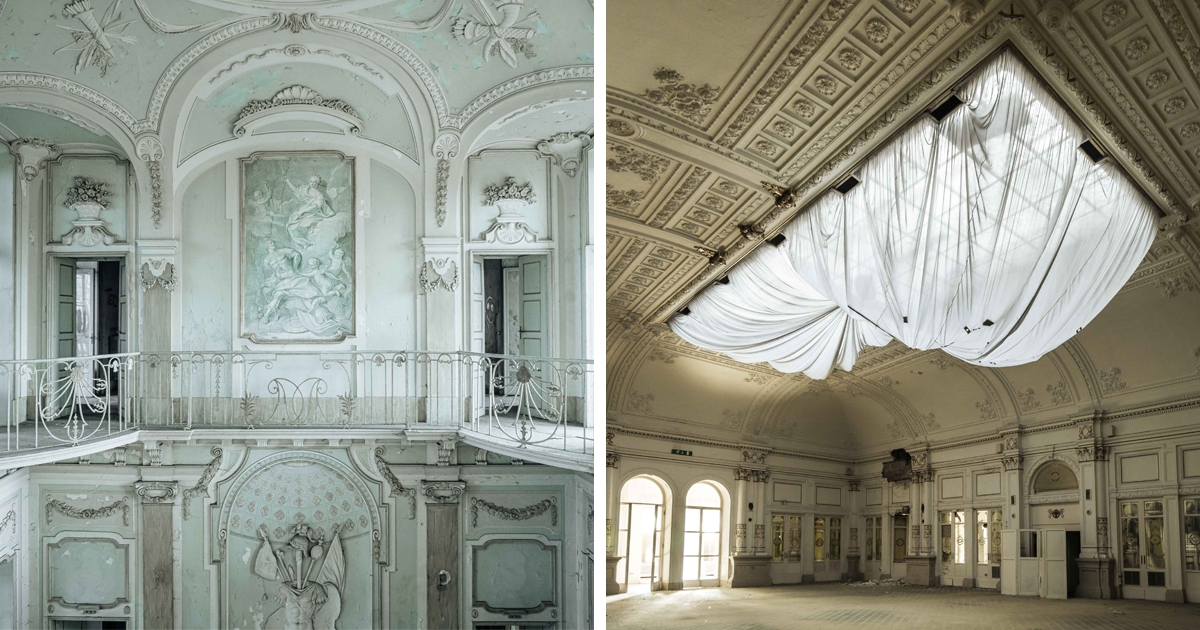
Italy is famous for the obvious stuff: Rome, pasta, Renaissance art, dramatic hand gestures, and coffee so strong it can probably see into your childhood. But beyond the postcard Italy, there is another country hiding in plain sight: silent villas with vines crawling through ballroom windows, ghost towns balanced on cliffs, drowned medieval villages, abandoned hospitals, empty churches, forgotten hotels, and staircases that still look ready for a grand entrance nobody is coming to make.
Traveling through Europe in search of forgotten places is not about chasing “creepy” scenes for cheap thrills. At its best, it is a slow, respectful way of listening. Abandoned places in Italy are not empty; they are crowded with clues. A broken tile can hint at wealth. A rusted bed frame can whisper about illness. A theater curtain rotting in place can suggest the final applause happened long before the building understood the show was over.
The 25 pictures imagined below are inspired by real Italian ghost towns, abandoned architecture, and historic ruins. Some locations are well known and visited by guided tour; others are private, fragile, or unsafe, so exact addresses are best left off the internet. The golden rule is simple: take only photos, leave only footprints, and definitely do not kick open a 200-year-old door just because your Instagram caption needs “mood.”
Why Italy Is a Dreamland for Forgotten Places
Italy’s abandoned places are unusually rich because the country’s history stacks up like a very old, very stylish lasagna. Ancient Roman resorts sank into the sea. Medieval villages were emptied by earthquakes and landslides. Rural towns lost residents to migration and changing economies. Grand villas, orphanages, hospitals, and hotels closed their doors as families moved, money disappeared, or new roads pulled life elsewhere.
Unlike modern ruins that can feel anonymous, forgotten places in Italy often keep their identity. You can still see frescoes, marble floors, wrought-iron balconies, hand-painted ceilings, chapel altars, and grand staircases designed for people who clearly owned capes or at least walked like they did. Decay here does not erase beauty; it argues with it. The result is haunting, elegant, and occasionally so dramatic that even the dust looks like it studied opera.
25 Pictures of Forgotten Places I Found in Italy
1. Craco, Basilicata: The Hilltop Ghost Town
Craco looks like a stone ship stranded above the badlands of Basilicata. Its empty houses climb the ridge toward a Norman tower, while the surrounding hills roll away in dry, cinematic waves. Landslides, erosion, and seismic risk pushed residents out over the 20th century, leaving behind one of Italy’s most famous ghost towns. In a photo, Craco does not look dead. It looks like it paused mid-sentence.
2. Roghudi Vecchio, Calabria: A Village with Greek Echoes
In the rugged Aspromonte mountains, Roghudi Vecchio sits above a riverbed like a secret that forgot how to hide. Once connected to Calabria’s Greek-speaking heritage, the village was abandoned after natural disasters made life there unsafe. A picture from its lanes captures cracked walls, empty rooms, and mountain silence so complete you start apologizing to your own footsteps.
3. Pentedattilo, Calabria: The Five-Fingered Rock
Pentedattilo clings beneath Monte Calvario, a rock formation shaped like five fingers. The village has legends, tragedy, earthquakes, and a setting so theatrical it almost feels professionally lit. Photographing it at sunset is unfair to other villages; they simply cannot compete with a ghost town under a giant stone hand.
4. Bussana Vecchia, Liguria: Ruins Reclaimed by Artists
Bussana Vecchia was badly damaged by an 1887 earthquake and later reborn as an artists’ village. Here, abandonment did not end the story; it changed the cast. Studios, workshops, and plants fill the old stones. A picture of the ruined church tower beside handmade art stalls says what Italy says best: collapse is terrible, but have you considered adding ceramics?
5. Poggioreale, Sicily: Streets Frozen After the Belice Earthquake
Poggioreale Antica was abandoned after the devastating 1968 Belice earthquake. Its grid of streets, damaged homes, and broken civic buildings remains eerily legible. The town feels less like a ruin than a paused map. One photo down its main street shows the painful geometry of sudden departure.
6. Gairo Vecchio, Sardinia: The Village the Mountain Reclaimed
Gairo Vecchio was gradually abandoned after floods and landslides made the old settlement unsafe. Today, stone homes crumble under Sardinian sun, with wild plants growing where kitchens once steamed. It is beautiful in the way an old family album is beautiful: tender, incomplete, and slightly dusty.
7. Civita di Bagnoregio, Lazio: The Dying City That Refuses to Die
Civita di Bagnoregio is not fully abandoned, but its reputation as “the dying city” comes from the erosion of the volcanic tuff beneath it. Reached by a long footbridge, it seems to float above the valley. A picture from the approach captures the paradox perfectly: a fragile town that looks invincible from a distance.
8. Matera’s Sassi, Basilicata: From Abandonment to Revival
Matera’s Sassi are not forgotten anymore, but they once stood as a symbol of poverty and forced relocation. Cave dwellings carved into limestone were later restored, protected, and celebrated. A photo of the Sassi at blue hour shows how a place can move from shame to pride without pretending the hard years never happened.
9. Baiae, Campania: The Sunken Roman Playground
Baiae was the luxury resort of ancient Rome, a place where elites came for thermal baths, parties, politics, and probably gossip powerful enough to alter the empire. Much of it now lies underwater due to volcanic ground movement. A picture taken through the sea shows mosaic floors and ruins beneath fish, which is humbling. Even Roman decadence eventually becomes a snorkeling attraction.
10. Fabbriche di Careggine, Tuscany: The Village Under the Lake
Fabbriche di Careggine was submerged after the creation of a hydroelectric reservoir in the 20th century. On rare occasions when the lake is drained, the village reappears like a medieval memory holding its breath. The most powerful photo would be the church tower rising from mud, looking mildly annoyed about the whole underwater arrangement.
11. Consonno, Lombardy: The Failed City of Toys
Consonno began as a village and was transformed in the 1960s into an entertainment complex dreamed up as an Italian playground. Landslides and failed ambition left behind a surreal ghost town of strange towers, faded signs, and structures that feel like a carnival after everyone suddenly remembered they had laundry to do.
12. Roscigno Vecchia, Campania: The Open-Air Time Capsule
Roscigno Vecchia was abandoned after landslide risks pushed residents to a newer settlement. Its lanes, stone homes, and quiet square remain remarkably atmospheric. A photo of a doorway opening into weeds makes the village feel like a museum curated by weather.
13. Romagnano al Monte, Campania: Earthquake Silence
After the 1980 Irpinia earthquake, old Romagnano al Monte was left behind and rebuilt nearby. The abandoned settlement now watches over the mountains with roofless houses and broken arches. It is a reminder that earthquakes do not only damage buildings; they rearrange memory.
14. Apice Vecchia, Campania: A Town Behind Locked Gates
Apice Vecchia was evacuated after earthquake damage made the historic center unsafe. Its streets still hold palaces, churches, and homes that suggest a once-busy community. A photo of its closed gates says plenty: sometimes preservation begins with keeping people out, even curious people with expensive cameras and poor self-control.
15. Balestrino, Liguria: The Medieval Village on Unstable Ground
Balestrino’s old center was abandoned because of geological instability. Stone houses, narrow lanes, and a castle remain, creating one of Liguria’s most evocative forgotten scenes. In pictures, it has the elegance of a place that aged without asking permission.
16. Canale Monterano, Lazio: Ruins, Fountains, and Wild Grass
Canale Monterano offers dramatic ruins of a former settlement, including church remains and stone architecture surrounded by nature. It is the kind of place where a single photograph can include archaeology, landscape, and a suspiciously photogenic goat if you are lucky.
17. Cirella Vecchia, Calabria: Old Stones Above the Sea
Above the modern seaside town, the ruins of Cirella Vecchia look toward the Tyrrhenian coast. Broken walls, castle remains, and blue water create the classic Italian contrast: tragedy in the foreground, vacation brochure in the background.
18. San Pietro Infine, Campania: War Memory in Stone
San Pietro Infine was heavily damaged during World War II and preserved as a memorial landscape. Its ruined houses speak less of abandonment than sacrifice. A photograph here should be quiet, respectful, and free of dramatic ghost jokes. Some places have earned silence.
19. Osini Vecchio, Sardinia: The Old Village After the Flood
Osini Vecchio was abandoned after destructive flooding and geological danger. Today, its empty homes sit among rugged Sardinian scenery. The best image is not the collapse itself, but the way sunlight still enters rooms built for families who moved on.
20. Monteruga, Puglia: The Rural Village Left Behind
Monteruga was once tied to agricultural life in Salento. As rural economies shifted, the village emptied. A photo of its abandoned school or church captures a quieter kind of loss: not disaster, but slow departure.
21. Leri Cavour, Piedmont: Agricultural Grandeur Gone Quiet
Leri Cavour was connected to agricultural estates and the legacy of Camillo Benso, Count of Cavour. Today, its neglected buildings feel grand and tired. It is a place where history wears work boots rather than a crown.
22. Valle Piola, Abruzzo: A Mountain Hamlet Without Neighbors
Valle Piola sits in a remote mountain setting, emptied by depopulation and changing rural life. In photographs, its stone houses and surrounding peaks feel peaceful rather than frightening. The village seems less abandoned than asleep under a very large blanket of sky.
23. Castelnuovo dei Sabbioni, Tuscany: Mining Memories
Old mining settlements in Tuscany reveal another side of forgotten Italy: industrial life, labor, dust, and departure. A picture of empty workers’ houses near former mining zones shows that ruins are not always romantic villas. Sometimes they are lunch pails, soot, and hard-earned wages.
24. An Abandoned Liberty Villa: Italy’s Elegance in Decline
Across Italy, abandoned villas preserve traces of Art Nouveau and Liberty-style design: floral ironwork, curved windows, painted ceilings, and staircases made for entrances far more graceful than mine. One photo of such a staircase can feel like a whole novel, preferably one with family secrets and an overdramatic aunt.
25. A Forgotten Hospital Corridor: The Most Human Ruin
Among the most emotional abandoned places in Italy are former hospitals, orphanages, and care institutions. These spaces should be approached with caution and empathy. A photo of a long corridor, peeling paint, and a single chair can be more powerful than any palace. It reminds us that forgotten places were never just buildings. They were systems of care, failure, hope, fear, and ordinary Tuesdays.
What These Forgotten Places Teach Us
The easy way to look at abandoned places is to treat them as spooky entertainment. The better way is to treat them as unfinished conversations. Why did people leave? Was it danger, poverty, war, migration, modernization, corruption, or simple time? Every ruin has a cause. Every collapsed roof is part architecture, part economics, part weather report.
Italy’s forgotten places also challenge the idea that preservation means polishing everything until it shines. Some sites should be restored. Others should be stabilized. A few should remain partly wild, because their power comes from the honest meeting of culture and nature. When ivy grows through a palace window, it is not just “aesthetic.” It is a reminder that humans build loudly, but nature edits patiently.
For travelers, the appeal is obvious. These places offer atmosphere, history, mystery, and visual drama. For local communities, the question is more complicated. Tourism can bring money and attention, but it can also bring trespassing, vandalism, overcrowding, and disrespect. A responsible visitor supports guided tours, follows safety rules, avoids revealing sensitive locations, and remembers that “abandoned” does not mean “available.”
My Experience Traveling Through Europe for Forgotten Places
The strangest thing about searching for forgotten places in Italy is how much time you spend not taking pictures. You research maps, read old articles, compare satellite images, ask polite questions, get lost, find the wrong road, discover the right road is blocked, and then have a long philosophical conversation with a parking lot. Urban exploration sounds glamorous until you are eating gas-station crackers in a rental car while a sheep judges your life choices.
But then the door opensor more responsibly, the guide unlocks the gateand everything changes. The first breath inside a forgotten building is always different. It smells of dust, stone, damp wood, dry leaves, and time. Your voice drops automatically. Even people who talk too much, which is to say people like me, suddenly become monks with camera bags.
In Italy, the emotional range is enormous. In one village, you might laugh because a fig tree has taken over someone’s kitchen with the confidence of a new homeowner. In another, you stand before a cracked schoolroom and feel your stomach tighten because the silence is too specific. The blackboard is gone, but you can still imagine chalk dust, shoes scraping the floor, children leaning out windows, teachers asking for attention they absolutely did not receive.
The most unforgettable places are not always the grandest. A palace staircase is impressive, yes. A ballroom with peeling frescoes can make your camera practically start writing poetry. But a small domestic detail often lands harder: a patterned tile, a curtain hook, a broken cup, a faded devotional image above a doorway. These objects shrink history down to human size. Suddenly you are not photographing “decay.” You are meeting the leftovers of daily life.
Traveling this way also changes how you see famous Italy. After walking through ghost towns, Rome feels less eternal and more miraculous. After seeing villages emptied by landslides, every inhabited hill town feels like an act of defiance. After staring at Baiae beneath the water, you become suspicious of every luxury resort. The lesson is clear: nothing is permanent, not even excellent plumbing and imperial confidence.
The road teaches patience, too. You learn that not every place should be entered. Some buildings are too dangerous. Some are private. Some are sacred to the people who left them. Turning around can feel disappointing, but it is part of the ethics of the journey. The goal is not conquest. The goal is witness.
By the end of a long day, when the camera card is full and your shoes look like they personally fought a vineyard, forgotten Italy stays with you. It follows you back to the hotel, sits beside your dinner, and quietly interrupts your plans to photograph something cheerful tomorrow. That is the beauty of these places. They do not shout. They linger.
Conclusion
Forgotten places in Italy are not simply ruins for adventurous photographers. They are chapters of Italian history written in stone, mud, fresco, rust, and silence. From Craco’s dramatic ridge to Baiae’s underwater mosaics, from Bussana Vecchia’s artistic rebirth to Fabbriche di Careggine’s rare resurfacing, each place reveals a different reason communities disappear and memories remain.
The 25 pictures in this journey show that abandonment is not one story. It can be sudden, like an earthquake. It can be slow, like erosion. It can be economic, environmental, political, or personal. Yet these places continue to matter because they help us see what ordinary travel often misses: the fragile relationship between people and the places they call home.
Note: This article is written as an original travel feature inspired by real Italian abandoned places, ghost towns, and heritage sites. Always respect private property, local laws, safety barriers, conservation rules, and guided-access requirements when visiting forgotten places.