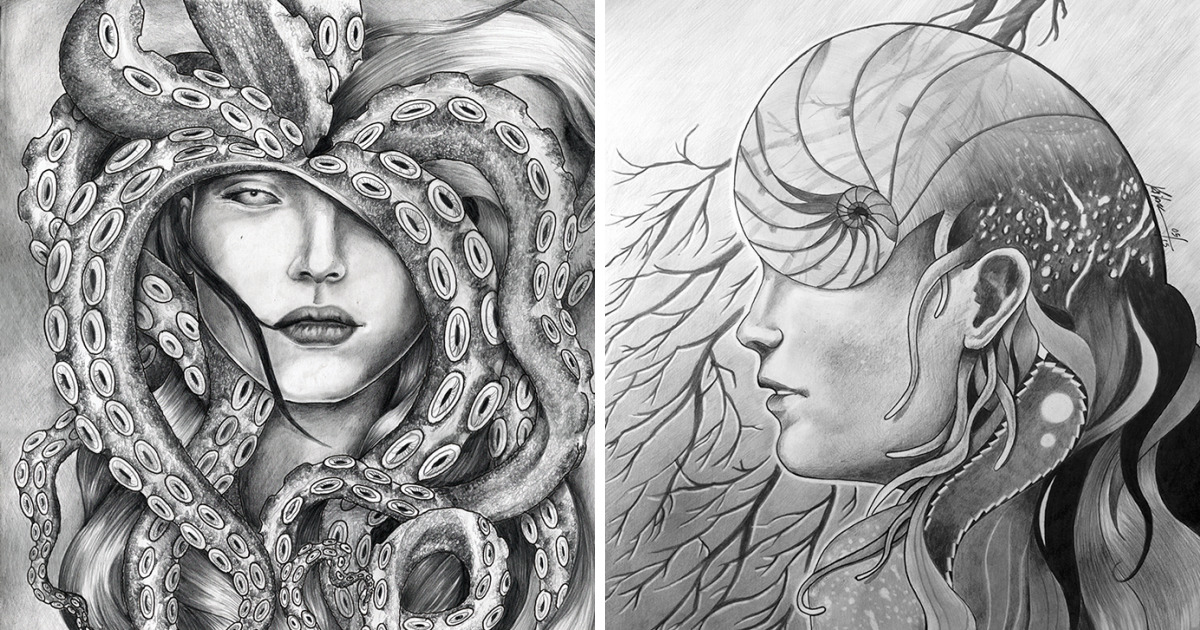
There is something irresistible about giving the ocean a face. One moment it is calm enough to reflect the moon; the next it is rearranging a coastline like an impatient interior designer. That contradiction is exactly why I create drawings depicting sea goddesses. These figures let me explore beauty, danger, motherhood, mystery, grief, power, and the occasional highly dramatic crown made of coral.
Although people often use “sea” and “ocean” interchangeably, seas are generally smaller and more enclosed by land. Artistically, however, both words open the same enormous door: a world of tides, trenches, storms, sailors, sea creatures, and myths that have traveled across generations. My sea goddess drawings do not simply place a woman underwater. They attempt to turn water itself into a personality.
Research basis: NOAA explains the geographic distinction between seas and oceans.
Why Sea Goddesses Make Powerful Artistic Subjects
The sea has always been larger than a landscape. It feeds communities, carries travelers, separates families, hides wrecks, and changes without asking permission. Cultures around the world have therefore imagined water as a living force with moods, rules, gifts, and consequences. A sea goddess can be protective or terrifying, generous or unpredictable. Sometimes she is all four before lunch.
This emotional range gives an artist unusual freedom. A mountain deity may suggest permanence, while a sea deity suggests motion. Her silhouette can curl like a wave. Her hair can float against gravity. Her clothing can dissolve into foam, fish, fog, or ink. Even a still portrait can feel active because the viewer expects water to keep moving beyond the edges of the page.
Museum collections show how long artists have been fascinated by these possibilities. Greek and later European works depict Amphitrite with dolphins, marine animals, children, shells, and flowing forms. Nereids appear riding sea monsters, leaning into twisting poses, or gliding through ornament as if the entire composition were caught in a current.
These artworks remind me that ocean mythology art has never required strict realism. The sea is already strange; imagination merely agrees to meet it halfway.
Research basis: The Met identifies Amphitrite as a Greek sea goddess and records artworks pairing her with dolphins and marine symbols; the National Gallery of Art and Art Institute of Chicago document Nereids with sea creatures and dynamic poses.
Mythology Is the Starting Point, Not a Costume Closet
When drawing mythical sea women, research matters. It is tempting to collect a shell crown, a blue dress, and a convenient trident, then declare the design complete. That approach creates a generic fantasy queen rather than a character with cultural weight. I prefer to begin with the stories, symbols, artistic traditions, and emotional roles connected to a figure.
Amphitrite and the Nereids: Movement and Ceremony
In Greek mythology, Amphitrite is associated with the sea and is commonly described as the wife of Poseidon. The Nereids are sea nymphs, traditionally numbered among the many daughters of Nereus. In art, they may appear benevolent, playful, elegant, or closely connected with sailors and marine creatures.
For an Amphitrite-inspired design, I might use a balanced pose, a lowered gaze, and a broad shape behind the head that resembles both a halo and a curling tide. For a Nereid, I might choose a diagonal composition, allowing limbs, fabric, and sea animals to create a visual rhythm.
Historical works often pair these figures with dolphins, shells, sea monsters, and hybrid creatures. That gives modern artists a rich visual vocabulary without forcing us to copy a single old image.
Research basis: The National Gallery of Art describes Nereids as daughters of Nereus who are often benevolent toward sailors; The Met and Art Institute document Amphitrite and Nereid imagery.
Yemayá, Iemanjá, and Water as Motherhood
Across Yoruba-derived and African Atlantic traditions, Yemayá or Iemanjá is connected with water, motherhood, fertility, protection, and the sea, although names, practices, and visual expressions vary by region and community. Smithsonian sources describe Yemayá in Caribbean spiritual and musical contexts, while museum exhibitions have examined celebrations of Iemanjá in Brazil.
These are living religious traditions, not abandoned mythology props. That distinction changes how I draw. Instead of treating sacred imagery as a collection of decorative accessories, I focus on broader themes such as maternal scale, wave-like movement, luminous fabric, offerings, community, and the boundary between personal memory and collective ritual.
Respectful inspiration should lead to learning, not to flattening several traditions into one attractive mermaid.
Research basis: Smithsonian Folklife discusses Yemayá as an orisha associated with fertility, motherhood, and sea waters; the MFA Boston discusses an Iemanjá festival in Salvador, Brazil.
Mami Wata: Beauty, Power, and Contradiction
Mami Wata is recognized across diverse African and African Atlantic communities as a powerful water spirit, but there is no single universal design or story. The National Museum of African Art emphasizes regional variation in related ritual knowledge, shrines, sculpture, masking, and visual culture.
When studying Mami Wata-related art, I pay attention to how beauty, wealth, danger, attraction, and spiritual authority can coexist. A character may offer abundance while remaining impossible to control. Visually, that can become a polished face surrounded by turbulent marks, luxurious jewelry beside predatory fish, or a symmetrical pose interrupted by one unsettling detail.
Research basis: The Smithsonian National Museum of African Art describes Mami Wata as a powerful water spirit with diverse regional practices and visual forms.
Sedna, Nammu, and the Deep Ocean
Not every sea goddess belongs to a warm, turquoise world. Sedna is an important sea figure in Inuit traditions and is associated with marine animals. Because versions of her story differ across communities, I avoid presenting one retelling as the only correct account.
Visually, Sedna invites a colder language: compressed shapes, dark water, seal forms, broken light, and a sense that survival depends on respecting the marine world rather than conquering it.
In ancient Mesopotamian tradition, Nammu was associated with the primeval sea and creation, while Tiamat became connected with primordial salt water and cosmic conflict. These figures expand the idea of a sea goddess beyond the familiar mermaid silhouette. The ocean can be maternal, cosmic, monstrous, formless, or older than the gods themselves.
That is excellent news for artists and terrible news for anyone hoping to finish a sketch quickly.
Research basis: Smithsonian collections identify Sedna as a sea goddess in Inuit art; the Penn Museum discusses Nammu as goddess of the primeval sea; the University of Pennsylvania’s ORACC project describes Tiamat’s Mesopotamian iconography.
How I Design a Sea Goddess Drawing
Start With an Emotion, Not an Outfit
Before drawing jewelry, fins, or a throne made from suspiciously cooperative octopuses, I choose one emotional sentence:
- She welcomes lost sailors.
- She remembers every shipwreck.
- She is the calm before a storm.
- She guards a reef that humans have damaged.
A clear sentence keeps the design from becoming a pile of attractive ocean objects. It also determines the pose. Protection suggests a curved body surrounding smaller forms. Authority suggests a stable triangle or frontal silhouette. Grief may appear through downward movement, empty space, or objects sinking away from the figure.
Build a Silhouette That Moves Like Water
A strong silhouette should communicate before the details arrive. I often combine one stable human shape with several fluid extensions: hair, fabric, fins, smoke-like ink, or schools of fish. Long S-curves create grace, while spirals suggest whirlpools. Repeated arcs can imitate waves.
A single hard vertical shape, such as a staff, mast, or spear, provides contrast and prevents the composition from turning into decorative soup.
I also decide whether the goddess belongs above, within, or beneath the water. A figure rising from the surface feels revealed. A figure entirely underwater feels observed in her own domain. A colossal face hidden inside a storm makes the human viewer feel wonderfully insignificant.
Use Marine Symbols With Purpose
Dolphins can imply guidance, play, or classical references. Shells may suggest birth, protection, sound, wealth, or pilgrimage. Nets can symbolize capture, fate, labor, or the danger of being claimed by the sea.
Sea serpents bring older fears into the image; historical folklore frequently imagined them as threats to ships and sailors. Coral can act like a crown, a city, or a fragile ecosystem. The best symbols do more than announce “ocean.” They participate in the story.
Research basis: Museum works repeatedly associate sea deities with dolphins, shells, sea monsters, and hybrid creatures; the Library of Congress documents the long history of dangerous sea-serpent imagery.
Let Color Describe the Water’s Personality
Blue is useful, but it should not be given every job. Green can feel biological or ancient. Violet suggests depth and ceremony. Gray creates distance, cold, or mourning. Rust and gold can evoke shipwrecks, treasure, sunlight, or divine radiance. Black water is especially effective because it makes small highlights feel precious.
Ancient artists and writers also connected material color with subject. A Getty publication notes an ancient example in which blue-green beryl suited Galene, a personification of the calm sea. I like the principle behind that choice: color should feel inseparable from character.
A peaceful goddess may carry pale, transparent layers. A storm goddess may be built from bruised clouds and sudden flashes of white.
Research basis: The Getty discusses the ancient association of blue-green beryl with Galene, personification of the calm sea.
Making Water Feel Alive on a Flat Page
Water is difficult to draw because it has no permanent outline. The solution is not to draw every ripple. Instead, I describe what water does to light, hair, fabric, bodies, and objects.
Reflections break. Edges disappear. Values become softer with distance. Bubbles rise in clusters. Hair spreads into shapes that would collapse immediately on land.
I use three kinds of marks. Broad shapes establish the mass of the ocean. Directional lines show currents and movement. Small highlights provide sparkle, foam, scales, and suspended particles.
When every mark is equally detailed, the picture becomes noisy. When detail is concentrated around the face and hands, the viewer receives a clear invitation to enter the image.
The sea can also carry narrative without showing a goddess at all. A crown beneath the surface, a hand-shaped wave, or a school of fish circling an empty throne may suggest divine presence.
Contemporary museum exhibitions continue to explore the ocean as a place of memory, mourning, fragility, resilience, and imagined futures. Those themes encourage me to treat the sea as more than a pretty blue background.
Research basis: MFA Boston’s “Deep Waters” frames the sea through memory, mourning, fragility, resilience, histories, and possible futures.
Originality Comes From Decisions, Not Extra Accessories
Fantasy art can become crowded very quickly. Add pearls, add fins, add six jellyfish, add a moon, and then add another moon because symbolism is apparently sold in bulk. Yet originality rarely comes from quantity. It comes from a specific relationship among character, culture, setting, and emotion.
I ask practical questions:
- What does this goddess protect?
- What does she fear?
- Who tells stories about her?
- Does she appear to sailors, children, or divers?
- Is she ancient, newly born, or slowly disappearing?
- Does she command the ocean, or is she the ocean?
Each answer changes the anatomy, clothing, scale, environment, and mood. Research also helps avoid accidental copying. Recurring motifs such as shells, waves, fish tails, serpents, and flowing hair can be transformed through different materials, viewpoints, and stories.
The goal is not to invent without influence. The goal is to transform influence through thoughtful choices.
Why I Keep Returning to Sea Goddess Drawings
Sea goddesses allow me to draw power without making it rigid. Their strength bends, circles, floods, retreats, and returns. They can be colossal without wearing armor and gentle without becoming weak.
They offer a visual language for feelings that are difficult to describe directly: awe, loneliness, longing, protection, fear of change, and the desire to belong to something larger than oneself.
They also create room for environmental meaning. A goddess tangled in plastic, standing over bleached coral, or holding a tiny surviving fish can communicate ecological loss without turning the artwork into a lecture. The image remains mythic, but the stakes are contemporary.
When the ocean changes, the goddess changes with it.
My Experience Creating Drawings of Sea Goddesses
My process usually begins with a page that looks disappointingly ordinary. There is no thunder, no choir, and no mysterious wet footprint leading to the sketchbook. I write a few words at the top: “guardian of drowned songs,” “mother of winter tides,” or “the reef remembers her.” One phrase is enough to create direction. Without it, I tend to design a beautiful character who appears to be waiting for an underwater fashion photographer.
The first sketches are fast and often ugly. I draw the body as a simple gesture, then test the movement of hair and fabric around it. I have learned not to polish the face too early. A perfect eye attached to a weak composition is still a weak composition, only now it looks concerned.
Instead, I search for the large rhythm: one curve for the spine, another for the current, and a third for the creature or object that completes the scene.
Reference gathering is one of my favorite stages. I study waves folding over rocks, translucent fins, kelp forests, storm clouds, antique sculpture, ceremonial clothing, fish anatomy, and the way light breaks into moving patterns at the bottom of a pool.
I do not use every reference literally. The point is to collect believable behavior. A sleeve may move like a manta ray. A crown may branch like coral. A shadow may resemble the mouth of a trench.
The hardest part is balancing the human and the elemental. When the figure is too human, she looks like a model wearing ocean-themed accessories. When the water effects dominate, she disappears into a very ambitious weather report.
I solve this by repeating shapes across both. The curve of an eyebrow may echo a wave. Fingers may taper like fins. Hair may divide into currents that guide the viewer toward the face.
Mistakes often improve the design. A spilled wash can become a storm front. An over-darkened background can turn into deep water. A strange hand may be hidden by foam, which is not cheating; it is creative marine camouflage.
More importantly, errors force me to respond instead of merely executing a plan. That responsiveness feels appropriate for ocean art, because water never behaves like a perfectly obedient object.
I also spend time deciding what not to include. Early versions may contain shells, pearls, fish, moons, ruins, anchors, and enough floating fabric to endanger local shipping. Removing half of those elements usually strengthens the story.
If the goddess is mourning a lost city, perhaps one broken column and one silent fish are more powerful than an entire underwater gift shop.
Finishing a piece is less dramatic than beginning one. I adjust value contrast around the face, simplify distant textures, sharpen a few highlights, and check whether the eye moves through the image smoothly. Then I leave the drawing alone for a day.
On returning, I usually discover one unnecessary jellyfish. There is always one.
What keeps me interested is that no two sea goddesses require the same visual solution. One may emerge from warm surf with a generous, maternal presence. Another may exist beneath Arctic darkness, surrounded by marine life and silence. A third may be almost abstracta body suggested by currents, stars, and salt.
Each drawing becomes a conversation between research and imagination.
Creating these images has also changed the way I look at real water. I notice the green beneath a gray wave, the purple inside a shadow, the sudden silver of a fish turning, and the way foam draws temporary maps on sand. Those observations return to the sketchbook.
In that sense, I do not draw sea goddesses because I believe the ocean needs more decoration. I draw them because personifying the sea helps me pay closer attention to it.
Conclusion
I create drawings depicting sea goddesses because the subject can hold history, spirituality, fantasy, ecology, and emotion in a single frame. The strongest images begin with research, continue through deliberate design, and end with a character who feels shaped by water rather than merely placed beside it.
Whether inspired by Amphitrite, the Nereids, Yemayá, Mami Wata, Sedna, Nammu, or an entirely original aquatic deity, a meaningful drawing should respect the complexity behind its symbols.
The ocean is not one color, one mood, or one story. Fortunately, neither is a goddess.
Note: Mythic and sacred water figures belong to distinct cultures and living traditions. Artists should consult community-informed and museum-quality sources, acknowledge cultural context, and avoid presenting one regional version as universally authoritative.