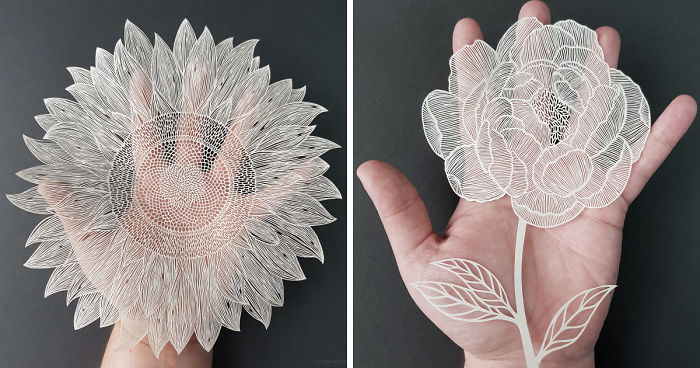
Some artists paint with oil. Some sculpt with marble. Some, apparently, look at a single sheet of paper and think, “Yes, I shall turn this into a botanical miracle using patience, a scalpel, and the steady hand of a jewel thief.” That is the quiet magic behind detailed and delicate flower art: a slow, precise, slightly nerve-wracking process where one wrong cut can turn a petal into confetti.
The flower artworks associated with this title belong to the world of contemporary paper cutting, a craft that feels both ancient and startlingly modern. In the case of Yorkshire-based paper artist Pippa Dyrlaga, each flower begins as a hand-drawn design and is then carefully cut from paper, often using extremely lightweight Japanese washi. The result is not simply a picture of a flower. It is a flower translated into shadow, lace, negative space, and breath.
These works can take anywhere from 10 to 40 hours to complete. That time is not spent filling a page with visual noise. It is spent removing material with intention. Every vein, curve, petal edge, stem, and tiny botanical tremor has to survive the process. It is art made by subtraction, which sounds simple until you remember that paper does not come with an undo button.
The Beauty of Paper Cutting Flower Art
Delicate flower art has a special pull because flowers are already temporary. A tulip bends, a sunflower follows the light, a sweet pea curls like a whisper, and a dandelion exists mostly to be blown apart by children with excellent timing. Turning those forms into hand-cut paper creates a lovely contradiction: the subject is fragile, the material is fragile, and yet the finished artwork feels permanent.
Paper cutting art depends on the conversation between what remains and what disappears. Unlike painting, where the artist builds color on top of color, paper cutting often asks the artist to carve light into the surface. The empty spaces matter as much as the solid lines. A missing sliver can become a petal vein. A narrow bridge of paper can hold together an entire stem. Negative space becomes the secret architecture of the image.
That is why flower paper art feels so alive. A blossom is never just a circle with petals attached. It has rhythm. It has weight. It has soft folds, asymmetry, damaged edges, and tiny accidents of growth. To capture that in paper, the artist must understand the flower as both a natural form and a structural puzzle. The artwork has to look airy, but it must also physically hold together. Nature can be chaotic; paper prefers rules. The artist has to negotiate between the two.
Meet the Artist Behind the 40-Hour Flowers
Pippa Dyrlaga is known for hand-cut paper artworks inspired by nature, memory, folklore, animals, plants, and the emotional pull of the natural world. Her practice uses traditional paper cutting techniques to create contemporary pieces that can feel part botanical study, part fairytale, and part extremely elegant evidence that patience is a superpower.
Her flower series began as a way of making a kind of permanent garden. That idea is quietly powerful. A garden changes constantly. It blooms, wilts, surprises you, fails dramatically, returns next season, and occasionally gets eaten by something rude. Paper flowers, however, pause that cycle. They preserve the feeling of bloom without pretending to be real plants. They are not replacements for flowers; they are love letters to them.
Dyrlaga’s process often begins with drawing on the reverse side of the paper. This is important because the final piece is revealed from the front after the cutting is complete. In other words, the artist spends hours working backward, trusting the plan, the blade, and her ability to imagine the finished image while looking at its hidden side. Most of us struggle to wrap gifts neatly. This is several levels above that.
Why Washi Paper Matters
One reason these flower artworks look so ethereal is the paper itself. Washi, a traditional Japanese paper, is prized by artists, designers, printmakers, and conservators because it can be lightweight, textured, strong, and beautiful all at once. In this flower series, papers from Awagami Factory were used, including very thin sheets in the 36–90gsm range. That is delicate territory. It is the paper equivalent of handling a moth wing while trying not to breathe too dramatically.
Thin washi allows for graceful cuts and floating details, but it also raises the stakes. The lighter the paper, the more responsive it becomes to moisture, pressure, blade angle, and handling. A heavy paper may forgive a clumsy moment. A whisper-thin sheet of washi will remember everything.
The appeal, though, is obvious. Washi can hold a fine line without looking stiff. It can make a petal appear translucent even when it is opaque. It can bring softness to a medium that relies on sharp tools. That contrast is part of the charm: the artwork is created with a blade, but the final feeling is gentle.
From Botanical Illustration to Contemporary Paper Art
Flower art has a long history. Botanical illustration has been used for centuries to document plant forms with scientific accuracy. Artists such as Mary Delany, famous for her “paper mosaick” botanical works, cut and assembled colored paper pieces to create precise plant images. Her work proved that paper could be more than a surface. It could become the plant itself, petal by petal.
Modern paper cutting flower art carries that history forward but does not simply imitate it. Contemporary artists can borrow the attention of botanical illustration while adding mood, symbolism, personal memory, and abstraction. A cut-paper tulip does not have to function as a scientific record. It can be a meditation on winter, growth, stillness, resilience, or the strange joy of spending 40 hours on something that could be destroyed by a sneeze.
This is where Dyrlaga’s flower pieces become especially interesting. They are detailed enough to satisfy the eye, but not coldly technical. They feel observed, not copied. The flowers retain their character: the droop of a tulip, the confidence of a sunflower, the delicacy of sweet pea tendrils, the little firework geometry of a dandelion. Each piece invites close looking, which is increasingly rare in a world where most images are swiped past at thumb speed.
The Process: Drawing, Cutting, Breathing, Repeating
Creating delicate paper flower art usually begins with observation. The artist studies the flower’s structure: where the stem supports the bloom, how petals overlap, which details are essential, and which can be simplified without losing the soul of the plant. This stage is less glamorous than the final reveal, but it is where the artwork earns its strength.
Next comes the drawing. In hand-cut paper work, the drawing is not merely a sketch; it is a map for the blade. Lines must be beautiful, but they must also be practical. A petal cannot float in space unless it is intentionally separated. A thin stem must be narrow enough to feel delicate but wide enough to survive. The design has to balance visual complexity with physical stability.
Then comes the cutting, which is where time slows down. A scalpel or craft blade removes tiny sections of paper one by one. The artist may rotate the paper rather than the hand, keeping the blade controlled. Curved lines require careful pressure. Corners require patience. Long cuts require confidence. Tiny cuts require the emotional stability of someone defusing a glitter bomb.
As more paper is removed, the piece becomes more vulnerable. Early mistakes may be fixable; late mistakes can be devastating. That is one reason the final hours of a detailed paper cut can feel more intense than the beginning. The closer the artwork gets to completion, the more there is to lose. It is a craft that teaches humility with excellent customer service.
Why It Can Take Up To 40 Hours
Forty hours may sound excessive until you look closely at the density of the cuts. A flower is full of small transitions: the edge of a petal thinning into air, a vein branching into smaller veins, a leaf folding over itself, a stem bending under weight. Translating these details into paper requires hundreds or even thousands of micro-decisions.
The time also includes mental work. The artist must constantly decide what to keep and what to remove. In drawing or painting, adding one more line may clarify a form. In paper cutting, removing one more piece may either improve the design or break the entire structure. That makes every cut a commitment.
There is also the physical reality of working slowly. Hands need breaks. Eyes need rest. Blades need changing. Paper must be protected from oils, creases, dust, and enthusiastic pets who believe every flat surface is a personal invitation. A 40-hour paper artwork is not just a test of skill. It is a test of stamina, planning, and the ability to remain calm while holding a very sharp object near something extremely fragile.
What Makes the 27 Pictures So Captivating?
The original 27-picture collection works because it gives viewers variety without losing focus. Each flower has its own personality. The “Sinking Tulip” suggests movement and weight. The sunflower carries a bold, familiar brightness even when translated into paper. Sweet pea feels light and curling. Daffodils bring a cheerful spring energy, while dandelions carry that mix of weed, wish, and wild geometry that makes them secretly one of the most interesting plants in the yard.
Seen together, the series becomes more than a set of pretty flowers. It becomes a study in how many moods can live inside one theme. Floral art can be romantic, but it can also be strange, architectural, melancholic, playful, or dramatic. A flower is never just “nice.” It can be resilient, invasive, medicinal, symbolic, poisonous, edible, nostalgic, or associated with a memory you did not realize you still had.
That emotional range is why handmade flower art continues to connect with people. We give flowers at weddings, funerals, birthdays, apologies, anniversaries, and “I saw these and thought of you” moments. They carry meaning before an artist even touches them. Paper cutting adds another layer: time. When viewers learn that one piece may take up to 40 hours, the flower becomes a record of attention.
Slow Art in a Fast-Scrolling World
One of the most refreshing things about delicate paper cutting is that it refuses to hurry. It is not optimized for speed. It is not generated in seconds. It does not pretend that detail is effortless. The work carries visible evidence of time, and that matters.
In a digital culture where images appear instantly and disappear almost as fast, slow art has a different kind of value. It asks the viewer to pause. It rewards zooming in. It makes craftsmanship visible. You can sense the hours in the edges, the restraint in the empty spaces, and the care in the areas where the paper almost seems too thin to survive.
This does not make handmade art better than digital art; they are different languages. But paper cutting has a physical honesty that is hard to fake. The paper was there. The blade moved through it. The hand made choices. The finished object carries the risk of its making.
Tips for Appreciating Delicate Flower Paper Art
Look at the Negative Space
Do not only look at the petals and leaves. Look at what has been removed. In paper cutting, empty space often creates the rhythm of the entire piece.
Notice the Bridges
The thinnest connecting lines are often the most impressive parts. They hold the image together while preserving a sense of lightness.
Think About the Order of Cuts
A complex piece cannot be cut randomly. Artists often need to plan which areas should be removed first so the paper remains stable until the end.
Consider the Material
A flower cut from heavy card feels different from one cut from delicate washi. The paper’s weight, fiber, texture, and color shape the final mood.
Why Handmade Floral Art Still Matters
Handmade floral art matters because it reconnects us with attention. Flowers are among the most photographed subjects on earth, yet a hand-cut paper flower makes us see them again. It slows the familiar down. It turns “pretty” into “how on earth did someone make that?”
It also reminds us that craft is not separate from fine art. Paper cutting requires drawing, design, material knowledge, composition, patience, and technical control. It can be decorative, but decoration is not a weakness. Humans have decorated meaningful objects for thousands of years. Beauty is not shallow just because it is pleasant to look at.
In Dyrlaga’s flower pieces, the decorative and the emotional work together. The artworks are lovely from a distance, then increasingly complex up close. That double experience is a hallmark of strong craft: it welcomes the casual viewer and rewards the devoted one.
Experiences Related to Creating Detailed and Delicate Flower Art
Anyone who has tried to make delicate flower art by hand quickly learns that the process is both peaceful and mildly ridiculous. At the beginning, everything feels possible. The paper is clean. The pencil lines look graceful. The tools are lined up neatly. You imagine yourself becoming the sort of calm, elegant person who drinks tea beside a window and creates botanical wonders while birds approve from nearby branches.
Then the first tiny cut happens, and reality enters the studio wearing practical shoes.
The biggest experience is learning to respect the material. Paper seems simple because we use it every day. We write grocery lists on it, print receipts on it, fold it into airplanes, and accidentally leave it in pockets during laundry. But art paper has moods. Thin paper bends if you look at it too intensely. Textured paper may catch the blade. Handmade paper may have fibers that pull in unexpected ways. Even humidity can change how the surface behaves. Suddenly, paper is not ordinary at all. It is a collaborator with opinions.
Another experience is discovering that patience is not a personality trait; it is a practice. You do not need to be naturally serene to make slow art. You become slower because the work demands it. If you rush, the flower punishes you. A petal tears. A line wobbles. A stem becomes too thin. The artwork quietly says, “Interesting choice,” and you must live with the consequences.
There is also a strange intimacy in studying flowers closely. You begin to notice that petals are not symmetrical in the way you assumed. Leaves have scars. Stems twist. Seed heads follow mathematical patterns that look designed by someone with both genius and a flair for drama. The more you observe, the less generic a flower becomes. A daffodil is not just a yellow trumpet. A tulip is not just a cup. A dandelion is not just the enemy of lawn perfectionists everywhere. Each has structure, movement, and personality.
Long projects also teach you how to handle mistakes. In delicate paper cutting, mistakes are not always disasters. Sometimes a torn edge can become part of the organic feeling of the piece. Sometimes a design changes because the paper insists on a different solution. The trick is knowing when to repair, when to adapt, and when to step away before frustration convinces you to make “one quick cut,” the most dangerous phrase in craft.
The final experience is the reveal. After hours of drawing, cutting, adjusting, and holding your breath like a suspicious Victorian ghost, the piece is lifted from the mat. Light passes through the openings. Shadows appear. The flower suddenly looks less like a project and more like a living thing. That moment is the reason artists return to the process. Not because it is easy. Not because it is fast. But because the result feels earned.
Creating detailed and delicate flower art is an act of devotion. It honors the plant, the paper, the hand, and the many quiet hours that most people never see. In a world that often celebrates instant results, a 40-hour paper flower is a beautiful rebellion. It says that slowness still has value, that fragility can be powerful, and that a blank sheet of paper may be ordinary only until someone brave enough picks up a blade.
Conclusion
Detailed and delicate flower art proves that the simplest materials can produce the most astonishing results. A sheet of paper, a pencil, a scalpel, and many hours of focused work can become a permanent garden filled with tulips, sunflowers, sweet peas, dandelions, and quiet botanical drama. The charm of this art form is not only in its beauty but in its honesty. Every cut is visible. Every decision matters. Every finished flower carries the time it took to make.
That is why these 27 pictures resonate so strongly. They remind us to look closer, move slower, and appreciate the handmade details that survive in an increasingly instant world. Paper may be fragile, but in the right hands, it blooms.