Integers are the “no-fractions-allowed” crowd of the number world: positive whole numbers, negative whole numbers, and zero. They look simple at firstuntil a problem like -8 – (-5) strolls in wearing sunglasses and pretending to be complicated. The good news? Integer operations follow clear, dependable rules. Once you understand how signs, absolute value, number lines, and properties work together, solving integers becomes much less like guessing and much more like following a recipe.
This guide explains how to solve integers and their properties in 10 practical steps. You will learn how to add, subtract, multiply, divide, compare, simplify, and use integer properties such as closure, commutative, associative, identity, inverse, and distributive properties. We will also walk through examples, common mistakes, and learning experiences that make integers feel less mysterious and more like a math tool you can actually trust.
What Are Integers?
Integers are numbers that include negative whole numbers, zero, and positive whole numbers. In set form, they look like this:
{…, -5, -4, -3, -2, -1, 0, 1, 2, 3, 4, 5, …}
Integers do not include fractions, decimals, or mixed numbers. So 7, -12, and 0 are integers, but 3.5, -2.75, and 1/4 are not. Think of integers as elevator floors: basement levels are negative, ground level is zero, and upper floors are positive. Thankfully, unlike real elevators, integers rarely get stuck between floors.
How to Solve Integers and Their Properties: 10 Steps
Step 1: Identify the Sign of Each Integer
Before doing anything fancy, look at the signs. Is the number positive, negative, or zero? A number without a visible sign is positive. For example, 9 means +9. A negative sign means the number is less than zero, such as -9.
Example:
- +6 is positive.
- -6 is negative.
- 0 is neither positive nor negative.
This matters because signs control the direction and result of integer operations. In integer math, the sign is not decoration. It is the steering wheel.
Step 2: Use a Number Line to Understand Direction
A number line is one of the best tools for solving integers, especially when you are first learning. Positive numbers move to the right. Negative numbers move to the left. Zero sits in the middle, minding its own business.
For example, to solve -3 + 5, start at -3 and move 5 spaces to the right. You land on 2. Therefore:
-3 + 5 = 2
To solve 4 + (-7), start at 4 and move 7 spaces to the left. You land on -3. Therefore:
4 + (-7) = -3
The number line helps make negative numbers visual. Instead of memorizing rules with a stressed-out face, you can see what is happening.
Step 3: Add Integers With the Same Sign
When two integers have the same sign, add their absolute values and keep the shared sign. Absolute value means the distance from zero, so it is always nonnegative.
Examples:
- 5 + 8 = 13
- -5 + (-8) = -13
In the first example, both numbers are positive, so the answer is positive. In the second example, both numbers are negative, so the answer is negative. Imagine two people pulling a rope in the same direction. The result moves strongly that way.
Step 4: Add Integers With Different Signs
When integers have different signs, subtract the smaller absolute value from the larger absolute value. Then keep the sign of the number with the larger absolute value.
Example:
-12 + 7
The absolute values are 12 and 7. Subtract:
12 – 7 = 5
Since -12 has the larger absolute value, the answer is negative:
-12 + 7 = -5
Another example:
15 + (-9) = 6
Here, 15 has the larger absolute value, so the answer is positive.
Step 5: Turn Subtraction Into Addition
Subtracting integers becomes easier when you rewrite subtraction as adding the opposite. This is one of the most important integer-solving habits.
The rule is:
a – b = a + (-b)
Example:
8 – 13 = 8 + (-13) = -5
Another example:
6 – (-4) = 6 + 4 = 10
This is where many students say, “Wait, why did two negatives become a positive?” Because subtracting a negative means moving in the opposite direction of a negative move. In plain English: you are backing away from the basement stairs.
Step 6: Multiply Integers Using Sign Rules
Multiplication with integers follows a simple sign pattern:
- Positive × Positive = Positive
- Negative × Negative = Positive
- Positive × Negative = Negative
- Negative × Positive = Negative
In short, same signs give a positive product. Different signs give a negative product.
Examples:
- 4 × 6 = 24
- -4 × -6 = 24
- 4 × -6 = -24
- -4 × 6 = -24
If there are several factors, count the negative signs. An even number of negative factors gives a positive product. An odd number of negative factors gives a negative product.
Example:
(-2)(-3)(-4)
There are three negative signs, which is odd, so the product is negative:
(-2)(-3)(-4) = -24
Step 7: Divide Integers Using the Same Sign Rules
Division uses the same sign rules as multiplication. Same signs make a positive quotient. Different signs make a negative quotient.
Examples:
- 20 ÷ 5 = 4
- -20 ÷ -5 = 4
- 20 ÷ -5 = -4
- -20 ÷ 5 = -4
One important warning: division by zero is undefined. You can divide zero by a nonzero integer, such as 0 ÷ 4 = 0, but you cannot divide by zero. Math draws the line there and refuses to negotiate.
Step 8: Understand Absolute Value
Absolute value is the distance a number is from zero. It is written with vertical bars, like this: |-9|. Since distance cannot be negative, the absolute value of -9 is 9.
Examples:
- |7| = 7
- |-7| = 7
- |0| = 0
Absolute value helps when comparing integers and solving expressions with different signs. For example, in -14 + 9, compare |-14| = 14 and |9| = 9. Since 14 is larger, the answer will be negative.
Step 9: Apply the Main Properties of Integers
Integer properties explain why operations behave the way they do. They are the “house rules” of integer math. Once you understand them, simplifying expressions becomes faster and more logical.
Closure Property
Integers are closed under addition, subtraction, and multiplication. That means when you add, subtract, or multiply two integers, the result is always an integer.
Examples:
- -3 + 10 = 7
- 8 – 12 = -4
- -5 × 6 = -30
However, integers are not closed under division because dividing two integers does not always produce an integer. For example, 5 ÷ 2 = 2.5, and 2.5 is not an integer.
Commutative Property
The commutative property says that changing the order does not change the result for addition and multiplication.
Examples:
- 4 + (-9) = -9 + 4
- 6 × (-3) = -3 × 6
This property does not work for subtraction or division. For example, 7 – 2 is not the same as 2 – 7. Order matters there, just like putting socks on before shoes. Usually.
Associative Property
The associative property says that changing the grouping does not change the result for addition and multiplication.
Examples:
- (2 + 3) + 4 = 2 + (3 + 4)
- (-2 × 5) × 3 = -2 × (5 × 3)
This property is useful when rearranging mental math. For example, -8 + 13 + 8 can be grouped as (-8 + 8) + 13, which equals 13.
Identity Property
The additive identity is 0 because adding zero does not change a number:
-11 + 0 = -11
The multiplicative identity is 1 because multiplying by one does not change a number:
-11 × 1 = -11
Additive Inverse Property
Every integer has an opposite, called its additive inverse. A number plus its opposite equals zero.
Examples:
- 9 + (-9) = 0
- -15 + 15 = 0
This property is especially helpful when solving equations because it helps “cancel” terms.
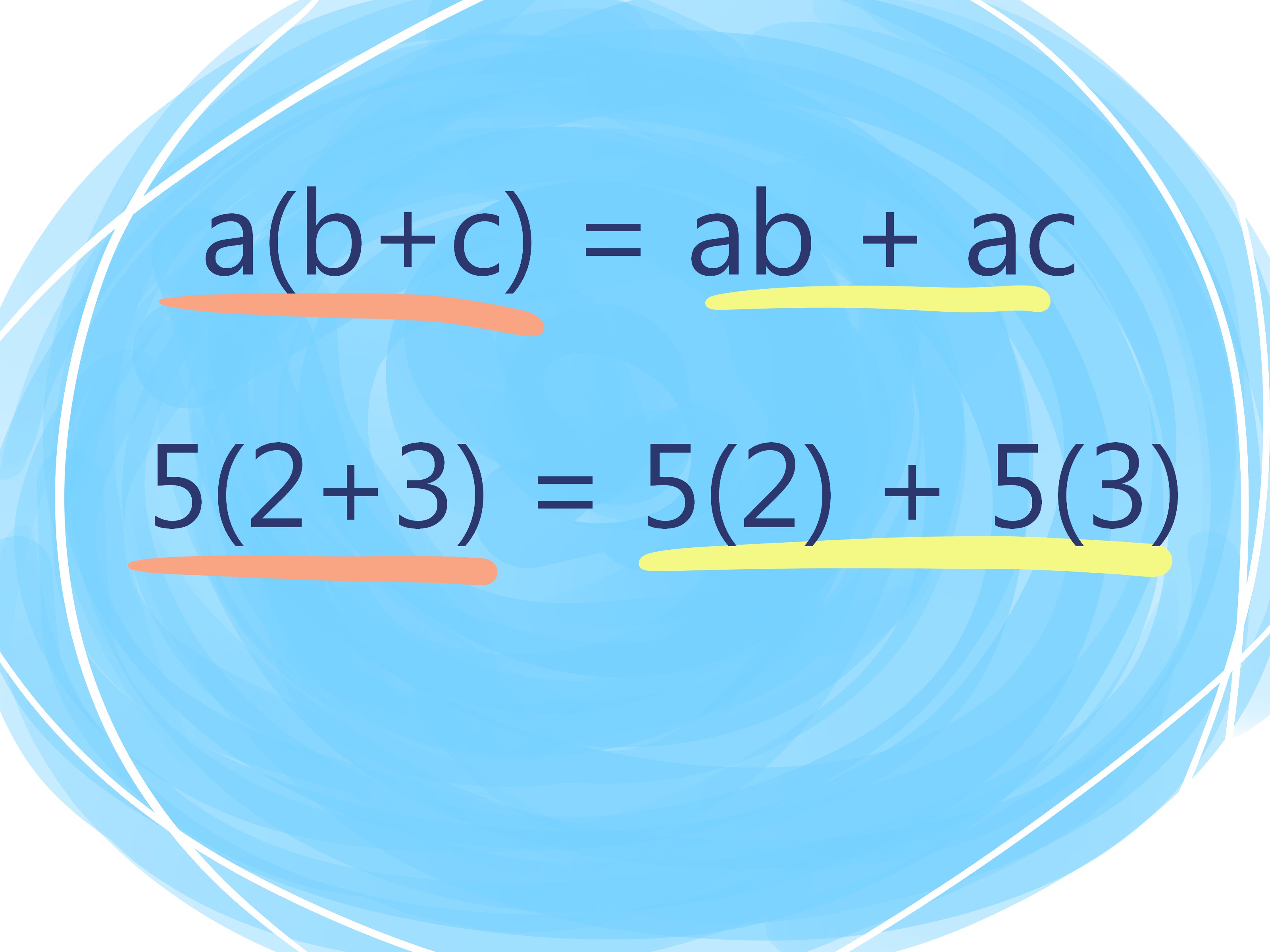
Distributive Property
The distributive property connects multiplication and addition. It says:
a(b + c) = ab + ac
Example:
-3(4 + 5) = (-3 × 4) + (-3 × 5)
-3(9) = -12 + (-15)
-27 = -27
The distributive property is a superstar in algebra. It appears constantly when simplifying expressions and solving equations.
Step 10: Check Your Answer With Estimation and Logic
After solving an integer problem, pause for a quick reasonableness check. Does the sign make sense? Did you subtract when the signs were different? Did you accidentally turn subtraction into a tiny math tornado?
Example:
-18 + 6 = -12
This makes sense because -18 has the larger absolute value, so the result should be negative.
Another example:
-7 × -8 = 56
This makes sense because multiplying two negatives gives a positive product.
Checking your answer is not just for tests. It builds confidence and catches sneaky sign errors, which are the raccoons of integer math: small, fast, and always getting into things.
Common Mistakes When Solving Integers
Mistake 1: Forgetting That Subtracting a Negative Means Adding
Many students get stuck on problems like 10 – (-3). Remember, subtracting a negative turns into addition:
10 – (-3) = 10 + 3 = 13
Mistake 2: Mixing Up Addition Rules and Multiplication Rules
For multiplication and division, same signs mean positive and different signs mean negative. For addition and subtraction, you must consider absolute values. Do not apply the multiplication rule to every situation like it is a universal remote.
Mistake 3: Ignoring Parentheses
Parentheses can change the meaning of a problem. Compare:
- -3² = -9
- (-3)² = 9
In the first expression, only 3 is squared, and the negative sign remains outside. In the second expression, the entire negative number is squared.
Mistake 4: Dividing by Zero
Division by zero is undefined. If you see a zero in the denominator or after a division symbol, stop and check the expression carefully.
Practice Examples for Solving Integers
Example 1: Solve -9 + 14
The signs are different, so subtract the absolute values:
14 – 9 = 5
Since 14 has the larger absolute value, the answer is positive:
-9 + 14 = 5
Example 2: Solve -6 – 11
Rewrite subtraction as addition:
-6 – 11 = -6 + (-11)
Same signs: add and keep the negative sign.
-6 + (-11) = -17
Example 3: Solve -4(7 – 10)
First solve inside the parentheses:
7 – 10 = -3
Then multiply:
-4 × -3 = 12
So:
-4(7 – 10) = 12
Example 4: Solve 36 ÷ (-9)
The signs are different, so the quotient is negative:
36 ÷ (-9) = -4
Why Integer Properties Matter in Algebra
Integer properties are not just vocabulary words for a quiz. They are the foundation of algebra. When you combine like terms, solve equations, factor expressions, or work with coordinate planes, integer rules are quietly doing the heavy lifting in the background.
For example, solving x – 7 = -2 requires the additive inverse property. Add 7 to both sides:
x – 7 + 7 = -2 + 7
x = 5
The integer operation -2 + 7 gives the final answer. If you are strong with integers, equations become much easier. If integers feel shaky, algebra can feel like trying to build furniture with missing instructions and one suspicious extra screw.
Tips to Get Better at Solving Integers
Practice With Small Numbers First
Start with integers between -10 and 10. Smaller numbers make it easier to focus on signs and rules instead of getting distracted by arithmetic.
Say the Operation Out Loud
For subtraction problems, say “add the opposite.” For example, read -5 – (-8) as -5 plus positive 8. This simple language trick can prevent many sign mistakes.
Use Real-Life Situations
Integers show up in temperatures, bank balances, elevation, sports scores, and elevator floors. If the temperature changes from -4°F to 6°F, it increased by 10 degrees. That is integer thinking in real life.
Create a Sign Rule Cheat Sheet
A small cheat sheet can help while practicing. Write down addition rules, subtraction rules, multiplication sign rules, division sign rules, and the major integer properties. Over time, you will need it less and less.
Learning Experiences: How Integers Start Making Sense
Many students do not struggle with integers because the math is impossible. They struggle because integers require a new way of thinking. In early math, numbers often mean “how many things you have.” Three apples, eight pencils, twelve cookiesdeliciously straightforward. Then negative numbers arrive, and suddenly math says, “What if you had less than zero cookies?” That sounds rude, but it is useful.
One of the best learning experiences with integers is connecting them to money. Suppose you have $5, but you owe your friend $8. Your situation can be represented as 5 + (-8). You are not just doing a random worksheet problem; you are describing a real balance. Since you owe more than you have, your final balance is -$3. Suddenly, negative numbers are not strange. They are just debt, loss, or a position below zero.
Temperature is another powerful example. If the temperature is -2°F in the morning and rises by 9 degrees, the expression is -2 + 9. The answer is 7°F. Students can imagine a thermometer climbing upward. If the temperature drops instead, the movement goes downward. This makes integer addition and subtraction easier to visualize because you are not just “doing signs”; you are watching movement.
Elevation also works beautifully. Sea level is 0. A mountain peak might be +3,000 feet, while a submarine might be at -500 feet. If the submarine rises 200 feet, it moves from -500 to -300. It is still below sea level, but it is closer to zero. That idea helps students understand why -500 + 200 = -300, not -700.
Another helpful experience is using integer chips or counters. A positive chip represents +1, and a negative chip represents -1. One positive chip and one negative chip form a zero pair because they cancel each other out. To solve -4 + 6, place four negative chips and six positive chips. Match four pairs that cancel to zero. Two positive chips remain, so the answer is 2. This hands-on approach is especially useful because it turns an abstract rule into something visible.
The biggest breakthrough often comes when students stop memorizing every individual case and start recognizing patterns. Adding integers is about direction and distance. Subtracting integers is about adding the opposite. Multiplication and division are about sign pairs. Properties explain why expressions can be rearranged, grouped, simplified, or expanded. Once those patterns click, integers become less intimidating.
A good personal strategy is to slow down for the sign, then speed up for the arithmetic. Most integer mistakes happen before the actual calculation begins. A student may know that 8 + 5 = 13, but the real question is whether the answer should be positive or negative. When learners build the habit of asking, “What sign should this have?” they become much more accurate.
Integer practice also teaches patience. At first, problems like -6 – (-9) may feel like math is playing a prank. But after rewriting it as -6 + 9, the problem becomes friendly: the answer is 3. That is the experience many learners have with integers. The confusion does not last forever. With enough examples, the signs stop looking like traps and start acting like helpful instructions.
Conclusion
Learning how to solve integers and their properties is a major step toward becoming confident in math. Integers appear in arithmetic, pre-algebra, algebra, geometry, science, finance, and everyday problem-solving. Once you know how to add, subtract, multiply, divide, compare, and simplify integers, you gain a skill that keeps showing up like a reliable friend.
The key is to understand the logic behind the rules. Use a number line for direction, absolute value for distance, sign rules for multiplication and division, and integer properties for simplifying expressions. Practice with real-world examples like temperature, money, and elevation. And when in doubt, check whether your answer makes sense. Integer math is not about memorizing a mountain of random rules. It is about learning a small set of powerful patterns and using them well.
Note: This article is written in original, publish-ready language and is based on standard integer rules, arithmetic properties, and widely accepted mathematics instruction.