Mezcal does not begin in a bottle. It begins in patience, dust, muscle, fire, and a plant that takes its sweet time getting ready for the party. If tequila is the polished cousin who shows up in a pressed shirt, mezcal is the relative who arrives smelling faintly of campfire, earth, and mysteryand somehow steals the whole evening without even trying.
So, how is mezcal made? In simple terms, mezcal is made by harvesting mature agave, roasting the hearts of the plant, crushing them, fermenting the sugary fibers and juice, and then distilling the liquid into a spirit. That sounds straightforward enough, but the reality is wonderfully messy, deeply traditional, and wildly variable. Tiny changes in agave species, soil, altitude, roasting method, fermentation, and still type can create two bottles that taste like they came from different planets.
That is part of mezcal’s charm. It is not built to be bland. It is built to tell you where it came from.
What Is Mezcal, Exactly?
Mezcal is a distilled agave spirit from Mexico, but it is not just “smoky tequila.” That shortcut is catchy, but it leaves out the best part. Mezcal can be made from many different types of agave, and those agaves can grow in very different environments. One plant may deliver earthy, peppery notes; another can lean floral, tropical, herbaceous, savory, or minerally. Smoke may be part of the picture, but it is not the whole movie.
Most mezcal is associated with Oaxaca, and for good reason: it is the heartland of the category. But mezcal production is not limited to one state, and it is not limited to one flavor profile. That is why people who really love mezcal talk about it less like a generic liquor and more like an agricultural product with terroir. In other words, mezcal is shaped by place. Soil matters. Rain matters. Elevation matters. Even the microbes floating around the fermentation area can leave fingerprints on the final spirit.
The Step-by-Step Process of How Mezcal Is Made
1. Growing the Agave and Waiting. And Waiting Some More.
The first step in making mezcal is the least glamorous and the most important: growing agave until it is mature enough to harvest. This is where mezcal laughs in the face of instant gratification. Depending on the species, an agave may take anywhere from roughly eight years to several decades to mature. Espadín, the most common agave used in mezcal, is popular partly because it is relatively efficient and easier to cultivate. Wild agaves, on the other hand, can take much longer and often produce lower yields.
That long growing cycle is one reason mezcal can be expensive. You are not paying only for what happens in the distillery. You are also paying for years of sun, soil, labor, risk, and agricultural uncertainty. Grapes and grains move faster. Agave prefers drama.
2. Harvesting the Piñas
When the agave is mature, it is harvested by hand by skilled workers often called jimadores or mezcaleros, depending on the local tradition and context. The long, spiky leaves are chopped away, revealing the dense heart of the plant, known as the piña because it looks a bit like a giant pineappleif pineapples had anger issues and a taste for arid hillsides.
This stage matters more than many casual drinkers realize. A well-timed harvest helps ensure the plant has developed enough sugars to make a flavorful spirit. Harvest too early, and the mezcal can lack depth. Harvest too late, and the plant may have already put energy into flowering, reducing the quality of the heart for distillation. In other words, timing is everything.
3. Roasting the Agave Hearts
Once harvested, the piñas are roasted to convert their complex carbohydrates into fermentable sugars. This is one of the defining moments in mezcal production. In traditional methods, the hearts are cooked in underground pit ovens lined with hot stones and fueled by wood. The agave is piled in, covered with natural fibers or earth, and left to roast slowly for several days.
This roasting process is a huge reason mezcal often develops smoky, savory, earthy aromas. The underground pit does not simply cook the agave; it transforms it. Raw agave can be fibrous and vegetal, but roasted agave becomes sweet, soft, aromatic, and deeply expressive. Think caramelized vegetables meeting wood smoke and desert herbs, then deciding to form a union.
Not every producer uses the exact same setup. Some artisanal makers use above-ground masonry ovens, and more industrial operations may adopt more modern cooking methods. But when people talk about classic mezcal character, pit roasting is usually the star of the show.
4. Crushing the Roasted Agave
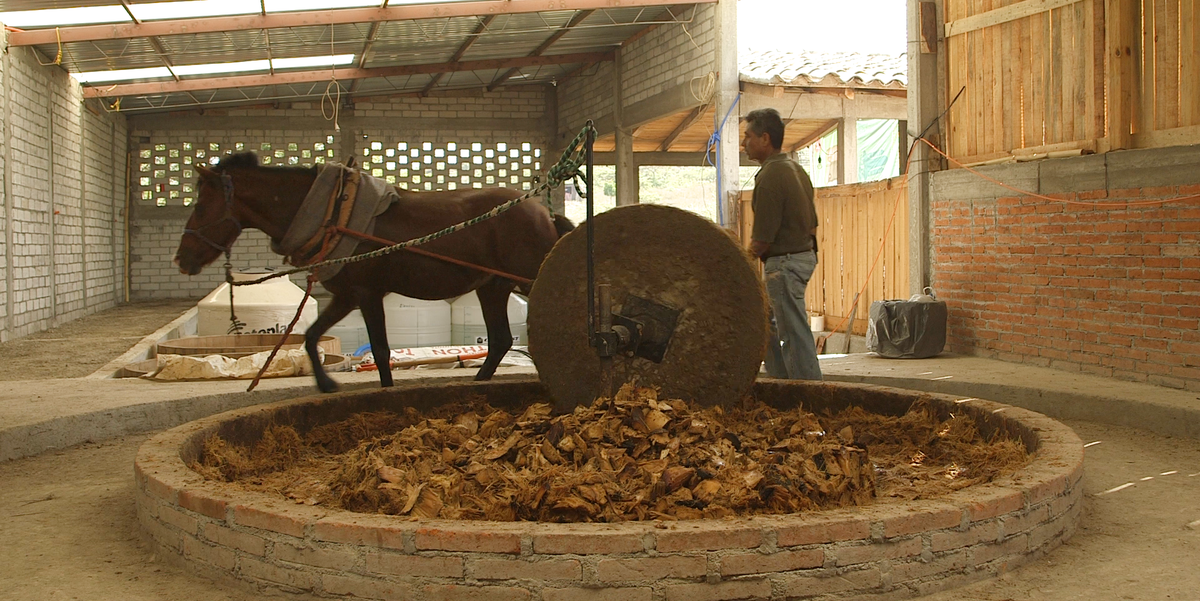
After roasting, the softened agave must be crushed to release its juices and break down the fibers. Traditional producers often use a tahona, a large stone wheel that rolls over the cooked agave, sometimes pulled by an animal. Other producers use hand-mallet methods, pounding the roasted piñas in a stone trough until the plant material is reduced to a workable mash.
This is not exactly a dainty process. No one is out there whispering sweet encouragement to the agave. It is crushed, pressed, and worked until the sugars are accessible for fermentation. Some contemporary artisanal operations may use mechanical shredders, which can save time and labor, but traditional crushing methods remain a major part of mezcal’s identity.
5. Fermentation
Next comes fermentation, where the crushed agave fibers and juice are placed into vats, tanks, pits, or wooden tubs and left to ferment. In many traditional mezcal operations, fermentation happens with ambient or wild yeast rather than laboratory-selected yeast strains. That means the local environment plays a real role in shaping flavor.
This stage can take several days or even weeks, depending on temperature, sugar content, vessel type, and the producer’s style. Fermentation is where sweetness starts becoming alcohol, but it is also where aroma gets more complicated. Fruit notes, funk, savory character, acidity, and texture can all begin forming here. It is one reason mezcal can taste so alive compared with more standardized spirits.
In practical terms, fermentation is less glamorous than people imagine. It is not a cinematic montage with golden-hour lighting and a violin soundtrack. It is bubbling, sticky, warm, fragrant, and sometimes weird. But weird in the best possible way.
6. Distillation
Once fermentation is complete, the liquid is distilled. Many mezcals are distilled twice, though exact methods vary by producer and category. Copper pot stills are common, but some ancestral styles use clay stills, which can produce a spirit with a different texture and aromatic profile.
Distillation concentrates the alcohol and refines the flavors, but it does not erase the character built earlier in the process. Great mezcal still tastes like agave, place, and method. The still is not there to wipe the slate clean. It is there to sharpen the handwriting.
This is also where the mezcalero’s skill becomes especially visible. Small decisions about cuts, proof, and blending can make the final spirit cleaner, richer, brighter, smokier, softer, or more intense. Mezcal is not factory logic in a cowboy hat. It is craft, judgment, and repetition.
7. Resting or Aging
After distillation, some mezcal is bottled young, while some is rested or aged. Joven mezcal is unaged and usually the purest expression of agave and production method. Reposado is aged for at least two months and up to a year. Añejo spends one to three years in oak. Extra añejo goes beyond three years.
Many mezcal fans prefer joven expressions because oak can soften or cover some of the spirit’s raw agricultural personality. That does not make aged mezcal bad. It just changes the conversation. A joven says, “Meet the agave.” An añejo says, “Meet the agave, now wearing vanilla cologne.”
Why Mezcal Tastes Different from Bottle to Bottle
If one mezcal tastes like roasted citrus and wet stones while another leans toward black pepper, herbs, and grilled pineapple, that is normal. Mezcal is not supposed to be uniform. Agave species matter. Espadín is common, approachable, and often herbaceous or gently fruity. Tobalá can be floral and elegant. Tepeztate may take decades to mature and can produce intensely expressive mezcal. Other agaves bring their own personalities, and that is before terroir enters the room and starts rearranging the furniture.
Then there is production. How long the agave was roasted, what wood was used, how it was crushed, what vessel it fermented in, whether the yeast was ambient, whether the still was copper or clay, and how the distiller made the cutsall of that affects the result. Mezcal is one of the clearest examples in the spirits world that process is flavor.
Traditional, Artisanal, and Ancestral Mezcal
If you look closely at labels, you may see categories such as mezcal, mezcal artesanal, or mezcal ancestral. These categories relate to the methods and equipment allowed in production.
Ancestral mezcal is the most traditional in its permitted techniques, often involving pit ovens, manual or tahona crushing, natural fermentation, and clay distillation. Artesanal mezcal still follows traditional production more closely than industrial methods, but it can allow a few more modern tools, such as certain mechanical mills or copper stills. The plain “mezcal” category can include more industrialized equipment and processes.
That does not mean one label automatically guarantees quality. But it does give buyers clues about how the spirit was made. In mezcal, method is not just trivia for label nerds. Method is flavor, texture, and identity.
Is All Mezcal Smoky?
No. Let us set that myth down gently and back away from it.
Many mezcals do have smoky notes because of the roasting process, especially when agave is cooked in underground pits. But smoke is only one part of the profile. Mezcal can also be grassy, floral, tropical, cheesy, peppery, mineral, earthy, fruity, or deeply savory. Some bottles are bold and campfire-like. Others are surprisingly delicate. Saying all mezcal tastes smoky is like saying all barbecue tastes the same because, technically, there was fire involved.
How Mezcal Differs from Tequila
Tequila and mezcal are both agave spirits, but they usually part ways in raw material and process. Tequila is made only from Blue Weber agave and generally relies on above-ground ovens or autoclaves for cooking. Mezcal can be made from many agave varieties and is often associated with pit roasting, wild fermentation, and a wider range of traditional methods.
That helps explain why tequila often feels more streamlined and consistent, while mezcal feels more rustic, varied, and place-driven. Tequila can absolutely be complex, but mezcal often wears its process more openly on its sleeve.
Why Making Mezcal Is So Labor-Intensive
Mezcal asks a lot of everyone involved. The agave takes years to mature. The harvest is manual. The roasting is slow. The crushing is physical. Fermentation can be unpredictable. Distillation happens in small batches. Add in the challenges of sustainability, replanting, and protecting wild agave populations, and you begin to understand why serious mezcal is not a cheap, fast product.
That is also why the best mezcal conversations are about producers, regions, agaves, and methodsnot just hype. Behind every bottle is agriculture, craftsmanship, and time. A lot of time.
The Experience of Mezcal-Making: What It Feels Like Beyond the Technical Steps
To understand how mezcal is made, it helps to move beyond the checklist and imagine the experience around it. Mezcal production is not only a sequence of steps. It is a sensory environment. It is heat, sound, smell, texture, and rhythm. It is work you can almost hear in the spirit.
Picture a mature agave plant standing in a dry landscape after years of storing energy in its heart. Harvest day is not a quiet little garden activity. The leaves come off with force. The piña appears gradually, pale and dense under the blades, like a secret the plant did not plan on sharing. Even before roasting, there is something impressive about the scale of it. Agave is agricultural, yes, but it also feels sculpturalbig, fibrous, prehistoric, and slightly dramatic.
Then comes the roasting pit, which may be the most romanticized part of mezcal-making, and honestly, for once the hype is understandable. Hot stones, wood fire, earth, smoke, and time do something magical to the agave. When producers uncover roasted piñas after days of cooking, what started as a tough, starchy plant has turned soft, fragrant, and sweet. It is one of those transformations that makes food and drink feel less like chemistry and more like theater. Not subtle theater, either. This is a full production with smoke machines and emotional range.
The crushing stage brings the process back down to earth in the best way. Whether the agave is milled by tahona or pounded by hand, you are suddenly reminded that mezcal is agricultural labor before it is luxury branding. The fibers are heavy. The work is repetitive. Nothing about it suggests convenience. And yet this physical effort is part of why mezcal feels so connected to place. It has not been polished into anonymity.
Fermentation adds another dimension entirely. Here the process gets less visual and more atmospheric. Warm tanks or vats hold the mash as yeast gets to work, and the aromas shift from cooked sweetness to something alive, funky, fruity, sour, and complex. Fermentation is where mezcal stops being “cooked agave” and starts becoming a spirit in waiting. It is also where the local environment enters the story in a vivid way. Air, temperature, microbes, vessel materialall of it matters.
Distillation, meanwhile, feels like concentration in every sense. The goal is not to erase what came before, but to focus it. When producers use copper or clay stills, they are not just making alcohol; they are making decisions about texture, aroma, and identity. The final liquid may be clear, but the process behind it is anything but simple.
What makes the mezcal-making experience especially compelling is that it resists standardization. One producer’s routine is not another’s. One village’s traditions are not exactly the next village’s. Even bottles made from the same agave species can speak in different accents. That variability is not a flaw. It is the point.
In the end, the experience of mezcal-making feels human. It is slow where modern industry wants speed. It is local where modern branding wants sameness. It is imperfect in ways that make it more interesting, not less. And that may be the deepest answer to the question “How is mezcal made?” It is made by turning a stubborn desert plant into a liquid record of labor, landscape, and traditionone batch at a time.
Final Thoughts
So, how is mezcal made? With mature agave, careful harvest timing, slow roasting, serious physical labor, open-ended fermentation, and deliberate distillation. But that answer, while accurate, still feels a little too tidy for a spirit this unruly and expressive.
Mezcal is made the long way. It is made with plants that refuse to hurry, with methods that often favor flavor over efficiency, and with producers whose choices shape every sip. That is why mezcal can taste smoky, floral, savory, fruity, herbal, earthy, or all of the above before your brain catches up. It is not trying to be one thing. It is trying to be itself.
And frankly, in a world full of polished, predictable drinks, that is a pretty beautiful thing.