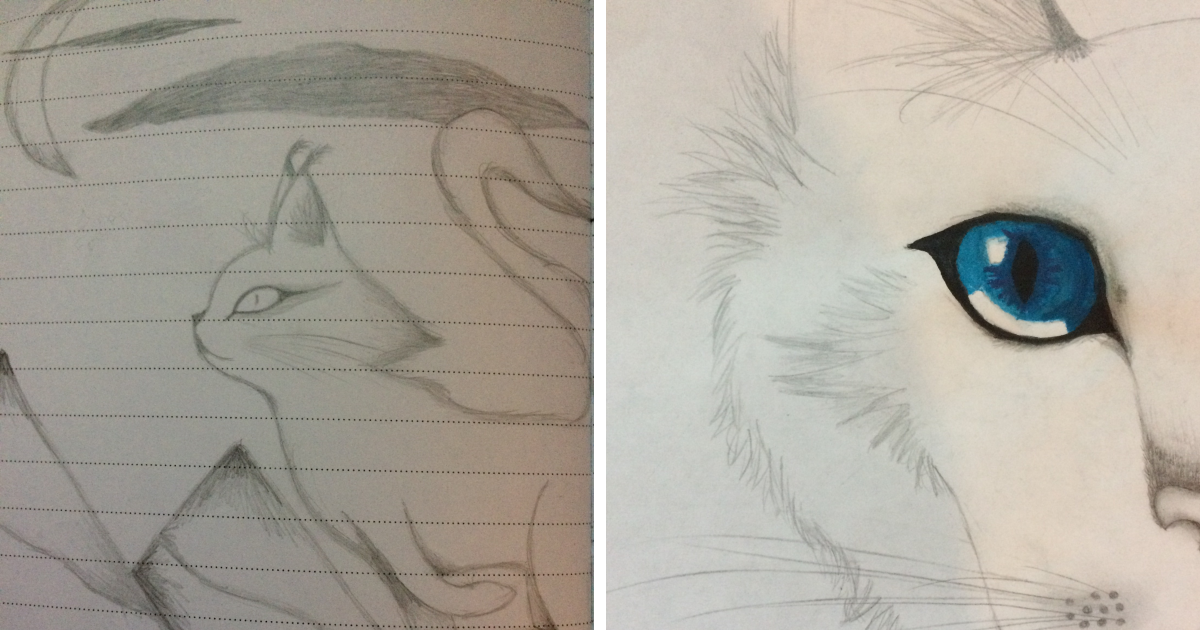
Note: Artistic talent is welcome, but it is absolutely not required. A pencil, a pet, and the courage to draw a suspiciously potato-shaped cat are enough to begin.
Pets spend years studying us. They know the precise sound of a snack bag opening from three rooms away, recognize the difference between work shoes and walking shoes, and can detect an unattended sandwich with technology unavailable to modern science. It seems only fair that we study them for a change.
Hey Pandas, Draw Your Pet is a cheerful creative challenge for pet lovers, experienced artists, casual doodlers, and people whose dogs currently resemble furry rectangles on paper. The goal is not to create a museum masterpiece. It is to observe your pet closely, capture a little personality, and share an image that makes other animal lovers smile.
Your drawing can be realistic, cartoonish, dramatic, minimalist, or delightfully strange. You might create an elegant pencil portrait of your senior cat, a watercolor painting of your parrot, or a five-minute sketch of your hamster looking like the tiny landlord he believes himself to be. There is no single correct style because there is no single correct way to celebrate an animal you love.
Why Drawing Your Pet Is Such a Great Creative Challenge
Pets make unusually rewarding art subjects because they are familiar but never boring. You already know the tilt of your dog’s ears when dinner is late, the judgmental half-squint your cat uses during video calls, or the determined posture your rabbit adopts before rearranging the furniture.
These details give a pet portrait emotional value. A technically perfect drawing of an anonymous animal may be impressive, but a slightly crooked sketch that captures your pet’s legendary side-eye can feel far more personal.
It trains you to notice small details
Drawing encourages close observation. Instead of thinking, “My dog has brown fur,” you begin noticing that the coat is made of warm reddish areas, cooler shadows, pale tips, and darker fur around the muzzle. You may discover that one ear sits higher than the other or that your cat’s face is less circular than your memory insists.
Observation is one of the foundations of drawing. Before adding detail, look at the overall shape, posture, proportions, and direction of the animal’s body. The more carefully you look, the less you have to rely on assumptions about what a dog, cat, bird, or guinea pig is “supposed” to look like.
It turns an ordinary moment into a keepsake
A pet portrait records more than physical appearance. It can preserve a favorite sleeping position, an old collar, a ridiculous haircut, or the expression your pet makes immediately before committing a minor household crime.
The finished artwork does not need to be flawless to become meaningful. Wobbly lines and imperfect proportions often make a handmade drawing more charming. Years later, those quirks may remind you exactly where you were in your creative journey and why you chose that particular moment.
It makes art feel less intimidating
A blank page can feel serious until your subject begins licking a chair leg. Drawing your own pet lowers the pressure because you already have a connection to the subject. Instead of worrying about whether the artwork looks important, you can focus on whether it feels recognizable.
That shift is useful for beginners. You are not auditioning for an art academy. You are trying to capture the essential truth of a creature who once barked at a decorative pumpkin for nine consecutive minutes.
Choose a Pet Portrait Style That Fits You
Before drawing, decide what kind of image you want to make. Your choice of style affects the materials, time, and level of detail needed.
Realistic portrait
A realistic pet portrait focuses on accurate proportions, believable textures, light, shadow, and recognizable features. Graphite, charcoal, colored pencils, watercolor, acrylic paint, and digital painting tools all work well.
Realism does not require drawing every hair. In fact, trying to illustrate the entire coat strand by strand can make the portrait stiff. Begin with large shapes and tonal areas. Add selected fur details around the eyes, ears, muzzle, and outer silhouette where they contribute most to the likeness.
Cartoon or caricature
A cartoon pet drawing exaggerates personality. Enlarge expressive eyes, stretch long ears, emphasize tiny legs, or make a fluffy tail even more spectacular. The trick is to exaggerate traits that already exist rather than randomly changing the animal.
A dignified Persian cat might become an offended emperor. A cheerful retriever could be drawn as an unstoppable yellow tornado. A dachshund may require very little exaggeration because nature has already completed most of the cartooning.
Minimalist line art
Minimalist pet art uses a limited number of lines to suggest the animal’s form. This style looks simple, but it requires careful decisions. Every mark matters when there are only twelve of them.
Look for the most recognizable contours: the slope of the forehead, the curve of the back, the shape of the ears, and the angle of the nose. Use one continuous line if you enjoy a challenge, or build the image from several clean strokes.
Fantasy or character portrait
Perhaps your bearded dragon deserves armor. Maybe your rabbit should command a pirate ship. Perhaps your cat has always behaved like a Victorian duchess and merely needs the official portrait to confirm it.
Fantasy pet portraits combine observation with imagination. Keep a few recognizable physical features, then add clothing, scenery, symbols, or props that reflect the pet’s personality. This approach is especially good for artists who prefer storytelling over strict realism.
How to Draw Your Pet Step by Step
1. Pick a clear reference image
Drawing from life is wonderful until your model sees a dust particle and leaves the studio at top speed. A photograph gives you time to study proportions and details without negotiating with an animal who has other appointments.
Choose a sharp image with clear lighting and visible eyes. Eye-level photographs often feel more personal than pictures taken from far above. Natural window light or outdoor shade can reveal coat texture without creating harsh shadows. Avoid forcing your pet into an uncomfortable pose. Use toys, praise, treats, and breaks, and let the session end when your model has had enough.
Try to select a reference that shows personality. A technically clear photograph is useful, but a slightly less formal image may better capture the expression everyone recognizes.
2. Identify the largest shapes
Ignore fur, whiskers, markings, and other details for the moment. Reduce the pet to basic forms. The head might be a circle, oval, wedge, or rounded box. The chest may resemble an egg, while the legs can begin as tapered cylinders.
Draw these shapes lightly. They are construction lines, not permanent commitments. Check how the forms overlap and compare their sizes. Is the head wider than the chest? How far apart are the eyes? Where does the nose sit in relation to the lower edge of the face?
3. Check angles and proportions
Many pet drawings go wrong not because of poor shading but because the initial proportions are slightly off. A nose placed too low, eyes spaced too widely, or ears made too small can change the animal’s identity.
Imagine straight guide lines between key points. Compare the angle from one eye to the other, the width of the muzzle, and the distance from the nose to the forehead. Looking at the empty spaces around the pet can also help. The triangular gap between two legs may be easier to judge than the complicated legs themselves.
4. Establish light and shadow
Squint at the reference image to simplify it. Fine details will blur, leaving the major light, middle, and dark areas. Mark those areas before rendering individual hairs or feathers.
If the colors are confusing, view the reference in black and white. This makes the value pattern easier to understand. A convincing arrangement of light and shadow creates form even when the drawing uses unrealistic colors.
5. Draw the eyes with restraint
The eyes often become the emotional center of a pet portrait. Observe their actual shape instead of automatically drawing two matching almonds. One eye may appear narrower because the head is turned, and part of the iris may disappear beneath the eyelid.
Leave a small highlight where light reflects from the surface. Do not make the entire eye equally dark. Subtle changes around the eyelids, tear ducts, and surrounding fur help the eyes sit naturally within the face rather than floating like decorative stickers.
6. Build fur, feathers, scales, or skin texture
Texture should follow the animal’s form. Fur on the forehead may grow upward or outward, while cheek fur curves around the muzzle. Short hair can be suggested with compact marks; long hair benefits from broader flowing groups.
Begin with the general tone beneath the coat, then place selected lighter and darker marks over it. Leave some areas quiet. When every inch receives the same level of detail, the viewer has nowhere to focus.
For birds, organize feathers into overlapping groups before drawing individual edges. For reptiles, establish the three-dimensional body first and add scale patterns afterward. Texture should describe the form, not bury it.
7. Add the personality details
This is where the drawing becomes your pet instead of merely an animal. Include the bent whisker, uneven ear, spotted paw, unusual collar, or tiny tooth that appears during naps.
Body language matters too. Ear position, tail carriage, posture, and facial tension can completely change the mood. Use a relaxed reference whenever possible, and never pressure a nervous pet to remain in a pose for the sake of a drawing.
8. Know when to stop
Artists frequently damage a lively sketch by continuing long after it is finished. Step away, view the drawing from a distance, or look at it in a mirror. Ask whether additional marks will improve the likeness or merely prove that you still possess a pencil.
A few unfinished areas can make the completed details more effective. Your viewer’s imagination is surprisingly capable and appreciates being given a small assignment.
Easy Pet Drawing Ideas for Every Skill Level
Not every submission needs to be a formal portrait. Try one of these approaches when you want something faster or funnier:
- Draw your pet using only one continuous line.
- Create a portrait without lifting your pencil from the paper.
- Draw your pet from memory, then compare it with a photograph.
- Turn your pet into a superhero, astronaut, chef, or monarch.
- Illustrate the moment your pet hears the word “treat.”
- Use only three colors for the entire portrait.
- Draw the same pose in realistic, cartoon, and minimalist styles.
- Create a “before and after dinner” expression study.
For a group activity, trade pet photographs with friends and draw one another’s animals. The results may range from touching to mildly confusing, which is part of the fun.
Common Pet Portrait Mistakes and How to Fix Them
Starting with tiny details
Drawing a magnificent eye does not help much when the head surrounding it is the wrong size. Work from large shapes to small details. Structure first, eyelashes later.
Using symbols instead of observation
Beginners often draw what they think an eye, paw, or ear looks like. Compare those assumptions with the reference. Real features are usually more irregular and interesting than the symbols stored in memory.
Making both sides identical
Faces are not perfectly symmetrical, especially when viewed at an angle. One ear may appear smaller, one eye may be partly hidden, and one side of the muzzle may catch more light. Those differences create depth.
Drawing every hair separately
A pet is not a collection of noodles. Group the coat into masses, then add enough directional marks to communicate texture. Save the sharpest detail for the focal area.
Comparing your work with professionals
A professional pet artist may have completed hundreds of portraits. Your first drawing is not required to compete with someone else’s five-hundredth. Compare it with your previous work instead. Progress is quieter than perfection but considerably more useful.
How to Share Your “Hey Pandas, Draw Your Pet” Entry
Photograph or scan your artwork in even lighting. Crop distracting edges, straighten the image, and make small brightness adjustments when needed, but avoid editing it until the original colors no longer resemble the drawing.
Include a photograph of your pet beside the portrait when possible. Viewers love comparing the model with the interpretation, particularly when both have the same expression of deep personal disappointment.
Add a short caption with the pet’s name, favorite activity, and the story behind the drawing. A few specific details make the post memorable. “This is Maple, a rescue dog who fears umbrellas but confidently challenges vacuum cleaners” tells readers far more than “Here is my dog.”
Keep feedback friendly when responding to other artists. Celebrate personality, effort, humor, color choices, or improvement. A community drawing challenge should make people more excited to create, not afraid to touch a pencil again.
My Experience Drawing Pets: What the Process Really Teaches You
The first lesson pet drawing teaches is that familiarity can be misleading. You may see your animal every day and feel certain you know every feature. Then you begin drawing and realize you cannot confidently explain the shape of your own dog’s nose. You remember the general dogness of it, certainly, but the precise structure has apparently escaped your attention for years.
That discovery can be frustrating, but it is also valuable. It reveals the difference between recognizing something and truly observing it. During a pet portrait, you begin seeing changes in direction, small asymmetries, and relationships between features. The ears are not simply “floppy”; they attach at a particular angle and fold in a specific place. The cat is not merely “fluffy”; the hair around the neck forms larger shapes that frame the face.
Another surprise is how quickly personality can appear. Sometimes it emerges before the drawing is technically accurate. A slight tilt of the head or uneven eyebrow marking can suddenly make the page feel alive. That moment is satisfying because the portrait stops being a collection of shapes and starts looking like an individual.
Not every attempt reaches that moment immediately. One early sketch may look like your pet’s distant cousin. Another may resemble an animal that has just received shocking financial news. This is normal. The useful response is not to hide the page but to identify the largest problem. Perhaps the muzzle is too long, the eye line is tilted incorrectly, or the body is missing the weight visible in the reference.
Quick studies are often more educational than one endlessly corrected portrait. Drawing the same pet five times for ten minutes each helps you experiment without becoming emotionally attached to every line. One study can focus on posture, another on facial proportions, and another on coat direction. By the fifth sketch, your hand usually moves with more confidence because your eyes have learned what to look for.
Working with a live model adds a separate kind of comedy. A cat may sit perfectly still until the pencil touches the paper. A dog may interpret eye contact as an invitation to climb into your lap. Birds can rotate their heads into positions that appear anatomically illegal. Instead of fighting this behavior, use it. Make several rapid gesture drawings that capture movement, balance, and attitude. A ten-second sketch of a dog stretching may express more life than a carefully polished image copied from a stiff pose.
Drawing pets also changes how you think about mistakes. A misplaced line can become part of the texture. An oversized ear may inspire a caricature. A watercolor bloom can suggest soft fur or an interesting background. The ability to adapt is more valuable than the ability to execute a rigid plan perfectly.
The most memorable portraits are not always the most realistic. One drawing might capture the exact shine of a dog’s coat, while another captures the way that dog waits beside the refrigerator with theatrical hope. Technical skill creates credibility, but observation and affection create connection.
It is also worth keeping unsuccessful drawings. They become a record of improvement that finished pieces alone cannot provide. Date each sketch and resist the urge to throw it away. Months later, the awkward proportions that once annoyed you may become proof that practice worked.
Most importantly, drawing your pet creates a period of focused attention. For a little while, you are not scrolling, rushing, or multitasking. You are noticing how light falls across an ear, how paws support the body, and how a familiar expression is constructed. That quiet attention is part of the artwork, even if the final portrait looks less like a noble companion and more like a surprised loaf of bread.
Conclusion: Pick Up a Pencil and Celebrate Your Pet
Hey Pandas, Draw Your Pet is not a contest to determine who can produce the most realistic fur or the most geometrically accurate whiskers. It is an invitation to look closely, experiment freely, and turn affection into something visible.
Choose a favorite photograph, begin with simple shapes, observe more than you assume, and let your style show. Make the portrait serious, silly, colorful, dramatic, or wonderfully imperfect. Your pet has already provided the personality. You only need to put it on the page.
And should your first attempt resemble an unidentified woodland creature, do not panic. Write your pet’s name underneath it. Confidence is an artistic technique too.