Your car may not have eyes, opinions, or a favorite coffee order, but it does have a surprisingly sophisticated way of “seeing” the world. Hidden behind bumpers, grilles, and side panels are small radar sensors that quietly measure distance, speed, and direction while you argue with the navigation system. One of the most important technologies behind this sensing superpower is FMCW radar, short for frequency-modulated continuous wave radar.
FMCW radar is the reason many modern vehicles can support adaptive cruise control, blind-spot monitoring, automatic emergency braking, rear cross-traffic alerts, lane-change assistance, and increasingly advanced driver assistance systems. Unlike a camera, radar does not need perfect lighting. Unlike your uncle in the passenger seat, it does not get distracted by billboards. It sends radio waves outward, listens for echoes, and converts those echoes into useful information about nearby vehicles, pedestrians, guardrails, signs, and other objects.
Understanding the fundamentals of FMCW radar helps you understand your car’s point of view: not as a human-like picture, but as a dynamic map of reflections, velocities, angles, and probabilities. That may sound like wizardry wearing a lab coat, but the core idea is elegant. Your car chirps, the world chirps back, and the computer does math faster than you can say, “Was that parking sensor yelling at me?”
What Is FMCW Radar?
FMCW radar is a radar system that continuously transmits a radio signal whose frequency changes over time. Instead of sending one big pulse and waiting for a return, it sends a continuous wave that sweeps across a frequency band. This sweep is called a chirp. The word sounds cute, as if your bumper is full of birds, but in radar engineering it means a signal that rises or falls in frequency in a controlled way.
In automotive radar, FMCW systems commonly operate in millimeter-wave frequency ranges, especially around 76 GHz to 81 GHz. These high frequencies allow compact antennas, narrow beams, and useful resolution for vehicle sensing. In simple terms, higher-frequency radar can fit into a car-friendly package while still detecting objects at practical distances.
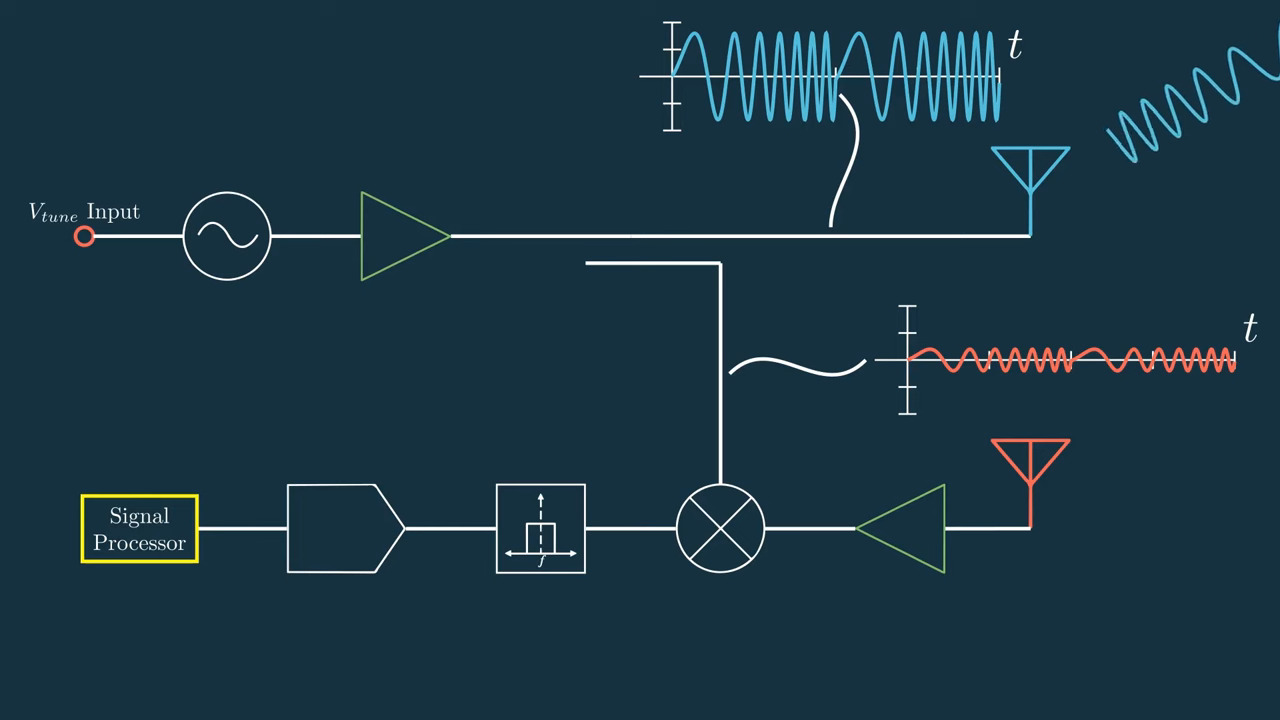
The “continuous wave” part means the radar keeps transmitting. The “frequency-modulated” part means the transmitted frequency changes predictably. When that signal hits an object, some energy reflects back to the receiver. Because the radar knows exactly what it transmitted at each moment, it can compare the returning echo with the current transmitted signal. The difference between the two reveals information about distance and motion.
How FMCW Radar Measures Distance
Imagine you are playing a note on a slide whistle and steadily moving the pitch upward. Now imagine the sound bounces off a wall and comes back slightly delayed. By the time the echo returns, your current whistle pitch is a little higher than the pitch that originally bounced off the wall. The difference between those pitches tells you how long the echo took to return. Radar does something similar, only with electromagnetic waves instead of musical comedy.
In an FMCW radar, the transmitted chirp increases in frequency over a short period. The reflected signal arrives after a delay because radio waves take time to travel to the object and back. The farther the object, the longer the delay. When the radar mixes the transmitted signal with the received echo, it produces a lower-frequency signal called the beat frequency. This beat frequency is tied directly to range.
A nearby object produces a smaller delay and a lower beat frequency. A farther object produces a larger delay and a higher beat frequency. The radar processor then converts that frequency information into a distance estimate. That is how a vehicle can know whether the car ahead is 15 feet away in stop-and-go traffic or 150 feet away on the highway.
Bandwidth Matters for Range Resolution
One key radar concept is range resolution, or the ability to distinguish two objects that are close together in distance. In FMCW radar, range resolution depends heavily on chirp bandwidth. A wider sweep bandwidth allows finer distance separation. That is one reason modern automotive radar systems benefit from wide millimeter-wave bands.
For example, if two motorcycles are riding close together ahead of your vehicle, a radar with poor range resolution might blur them into one target. A higher-resolution system has a better chance of separating the reflections. This matters for adaptive cruise control, collision warning, and automated driving features because the vehicle must understand not just that “something” exists, but where each object is.
How FMCW Radar Measures Speed
Distance is only half the story. A traffic cone sitting still and a truck barreling toward you are both “objects,” but your car should be much more emotionally invested in one than the other. FMCW radar estimates relative speed using the Doppler effect.
The Doppler effect is the same phenomenon that makes a siren sound higher-pitched as an ambulance approaches and lower-pitched as it moves away. With radar, motion changes the frequency of the returned signal. If an object is moving toward the radar, the echo shifts one way. If it is moving away, the echo shifts the other way. This shift helps the system calculate radial velocity, meaning speed toward or away from the sensor.
Automotive FMCW radar systems often transmit many chirps in a sequence. By examining how the phase of reflections changes from chirp to chirp, the radar can estimate velocity. The result is a range-Doppler map, which organizes targets by both distance and relative speed. This is extremely useful for separating stationary background objects from moving vehicles and pedestrians.
How Radar Figures Out Angle
Knowing that an object is 40 meters away is helpful. Knowing whether it is in your lane, the next lane, or on the sidewalk is even better. To estimate direction, automotive radar uses multiple antennas. These antennas receive the same reflected signal at slightly different times or phases. By comparing those phase differences, the radar can estimate the object’s angle.
Modern systems often use MIMO radar, which stands for multiple-input, multiple-output. This approach uses multiple transmit and receive antennas to create a larger “virtual” antenna array. The larger the effective antenna aperture, the better the radar can estimate direction. That is how a compact radar module hidden behind plastic can help build a wider understanding of the surrounding scene.
Angle estimation is vital for features such as blind-spot detection, lane-change assist, cross-traffic alerts, and front collision systems. Without angle information, a radar might know that something is nearby but struggle to decide whether it is relevant. With angle information, the system can make a smarter judgment: “That sedan is in the adjacent lane,” or “That cyclist is crossing the path ahead.”
Your Car’s Radar View Is Not a Camera Image
A camera produces an image that looks familiar to humans. Radar produces something different: a collection of detections based on reflected radio energy. This may become a point cloud, a cluster of targets, or a processed object list. It does not “see” a red pickup truck the way you do. It sees reflections at certain ranges, speeds, angles, and strengths, then software interprets those reflections.
This is why automotive radar can be both powerful and strange. Metal objects often produce strong reflections. Smooth surfaces can reflect energy away from the sensor. Large vehicles may generate multiple reflection points. Road signs, guardrails, bridges, and parked cars can all become part of the radar scene. The vehicle’s perception system must sort through this information and decide what matters.
Think of radar as your car’s highly practical friend. It may not appreciate sunsets, but it is excellent at answering urgent questions: How far away is that object? Is it moving? Is it in my path? Is it closing fast? Should we brake before physics sends an invoice?
Why Cars Use FMCW Radar for ADAS
FMCW radar has become a core sensor in advanced driver assistance systems because it offers a strong combination of range, velocity measurement, compact hardware, and all-weather usefulness. It can operate in darkness, glare, fog, rain, dust, and many conditions that make camera-only perception harder.
Radar also directly measures relative speed, which is a major advantage for driving. A camera can infer motion by comparing frames over time, but radar detects velocity as part of its basic physics. That makes it especially helpful for adaptive cruise control and automatic emergency braking, where closing speed can determine whether the car should gently slow down or urgently intervene.
Common Automotive Radar Applications
FMCW radar supports a wide range of vehicle safety and convenience features. In the front of the vehicle, long-range radar helps with adaptive cruise control, forward collision warning, and emergency braking. Corner radar sensors can monitor adjacent lanes and support blind-spot detection. Rear radar sensors help with backing out of parking spaces, especially when cross traffic is approaching faster than a grocery cart with a grudge.
As vehicles become more software-defined, radar data is increasingly fused with camera, ultrasonic, lidar, map, and vehicle-motion data. Sensor fusion gives the car multiple ways to understand the environment. Cameras are rich in visual detail. Radar is strong at distance and velocity. Ultrasonic sensors are useful at very short range. Lidar, where used, provides high-resolution 3D geometry. Together, these sensors can compensate for one another’s weaknesses.
The Signal Processing Pipeline: From Chirp to Decision
Raw radar data is not immediately useful to the vehicle. It must be processed. First, the radar transmits chirps and receives echoes. The analog signal is mixed down to a beat frequency and digitized. Then signal processing algorithms use fast Fourier transforms, filtering, detection thresholds, clustering, tracking, and classification methods to turn reflected energy into meaningful detections.
A simplified FMCW radar processing chain looks like this: transmit chirps, receive reflections, mix signals, sample the beat signal, perform range processing, perform Doppler processing, estimate angle, detect targets, track objects, and pass results to the vehicle’s decision-making system. Each step matters. Bad sampling, noisy oscillators, poor calibration, interference, or weak algorithms can all reduce performance.
One common detection method is CFAR, or constant false alarm rate processing. CFAR helps separate real targets from noise by adapting the detection threshold to the surrounding signal environment. In plain English, it tries to avoid screaming “object!” every time the radar hears electronic fuzz. This is important because automotive radar must operate in messy real-world environments full of reflections, motion, and other vehicles transmitting their own radar signals.
What Can Confuse Automotive Radar?
Radar is impressive, but it is not magic. It can be confused by multipath reflections, interference, sensor blockage, unusual object shapes, low-reflectivity materials, and complex urban scenes. Multipath happens when radar energy bounces off multiple surfaces before returning to the receiver. This can create ghost targets or shift the apparent location of real ones.
Interference is another growing challenge. As more vehicles carry multiple radar sensors, the road becomes a crowded radio environment. Two radars using overlapping frequencies and similar timing may interfere with one another. Engineers address this with waveform design, filtering, scheduling, detection logic, and interference mitigation techniques.
Sensor blockage also matters. Snow, mud, ice, bumper damage, poorly installed accessories, or even certain paint and repair materials can degrade radar performance. That is why many vehicles display warnings when sensors are blocked. The car is not being dramatic. It is saying, “My front-row seat to the electromagnetic theater is covered in slush.”
FMCW Radar vs. Cameras, Lidar, and Ultrasonic Sensors
Each vehicle sensor has strengths and weaknesses. Cameras can identify lane markings, traffic lights, signs, colors, and object types with rich visual detail. However, they can struggle with darkness, glare, heavy rain, fog, or dirty lenses. Lidar can produce detailed 3D structure, but cost, packaging, weather performance, and integration vary by system. Ultrasonic sensors are inexpensive and useful for parking, but their range is short.
FMCW radar excels at measuring distance and relative speed over practical automotive ranges. It works well in many weather and lighting conditions and can be hidden behind certain bumper materials. Its weakness is that radar returns are less visually descriptive than camera images. Radar may know something is there and moving, but identifying exactly what it is can be harder without help from other sensors.
This is why modern driver assistance systems rarely rely on only one sensing method. A smart car uses sensor fusion, not sensor ego. Radar contributes a fast, physics-based understanding of motion. Cameras add semantic detail. Other sensors fill in close-range or high-resolution gaps. Together, they help the vehicle build a more reliable model of the road.
Why 77 GHz Became So Important
Automotive radar has evolved from older 24 GHz systems toward 76 GHz to 81 GHz millimeter-wave radar. This shift improves packaging and performance. Shorter wavelengths allow smaller antennas, and wider available bandwidth supports better range resolution. Modern radar modules can be compact enough to fit into bodywork while still supporting long-range and short-range sensing.
Long-range radar may focus narrowly down the road to monitor vehicles far ahead, while short- and medium-range sensors may cover wider fields for corners, blind spots, and cross traffic. Some newer imaging radar systems use more transmit and receive channels to produce denser point clouds and improved angular resolution. The trend is clear: radar is becoming more detailed, more integrated, and more central to vehicle perception.
Understanding Your Car’s Point Of View
When your car uses FMCW radar, it is not “looking” in the human sense. It is constantly asking practical questions. How long did the echo take to return? How much did the frequency shift? From what angle did the reflection arrive? Is the target moving? Is it getting closer? Does it line up with the lane? Has this object been tracked over several frames?
This point of view explains some everyday driver-assistance behavior. Adaptive cruise control may slow down smoothly when the radar tracks a lead vehicle. Blind-spot monitoring may warn you about a fast-approaching car that you barely noticed in the mirror. Rear cross-traffic alert may detect a vehicle moving behind you before you can see around the giant SUV parked next to you, the one with the turning radius of a small moon.
It also explains occasional oddities. A system may react cautiously near metal construction barriers, misread a complex reflection, or temporarily disable itself when sensors are blocked. These behaviors are reminders that ADAS is assistive technology, not a chauffeur with a perfect attendance record. The driver still has the ultimate responsibility to pay attention and stay in control.
Practical Example: Adaptive Cruise Control
Adaptive cruise control is one of the clearest examples of FMCW radar in action. The radar detects the vehicle ahead, estimates its distance, and measures relative speed. If the lead vehicle slows down, your car can reduce throttle or apply braking to maintain a safe following gap. If the lane clears, the system can accelerate back toward the set speed.
The key is continuous measurement. The radar does not check once and call it a day. It repeatedly updates the target’s range and velocity, allowing the control system to respond smoothly. When combined with camera data and vehicle sensors, the system can make better decisions about lane position, object relevance, and driving context.
Practical Example: Automatic Emergency Braking
Automatic emergency braking uses sensors such as radar and cameras to detect potential collisions. FMCW radar contributes distance and closing-speed information, which is crucial when deciding whether a warning or braking intervention is needed. If the system determines that a collision is likely and the driver has not responded, it may apply the brakes automatically.
This is one of the most safety-critical uses of automotive radar. The system must respond quickly but avoid unnecessary braking. That balance is hard. A false negative could mean failing to detect a real hazard. A false positive could mean braking when there is no real danger. Radar engineers, software developers, test teams, and safety experts spend enormous effort tuning these systems for real roads, not just perfect laboratory demonstrations.
The Future: Imaging Radar and Smarter Perception
The next wave of automotive radar is often described as imaging radar or 4D radar. The “4D” label usually refers to range, velocity, azimuth angle, and elevation angle. By adding more antenna channels and more advanced processing, imaging radar can create richer point clouds and help classify objects more effectively.
This does not mean radar will replace every other sensor. Instead, it will become a stronger member of the perception team. Better angular resolution, elevation sensing, interference resistance, and object classification can make radar more useful for automated driving and advanced safety features. In challenging weather or low-visibility situations, radar’s ability to keep working is especially valuable.
Experience-Based Notes: What FMCW Radar Teaches You About Real Driving
Spending time thinking about FMCW radar changes how you interpret modern cars. You begin to realize that driver assistance systems are not mysterious black boxes. They are practical systems built from measurements, assumptions, confidence levels, and constant trade-offs. The car does not “know” the road the way a human does. It estimates the road from sensor evidence, then acts when the evidence is strong enough.
One useful experience is observing adaptive cruise control in different traffic conditions. On an open highway with clear lane markings and steady traffic, the system can feel almost effortless. The radar tracks the vehicle ahead, the car maintains a gap, and driving becomes less tiring. In heavier traffic, you may notice the system becoming more cautious. Cut-ins, motorcycles, curves, and vehicles partially offset in the lane can all create more complicated radar scenes. The system may brake earlier than you would or hesitate when a target enters the edge of its field of view.
Another everyday lesson appears during parking and reversing. Rear cross-traffic alert often detects vehicles moving behind you before your eyes can confirm them, especially when your view is blocked. That is FMCW radar doing what it does well: detecting motion and range even when visual sight lines are poor. It feels like the car has peripheral vision, although technically it has radio-wave patience and a talent for math.
Weather also teaches respect for radar. In rain, darkness, and glare, radar-based features may continue to function when human visibility is reduced. However, snow or ice packed over a sensor can cause warnings or degraded performance. If your car says a radar sensor is blocked, it is worth checking. The system is not being needy; it may literally be unable to receive clean echoes.
Drivers can also learn from false alerts. A warning near a sharp curve, guardrail, steep driveway, or metal object does not necessarily mean the system is broken. Radar reflections can be complicated. A real-world scene may produce echoes that look temporarily important until tracking software sorts them out. The important takeaway is not that radar is unreliable, but that sensor interpretation is probabilistic. The car is constantly ranking what it thinks matters.
For owners, one practical experience stands above the rest: protect the sensor areas. Avoid covering radar zones with decorative plates, thick bumper repairs, poorly placed accessories, or materials not approved for that vehicle. After a collision or bumper replacement, calibration may be needed. A radar module that is slightly misaligned can misunderstand angles, and in vehicle safety systems, “slightly confused” is not a charming personality trait.
For technically curious drivers, FMCW radar also offers a humbling lesson in engineering. The system must generate precise chirps, receive extremely weak echoes, separate useful signals from noise, estimate range and speed, handle interference, track objects, and communicate with braking or steering systems in real time. All of that happens quietly while you are deciding whether the drive-thru line is worth it.
The best way to use radar-based driver assistance is to treat it as a capable assistant, not a replacement brain. Keep sensors clean. Read the owner’s manual. Learn when features work best and when they may be limited. Pay attention when the vehicle warns you, but do not outsource judgment to a bumper-mounted radio scientist. FMCW radar gives your car a powerful point of view, but you are still the one holding the wheel.
Conclusion
FMCW radar is one of the quiet heroes of modern automotive safety. By transmitting chirps, measuring beat frequencies, analyzing Doppler shifts, and estimating angles with antenna arrays, it helps vehicles understand distance, speed, and direction. This makes features like adaptive cruise control, blind-spot monitoring, rear cross-traffic alert, and automatic emergency braking possible.
The fundamentals are not as intimidating as they first appear. A chirp goes out. An echo comes back. The difference between them becomes data. That data becomes detections. Those detections become decisions. Somewhere inside that chain, your car forms its own practical point of view: less poetic than human vision, but remarkably useful when the road gets busy.
As imaging radar and sensor fusion continue to improve, FMCW radar will play an even bigger role in how cars perceive the world. It will not make vehicles perfect, and it will not excuse drivers from paying attention. But it will keep adding a valuable layer of awareness, one radio-wave echo at a time. In other words, your car may not see the world exactly like you dobut thanks to FMCW radar, it has a pretty sharp sense of what is coming.