Imagine putting on a virtual reality headset and stepping inside the remains of a star that exploded centuries ago. Not watching it from a safe little chair. Not scrolling past a pretty space photo while eating cereal. Actually moving through glowing clouds of silicon, sulfur, iron, calcium, and high-energy X-rays as if the universe had kindly turned a cosmic catastrophe into an interactive museum exhibit.
That is the promise behind the idea to explore a supernova with virtual reality. Instead of treating astronomy as something distant, flat, and locked behind telescope images, VR turns the wreckage of a dead star into a place. A learner can look around, move closer, rotate the object, compare layers, and begin to understand why supernova remnants are not just beautiful space fireworks. They are chemical factories, physics laboratories, and cosmic recycling centers.
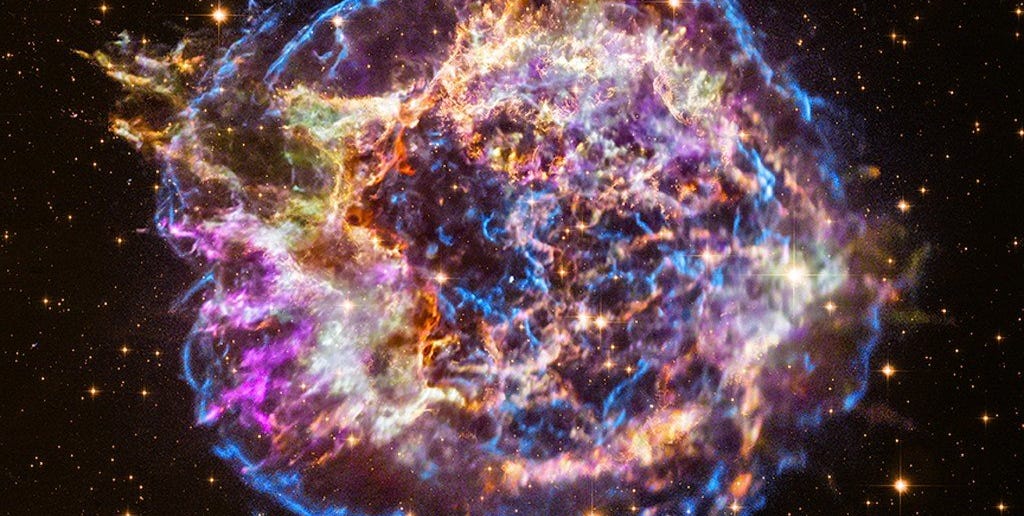
The best real-world example is Cassiopeia A, often called Cas A, one of the most studied supernova remnants in the Milky Way. Using observations from NASA’s Chandra X-ray Observatory, the Spitzer Space Telescope, ground-based facilities, and later studies from Webb and other instruments, scientists and visualization experts have created 3D models that help people walk through the aftermath of an exploded star. That sounds like science fiction, but it is very much science factwith better lighting.
Why Virtual Reality Is Perfect for Supernova Science
A supernova remnant is not a flat picture. It is a three-dimensional, expanding structure of gas, dust, shock waves, and stellar debris. Traditional telescope images are powerful, but they compress depth into a two-dimensional view. That is a little like trying to understand a cathedral by looking at a postcard of the front door. You get the mood, but not the architecture.
Virtual reality solves that problem by giving space objects volume. With VR, learners can move around a supernova remnant instead of only looking at it. They can see that the debris is not evenly spread out like a perfect balloon. It is clumpy, tangled, lopsided, and messythe way a real explosion should be. Stars, apparently, do not die with tidy handwriting.
In astronomy education, this matters because scale and structure are notoriously difficult to explain. A supernova remnant can span many light-years, yet the crucial details may involve tiny knots of gas, chemical layers, and shock fronts. VR gives teachers, students, museum visitors, and curious space fans a way to connect the big picture with the fine details.
What Is a Supernova Remnant?
A supernova remnant is the leftover structure from a stellar explosion. When a massive star runs out of fuel, its core can collapse under gravity. The outer layers crash inward, rebound, and blast into space. In another type of supernova, a white dwarf in a binary system can gain enough mass to trigger a runaway thermonuclear explosion. Either way, the result is dramatic: a star throws material outward at enormous speeds, creating a glowing debris field.
That debris does not simply drift away politely. It plows into surrounding gas and dust, generating shock waves that heat material to millions of degrees. These shocks produce X-rays, radio waves, infrared light, and visible emission. Supernova remnants also help distribute heavy elements through galaxies. The calcium in bones, the iron in blood, and the silicon in computer chips all belong to a much older cosmic supply chain. In other words, every time your laptop freezes, you can blame a star. Only partly, but it feels good.
Cassiopeia A: The Celebrity Supernova Remnant
Cassiopeia A is one of the brightest and youngest known supernova remnants in our galaxy. It sits roughly 11,000 light-years away in the constellation Cassiopeia and was created by a stellar explosion whose light reached Earth about 340 years ago from our perspective. Because Cas A is relatively young and nearby by astronomical standards, scientists can study the debris field in exceptional detail.
Cas A is especially useful for virtual reality because researchers have mapped different elements inside it. Chandra observations show regions rich in silicon, sulfur, calcium, and iron, each revealed through X-rays at specific energy ranges. Webb’s infrared views add another layer, showing delicate knots and filaments where the expanding shell of material interacts with gas shed by the star before it exploded.
Put those datasets together, and Cas A becomes more than an image. It becomes a navigable object. You are not just looking at a colorful cosmic donut. You are exploring the leftovers of a star that helped explain how massive stars live, explode, and seed the universe with raw material.
How Scientists Turn Telescope Data Into Virtual Reality
Creating a VR supernova is not as simple as asking a computer, “Please make space pretty.” The process begins with real observations. Telescopes capture different wavelengths of light: X-rays from Chandra, infrared from Spitzer or Webb, optical data from Hubble and ground-based observatories, and sometimes radio measurements from other facilities. Each wavelength reveals a different part of the story.
Scientists then interpret the motion, brightness, composition, and structure of the remnant. In the case of Cassiopeia A, researchers used velocity information and multiwavelength data to reconstruct a three-dimensional model. That model could then be adapted for virtual reality and augmented reality experiences.
The result is a data-driven visualization. It is not a fantasy spaceship ride through random glowing fog. The shape, colors, and structures are tied to actual astronomical measurements. The colors are usually assigned to represent different wavelengths, energies, or chemical elements, because human eyes cannot see X-rays or infrared light directly. Space is gorgeous, but it needs a translator.
What You Can See Inside a Virtual Supernova
When you explore a supernova with virtual reality, several features become easier to understand. First, there is the blast wavethe outer boundary where the explosion’s energy slams into surrounding material. In visualizations of Cas A, this can appear as an outer ring or shell of high-energy emission.
Second, there are chemical layers. Massive stars are built like onions, with different elements arranged in layers before collapse. Hydrogen, helium, carbon, oxygen, silicon, sulfur, calcium, and iron can all play roles in the star’s final structure. During the explosion, these layers are violently mixed and flung outward. VR helps show that this mixing is not smooth. It is chaotic, turbulent, and wonderfully rude to anyone expecting symmetry.
Third, there are knots and filaments. Webb’s high-resolution infrared observations of Cas A reveal tiny clumps of gas containing elements such as sulfur, oxygen, argon, and neon. These structures give scientists clues about how the original star shattered. In VR, such details can be explored as objects within a larger environment rather than tiny features in a flat image.
Finally, there may be a compact object left behind, such as a neutron star, depending on the supernova type. In a core-collapse supernova, the crushed core of the original star may remain as an incredibly dense object. A teaspoon of neutron star material would be absurdly heavy, which is why no one should bring one to a picnic.
Why Exploring a Supernova in VR Helps Students Learn
Virtual reality supports active learning. Instead of passively reading that a supernova remnant is expanding, learners can move through a simulation and observe the structure from different angles. Instead of memorizing that elements are forged and distributed by stars, they can see color-coded regions where those elements appear in the debris.
This type of learning is especially useful for abstract science. Astronomy deals with scales that the human brain did not evolve to handle gracefully. Light-years, million-degree gas, shock waves, and stellar death are not everyday experiences unless your neighborhood is unusually dramatic. VR gives learners a mental bridge between invisible data and understandable space.
For museums and planetariums, VR and 3D visualization can also make astronomy more inclusive. A visitor who may not be comfortable reading dense scientific panels can still understand structure by moving, looking, and interacting. Captions, narration, sound design, and data sonification can add more ways to engage. A supernova can become something to see, hear, and explore.
VR, AR, and the Future of Space Exploration From Home
Virtual reality is only one part of the bigger immersive astronomy trend. Augmented reality can place 3D space objects into a user’s room through a phone camera. Browser-based tools can let anyone explore planets, spacecraft, and astronomical data without specialized hardware. Open-source visualization platforms can bring real mission data into planetariums and science centers.
NASA’s interactive tools, Chandra’s 3D models, Smithsonian digital collections, Brown University collaborations, and OpenSpace-style platforms all point in the same direction: space education is becoming more interactive. The future astronomy classroom may look less like a lecture hall and more like a mission control room crossed with an art studio.
This does not replace telescopes, textbooks, or expert explanation. It enhances them. A VR tour can inspire a learner to ask better questions: Why is the blast wave brighter on one side? Why are some elements in unexpected places? How fast is the material moving? What does X-ray light reveal that visible light cannot? Curiosity is the real rocket fuel here.
Real Science Behind the Wow Factor
The phrase “explore a supernova with virtual reality” sounds flashy, but the science behind it is serious. Supernova remnants help astronomers understand stellar evolution, galactic chemistry, cosmic rays, shock physics, and the environments around dead stars. Cas A has been studied repeatedly because it preserves clues about what happened before, during, and after the explosion.
Recent observations suggest that some massive stars may experience violent internal rearrangements shortly before exploding. In Cas A, researchers have studied how layers rich in different elements may have shifted and mixed, helping shape the final blast. This kind of evidence matters because scientists still do not fully understand every detail of how massive stars explode.
Virtual reality can help communicate that uncertainty. A good VR experience should not pretend that astronomy is a solved puzzle. Instead, it can show users where the evidence is strong, where models are being tested, and why new telescope data can change the story. Science is not a dusty shelf of answers. It is more like a detective show, except the crime scene is 11,000 light-years away and the suspect exploded.
How to Experience a Supernova in Virtual Reality
People interested in immersive supernova exploration can start with publicly available 3D models and interactive astronomy resources. Some experiences are designed for VR headsets, while others work through web browsers, museum installations, planetarium domes, or augmented reality apps. The hardware may vary, but the goal is the same: make real astronomical data easier to understand.
For the best experience, approach the model like a scientist, not just a tourist. Begin from far away and observe the overall shape. Then move closer and look for uneven structures. Notice the outer shell, the inner knots, and any color-coded regions. Ask what each color represents. Is it an element? A wavelength? An energy range? A temperature? In astronomy, color is often a map, not decoration.
It also helps to compare different views of the same object. A Chandra X-ray image may emphasize extremely hot gas and energetic particles. A Webb infrared image may reveal dust, cooler structures, and delicate knots. A Hubble optical image may highlight visible filaments. Together, these views create a richer portrait than any single telescope could provide alone.
Why This Technology Matters Beyond Astronomy
Supernova VR is not only about space enthusiasm. It demonstrates how complex data can become more understandable through immersive design. Medical imaging, climate science, engineering, archaeology, and education can all benefit from similar methods. When data has structure, depth, and relationships, a 3D environment can help people see patterns more naturally.
That makes supernova VR a powerful example of science communication. It invites people who may feel intimidated by astrophysics to enter the subject through experience. Once inside, they discover that the beauty is not separate from the data. The beauty is the data, translated into human-friendly form.
Extended Experience: What It Feels Like to Explore a Supernova With Virtual Reality
The first moment inside a virtual supernova is usually quiet. That may seem strange, considering the object represents one of the most violent events in the universe. But the silence works. You are surrounded by luminous debris, floating inside a structure that looks part nebula, part shattered glass sculpture, and part cosmic weather report. Your brain knows you are standing in a room, but your eyes insist you have wandered into the aftermath of a star’s final tantrum.
From a distance, the remnant may look like a glowing shell. Move closer, and the smooth shape breaks into knots, ribbons, and tangled arcs. The outer regions feel like the edge of a storm front. The inner regions feel more complicated, as if the star’s hidden layers were thrown outward and frozen mid-argument. Colors guide your attention. Red may indicate silicon. Yellow may suggest sulfur. Green may point to calcium. Purple may mark iron. Blue may trace high-energy X-rays or the blast wave. The exact color key depends on the visualization, but the emotional effect is immediate: this is not random space glitter. This is a map of a dead star’s chemistry.
One of the most memorable parts of the experience is scale. A supernova remnant can be many light-years across, yet VR lets you move through it as if it were a room-sized sculpture. That compression is educational magic. You understand, in a physical way, that the object has depth. You can step to the side and see how a filament that looked central from one angle is actually off to the edge. You can look back and realize the whole structure is irregular, with gaps, clumps, and asymmetry. The universe, it turns out, does not use a ruler as often as textbook diagrams suggest.
The experience also makes time feel strange. The explosion happened centuries ago from Earth’s point of view, and the debris is still expanding. In daily life, an explosion is over in seconds. In astronomy, the aftermath can glow for thousands of years. VR helps stretch the imagination enough to grasp that a supernova remnant is not a static object. It is an event still unfolding, a slow-motion wave of energy and matter moving through interstellar space.
For students, the most valuable moment may come when wonder turns into questions. Why is iron over there instead of neatly in the center? Why is one side brighter? What caused the shell to look uneven? What would X-rays reveal that infrared light does not? A strong VR experience does not simply say, “Look, space is pretty.” It says, “Look closer. Something happened here.”
For adults, the experience can be unexpectedly personal. The elements inside the virtual remnant are not abstract labels. They are part of the same cosmic story that leads to planets, oceans, rocks, technology, and living bodies. Walking through a supernova remnant is a reminder that the universe is not separate from us. We are made from old stellar material that has been recycled, reorganized, and given the ability to wear headsets and ask dramatic questions about where it came from. That is both scientifically accurate and deeply weird, which is often the best kind of truth.
By the time the headset comes off, a supernova may no longer feel like a distant flash in a telescope image. It feels like a place you visited. Not literally, of course; nobody is recommending a vacation package to an X-ray-hot debris field. But mentally, the distance has shrunk. Virtual reality gives the mind a handle on cosmic scale, and once you have walked through the remains of a star, ordinary night-sky photos may never look quite so flat again.
Conclusion
To explore a supernova with virtual reality is to turn deep-space data into an experience that people can understand with their eyes, ears, curiosity, and sense of movement. Cassiopeia A shows why this matters. It is not just a beautiful remnant; it is a scientific record of stellar death, chemical creation, shock waves, and cosmic recycling.
As VR, AR, browser-based tools, planetarium software, and scientific visualization continue to improve, astronomy will become more interactive and more accessible. The next generation of learners may not only read about exploded stars. They may walk through them, inspect their structures, listen to their data, and come away with a sharper understanding of the universe. That is a pretty good upgrade from the old classroom model of “please stare at this diagram and pretend it makes sense.”