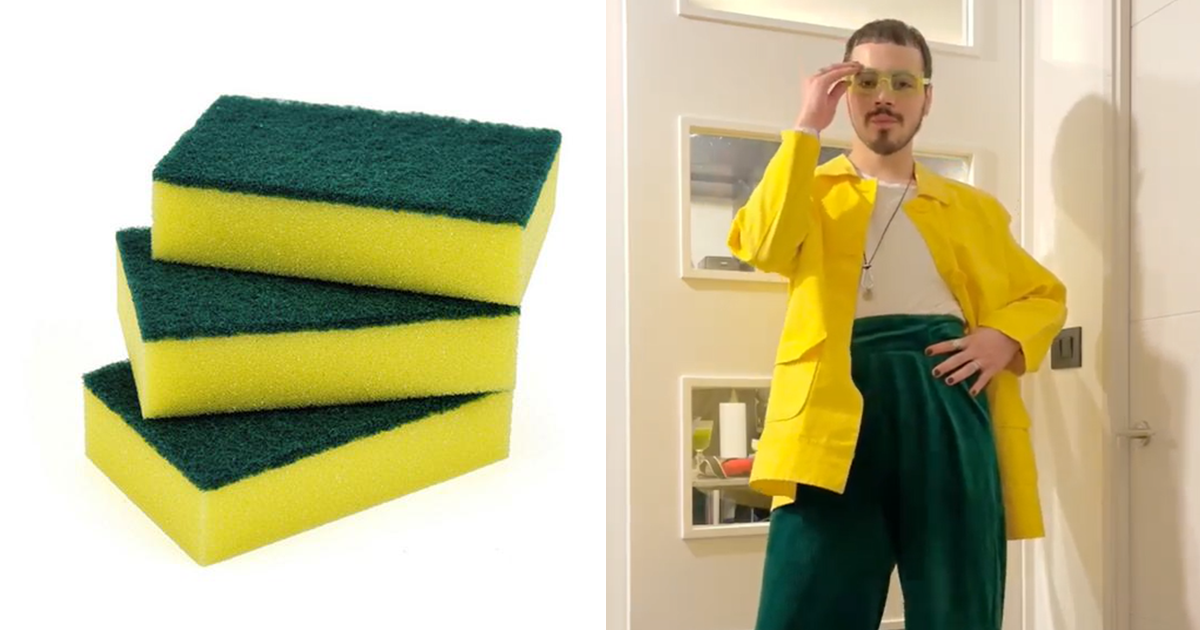
Most people look at a bottle of floor cleaner and think, “I should probably mop.” Felipe Cavieres looks at the same bottle and sees a color story, a silhouette, a pair of boots, and possibly a dramatic entrance involving a sponge. That difference in perspective powers his viral fashion project, which turns ordinary foods, drinks, and cleaning products into polished outfits with a generous splash of humor.
The Chilean costume designer does not simply copy a label. He studies its colors, shapes, visual energy, and associations, then translates those details into clothing and accessories. A bright detergent container may become a bold jacket with contrasting pants. A canned food label may suggest metallic accents. A drink can inspire a monochromatic party look. The result is part styling exercise, part performance art, and part reminder that inspiration may be sitting under the kitchen sink wearing a very loud logo.
Who Is Felipe Cavieres?
Felipe Cavieres is a Chilean costume designer whose playful outfit videos drew international attention in 2021. At the time, he was 28 and working at a design store in Santiago. His social media content had already featured recycled clothing, but the household-product series gave viewers an instantly understandable game: see the package, then see how he turns it into fashion.
The idea began with cleaning products common in Chilean homes. Cavieres has said that cleaning interested him from a young age and that he finds it relaxing. He has even experimented with his own cleaning formulas. After the first looks attracted attention, he expanded the concept to foods and beverages.
Each object became a compact creative brief. The packaging supplied a palette, the function suggested a mood, and the shape offered clues for proportion. Cavieres also explained that he built the viral looks from clothing he already owned, including sustainable and recycled pieces. These were imaginative combinations made from a real wardrobe rather than expensive costumes created only for a photograph.
How Cleaning Products Become Fashion Inspiration
Cleaning-product packaging is surprisingly theatrical. Brands compete for attention in crowded aisles, so their bottles often use high-contrast colors, energetic lettering, sweeping curves, and shiny surfaces. Cavieres recognizes that visual drama and transfers it to clothing.
Color Comes First
The fastest way to connect an outfit to a product is through color. A package built around electric blue, white, and red can become blue trousers, a white shirt, and a red accessory. A green-and-yellow bottle may inspire a green coat with yellow shoes or sunglasses.
The colors do not need to appear in identical proportions. They only need to preserve the product’s visual rhythm. One dominant shade establishes the identity, a supporting shade keeps the outfit coherent, and a smaller accent creates the “Oh, I get it” moment. This mirrors the basic design principle of using a curated palette to create consistency across packaging, branding, and visual media.
Shape and Silhouette Do the Heavy Lifting
Cavieres also echoes the object’s physical character. A tall, narrow bottle may suggest a long coat. A rounded container can inspire volume at the shoulders or hips. A diagonal label may be translated through a cross-body bag, scarf, or asymmetrical layer.
The strongest looks feel like human versions of the products without becoming mascot suits. Nobody is dressed as a literal toilet-cleaner nozzle. The design language is translated into wearable proportions.
Props Complete the Joke
Cavieres has used fitting props, including a pan or can opener, in food-based looks. These objects act like punctuation marks: the clothes establish the connection, while the prop delivers the punch line.
His straight-faced runway poses make an absurd reference feel unexpectedly elegant. The humor works because he commits to the performance as though citrus degreaser has always been a respected couture house.
Food-Inspired Fashion Is More Than a Viral Gimmick
Food and fashion have been flirting for years. Fashion illustrators have used fruit, vegetables, candy, pasta, and other edible materials to complete drawn silhouettes. Edgar Artis has created dress illustrations with popcorn, chocolate, and snacks, while Gretchen Röehrs became known for turning items such as banana peels, kale leaves, and radish slices into miniature fashion compositions.
Runway designers and lifestyle brands also borrow from food because it is familiar, emotional, colorful, and easy to share. Food can suggest nostalgia, luxury, comfort, celebration, or humor in a single image. Fashion coverage has documented everything from fruit-heavy collections to restaurant merchandise and edible brand experiences.
Cavieres adds a more accessible twist. He generally does not build garments from food. He styles clothes based on the visual identity of food and drink products. A viewer does not need a sewing team or thirty pounds of lettuce. The challenge can begin with a closet, a package, and an eye for color.
Why Familiar Products Make Strong Creative Prompts
A familiar package arrives with built-in meaning. A soda may feel youthful and energetic. A traditional drink may carry regional associations. Cookies can suggest nostalgia, while cleaning products communicate brightness, freshness, efficiency, and exaggerated purity.
Viewers participate by decoding the outfit. They are not merely looking at clothes; they are solving a visual riddle whose answer may appear in a jacket, belt, hat, boot, or perfectly chosen household prop.
Why the Outfits Went Viral
The concept is easy to understand in seconds, which makes it ideal for short-form video. The creator shows the source object, reveals the outfit, and gives the audience an immediate comparison. No fashion degree is required; nearly everyone recognizes supermarket packaging.
The Transformation Is Instantly Satisfying
The ordinary object creates anticipation. Viewers wonder how anyone could turn it into a stylish look, and the reveal answers the question while encouraging a second viewing to catch the details.
The Styling Is Skilled Enough to Admire
The series would not work if the outfits were only jokes. Cavieres balances proportion, layering, accessories, and color. The styling is credible enough to admire, while the reference is funny enough to share.
Personality Is the Final Accessory
Facial expressions, movement, and poses help each look develop a character. Cavieres has also used fashion to challenge restrictive expectations, including assumptions about men wearing skirts. He has spoken about receiving praise and insults while maintaining that clothing communicates and can educate. The household-product series may be playful, but its confidence is serious: personal style does not require permission.
What the Project Says About Everyday Design
The project belongs to a larger tradition of treating ordinary objects as worthy of attention. Museums and design institutions study the shape, function, cultural meaning, and beauty of things people use every day. MoMA notes that design makes ideas tangible, while Cooper Hewitt has repeatedly explored the relationship between function, appearance, and human use.
Fashion works especially well for this translation because clothing already combines function, identity, art, and social behavior. PBS has presented wearable art as work designed for the body, while New York’s Museum of Arts and Design has examined clothing as a medium of contemporary art. Smithsonian coverage and FIT exhibitions likewise show how garments can carry personal stories, social ideas, and unexpected materials.
Designers have long found beauty in unlikely references. The New Yorker has documented Jean Paul Gaultier’s use of unconventional sources and everyday objects, while other experimental designers treat clothing as living sculpture. Both a bottle and an outfit use color, material, proportion, and branding. Cavieres simply places them in conversation and lets the bottle have better shoes.
A Sustainable Styling Lesson Hidden Inside the Fun
One of the most useful elements of Cavieres’ process is his decision to work from an existing wardrobe. The project does not solve fashion’s environmental problems, but it demonstrates that creativity can come from recombination rather than constant purchasing.
EPA data show that the United States generates a large amount of clothing and textile waste and recycles only a minority of it. Fashion organizations such as the Council of Fashion Designers of America continue to promote reuse, circular systems, and strategies that reduce waste.
A household-packaging challenge encourages people to look harder at what they already own. A difficult yellow shirt may become the foundation of a mustard-bottle look. An old metallic belt might provide the perfect canned-food accent. A scarf can repeat a label stripe, while sunglasses can echo the color of a cap.
The limitation creates a useful question: “How can I express this object with six things I already have?” That is more focused, more sustainable, and considerably more entertaining than buying a new outfit because the closet feels boring.
What Designers and Content Creators Can Learn
Start With One Clear Constraint
Choose one object and treat it as a fixed brief. Its dominant colors, accent shades, shape, texture, typography, and brand personality provide enough information for a complete concept.
Translate Instead of Copying
Literal imitation can look clumsy. Translation creates style. A glossy shoe can echo plastic packaging, a curved handbag can reflect a rounded bottle, and sharp tailoring can mimic a geometric label.
Tell the Story From Head to Toe
Hair, makeup, jewelry, shoes, and props should support the central idea. One matching shirt is not a finished translation; it is merely a shirt that met a bottle at a party.
Make the Reveal Easy to Read
Show the source object clearly and use simple lighting that preserves its colors. The audience should understand the reference without needing a long explanation.
Keep the Human Element
Confidence, timing, and humor turn a styling exercise into memorable content. People connect with the creator’s interpretation, not only with the color match.
Experience-Based Lessons for Recreating the Idea at Home
The most revealing part of a household-item fashion challenge is how quickly it changes the way you see familiar surroundings. A kitchen cabinet stops being storage and becomes a wall of miniature mood boards. The useful experience is not simply finding a blue shirt for a blue bottle; it is learning to separate an object into design decisions.
Begin by placing one product in bright, neutral light. Write down the three most visible colors, then describe its personality in a few words. Is it energetic, clinical, nostalgic, luxurious, cheerful, or aggressively lemon-scented? That emotional description prevents the final look from becoming a flat color match. Two outfits can use the same blue-and-white palette, yet one may feel sporty while the other feels formal.
Next, shop your closet in layers. Pull every plausible garment before judging combinations. A piece that looks wrong by itself may become perfect once another color is introduced. Start with the largest area of the outfit, usually a coat, dress, shirt, or pants. Add the secondary color through another garment, then reserve the smallest packaging accent for jewelry, socks, a bag, sunglasses, or makeup.
Photograph the outfit before declaring it finished. Cameras simplify visual information, and details that seem obvious in a mirror may disappear on screen. The opposite can also happen: a tiny red belt may dominate the image. Compare the photograph with the product and adjust the proportions. This test is especially helpful for short-form video, where viewers need to understand the connection immediately.
Props should clarify the concept, not overwhelm it. One pan, sponge, spoon, spray bottle, or can opener is usually funnier than carrying the entire utility closet. Safety matters, too. Keep chemicals closed, never mix cleaning products, and do not place leaking containers near skin, eyes, food, or clothing. The fashion reference should be dramatic; the emergency-room story should not.
Avoid buying a new wardrobe for the challenge. Limitation produces better ideas. Try turning a sweater backward, knotting a shirt, layering a skirt over pants, borrowing an accessory, or using removable clips to create a temporary shape. The goal is not to manufacture a perfect replica of the package. It is to discover how much visual range already exists in ordinary clothes.
Finally, allow the result to be funny. Many people abandon creative styling because they worry about looking ridiculous. Yet ridiculousness is often the doorway to originality. A detergent-inspired outfit may begin as a joke, but the process teaches real skills: color editing, proportion, visual storytelling, wardrobe planning, camera awareness, and confident presentation. Even when the final look never leaves the living room, the experiment can sharpen a designer’s eye.
Conclusion: Great Style Can Begin Under the Sink
Felipe Cavieres’ outfits based on foods and cleaning products succeed because they combine recognizable objects with thoughtful styling. He interprets each package’s shape, energy, function, and familiarity, then completes the idea with accessories, props, poses, and humor.
The project offers a useful lesson for anyone staring suspiciously at an uninspiring closet: creativity is not always found in exotic places. It can begin with detergent, canned food, a favorite drink, or any package everyone else has stopped noticing. The object provides the prompt. The wardrobe supplies the materials. Style performs the transformation.
So the next time a cleaning product catches your eye, consider its palette before putting it away. It may not improve your laundry technique, but it could begin an excellent outfit.