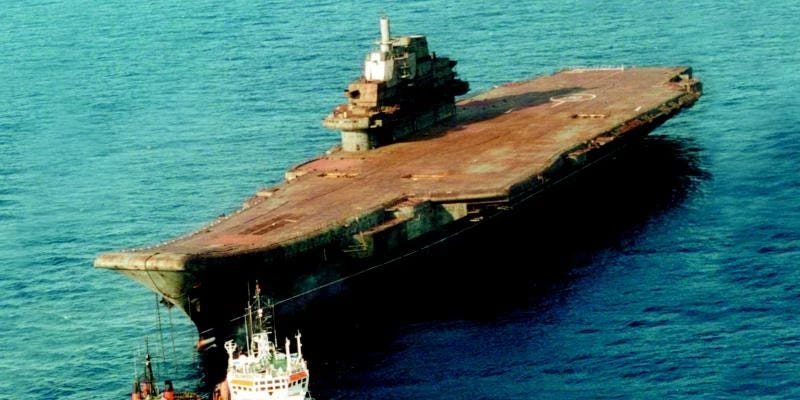
China’s first aircraft carrier did not begin life as a polished symbol of modern naval power. It started as an unfinished Soviet hull, passed through Ukraine, endured a strange sale involving casino rumors, survived a dramatic tow across seas, and finally emerged from a Chinese shipyard as the Liaoning. If warships could write memoirs, this one would need a ghostwriter, a maritime lawyer, and probably a very patient tugboat captain.
Yet the story of China’s first aircraft carrier is much more than a naval oddity. The Liaoning marked a turning point in the development of the People’s Liberation Army Navy, often called the PLAN. When it entered service in 2012, China moved from talking about carrier aviation to actually training pilots, deck crews, commanders, and shipbuilders for a new era of blue-water naval operations. It was not the biggest, newest, or most advanced carrier in the world. But strategically, it was enormous.
To understand the Liaoning is to understand how China learned the difficult art of aircraft carrier operations: launching jets from a moving deck, recovering them safely, coordinating escorts, managing aviation fuel and weapons, and turning a floating runway into a working naval system. The ship became China’s classroom at sea, and like many classrooms, it was occasionally noisy, complicated, and full of people learning not to touch the dangerous equipment.
What Was China’s First Aircraft Carrier?
China’s first aircraft carrier is the Liaoning, hull number 16. It is a Type 001 aircraft carrier operated by the People’s Liberation Army Navy. The ship was commissioned on September 25, 2012, after years of refitting at Dalian, a major shipbuilding center in northeastern China.
The Liaoning was originally built as the Soviet aircraft carrier Varyag, a sister ship to Russia’s Admiral Kuznetsov. Construction began during the Cold War, but the collapse of the Soviet Union left the vessel unfinished in Ukraine. China later acquired the incomplete hull, brought it home, rebuilt it, modernized its systems, and transformed it into the foundation of its carrier program.
In plain English, China did not start its carrier journey by building a ship from scratch. It bought a very large, very incomplete naval puzzle and then spent years figuring out how to make all the pieces work. That may sound like buying a used car without an engine, wheels, or keys, but in naval development, it was a practical shortcut. The hull gave Chinese engineers and sailors a platform for learning carrier design, maintenance, flight operations, and command procedures.
From Soviet Varyag to Chinese Liaoning
The Liaoning’s backstory is one of the most unusual in modern naval history. The ship was laid down in the Soviet era as the Varyag, but when the Soviet Union dissolved in 1991, construction stopped. Ukraine inherited the unfinished carrier, which reportedly lacked many essential combat systems and was not ready for active service.
In 1998, the hull was sold to a buyer connected to Macau, officially for conversion into a floating hotel and casino. That explanation raised eyebrows among analysts because the vessel was not exactly a cozy boutique property. Nothing says “relaxing weekend getaway” like a 60,000-ton ex-Soviet aircraft carrier with a ski-jump flight deck.
The journey to China was slow and difficult. The Varyag had to be towed through sensitive waterways, including the Turkish Straits, and eventually traveled a long route before arriving in Dalian in 2002. Once there, Chinese shipbuilders began the long process of stripping, repairing, redesigning, and rebuilding the ship.
Why China Wanted the Carrier
China’s interest in aircraft carriers was tied to several long-term goals. First, carriers are symbols of national power. Countries that operate them can project influence far from their own coastlines. Second, carriers provide air cover for naval task groups, allowing fleets to operate beyond the range of land-based aircraft. Third, a carrier program helps develop advanced shipbuilding, aviation, radar, logistics, and command systems.
For China, the Liaoning was also a bridge from coastal defense to far-seas operations. For decades, the PLAN focused mainly on defending waters near China’s coast. As China’s economy expanded and its global interests grew, Beijing wanted a navy capable of operating farther into the Pacific and Indian Oceans. The Liaoning did not instantly make China a carrier superpower, but it gave the PLAN a way to practice the skills required to become one.
Key Features of the Liaoning Aircraft Carrier
The Liaoning is a conventionally powered carrier, meaning it does not use nuclear propulsion like U.S. Navy supercarriers. It has a full-load displacement often estimated at around 60,000 tons. That makes it large, but still smaller and less capable than America’s Nimitz-class and Ford-class carriers.
STOBAR Design and Ski-Jump Launch
One of the most recognizable features of the Liaoning is its upward-curving bow, known as a ski jump. The ship uses a STOBAR system, short for Short Take-Off But Arrested Recovery. Aircraft launch under their own power using the ski jump, then land using arresting wires that catch a tailhook and bring the jet to a rapid stop.
This design is simpler than catapult launch systems, but it comes with limitations. Aircraft taking off from a ski jump generally cannot carry as much fuel or weaponry as aircraft launched by steam or electromagnetic catapults. In other words, the jet can still leap off the deck, but it may not leap off wearing its heaviest backpack.
The J-15 Fighter
The Liaoning’s main fixed-wing aircraft is the Shenyang J-15, a Chinese carrier-based fighter derived from the Russian Su-33 design lineage. The J-15 is often nicknamed the “Flying Shark,” which sounds like something invented by a marketing department that had already finished its coffee.
The J-15 gives the Liaoning air-defense and strike potential, but operating it from a ski-jump carrier presents challenges. Launch weight matters. Deck handling matters. Pilot training matters. Carrier aviation is unforgiving; the runway is moving, the ocean is rude, and the margin for error is thinner than a flight-deck safety line.
Helicopters and Support Aircraft
In addition to fighters, the Liaoning can operate helicopters for anti-submarine warfare, search and rescue, and airborne early warning. These support aircraft are crucial because an aircraft carrier never fights alone. It depends on sensors, escorts, logistics ships, submarines, aircraft, and trained crews working as a coordinated system.
This is why calling a carrier “a floating air base” is only partly accurate. A carrier is more like a floating airport, warehouse, command center, maintenance shop, fuel depot, weather office, and emergency room, all packed into one steel city that also needs to avoid missiles and submarines. Easy, right?
Why the Liaoning Was First a Training Carrier
When the Liaoning entered service, it was widely understood as a training and experimentation platform. That role was not a weakness; it was the whole point. No navy becomes skilled at carrier operations by reading a manual and saying, “Looks manageable.” Carrier aviation takes years of repeated practice.
The PLAN needed to learn how to conduct takeoffs and landings at sea, maintain aircraft in harsh marine conditions, manage flight-deck choreography, coordinate escorts, and develop carrier-qualified pilots. The Liaoning gave China a platform to train deck crews, refine procedures, and test the realities of operating aircraft at sea.
Two months after commissioning, China conducted its first carrier-based takeoffs and landings. That milestone may sound routine to countries with decades of carrier experience, but for China it was historic. A successful arrested landing is not just a pilot achievement; it is proof that aircraft, ship, crew, engineering, communications, and training systems are beginning to work together.
Strategic Importance of China’s First Aircraft Carrier
The Liaoning changed how observers viewed China’s naval ambitions. Before the ship, China’s carrier program was mostly a matter of speculation. After the ship, it became concrete. There it was: gray, massive, photographed, tracked, analyzed, and discussed by defense experts around the world.
A Symbol of Great-Power Ambition
Aircraft carriers are expensive, visible, and politically powerful. They send a message before they launch a single aircraft. For China, the Liaoning symbolized technological progress and national prestige. It showed domestic audiences that China could join the small group of countries capable of operating carriers.
Internationally, the ship signaled that China wanted a navy capable of more than coastal defense. It was a visible step toward blue-water operations, meaning sustained activity across open oceans. While the Liaoning alone did not give China global naval dominance, it showed the direction of travel clearly enough that nobody needed binoculars.
South China Sea and Western Pacific Operations
The Liaoning has operated in areas that matter deeply to regional security, including the South China Sea and the Western Pacific. These deployments help the PLAN practice task-group operations and demonstrate presence. They also attract attention from neighboring countries, especially Japan, Taiwan, and the Philippines, as well as from the United States.
In recent years, Chinese carrier groups have operated beyond the first island chain, the arc of islands stretching from Japan through Taiwan and the Philippines. Such movements show that China’s carrier force is gradually becoming more comfortable farther from home waters. The Liaoning’s later deployments therefore represent more than training cruises; they are part of a broader learning curve in regional power projection.
How the Liaoning Compares With U.S. Aircraft Carriers
The Liaoning is often compared with U.S. Navy carriers, but the comparison needs context. U.S. supercarriers are nuclear-powered, larger, and equipped with catapult launch systems that allow heavier aircraft to take off with more fuel and weapons. They also operate with decades of institutional experience, global logistics networks, and large carrier air wings.
The Liaoning is smaller, conventionally powered, and limited by its ski-jump launch system. It does not match the sortie generation, range, or aviation capacity of a U.S. Ford-class or Nimitz-class carrier. But that does not make it irrelevant. Its value lies in training, experimentation, regional signaling, and helping China build the knowledge required for more advanced carriers.
A fair analogy is that the Liaoning was not China’s final exam. It was China’s first serious lab course. The ship allowed Chinese naval planners to discover what worked, what needed improvement, and what future carriers should do differently.
From Liaoning to Shandong and Fujian
The clearest proof of the Liaoning’s importance is what came after it. China’s second carrier, the Shandong, was the country’s first domestically built aircraft carrier. It entered service in 2019 and was heavily influenced by the Liaoning’s design and lessons learned. Like the Liaoning, it uses a ski-jump launch system.
China’s third carrier, the Fujian, represents a much bigger leap. Commissioned in 2025, the Fujian uses electromagnetic catapults, allowing it to launch heavier and more varied aircraft than ski-jump carriers can typically support. This gives China a pathway toward more sophisticated carrier aviation, including airborne early-warning aircraft and future carrier-based stealth fighters.
Without the Liaoning, China’s later carrier progress would likely have been slower and riskier. The first carrier gave China a working platform for training people, testing equipment, and developing doctrine. In military modernization, experience is not a decorative accessory. It is the engine.
What China Learned From Its First Aircraft Carrier
The Liaoning taught China that aircraft carriers are not single weapons but complex ecosystems. A carrier needs pilots, deck crews, maintainers, air traffic controllers, engineers, intelligence teams, supply ships, destroyers, frigates, submarines, and command networks. One weak link can reduce the whole system’s effectiveness.
China also learned that carrier operations require patience. Building a carrier is hard. Operating one safely is harder. Using one effectively in a contested environment is harder still. The Liaoning helped the PLAN climb the first steps of that staircase.
Training Is the Real Technology
Modern warships are packed with radar, sensors, missiles, engines, and electronics. But the most important technology on a carrier may be human expertise. Pilots must land on a moving deck at night. Deck crews must work around jet blast, spinning rotors, weapons, fuel lines, and tight schedules. Commanders must coordinate the carrier with escorts and aircraft while tracking threats above, on, and below the sea.
The Liaoning gave China the chance to build this human capital. Every launch, landing, refit, patrol, and exercise created experience. Some of that experience likely shaped the design and operation of China’s later carriers.
Limitations of the Liaoning
For all its importance, the Liaoning has clear limitations. Its ski-jump design restricts aircraft launch weight. Its conventional propulsion limits endurance compared with nuclear-powered carriers. Its air wing is smaller than those of U.S. supercarriers. And because it began as an unfinished Soviet hull, its design reflects older priorities.
The Liaoning also operates in a dangerous neighborhood. In a high-intensity conflict, aircraft carriers face threats from submarines, anti-ship ballistic missiles, cruise missiles, mines, drones, and long-range aircraft. A carrier is powerful, but it is not invincible. It needs a protective screen and a sophisticated operating concept.
Still, judging the Liaoning only by its limitations misses the point. Its mission was not to be the perfect carrier. Its mission was to make China a carrier-operating navy. On that score, it succeeded.
Experiences and Reflections Related to China’s First Aircraft Carrier
Looking at the Liaoning from a broader perspective, one of the most interesting experiences related to the topic is how quickly a symbol can change the way people talk about national power. Before China had an operational aircraft carrier, discussions about Chinese naval ambitions often felt theoretical. Analysts could debate budgets, shipyards, missile ranges, and doctrine, but the lack of a carrier created a visible gap. Once the Liaoning appeared, the conversation changed. Suddenly, China was not merely planning for carrier aviation; it was practicing it.
For readers who follow military history, the Liaoning also offers a fascinating lesson in adaptation. Many famous military technologies did not arrive perfectly formed. They were improved through trial, failure, adjustment, and repetition. The Liaoning fits that pattern. It was not a clean-sheet masterpiece; it was a rebuilt platform that allowed China to learn. That makes it historically valuable. Sometimes the first version of a major capability is less about perfection and more about momentum.
Another experience worth noting is how the Liaoning reveals the difference between owning hardware and mastering a system. A person can buy a professional camera and still take blurry vacation photos. A navy can acquire a carrier hull and still need years to master flight-deck rhythm, maintenance cycles, pilot qualification, emergency response, escort coordination, and long-distance logistics. The Liaoning’s story reminds us that true capability is built through practice, not just procurement.
There is also a human side to the ship’s story. Thousands of sailors, engineers, aviators, and shipyard workers had to turn an inherited hull into a functioning aircraft carrier. That process required technical skill and institutional patience. Flight-deck crews had to learn jobs where mistakes can be dangerous. Pilots had to learn one of aviation’s most demanding tasks: landing on a carrier. Engineers had to keep an older design operational while China’s shipbuilding industry moved toward newer models. The ship became a national training ground not only for the navy, but also for the industrial base behind it.
For casual observers, the Liaoning can be a useful case study in how countries build military power step by step. It is tempting to imagine military modernization as a dramatic movie montage: sparks fly, music swells, and suddenly a navy becomes world-class. Real life is slower. It involves refits, sea trials, boring paperwork, awkward early exercises, maintenance headaches, and many meetings where someone probably says, “Let’s review the procedure one more time.” The Liaoning shows that modernization is not magic. It is accumulation.
The ship also changed the way regional navies think about the Western Pacific. Even if the Liaoning is less capable than U.S. supercarriers, its deployments matter because they show intent and build experience. Each patrol gives Chinese crews more familiarity with distant waters. Each exercise helps commanders understand how to operate with escorts. Each observation by foreign militaries adds another data point to the regional security picture. In this sense, the Liaoning is both a ship and a signal.
From an educational standpoint, China’s first aircraft carrier is a rich topic because it connects engineering, history, geography, politics, and strategy. The ship began in a Soviet shipyard, was inherited by Ukraine, purchased through a commercial arrangement, towed through contested waterways, rebuilt in China, and then used to train a rising navy. Few machines carry that much geopolitical luggage. The Liaoning is not just steel and radar; it is a timeline of post-Cold War change floating on the ocean.
Finally, the Liaoning’s experience shows why first steps matter. China’s later carriers, especially the Fujian, are more advanced. But the first carrier created the foundation. It gave China confidence, data, habits, and lessons. In that sense, the Liaoning’s greatest achievement may not be the number of aircraft it can carry or the distance it can sail. Its greatest achievement is that it made the next carrier easier to build, operate, and understand.
Conclusion
China’s first aircraft carrier, the Liaoning, is more than a refurbished Soviet-era ship. It is the vessel that launched China into the aircraft carrier era. From its unfinished origins as the Varyag to its commissioning in 2012, the Liaoning became a practical training platform, a national symbol, and a stepping stone toward a larger Chinese carrier fleet.
The ship has limitations, especially compared with nuclear-powered U.S. supercarriers. But its historical importance is undeniable. It taught the PLAN how to operate aircraft at sea, helped shape the domestically built Shandong, and prepared the way for the more advanced Fujian. The Liaoning may not be the final word in Chinese naval power, but it was the first sentence in a much bigger story.
Note: This article is based on publicly available information from reputable defense, policy, naval, and news sources, including U.S.-based analysis and reporting from organizations such as CSIS, Congressional Research Service materials, U.S. defense publications, USNI News, Reuters, AP, Britannica, Naval War College Review, and Popular Mechanics.