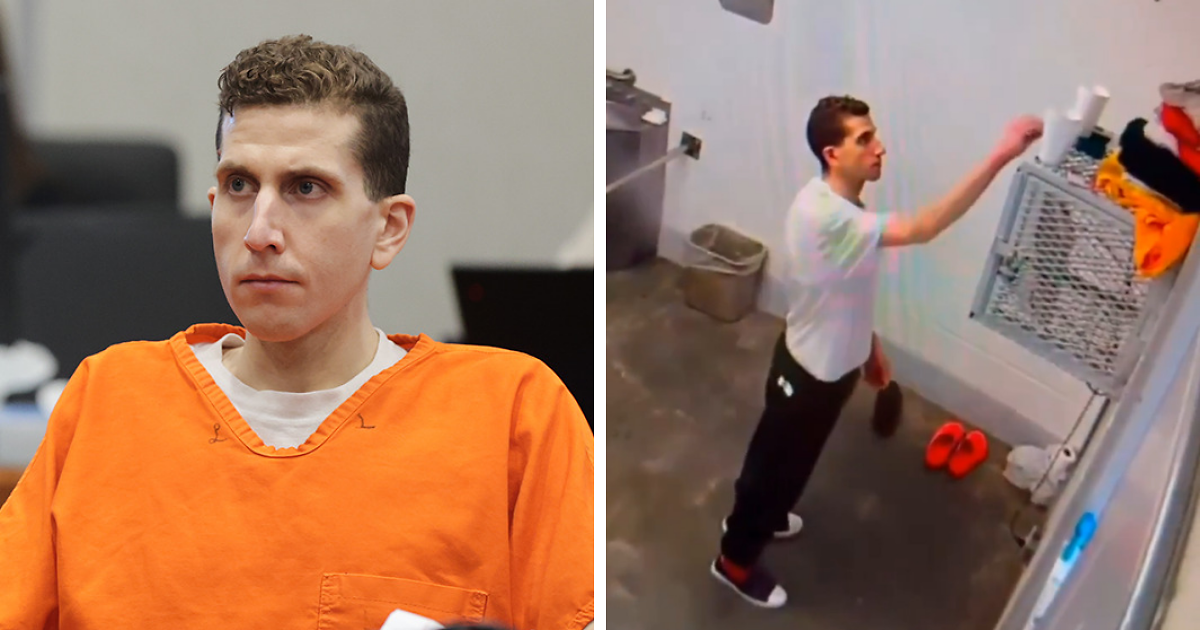
Few things travel faster online than a blurry prison clip, a creepy soundtrack, and a headline that sounds like it was written by a caffeinated raccoon with a true-crime podcast. That formula helped turn short videos appearing to show Bryan Kohberger in his Idaho prison cell into a major viral story.
The footage drew attention because the man in the clip appeared to have unusually red or reddish-purple hands while moving around his cell. At the same time, reports circulated that other incarcerated people were yelling at Kohberger through vents and taunting him from nearby cells. The result was a perfect storm of social-media speculation: red hands, prison drama, leaked surveillance footage, and a case that had already captured national attention.
But the real story is more complicated than the most dramatic headline. The videos were initially unverified, prison officials warned that online clips could be fake or AI-enhanced, and later reporting indicated that an Idaho Department of Correction employee was identified as the person who leaked footage. The employee had left the agency, and state police did not pursue criminal charges.
What the Bryan Kohberger Prison Footage Actually Appears to Show
The leaked clips were brief and visually limited. Reports described footage of Kohberger inside a cell, walking, handling items near a shelf, and looking down at or toward his hands. The video became famous less because of any dramatic action and more because of the strange visual detail: his hands appeared red.
That detail launched an avalanche of theories. Some viewers suggested excessive handwashing. Others guessed irritation, lighting, medical issues, cleaning chemicals, or injuries. The honest answer is far less cinematic: publicly available reporting did not establish a confirmed medical explanation for the appearance of his hands.
It is tempting to turn a few pixels into a diagnosis. The internet loves doing this. Give social media a dimly lit hallway and a red sleeve, and suddenly thousands of people become forensic dermatologists with Wi-Fi. But a surveillance clip is not a medical report, and redness in a low-quality video is not proof of what caused it.
Why “Red Hands” Became the Center of the Story
Visual details stick because they are easy to understand. A complicated criminal case may involve court filings, plea agreements, sentencing records, and difficult questions about victims and justice. Red hands, by contrast, fit neatly into a caption. They are visual, unsettling, and mysterious.
Yet the footage does not show physical violence against Kohberger, does not prove the source of the redness, and does not independently establish that he was being harmed at the time it was recorded. It shows a highly watched prisoner in a confined setting, which is enough to spark attention but not enough to support every theory that followed.
Prison, Not Jail: Why the Difference Matters
After sentencing, Kohberger was transferred into the Idaho prison system. Jails generally hold people awaiting trial, serving short sentences, or moving through local custody. Prisons hold people serving longer sentences after conviction. The distinction may sound small, but in a case filled with viral shorthand, accuracy matters.
Kohberger pleaded guilty in July 2025 to the murders of University of Idaho students Kaylee Goncalves, Madison Mogen, Xana Kernodle, and Ethan Chapin. On July 23, 2025, he received four consecutive life sentences without the possibility of parole, along with a 10-year sentence for burglary.
The phrase “serial killer” is also more dramatic than precise. The FBI’s research definition of serial murder involves killings by the same offender in separate events at different times. Kohberger admitted to four murders in a single criminal episode, making “convicted murderer” or “quadruple murderer” more accurate descriptions than “serial killer.”
That does not reduce the horror of the crimes. It simply avoids turning true crime into a word salad of labels chosen for clicks. Facts can be disturbing without being stretched like pizza dough.
What Happened in the Idaho Murder Case
The University of Idaho murders shocked the college town of Moscow and drew national attention almost immediately. The four students were killed in November 2022 at an off-campus home near the university. Kohberger, a former criminology doctoral student at Washington State University, was later arrested and charged with the killings.
His guilty plea ended the possibility of a public trial and spared him the death penalty. The agreement also left major questions unanswered, especially the motive. During sentencing, family members and friends of the victims described the lasting pain caused by the murders, while Kohberger declined to address the court.
That unresolved motive is one reason the case continues to attract intense attention. People often want a neat explanation for an act that feels impossible to understand. Unfortunately, criminal cases do not always come with a tidy final chapter, a detective’s monologue, and dramatic rain tapping against a courthouse window.
Were Other Inmates Really Tormenting Kohberger?
Reports about inmate taunting did not come out of nowhere. Kohberger complained about what he described as taunting from nearby incarcerated people. Idaho Department of Correction officials acknowledged that he had made complaints, while also saying that people in prison commonly communicate with one another and that staff were maintaining safety and order.
Media reports described alleged yelling through vents, door-kicking, and hostile comments from other people housed in the area. However, the strongest public confirmation was limited: Kohberger reported being taunted, and prison officials acknowledged the complaints. That is different from proving every detail of the more sensational descriptions circulating online.
Reported Threats and Harassment Complaints
Reporting later indicated that Kohberger submitted complaints alleging sexually threatening comments from other inmates. A correctional officer reportedly confirmed hearing vulgar language directed toward him but could not identify exactly who made particular statements. That distinction matters because prison complaints, witness recollections, and confirmed disciplinary findings are not always the same thing.
Prison life can involve intimidation, noise, threats, and psychological pressure, especially for high-profile people convicted of notorious crimes. But responsible reporting should resist the urge to convert every complaint into a fully proven narrative of nonstop torture. A dramatic claim may be possible, but possible is not the same thing as proven.
The Leaked Video Was a Security Problem, Not Entertainment
The most significant confirmed issue surrounding the footage was not the color of Kohberger’s hands. It was the leak itself. Security video inside a correctional facility is not supposed to become viral content. It can expose facility operations, compromise staff, create safety risks, and turn incarcerated people into props for online spectators.
Initially, Idaho correctional officials said they could not confirm whether the clips were authentic and warned that some material online might be fake or AI-enhanced. That caution was sensible. In the era of synthetic video, a convincing clip can be real, altered, mislabeled, or completely fabricated. Later reporting said the agency identified a former employee as responsible for leaking the footage, though authorities did not bring criminal charges.
There is an uncomfortable irony here. The public has a strong interest in understanding high-profile criminal cases, but a prison cell is not a reality-TV set. A prisoner can be guilty of terrible crimes and still be entitled to institutional rules, safety procedures, and basic custody standards.
Why Viral True Crime Needs a Fact Check
True crime can inform people about court cases, policing, victims’ rights, and the justice system. It can also become a carnival mirror, where every detail grows wider, darker, and stranger than reality. The Kohberger footage is a good example of that tension.
The viral version of the story sounds simple: a notorious killer with red hands is being tormented by inmates inside a cell. The verified version is more careful. Footage circulated. It appeared to show Kohberger in prison. Prison officials initially questioned whether the video was authentic and warned of possible AI manipulation. An investigation later identified a former employee as the leaker. Kohberger complained about taunting, and officials acknowledged those complaints while disputing the most dramatic framing of prison communication.
That version may not come with thunder sound effects, but it is closer to reality. And reality matters, especially when the names of Kaylee Goncalves, Madison Mogen, Xana Kernodle, and Ethan Chapin are attached to the story.
How Readers Can Separate Fact From Prison Rumor
When a prison video goes viral, start by asking a few simple questions. Who released it? Has the correctional agency confirmed it? Is the footage complete or clipped? Does the video show the claim being made, or are viewers filling in the blanks? Is the headline using words such as “torment,” “breakdown,” “torture,” or “confession” without evidence?
It also helps to look for primary documentation. Court judgments, sentencing records, correctional statements, and official incident reports usually offer a sturdier foundation than anonymous posts or grainy reposts with twenty-seven fire emojis.
Most importantly, remember that viral clips often reward emotional reactions before careful thinking. The faster a story makes you feel shocked, angry, or fascinated, the more useful it is to pause for a minute. The internet has enough amateur detectives. It could use a few more patient readers.
The Experience of Watching Viral Prison Footage: What This Story Teaches Us
Watching a high-profile prison video can feel strangely personal, even when the viewer knows almost nothing about the circumstances behind it. A small cell, a person pacing, a strange detail like red hands, and a few seconds of silence can create the illusion that the audience is seeing something secret and important. The brain fills in the rest. It starts writing a story before the facts have even put their shoes on.
That experience is part of why leaked prison footage is so powerful. It is not polished courtroom video. It feels forbidden. It feels like peeking behind the curtain of the justice system. But “forbidden” does not automatically mean “revealing.” Sometimes it only means the footage was never meant to be released because it lacks context, risks security, or invites people to make assumptions about what they see.
For readers following the Kohberger case, the footage can produce mixed reactions. Some may feel anger because of the crimes he admitted to committing. Some may feel curiosity about how a person convicted of four murders lives in a maximum-security prison. Others may feel uncomfortable watching someone in a vulnerable or isolated setting, even when that person is widely condemned.
All of those reactions are understandable. What matters is what happens next. Does the viewer seek verified information? Do they remember the victims? Do they distinguish between confirmed prison records and social-media storytelling? Or do they pass along the most dramatic claim because it feels satisfying?
There is also a broader lesson about justice. A prison sentence is the punishment imposed by the legal system. Harassment, threats, and unauthorized leaks are not extra bonus levels in a video game. Correctional facilities have rules because chaos makes everyone less safe, including staff, incarcerated people, and the public.
The most responsible way to engage with stories like this is to keep the focus in the right place. The leaked video is a side story. The central reality is the loss of four young people: Kaylee Goncalves, Madison Mogen, Xana Kernodle, and Ethan Chapin. Their families live with consequences that no viral clip can capture.
So when a sensational headline appears, readers should be curious but careful. Watch less like a spectator at a circus and more like a person sorting through evidence. The truth may be less flashy than the rumor, but it is also more useful, more respectful, and far less likely to leave everyone chasing shadows in a comment section.
Conclusion
The Bryan Kohberger prison-video story is unsettling because it mixes real tragedy, prison rumors, unauthorized footage, and internet speculation. The clip may be visually strange, but the facts require restraint. Kohberger is serving four consecutive life sentences for the murders of four University of Idaho students. Prison officials acknowledged complaints about taunting, while the most dramatic claims about his treatment remain only partly confirmed in public reporting.
The red hands seen in footage are not a medical finding. The leaked video was not a complete explanation of prison life. And the case should never become so focused on a viral image that the victims disappear behind the spectacle.
In true crime, accuracy is not boring. It is the difference between understanding what happened and merely feeding the algorithm another spooky snack.