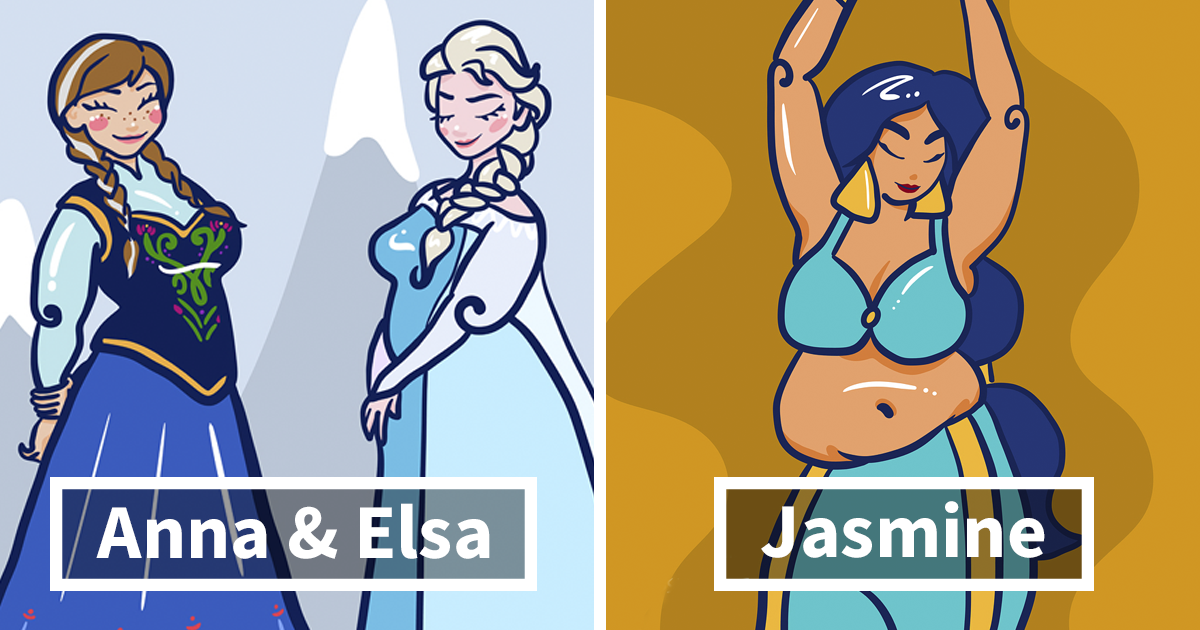
Note: This article discusses fan-made, body-positive artwork inspired by familiar fairy-tale princess characters. It is not affiliated with, sponsored by, or endorsed by Disney.
Once upon a time, in a kingdom suspiciously short on realistic waistlines, princesses twirled through castles, forests, ballrooms, and undersea palaces looking like they had never met a carb, a couch day, or a stretchy waistband. Then came artists like Crystal Walter, known online as Neoqlassical Art, who looked at the classic princess lineup and asked a wonderfully simple question: what if magical heroines came in more than one body type?
The result is a series of plus-size Disney princess reimaginings that feel fresh, joyful, and long overdue. These illustrations do not mock the originals or erase what made the characters beloved. Instead, they expand the visual vocabulary of fantasy. Aurora still has her dreamy elegance. Belle still looks curious and thoughtful. Ariel still seems ready to cause a tiny aquatic scandal. But in Walter’s world, they are drawn with fuller bodies, softer shapes, and the kind of confidence that says, “Yes, I can wear the gown, break the spell, and have dessert afterward.”
Among the many reimagined princesses, Aurora has become a standout. The Sleeping Beauty heroine is often remembered for her graceful silhouette, soft colors, and romantic design. In the plus-size version, those same qualities remain, but the image feels warmer and more alive. Aurora is not stunning because she has been “fixed.” She is stunning because the artwork makes room for a kind of beauty that popular animation has historically treated like a guest who forgot to RSVP.
Why Plus-Size Disney Princess Art Hit a Cultural Nerve
Princesses are not just cartoon characters. For many people, they are some of the first visual lessons about beauty, charm, goodness, romance, bravery, and what it means to be seen. Children do not watch animated heroines the way adults watch quarterly sales presentations. They absorb the colors, the songs, the costumes, the gestures, and the repeated message that a princess is worthy of attention.
That is why body diversity in animation matters. When nearly every princess shares a narrow body type, the pattern quietly teaches viewers that beauty has a strict dress code. And when fuller bodies are missing, treated as comic relief, or pushed to the side, the absence speaks loudly. It tells many viewers, especially young girls and teens, that fantasy is for someone else.
Walter’s artwork challenges that idea without turning the conversation into a lecture with a laser pointer. Her princesses are glamorous, playful, romantic, and expressive. They are allowed to be beautiful without an apology paragraph attached. That is the power of the project: it does not beg for permission. It simply shows plus-size women as princesses and lets the image do the talking.
Meet the Artist Behind the Reimagined Princesses
Crystal Walter, the artist behind Neoqlassical Art, has become known for drawing pop-culture characters with larger bodies and more body variety. Her style is affectionate rather than cynical. She is clearly engaging with characters she understands and enjoys, not tossing them into a blender labeled “internet controversy.”
Her plus-size princess art became widely discussed online because it sits at the intersection of nostalgia, fandom, body positivity, and the internet’s favorite hobby: arguing in comment sections as though the fate of civilization depends on a drawing of Cinderella. Some viewers praised the work for offering representation they rarely saw growing up. Others accused it of promoting unhealthy lifestyles, a familiar criticism that often appears whenever larger bodies are shown without shame.
But that criticism misses the point. Representation is not a medical diagnosis. A drawing of a plus-size princess is not a health plan, a warning label, or a public service announcement about vegetables. It is an image that says people in larger bodies can be heroic, stylish, romantic, funny, soft, adventurous, and worthy of being centered in a story.
Aurora Looks Absolutely StunningHere’s Why
Aurora is an especially interesting character to reimagine because her original design is so tied to elegance and delicacy. She is the princess of graceful hand poses, glowing hair, and woodland daydreams. In a less thoughtful redraw, she could easily be reduced to a body-size swap. But Walter’s plus-size Aurora keeps the character’s gentle, ethereal mood while giving her a fuller, more grounded presence.
The magic is in the balance. Aurora’s softness remains, but it no longer depends on being thin. Her gown still carries that fairy-tale drama, but the body inside it feels more relatable to viewers who have rarely seen their shape treated as romantic. She looks like someone who belongs in the palace, not someone sneaking into the ballroom before the fashion police arrive.
That distinction matters. Too often, plus-size characters in visual media are styled as jokes, sidekicks, villains, or “before” pictures in transformation stories. A plus-size Aurora flips the script. She is not waiting to shrink before she becomes worthy of the spotlight. She already has it.
Body Positivity Is Not About One “Correct” Body
A good body-positive conversation does not replace one narrow beauty standard with another. It does not say thin bodies are bad or plus-size bodies are better. That would only build a new tiny castle on the same shaky foundation. Instead, body positivity argues that people deserve dignity, visibility, and self-respect across sizes, shapes, abilities, ages, and appearances.
That is why these illustrations connect with so many people. They are not asking every princess to look the same. They are asking why princesses have looked so similar for so long. There is room in fantasy for slim bodies, athletic bodies, curvy bodies, disabled bodies, tall bodies, short bodies, scarred bodies, and bodies that do not fit neatly into a costume rack labeled “standard princess.”
In that sense, Walter’s work is less about changing Disney princesses and more about changing the lens through which viewers imagine beauty. The crown does not stop sparkling because the person wearing it has a fuller figure. The spell does not break. The carriage does not turn back into a pumpkin out of protest. If anything, the story becomes more interesting because more people can see themselves inside it.
Why Fans Love Reimagined Disney Princesses
Fan art has always been a place where audiences talk back to popular culture. People reimagine superheroes as parents, villains as misunderstood poets, mermaids as astronauts, and princesses in every era from Regency ballrooms to modern coffee shops. It is part tribute, part critique, and part “what if?” machine.
Plus-size Disney princess art belongs to that tradition. It does not need to replace the original films to have value. It exists because fans are allowed to imagine more. When an artist redraws Aurora, Moana, Belle, Tiana, Jasmine, Ariel, Merida, or Snow White with different body types, the artwork invites viewers to ask what visual habits they have accepted without question.
For many fans, the appeal is deeply personal. Someone may remember loving princess movies as a child but feeling excluded from the look. Someone else may have avoided costumes, dress-up parties, or fan events because the available outfits were not made with their body in mind. Seeing a plus-size princess can feel like a small correction to a long-running cultural typo.
Representation Works Best When It Feels Natural
The best part of Walter’s artwork is that it lets the characters remain themselves. Belle does not stop being bookish. Merida does not stop looking ready to cause archery-related chaos. Moana does not lose her strength or curiosity. Aurora does not lose her dreamy charm. Their bodies change, but their personalities do not vanish.
That is an important lesson for inclusive storytelling. Representation should not feel like a sticker slapped onto a finished product. It should feel integrated, ordinary, and emotionally honest. Audiences can usually tell the difference between meaningful inclusion and a brand trying to win applause with a suspiciously shiny press release.
When body diversity is handled well, it does not need a drumroll. A plus-size princess can simply exist in the story. She can fall in love, save the day, make mistakes, wear something fabulous, tell a joke, ride a horse, command an army, or spend an afternoon avoiding a suspicious spinning wheel. Her size can be part of her visual identity without becoming her entire personality.
The Bigger Conversation: Body Image and Media
Media plays a major role in shaping how people think about bodies. Movies, television, advertising, social platforms, toys, costumes, and fashion all contribute to the mental scrapbook people build about what is considered normal, attractive, acceptable, or “main character material.” When the same body type appears again and again, it can quietly narrow the imagination.
This does not mean one cartoon causes someone to feel bad about themselves. Culture is more complicated than that. But repeated images matter. A child who never sees a princess with a body like hers may notice. A teen shopping for a costume that does not come in her size may notice. An adult looking back on childhood favorites may realize how rarely fuller bodies were presented as graceful, desirable, or powerful.
That is why a single fan-art series can spark so much discussion. It touches something bigger than the drawings themselves. It asks whether our most beloved fantasy worlds are big enough for the bodies that exist in real life.
What Makes This Art Feel Empowering Instead of Gimmicky?
There is a difference between representation and tokenism. Tokenism says, “Look, we included one different person; please clap.” Representation says, “This person belongs here naturally.” Walter’s princesses feel closer to the second category because they are created with affection, style, and detail.
The characters are not drawn as punchlines. Their clothing is not treated like a problem to solve. Their expressions are not embarrassed. They are posed as princesses, not as disclaimers. That is why the art resonates. It offers beauty without asking viewers to first approve the body.
In Aurora’s case, the effect is especially strong because the character’s visual language has always been associated with classic feminine beauty. By reimagining her as plus-size while preserving her softness and elegance, the artwork expands the definition of “princess-like.” It gently suggests that grace was never about inches, pounds, or dress tags. Grace was always about presence.
Why the Debate Gets So Heated
Whenever plus-size representation appears online, the conversation often becomes emotional fast. Some people celebrate the visibility. Some people project their own anxieties onto it. Some people pretend to be concerned about health while behaving like they have been personally attacked by a digital ball gown.
The heated reaction reveals how uncomfortable society still is with larger bodies being shown in a positive, neutral, or glamorous way. If a plus-size character is miserable, dieting, comic, or apologetic, many viewers accept it. But when she is joyful, beautiful, romantic, or confident, suddenly everyone becomes an unpaid expert with a comment box.
That is exactly why the art matters. It challenges the idea that larger bodies must earn kindness through shame, transformation, or self-deprecating humor. A plus-size Aurora does not have to explain herself. She simply appears, looks radiant, and lets the audience deal with its own assumptions.
What Disney and Other Studios Can Learn
Fan art often points toward stories mainstream studios have been slow to tell. Viewers are not only asking for more princesses; they are asking for more kinds of princesses. That includes different races, cultures, abilities, ages, personalities, and body types. The modern audience is perfectly capable of loving a heroine who does not look like every heroine that came before her.
Studios do not need to turn every story into a public debate about representation. They can simply build richer worlds. Put different bodies in fantasy settings. Give them excellent costumes. Let them be brave, flawed, funny, romantic, ambitious, shy, loud, clever, glamorous, awkward, and complicated. In other words, let them be characters.
Animation is one of the best places to do this because it is not limited by reality. If animators can create talking snowmen, enchanted furniture, dragons, genies, glowing hair, and a crab with better musical timing than most humans, they can certainly create a wider range of beautiful bodies.
Experiences Related to the Topic: Why This Kind of Art Stays With People
One reason plus-size princess art feels powerful is that it connects to everyday experiences that many people carry quietly. Imagine being a child at a birthday party where everyone is invited to dress like a princess, but the costume rack seems to stop right before your size. No villain appears. No dramatic thunder cracks across the sky. But the message lands anyway: this fantasy was not designed with you in mind.
Now imagine seeing Aurora, Cinderella, Belle, or Jasmine drawn with a body closer to yours. The feeling can be surprisingly emotional. It is not just, “Oh, cute drawing.” It is the small relief of being included in a visual language you loved before it ever fully loved you back.
Many adults have similar memories. They remember loving princess stories while also noticing that the dolls, dresses, Halloween costumes, and marketing images all seemed to orbit one ideal body. They may have laughed it off, because that is what people often do when something hurts but seems too small to mention. But small exclusions add up. A costume that does not fit, a character who is always the joke, a shopping trip that ends in frustration, a movie where nobody shaped like you gets to be adoredthese moments can become part of how people understand themselves.
That is why fan-made reinterpretations can be healing. They do not erase the past, but they offer a different picture. A plus-size Aurora says the soft pink gown was never reserved for one kind of body. A plus-size Ariel says curiosity and romance are not size-restricted. A plus-size Merida says adventure does not require a specific silhouette. These images give viewers permission to revisit stories they loved with less distance and more ownership.
There is also joy in seeing fashion reimagined. Plus-size people are often told, directly or indirectly, to dress smaller, quieter, darker, or more “flattering,” which usually means “please make yourself less noticeable.” Princess art does the opposite. It leans into drama. Big skirts, bold colors, glittering details, fitted bodices, flowing sleeves, sparkling accessoriesthe whole fairy-tale toolbox comes out. The message is not “hide.” The message is “arrive.”
For artists, these redesigns can also be a form of creative freedom. Drawing different body types requires attention to shape, movement, fabric, posture, and character. It pushes visual storytelling beyond templates. A gown falls differently on a fuller body. A pose communicates confidence in a new way. A familiar character can feel renewed without losing her identity. That is not lazy fan service; that is thoughtful design.
For parents, teachers, and fans, artwork like this can open useful conversations without making anyone feel targeted. Instead of giving a lecture about body image, someone can simply ask, “How does this version change the way you see the character?” or “Why do you think people react so strongly to different body types?” The art becomes a doorway into media literacy, self-worth, and kindness.
Most importantly, these images remind people that fantasy should feel spacious. A fairy tale is not supposed to be a gated community for one beauty standard. It is supposed to be where impossible things become imaginable. If a castle can appear from a curse, if a pumpkin can become transportation, and if true love can survive a century-long nap, then surely a princess can be plus-size and breathtaking at the same time.
Conclusion: A Bigger Crown for a Bigger Imagination
“Artist Reimagines Disney Princesses As Plus-Size Women, And Aurora Looks Absolutely Stunning” is more than a catchy headline. It captures a cultural shift that has been building for years: audiences want fantasy worlds that reflect more of the real world. They want heroines who do not all share the same outline. They want beauty to feel abundant rather than rationed.
Crystal Walter’s plus-size princess illustrations are charming because they are beautiful, but they are meaningful because they are generous. They make room. They invite more viewers into the ballroom, the forest, the library, the tower, and the kingdom. Aurora looks absolutely stunning not because she fits an old rule, but because the art proves the rule was too small in the first place.
And that may be the most magical thing about the whole series: it does not ask anyone to stop loving the princesses they grew up with. It simply asks us to imagine a fairy tale where more people get to recognize themselves before the clock strikes midnight.