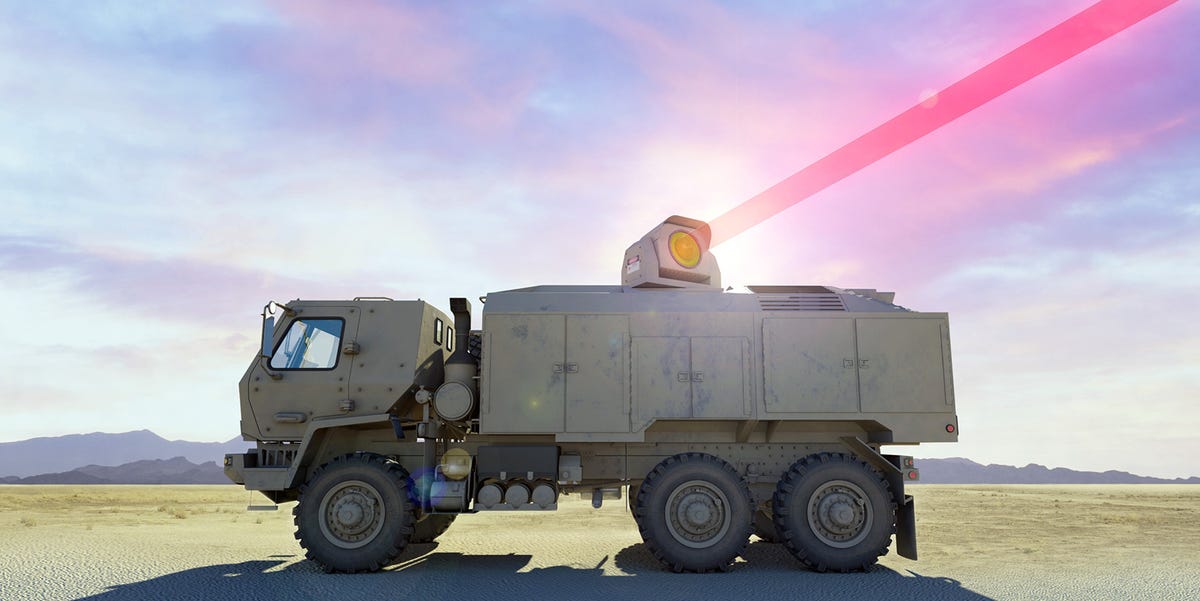
Editorial note: This article explains publicly reported information about ultrashort pulsed laser research in a non-instructional, educational way. It does not provide design, operating, targeting, or build guidance.
The phrase “Army laser weapon” used to sound like something a science-fiction writer would scribble on a napkin after drinking too much coffee. Today, it is part of a very real defense technology race. The U.S. Army has been testing and developing directed-energy systems to help defend soldiers, bases, and critical infrastructure from drones, rockets, artillery, mortars, and cruise missile threats. Among the most fascinating ideas in that world is the ultrashort pulsed laser, often shortened to USPL.
Unlike the familiar image of a laser beam steadily burning through a target like a very expensive flashlight with anger issues, an ultrashort pulsed laser works in a different way. It releases extremely short bursts of energy, often described in femtoseconds, which are quadrillionths of a second. In public reporting, Army-related ultrashort pulse concepts have been discussed in terms of enormous peak power delivered for an almost unbelievably tiny slice of time. That combination is what makes the technology so interesting, so complicated, and so far from being a simple “laser cannon” fantasy.
The key point is this: ultrashort pulsed lasers are not just stronger versions of existing continuous-wave lasers. They represent a different approach to directed energy, one that may produce effects through rapid energy delivery, plasma formation, and potential disruption of sensitive electronics or optical systems. In plain English, the Army is exploring whether pulses of light can do jobs that conventional munitions and continuous laser beams cannot do as efficiently.
What Is an Ultrashort Pulsed Laser?
An ultrashort pulsed laser is a laser system that emits energy in extremely brief bursts rather than as a continuous beam. In many public explanations, continuous-wave lasers are compared to blowtorches: they hold energy on a target long enough to heat, weaken, burn, or damage it. Ultrashort pulsed lasers are more like camera flashes from another dimension: incredibly fast, sharply concentrated, and capable of producing intense physical effects in tiny time windows.
The “ultrashort” part matters. When a pulse lasts only a femtosecond-scale moment, the peak power can be enormous even if the total energy involved is not the same as a long-burning beam. That is why reports have described tactical ultrashort pulse concepts using peak-power language such as terawatts. A terawatt is one trillion watts, which sounds like a villain’s utility bill, but peak power is not the same thing as running a trillion-watt device continuously. The pulse is extremely brief.
This is one reason ultrashort pulsed lasers can be confusing in headlines. A system may be described as “more powerful” than a kilowatt-class military laser because its peak power is vastly higher, but that does not mean it operates like a giant continuous beam. Peak power, average power, pulse length, repetition rate, beam quality, thermal control, and atmospheric propagation all matter. In directed energy, the headline number is only the appetizer; the engineering meal is much larger.
Why the Army Is Interested in Laser Weapons
The Army’s interest in laser weapons is tied closely to the changing nature of air defense. Low-cost drones have become a major problem for modern militaries. A small unmanned aircraft can be used for surveillance, targeting, harassment, or attack. Shooting down a cheap drone with an expensive missile can work, but it is a rough trade. Nobody enjoys spending luxury-car money to stop something that may cost less than a lawn mower.
Directed-energy systems offer a different economic and logistical idea. As long as a system has power, cooling, sensors, and a clear enough engagement environment, it may be able to fire repeatedly without needing a new missile round for every shot. That is the “deep magazine” argument often used in discussions of laser and microwave weapons. The ammunition is electricity, not a warehouse full of interceptors.
For the Army, this matters because soldiers may need layered defenses. Kinetic systems, electronic warfare, high-power microwave systems, and lasers can each have roles. A continuous-wave laser may be useful against certain drones. Missiles may remain necessary for faster or more dangerous threats. Ultrashort pulsed lasers could eventually add another layer if they prove practical, reliable, and safe enough for real military environments.
Continuous-Wave Lasers vs. Ultrashort Pulsed Lasers
The easiest way to understand the difference is to imagine two ways of damaging a metal object. A continuous-wave laser tries to keep energy on one spot until heat does the job. It needs dwell time, which means the beam must remain accurately pointed at the target despite motion, vibration, weather, turbulence, and battlefield chaos. That is not impossible, but it is not easy either. A moving drone is rude enough to keep moving.
An ultrashort pulsed laser, by contrast, concentrates energy into tiny bursts. Instead of relying only on steady heating, it may create rapid surface effects or plasma interactions. Public defense discussions often describe potential effects such as damaging exposed materials, affecting sensors, or disrupting electronics through intense electromagnetic interactions. The appeal is that a pulse-based system might reduce the need for long dwell time on a single point.
That does not make USPL a magic wand. It adds its own problems. The system must generate, shape, aim, and repeat ultrashort pulses reliably. It must deal with air, dust, moisture, heat, platform movement, and safety controls. A laboratory system can be large, delicate, and pampered. A battlefield system must survive vibration, transport, weather, maintenance schedules, and soldiers who do not have time to whisper encouraging words to sensitive optics.
Publicly Reported Army Laser Programs and Context
The Army has worked on several directed-energy efforts, and it is important not to mix them all into one glowing soup. DE M-SHORAD, for example, is a 50-kilowatt-class high-energy laser concept integrated on a Stryker vehicle for short-range air defense. It is associated with countering threats such as unmanned aircraft systems and other short-range aerial dangers. That is a continuous-wave high-energy laser approach, not the same as an ultrashort pulse concept.
The Army has also pursued higher-power systems for indirect fire protection, including 300-kilowatt-class high-energy laser efforts. Public reporting in 2026 indicated that the Army was changing course on one major 300-kilowatt IFPC-HEL effort, using the work to inform future joint laser development rather than moving that specific system directly into a program of record. That shift is not a sign that lasers are dead. It is a sign that military laser programs are still moving through the painful middle ground between impressive prototype and dependable fielded capability.
The ultrashort pulsed laser concept sits in this broader ecosystem. Army public solicitations and reporting have described interest in compact, ruggedized ultrashort pulse systems suitable for Army-relevant platforms. That phrase, “suitable for Army-relevant platforms,” hides a mountain of engineering difficulty. It means the technology cannot remain a delicate lab beast. It must eventually become something that fits within real-world limits for size, weight, power, cooling, ruggedness, maintainability, and safety.
How Ultrashort Pulsed Lasers Could Change Counter-Drone Defense
Drones are a natural focus for directed-energy discussions because many are small, numerous, and relatively inexpensive. A defensive system that can defeat drones at low cost per shot could be valuable for bases, convoys, airports, ports, and military formations. The Army has already been exploring directed energy in live-fire exercises, combining lasers with kinetic systems to understand how they fit into layered air defense.
An ultrashort pulsed laser could theoretically offer a different type of effect than a continuous-wave laser. Instead of heating a drone until a structural part fails, a pulse-based system may aim to create rapid effects on surfaces, sensors, or electronics. That distinction matters because not every target fails the same way. Some threats may be more vulnerable to heat. Others may be more vulnerable to optical, electronic, or material effects.
Still, “could” is doing a lot of work here. Publicly available information suggests that ultrashort pulse directed-energy systems remain technically challenging. They must be evaluated for propagation through the atmosphere, target interaction, pulse repetition, beam control, and integration with sensors and command systems. A useful military system must not only create an effect; it must create the right effect, at the right time, with enough reliability to be trusted by the people depending on it.
The Science Challenge: Light, Air, and Plasma
One of the strangest parts of ultrashort pulsed laser research is that the air itself becomes part of the problem. Extremely intense pulses can interact with the atmosphere in nonlinear ways. Public research discussions often mention phenomena such as filamentation and plasma-channel behavior. In simple terms, the beam does not merely pass through the air like a polite guest. Under some conditions, it changes the air as it travels.
That interaction can be both useful and troublesome. On one hand, plasma-related effects are part of what makes ultrashort pulse research interesting. On the other hand, atmospheric turbulence, moisture, dust, heat shimmer, and beam breakup can reduce performance. A system that works beautifully in a controlled test environment may face a very different personality from the real world, especially in desert heat, maritime humidity, urban clutter, or battlefield smoke.
This is why official research programs place so much emphasis on atmospheric characterization, adaptive optics, laser-material interaction, and modeling. A laser weapon is not just a laser. It is a sensor system, a tracking system, a power system, a cooling system, a safety system, a software system, and a maintenance problem wearing one dramatic name tag.
Why “Most Powerful” Can Be Misleading
When readers see phrases like “world’s most powerful laser weapon,” it is tempting to imagine a single ranking chart: bigger number wins. Directed energy is not that simple. A terawatt-class peak pulse sounds much larger than a 50-kilowatt continuous beam, but they are measured differently. One is peak power over an extremely short pulse. The other is continuous output over time.
Think of it like comparing a camera flash to a space heater. The flash can be intensely bright for a fraction of a second. The heater produces much lower power density in one instant, but it keeps going. Depending on the job, either one might be more useful. If you want a room warmed, use the heater. If you want a sharp burst of light, use the flash. If you want a military system, call thousands of engineers, add funding, testing, oversight, and patience.
For SEO readers searching “Army powerful new laser weapon,” the most accurate answer is that ultrashort pulsed laser research is powerful in peak-intensity terms, not necessarily in the cartoon sense of a giant beam sweeping across the sky. Its promise lies in unique effects, fast engagement possibilities, and future integration with layered defenses.
Major Obstacles Before Fielding
1. Size, Weight, and Power
Military platforms have strict limits. A system that needs too much space, too much electricity, or too much cooling may be impractical. Army vehicles already carry armor, radios, sensors, weapons, crew gear, fuel, and enough cables to make a garage look tidy. Adding a sophisticated laser system means every pound and watt must justify itself.
2. Cooling and Thermal Management
Directed-energy systems produce heat. Even if the beam is made of light, the equipment is not immune to thermodynamics. Heat must be managed so the system can operate repeatedly without damaging itself or becoming unreliable. In defense technology, “it worked once” is a science fair result. “It works repeatedly under stress” is the beginning of usefulness.
3. Beam Control and Tracking
Targets move. Vehicles shake. Air bends light. Sensors must detect, identify, track, and prioritize threats. The laser must then place energy precisely enough to matter. That is difficult for continuous-wave systems and remains challenging for ultrashort pulsed systems. Precision is not a luxury; it is the whole game.
4. Rules, Safety, and Integration
Lasers raise safety concerns for friendly forces, aircraft, sensors, and civilians. Any fielded system must operate within strict procedures and command controls. The Army’s live-fire directed-energy exercises show that technology is only one part of the puzzle. Doctrine, training, policy, maintenance, and human decision-making matter just as much.
What This Means for the Future of Warfare
Ultrashort pulsed lasers are part of a larger move toward energy-based defense. The battlefield is becoming more crowded with drones, loitering munitions, precision weapons, sensors, and electronic systems. Traditional ammunition is still essential, but militaries are searching for cheaper, faster, and more scalable defensive layers.
If ultrashort pulsed laser systems mature, they may complement continuous-wave lasers and high-power microwave systems. A future air defense network might use radar and optical sensors to detect threats, electronic warfare to confuse some of them, high-power microwaves to affect groups of electronics, continuous-wave lasers to burn through vulnerable targets, and kinetic interceptors for threats that require physical destruction. In that layered approach, USPL would be another tool, not the entire toolbox.
The most realistic view is neither hype nor dismissal. Laser weapons are no longer pure fantasy, but they are not effortless superweapons. The Army’s ongoing tests, program adjustments, and research investments show a field that is advancing while still wrestling with hard engineering truths. The future may be bright, but it will also need power cables, cooling loops, acquisition discipline, and a lot of test data.
Experience-Based Reflection: Watching the Laser Weapon Story Mature
Anyone who has followed military technology for a while has probably noticed a pattern: every few years, a new laser headline arrives wearing sunglasses and promising to change everything. Then reality enters the room with a clipboard. The result is usually less cinematic than the headline but more interesting in the long run.
The ultrashort pulsed laser story feels like that. At first glance, “trillion-watt laser pulse” sounds like a final boss weapon from a video game. But when you spend time reading public defense documents and credible reporting, the story becomes more nuanced. The exciting part is not simply raw power. It is the possibility of creating different effects from traditional lasers, especially against modern threats such as drones and sensitive electronic systems.
The practical experience of analyzing this topic is a reminder that defense technology is rarely a straight line. A prototype can be impressive and still not be ready. A program can be canceled or redirected and still leave behind useful data. A system can work in a test and still need years of refinement before soldiers can rely on it. That may sound frustrating, but it is also how serious engineering works. The battlefield is a terrible place to discover that a technology only behaves well on sunny Tuesdays.
Another lesson is that the human side matters. The Army’s directed-energy exercises are not only about whether a beam can defeat a target. They are about how soldiers detect threats, decide what to engage, coordinate with other systems, and operate safely under pressure. A laser without good training is just expensive light with paperwork attached.
There is also a public communication challenge. Terms like kilowatt, terawatt, femtosecond, high-energy laser, high-power microwave, and ultrashort pulse can blur together. For readers, the best approach is to ask: What effect is the system designed to create? What threat is it meant to address? Is it a prototype, a test system, or a fielded capability? What limitations are officials and independent analysts still discussing?
From an observer’s perspective, ultrashort pulsed lasers are most compelling because they show how modern defense is shifting from “bigger explosion” thinking toward more precise energy effects. That does not make war cleaner or simpler. It does, however, show why militaries are investing in systems that can respond quickly to fast, cheap, and numerous threats. The drone problem is not going away, and neither is the search for cost-effective defense.
The best takeaway is balanced curiosity. Ultrashort pulsed lasers deserve attention because the science is real, the military interest is real, and the potential applications are significant. They also deserve skepticism because integration, atmosphere, safety, reliability, and cost remain serious barriers. In other words, the Army’s powerful new laser weapon concept is not a toy, not a myth, and not a finished miracle. It is an ambitious technology path that may help shape the next generation of air defenseprovided the engineering can keep up with the imagination.
Conclusion
The Army’s ultrashort pulsed laser research represents one of the most intriguing branches of directed-energy development. Compared with continuous-wave lasers, USPL concepts focus on incredibly short bursts of high peak power that may create rapid effects on materials, sensors, or electronics. The promise is faster engagement, low cost per shot, and another layer in the defense against drones and other aerial threats.
But the technology still faces major hurdles. Size, weight, power, cooling, beam control, atmospheric propagation, safety, and integration all determine whether a laboratory concept can become a useful military capability. For now, ultrashort pulsed lasers should be viewed as a serious research direction rather than a fully mature battlefield solution. The future of Army laser weapons will likely be layered, practical, and less like science fiction than the headlines suggestbut possibly more important.