Every now and then, the internet does something surprisingly useful. Between cat videos, suspicious life hacks, and comment sections that should probably come with seatbelts, someone manages to turn a messy public debate into a clear lesson. That is exactly what happened when an anti-vaxxer tried to use a simple graph to “prove” vaccines cause autism, only for another person to respond with a brilliantly simple point: correlation is not causation.
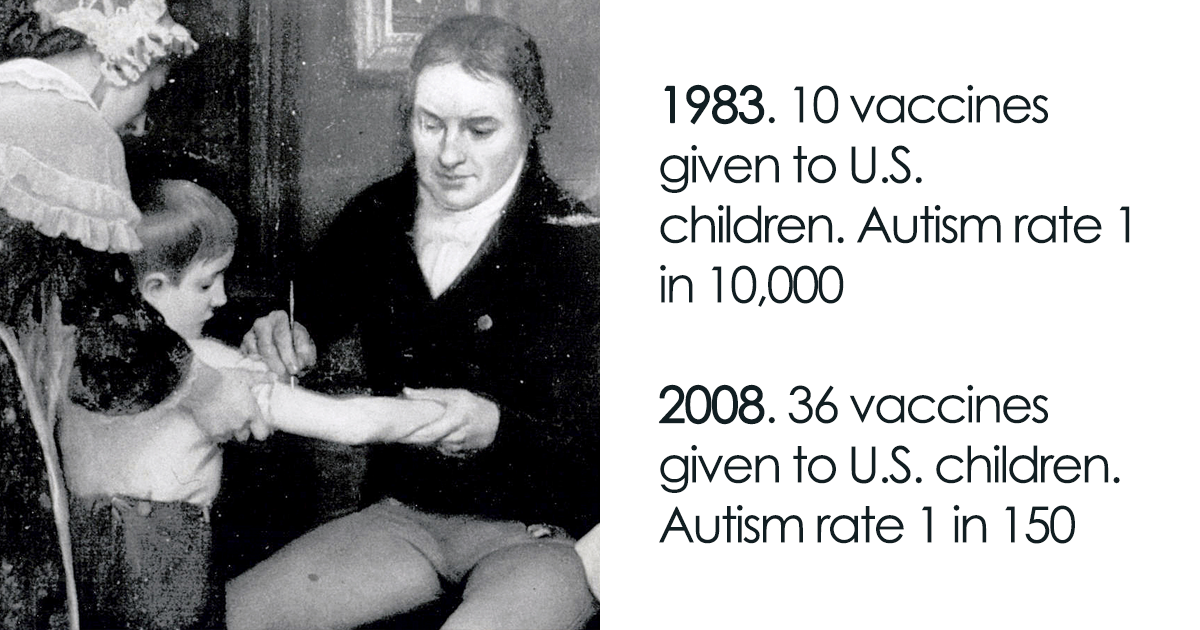
The original claim leaned on a familiar tactic. Put two lines on a chart, show that both seem to rise over time, and then imply one must be causing the other. Autism diagnoses increased. Childhood vaccination schedules expanded. Therefore, vaccines caused autism. Case closed, right? Not quite. By that logic, smartphones could cause gluten-free muffins, superhero movies could cause beard oil sales, and the rise of streaming services could be blamed for everyone suddenly owning too many throw pillows.
The genius reply was not complicated. It used the same type of correlation logic to show how absurd the argument was. Many unrelated things rise over time together: organic food sales, internet usage, yoga pants, specialty coffee, and the number of people who say “circle back” in meetings. A matching trend line can be interesting, but it is not proof of cause and effect. In science, the question is not “Can two things be drawn on the same graph?” The question is “Does strong, repeatable evidence show that one causes the other?”
Why the Vaccine-Autism Myth Became So Sticky
The vaccine-autism myth has survived for decades because it feeds on fear, timing, and confusion. Autism spectrum disorder is often identified in early childhood, around the same period when children receive several routine vaccines. When two major events happen close together, the human brain naturally wants to connect them. Parents are wired to search for explanations, especially when they notice developmental differences in a child they love.
That emotional search is understandable. The problem begins when fear gets dressed up as evidence. A child receiving a vaccine and later being diagnosed with autism does not prove the vaccine caused autism. It proves that two events happened in a sequence. Science then has to ask harder questions: Do vaccinated children develop autism at higher rates than unvaccinated children? Does the timing fit biologically? Do large studies find the same pattern? Do proposed mechanisms hold up under testing?
Over and over, large-scale studies, medical reviews, and expert organizations have found no credible evidence that vaccines cause autism. The American Academy of Pediatrics has stated that studies have repeatedly found no credible link between childhood vaccines and autism. Mayo Clinic likewise explains that vaccines do not cause autism and that the original 1998 claim was based on falsehoods and later removed from the scientific record. Johns Hopkins public-health experts have also noted that large epidemiological studies comparing vaccinated and unvaccinated children found no association between the MMR vaccine and autism.
The 1998 Study That Lit the Match
The modern myth is often traced back to a 1998 paper by Andrew Wakefield and colleagues that claimed a connection between the MMR vaccine and autism. The paper was small, flawed, and eventually retracted. Wakefield lost his medical license, and the study became one of the most infamous examples of how weak research can cause enormous public harm when it is amplified by media panic.
The damage was not just academic. Parents became frightened. Vaccination rates dropped in some communities. Measles, a disease that vaccines had pushed far out of everyday life in the United States, found pockets of opportunity. That is the thing about misinformation: it does not need to be correct to cause real-world consequences. A bad idea with a loud microphone can still send people to the emergency room.
What the Strongest Evidence Actually Shows
Large studies do not support the vaccine-autism claim
One of the strongest ways to test the claim is to compare large groups of vaccinated and unvaccinated children. If vaccines caused autism, researchers would expect to see higher autism rates among vaccinated children after accounting for other factors. That pattern has not appeared in credible research.
A major meta-analysis reviewed case-control and cohort studies and found no relationship between vaccination and autism or autism spectrum disorder. It also found no association between autism and MMR, thimerosal, mercury, or multiple vaccines. This matters because meta-analyses combine evidence across many studies, giving researchers a broader view than one isolated paper can provide.
Another widely discussed study from Denmark followed more than 650,000 children and found that the MMR vaccine did not increase autism risk, did not trigger autism in children considered more susceptible, and was not associated with clusters of autism cases after vaccination. That is not a tiny “we asked twelve people at a bus stop” sample. That is a huge national dataset, which is exactly the kind of evidence you want when testing a public-health claim.
Thimerosal is not the villain either
When the MMR claim failed to hold up, some vaccine critics shifted attention to thimerosal, a mercury-based preservative once used in some multi-dose vaccine vials. But this claim also runs into a wall of evidence. The FDA explains that all vaccines routinely recommended for children age six and younger in the United States are available in formulations that do not contain thimerosal. The FDA also notes that scientific evidence over more than 20 years does not show harm, including serious neurodevelopmental disorders, from thimerosal in vaccines.
There is also a timeline problem for the myth. Thimerosal was removed or reduced in most childhood vaccines as a precaution, yet autism diagnoses did not fall afterward. If thimerosal were a major driver of autism, removing it should have produced a clear drop. It did not. That is a bit like blaming a leaky roof on a lamp, removing the lamp, and then watching the rain continue to fall on your couch.
Why Autism Diagnoses Have Increased
Autism diagnoses have increased over recent decades, but that does not automatically mean autism itself is being “created” by vaccines. Several factors help explain rising diagnosis numbers, including broader diagnostic criteria, better screening, increased awareness, improved access to evaluations, and changes in how schools and health systems classify developmental differences.
In plain English: we got better at recognizing autism. Many people who might have been labeled “quiet,” “difficult,” “gifted but odd,” “socially awkward,” or “not trying hard enough” in earlier generations are now more likely to receive a clearer diagnosis. That is not a conspiracy. That is medicine learning to use better glasses.
Autism is also not a single-simple-cause condition. Research points to complex genetic and biological factors. That does not mean every detail is fully understood. Science is comfortable saying, “We know a lot, and we are still learning.” What science does not support is the leap from “autism is complex” to “vaccines must be the cause.” A mystery is not an invitation to blame the nearest syringe.
The Genius of the Correlation Comeback
The viral response to the anti-vaxxer’s graph was clever because it did not require a medical degree to understand. It showed that you can make many unrelated trends appear connected if you pick the right time period and ignore everything else. That is the danger of cherry-picked correlation.
For example, imagine a chart showing that autism diagnoses rose while sales of organic food rose. Should we conclude kale causes autism? Please do not arrest the salad bar. Or suppose autism diagnoses rose while the number of internet users increased. Is Wi-Fi the cause? No. These examples are silly on purpose, but they expose the same flawed reasoning.
A proper scientific argument has to do more than point at two rising lines. It must rule out coincidence, account for confounding variables, show consistency across populations, offer a plausible biological mechanism, and survive repeated testing by independent researchers. The vaccine-autism claim has failed those tests again and again.
How Misinformation Uses “Just Asking Questions”
One reason vaccine myths survive is that they often hide behind the phrase “I’m just asking questions.” Asking questions is good. Science loves questions. Science basically runs on questions, coffee, and peer review. The issue is when questions are used as a fog machine to keep a debunked claim alive forever.
There is a difference between honest curiosity and moving the goalposts. Honest curiosity says, “What does the best evidence show?” Moving the goalposts says, “If you cannot prove with impossible certainty that no vaccine in no child at no time could ever play any role, then my claim wins.” That is not how evidence works. By that standard, you could also claim chicken nuggets, birthday candles, or the color beige “might” cause autism because science cannot run every impossible test in the universe.
Good science deals in probabilities, patterns, mechanisms, and evidence quality. It does not require magical certainty before making responsible conclusions. The responsible conclusion from the evidence is clear: vaccines do not cause autism.
Vaccines Are Monitored More Closely Than Most People Realize
Another common myth is that vaccines are casually released and then ignored. In reality, vaccine safety is monitored before and after approval. Researchers track side effects, investigate safety signals, review population-level data, and update recommendations when needed. This is not a perfect system, because no human system is perfect, but it is extensive and continuously reviewed.
The United States uses multiple vaccine safety systems, and expert groups evaluate evidence from large databases, clinical trials, and post-market surveillance. The National Academies, FDA, AAP, CDC-linked research, university experts, and hospital-based vaccine education centers have all contributed to the public evidence base. The fact that vaccines continue to be recommended is not because nobody checked. It is because they have been checked repeatedly.
Respecting Autistic People While Debunking Bad Claims
There is another part of this conversation that deserves more attention: the vaccine-autism myth often treats autism as a worst-case horror story. That framing is unfair and harmful to autistic people. Autism can come with real challenges, and many families need better support, services, and understanding. But autistic people are not cautionary tales. They are people with personalities, talents, needs, frustrations, jokes, preferences, and rights.
Public-health communication should reject misinformation without making autism sound like something worse than vaccine-preventable diseases. Measles can cause pneumonia, brain swelling, long-term complications, and death. Rubella infection during pregnancy can cause severe harm to a developing baby. Mumps can lead to painful swelling and, in some cases, serious complications. Vaccines protect against these diseases. That protection matters.
Specific Examples of Bad Logic in Anti-Vaccine Arguments
Example 1: “My child was vaccinated, then diagnosed”
This is emotionally powerful but scientifically incomplete. Many autism signs become noticeable around the same age children receive routine vaccines. Timing alone cannot prove cause. Researchers must compare large groups, and those comparisons do not show that vaccines raise autism risk.
Example 2: “Autism rates rose as vaccine schedules expanded”
Many things changed during the same decades: diagnostic criteria, school reporting, medical awareness, parent education, internet access, and screening practices. A rising line next to another rising line is a starting point for a question, not the end of the investigation.
Example 3: “The ingredients sound scary”
Ingredient names can sound intimidating. So can dihydrogen monoxide, which is just water wearing a lab coat. Vaccine ingredients are used for specific purposes and in carefully measured amounts. Toxicity depends on dose, form, route, and context. The same basic principle explains why table salt is fine on fries but dangerous by the cupful.
Why the Internet Loved the “Genius” Reply
The response went viral because it did what good public communication often does: it made a complicated concept feel obvious. Instead of arguing line by line through every anti-vaccine claim, it exposed the broken engine underneath the claim. Once people understand the difference between correlation and causation, many misleading charts lose their magic trick.
That is why media literacy matters. A graph is not automatically truth. A confident caption is not evidence. A viral post is not a peer-reviewed study. And a person with a dramatic font choice is not necessarily a researcher, although they may be very committed to underlining things.
Experiences and Lessons Related to the Vaccine-Autism Debate
One common experience in conversations about vaccines is that facts alone do not always change minds immediately. A parent who is afraid is not simply a spreadsheet waiting for data. They may be carrying anxiety, past medical confusion, mistrust, or a painful memory of not being listened to. That is why the most effective conversations often start with respect rather than ridicule.
Imagine a parent sitting at a pediatric appointment, worried because their toddler has stopped using a few words or avoids eye contact more than before. Around the same period, the child received routine vaccines. The parent is scared and searching for a reason. If they go online, they may find a confident stranger saying, “I know exactly what caused it.” That answer can feel comforting because certainty feels better than uncertainty, even when the certainty is wrong.
In that moment, a doctor, nurse, teacher, or family member can help by separating empathy from agreement. It is possible to say, “I understand why the timing worries you,” while also saying, “The best evidence does not support vaccines as the cause.” That combination matters. People are more likely to listen when they do not feel mocked for being afraid.
Another real-world lesson is that simple explanations are attractive, especially when the truth is complicated. Autism research involves genetics, brain development, environmental factors, screening, diagnosis, and individual differences. That is a lot to hold in one conversation. “It was the vaccine” is simpler. But simple is not the same as true. A vending machine is simple too, and it still steals your dollar sometimes.
People also experience the vaccine debate differently depending on their community. In some places, nearly everyone vaccinates, so vaccine-preventable diseases feel distant. That distance can create a strange luxury: people forget what measles, polio, rubella, or diphtheria actually did. Vaccines become victims of their own success. When prevention works, the danger becomes invisible, and invisible dangers are easy to underestimate.
For autistic people and their families, the debate can feel especially exhausting. Instead of focusing on better therapies, school support, communication tools, employment access, sensory-friendly spaces, and respectful inclusion, public attention gets dragged back to the same disproven claim. Many autistic adults have pointed out that the vaccine-autism panic often talks about them as if their existence is a tragedy to be prevented. That is not just scientifically wrong; it is socially cruel.
A better experience is possible. Parents can ask questions without being shamed. Doctors can explain evidence without sounding robotic. Schools can support neurodivergent students without treating them as problems to be solved. Journalists can avoid sensational headlines that turn weak claims into public confusion. Social media users can pause before sharing a chart that looks convincing but proves nothing.
The viral “correlation comeback” works because it gives ordinary readers a tool they can use everywhere, not only in vaccine debates. When someone shows two rising lines and declares victory, ask: What is the sample size? What variables were controlled? Is there a plausible mechanism? Has the result been repeated? Are reputable experts convinced? Could another explanation fit better? These questions are not fancy. They are the seatbelts of critical thinking.
At the human level, the best lesson is this: caring about children means caring about evidence. It means protecting them from dangerous diseases and also supporting children who are autistic with dignity and resources. It means not letting a scary story outrun decades of research. And it means remembering that a clever internet joke can open the door, but good science is what keeps the room standing.
Conclusion
The anti-vaxxer’s graph tried to turn correlation into proof, but the genius response showed exactly why that logic falls apart. Two trends can move together without one causing the other. The serious scientific evidence does not support the claim that vaccines cause autism. Large studies, expert reviews, pediatric organizations, medical centers, and vaccine safety researchers have repeatedly found no credible causal link.
The real takeaway is bigger than one viral post. We need better science literacy, better public-health communication, and better respect for autistic people. Vaccines protect children and communities from dangerous diseases. Autism deserves understanding, support, and research rooted in evidence rather than fear. A graph can start a conversation, but facts should finish it.