Some events show you what people are building. Maker Faire Shenzhen shows you what the future looks like when those people can prototype it before lunch, refine it by dinner, and probably source parts for version two before bedtime. That is what makes this event different. It is not just a cheerful celebration of DIY culture, although it absolutely has that energy. It is a living collision between open-source curiosity, startup ambition, factory-speed iteration, design culture, and the kind of hardware optimism that makes engineers grin like kids in a candy store.
In recent years, Maker Faire Shenzhen has grown from an important regional gathering into a global checkpoint for anyone who cares about hardware innovation, AI devices, robotics, digital fabrication, and maker culture at industrial scale. The 2025 edition made that clear in spectacular fashion. Bigger, sharper, and more internationally connected than ever, it showed why Shenzhen remains one of the most fascinating cities on Earth for people who like their ideas physical, testable, and delightfully weird.
If the phrase maker movement once conjured images of garage workbenches, solder fumes, and half-finished robots held together by hope and zip ties, Maker Faire Shenzhen expands that vision. Here, the movement grows up without losing its sense of play. The result is a fair that still feels experimental and human, but now operates with the confidence of a serious innovation platform. In other words, it is still wonderfully nerdy, but now it also has a passport, a supply chain, and a very convincing business plan.
Why Maker Faire Shenzhen Matters More Than Ever
Maker Faire as a global concept has always celebrated the overlap of art, science, engineering, and hands-on invention. Maker Faire Shenzhen takes that formula and plugs it directly into one of the world’s most powerful hardware ecosystems. That changes everything. In Shenzhen, a prototype is not a final school project or a fun weekend build. It can be the first draft of a manufacturable product, a startup, a teaching tool, a research platform, or a cross-border collaboration.
That is why this event carries unusual weight. It attracts hobbyists, educators, founders, engineers, students, artists, open-source builders, and established technology companies, but unlike many fairs, conferences, or expos, these groups do not stay politely separated. They mix. A student booth can sit within walking distance of a major hardware brand. A maker demonstrating a handmade controller can spark interest from a supply-chain expert, a content creator, or an investor. A workshop attendee can leave with more than inspiration; they can leave with a realistic next step.
The phrase “soars to new heights” is not just promotional glitter. It reflects a visible expansion in scale, ambition, and relevance. The event now acts as both a showcase and a bridge: between local and international makers, between playful projects and serious commercialization, and between the romantic spirit of tinkering and the practical demands of modern hardware development.
From Chaihuo to a Global Stage
To understand why Maker Faire Shenzhen feels so distinctive, you have to start with Chaihuo Makerspace and the city around it. Chaihuo helped establish one of the earliest makerspace models in Shenzhen, and over time it became a crucial node in the city’s maker identity. The fair’s roots go back to the early 2010s, when Shenzhen was already famous for electronics manufacturing but was still earning wider recognition as a cultural home for makers, hackers, product designers, and hardware entrepreneurs.
That history matters because Maker Faire Shenzhen did not appear out of nowhere. It grew alongside Shenzhen’s transformation from “factory city” shorthand into a symbol of rapid, open-ended hardware innovation. Scholars and industry observers have long pointed to Shenzhen as a place where design and manufacturing blur together in unusually productive ways. The city’s maker culture was shaped not only by formal institutions, but also by supplier networks, open exchange, fast prototyping habits, and communities willing to share knowledge across disciplines.
In other words, Maker Faire Shenzhen works because Shenzhen itself works as a hardware city. You can feel that in the fair’s DNA. The event is not trying to imitate Silicon Valley with extra solder. It reflects a local innovation logic built around iteration, practicality, collaboration, and access to real manufacturing infrastructure.
What “New Heights” Looked Like in 2025
A Bigger and More International Event
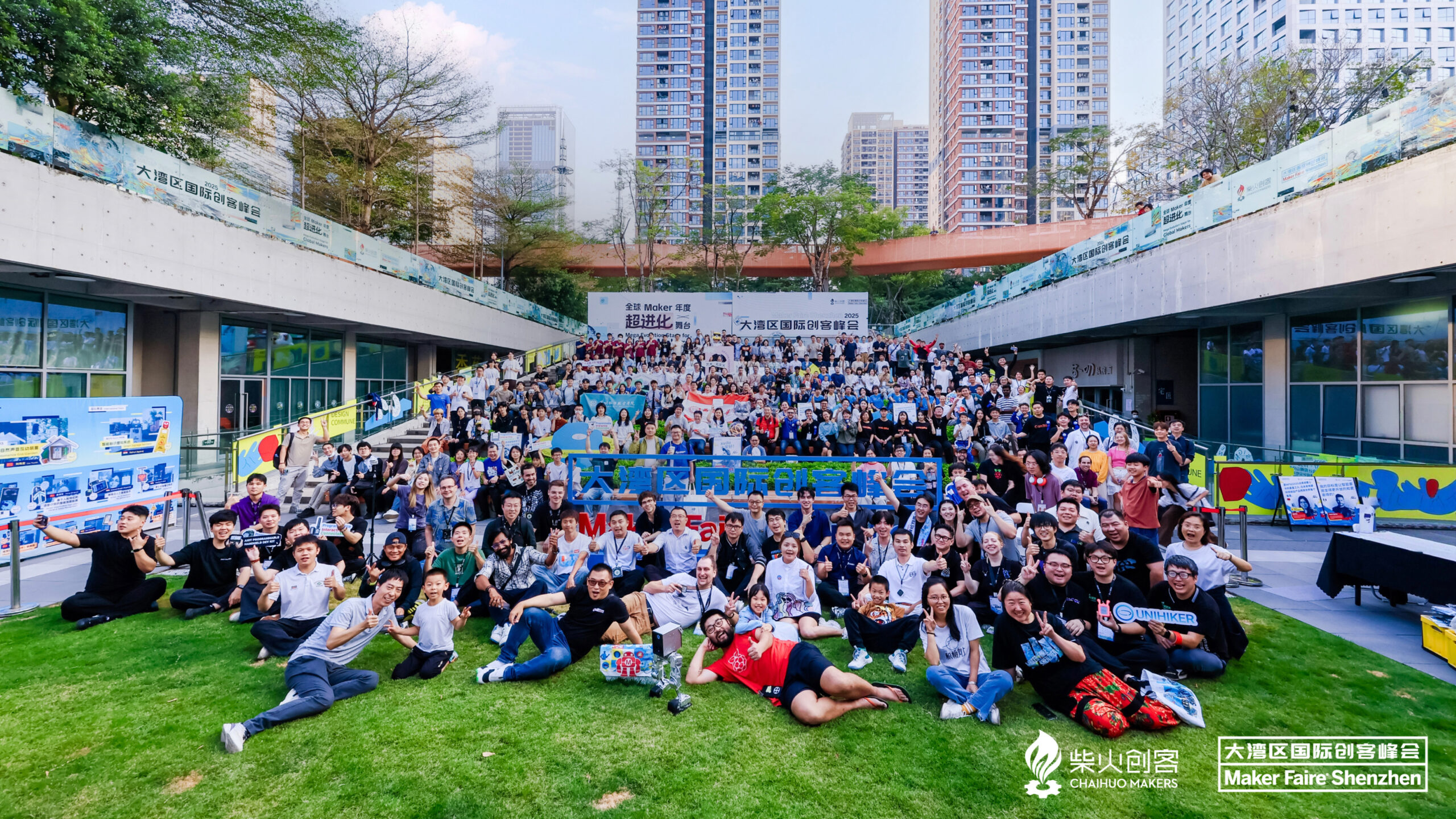
The 2025 edition showed just how far the fair has come. Organizers reported hundreds of project applications from across China and from countries spanning North America, Europe, Asia, Africa, and beyond. The booth structure itself reflected serious scale, with corporate exhibitors, universities, individual teams, domestic projects, Hong Kong makers, and international participants all mapped into distinct zones. That kind of organization signals maturity. This was not a chaotic hall full of cool gadgets and good intentions. It was a carefully built ecosystem under one roof.
The result was a fair that felt global without becoming generic. That is an important distinction. Plenty of technology events call themselves international because they include a few overseas speakers and a coffee station with lofty branding. Maker Faire Shenzhen feels international because the mix of projects, people, languages, and technical perspectives changes the texture of the event itself. It turns the floor into a conversation rather than a display.
AI Was Everywhere, but Not in a Buzzword Way
Another reason the 2025 fair stood out was its embrace of AI hardware and embodied intelligence. This was not the kind of AI discourse built entirely on keynote slides and dreamy promises. At Maker Faire Shenzhen, AI appeared in tangible forms: interactive robots, physical computing platforms, smart devices, experimental interfaces, educational tools, and prototypes aimed at real-world applications such as manufacturing, agriculture, and urban systems.
That grounded approach is one of the fair’s greatest strengths. Shenzhen has always been especially good at translating abstract technological excitement into things you can hold, modify, test, and improve. So when AI became a central theme, the fair did not dissolve into empty futurism. Instead, it asked a better question: what happens when makers turn AI into objects, tools, toys, machines, and interfaces that people can actually use?
The answer, judging by the projects on display, is that AI becomes more interesting when it leaves the cloud and gets a body. It becomes playful, strange, useful, localized, and occasionally adorable.
The Program Expanded Beyond Booths
Maker Faire Shenzhen 2025 was not just a walk-through exhibition. Its structure included innovation forums, workshops, satellite events, and a large ambassador presence that amplified participation and storytelling. That matters because a modern maker event has to do more than line up tables and hope curiosity does the rest. The strongest fairs create layers of engagement: things to see, things to discuss, things to touch, things to learn, and ideally things to build.
By combining exhibits with talks, workshops, and city-linked activities, Maker Faire Shenzhen positioned itself less like a trade show and more like a temporary innovation festival. That broader format helps explain why the event continues to grow in influence. It gives visitors multiple entry points, whether they arrive as first-time enthusiasts, experienced engineers, educators, media creators, or product builders scouting their next collaboration.
Standout Projects That Captured the Spirit of the Fair
One of the pleasures of Maker Faire Shenzhen is the range of projects that can coexist comfortably in the same space. In 2025, that range was on full display. Independent makers brought clever, eccentric, and highly personal projects. Student teams showed commercialization-ready concepts. Established hardware companies debuted new devices and demonstrated advanced use cases. The mix felt like a hardware conversation happening across different maturity levels at once.
Among the memorable examples were imaginative physical systems such as an automated crab habitat maintenance setup and an automated fish-feeding boat, both of which captured the fair’s love of practical absurdity. That may sound contradictory, but it is not. A project can be funny, charming, and deeply technical all at once. In fact, that sweet spot is practically the maker movement’s native language.
There were also more polished product-oriented highlights: companion robots from M5Stack, repurposed keyboards and mice turned into violin-like performance instruments, computer-control tools from Openterface, AI-generated maker trading card experiences, Meshtastic evangelism, 3D-printed teaching models, new devices from LilyGO, hardware demos from DFRobot, and eye-catching prototypes from ClockworkPi and others. These projects were not all trying to solve the same problem, and that is precisely the point. Innovation at a maker fair should not look standardized. It should look alive.
And then there is the wonderfully specific Maker Faire Shenzhen flavor: the kind of project you would struggle to explain in one sentence, but once you see it, you immediately understand why five people are filming it and ten others are asking how it was made. A payphone that lets you talk to birds? Of course. A fortune-telling machine printing AI-generated maker cards? Naturally. An interactive art-meets-tech installation that feels equal parts research prototype and party trick? That is practically expected.
Why Shenzhen Gives the Faire Its Superpower
Every Maker Faire reflects its city, but Shenzhen’s influence is unusually strong. This is a place long associated with electronics markets, rapid component sourcing, contract manufacturing, accelerator culture, and dense supplier networks. For hardware founders, the city has often represented speed. For researchers, it has represented a fascinating case study in how design, production, and entrepreneurship intertwine. For makers, it has become something close to a pilgrimage site.
That is one reason coverage from outlets like TechCrunch, WIRED, Arduino, and Hackaday has repeatedly returned to Shenzhen over the years. The city offers a rare environment where a concept can move from sketch to prototype to production-ready revision with startling efficiency. Hardware is never easy, but Shenzhen can make it more possible. Maker Faire Shenzhen channels that possibility into a public event.
This gives the fair an edge that many maker gatherings do not have. In some places, a booth is the end of the story: “Look what I made.” In Shenzhen, the booth can be the middle of the story: “Look what I made, here is version two, and version three may already be in a supplier chat.” That practical momentum does not diminish creativity. It energizes it.
The Real Meaning of Growth
It would be easy to measure Maker Faire Shenzhen’s success purely by numbers: project applications, booths, visitors, countries represented, workshops hosted, or media reach. Those metrics matter. But the fair’s real growth is cultural. It has become more than a showcase of interesting devices. It is increasingly a platform for translation between different worlds: education and industry, open-source culture and commercial ambition, grassroots tinkering and scalable innovation.
That role is especially important now, when so much technology conversation feels abstract, polarized, or strangely detached from material reality. Maker Faire Shenzhen brings things back to the bench, the board, the sensor, the shell, the workshop table, the enclosure, the motion test, and the demo that either works or hilariously does not. It reminds us that making is still one of the best ways to understand technology because it forces ideas to become accountable to physics, materials, and human use.
And yes, sometimes accountable to a confused robot, a stubborn cable, or a 3D printer with dramatic timing. Progress is beautiful, but it still jams occasionally.
Conclusion
Maker Faire Shenzhen has grown into something far more significant than a regional celebration of maker culture. It is now one of the clearest windows into where hardware innovation is going and how it gets there. The 2025 edition proved that the fair is scaling not only in size, but in substance. It is more international, more technically ambitious, more AI-aware, more commercially relevant, and still unmistakably maker at heart.
That last part matters most. Plenty of events grow and lose their soul along the way. Maker Faire Shenzhen seems to be doing the opposite. It is becoming more powerful precisely because it is keeping the maker spirit intact: curiosity over polish, participation over passivity, experimentation over empty branding, and community over gatekeeping.
In a world increasingly shaped by invisible software systems and distant technological abstractions, Maker Faire Shenzhen offers something refreshingly concrete. It shows the future not as a slogan, but as a table full of devices, a crowd full of questions, and a city uniquely equipped to help ideas become real. If you want to know where hardware, AI, open-source creativity, and hands-on invention are heading next, this fair is not just worth watching. It is one of the places where that future is already being built.
The Experience of Maker Faire Shenzhen: What It Feels Like on the Ground
To really understand Maker Faire Shenzhen, you have to imagine the experience not as a neat sequence of booths, but as a rolling wave of stimulation. You arrive expecting an event and quickly realize you have stepped into a hardware ecosystem with a pulse. The first sensation is scale. The venue feels busy in a way that suggests purpose rather than noise. People are not wandering aimlessly. They are comparing boards, scanning badges, testing demos, filming robots, translating product ideas between languages, and pointing excitedly at mechanisms that should probably not be this charming.
Then comes the rhythm of surprise. At one table, you may find a polished AI device presented with startup-level confidence. A few steps later, there is a student project full of raw invention and ambition. Around the corner, a maker is explaining a delightfully odd machine with the seriousness of a scientist and the joy of someone who still cannot believe it works. That emotional mixture is part of the fair’s appeal. It does not flatten everything into one corporate tone. It lets prototypes feel like prototypes and breakthroughs feel wonderfully close at hand.
There is also a distinct social energy. Maker Faire Shenzhen is full of people who seem ready to talk, not just pitch. A visitor can move from a conversation about sensors and edge AI to one about education, repair culture, fabrication, supply chains, or industrial design in a matter of minutes. It feels less like being marketed to and more like being invited into a giant collaborative brainstorm with soldering irons nearby. Even when booths are crowded, the atmosphere leans curious rather than closed.
And because this is Shenzhen, the experience carries a subtle undercurrent of possibility. Visitors are not only admiring what has been built; they are imagining what could be built next. That makes the fair feel unusually energizing. You leave with more than photos and product impressions. You leave thinking that some project on display could become a class, a company, a partnership, a factory run, a new open-source tool, or a side quest that accidentally changes someone’s career.
There is joy in the details too: the handmade signage, the improvised demos, the crowd reaction when a robot behaves itself for exactly seven glorious seconds, the workshops buzzing with hands-on concentration, and the unmistakable sound of technical people having fun in public. For visitors, that mix can be unforgettable. For makers, it can be validating. For anyone interested in the future of hardware, it can feel like a rare opportunity to see invention before it becomes overpackaged, overpriced, or turned into a bland press release.
That is the real experience of Maker Faire Shenzhen. It is fast, dense, generous, occasionally chaotic, and deeply alive. It gives technology back its texture. You do not just hear about innovation there. You walk past it, laugh at it, test it, question it, and sometimes watch it wobble a little before flying anyway. Honestly, that may be the most accurate metaphor for the entire maker movement.