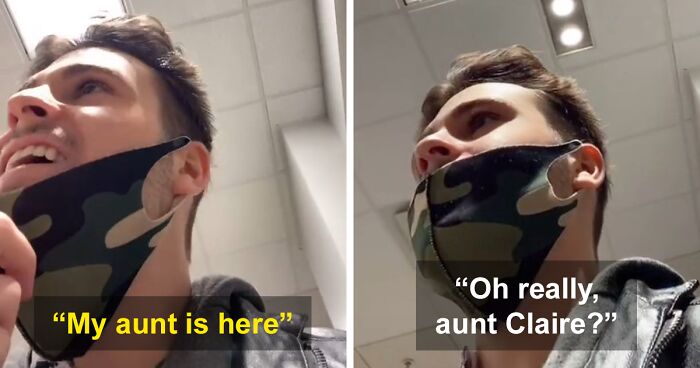
A casual trip to a store should not require an emergency escape plan, an imaginary aunt, and an alert stranger with excellent improvisational skills. Yet that is essentially what unfolded in a widely shared video in which a young man pretended to recognize a frightened woman so he could separate her from an overly persistent stranger.
The encounter was brief. The larger issue behind it is anything but.
According to the account given by TikTok creator Brandon Robert, he noticed a young woman being cornered by a man who appeared intoxicated or otherwise impaired. Her facial expression and body language suggested that she was uncomfortable. Brandon approached her enthusiastically, acted as though they were old friends, and mentioned that his aunt was nearby. The woman immediately understood the plan, played along, and followed him away.
It was quick-thinking bystander intervention, disguised as a slightly awkward reunion. It was also a painful reminder that a woman’s visible discomfortor even her direct refusalis sometimes ignored until another man enters the conversation.
What Happened in the Viral Encounter?
The video, which had reportedly accumulated more than 33 million views when it was covered in 2021, begins with Brandon observing the interaction from a distance. He later explained that he made eye contact with the woman before approaching, giving her an opportunity to recognize that he had noticed what was happening.
He then greeted her as if they knew each other. She responded immediately and even supplied a supporting character for their spontaneous production: “Aunt Claire.” Somewhere, an imaginary woman named Claire became the unexpected hero of a shopping trip she never attended.
Once the two were away from the stranger, the woman thanked Brandon and reportedly explained that the man had asked her to return to his place. Brandon walked her out of the store and accompanied her to her car in case the man followed.
The maneuver worked because it offered the woman a socially believable exit without requiring a confrontation. Instead of challenging the stranger directly, Brandon redirected the situation. In bystander-intervention language, this is commonly called distraction: interrupting harmful behavior by creating an unrelated conversation, asking a question, dropping something, pretending to need help, or acting as though the targeted person is an acquaintance.
Why Pretending to Know Her Was So Effective
It Centered the Person Who Needed Help
Brandon did not march in, announce himself as Captain Mall Security, and begin delivering a speech about proper behavior. He focused on the woman. His greeting created an opening, and she chose to take it.
That detail matters. Helpful intervention should restore control to the targeted person, not replace one controlling stranger with another. A bystander’s job is not to become the main character. The objective is to create options: a safe exit, access to other people, contact with security, or time to decide what to do next.
It Avoided an Immediate Power Struggle
Directly confronting a person who appears angry, intoxicated, armed, or unpredictable can increase danger. A distraction often works precisely because it does not openly accuse anyone. The harasser may suspect what is happening, but there is no dramatic challenge demanding a response.
“Hey, I haven’t seen you in forever” can be safer than “Leave her alone,” depending on the circumstances. It redirects attention while preserving everyone’s ability to move away.
It Gave the Woman Social Cover
People who disregard boundaries often exploit social pressure. They rely on the fact that many women are taught to remain polite, avoid causing a scene, and soften rejection so that a stranger does not become hostile.
A familiar-looking person suddenly appearing changes the social equation. The woman no longer has to invent an excuse or continue negotiating. She can simply leave with her “friend.” It is absurd that an imaginary relationship may receive more respect than a real “no,” but that absurdity is exactly what makes the incident so revealing.
The Big Problem: A Woman’s Discomfort Is Too Often Treated as Negotiable
The heartwarming interpretation of the video is that a stranger noticed someone in trouble and helped her. That interpretation is valid. The uncomfortable interpretation is that she needed rescuing from a conversation she apparently did not want in the first place.
Healthy social interaction depends on mutual interest. If one person is backing away, avoiding eye contact, giving minimal answers, looking around for assistance, or repeatedly attempting to leave, the correct response is not to intensify the sales pitch. Romance is not a cable subscription. Nobody should have to say “cancel” nine times and threaten to contact customer service.
Rejection Should Not Require Male Authorization
Many women describe unwanted interactions in which a man ignores “I’m not interested” but retreats after hearing “I have a boyfriend.” That reaction sends an ugly message: the woman’s wishes are less important than the presumed claim of another man.
The same dynamic can appear when a brother, male friend, bartender, security employee, or random male bystander steps in. The harasser suddenly understands a boundary that was perfectly understandable minutes earlier.
The solution is not to suggest that women always need male protection. It is to build a culture in which everyone’s boundaries are respected without requiring witnesses, explanations, fake partners, or fictional relatives.
Safety Work Has Become an Unpaid Second Job
Many people routinely perform mental safety calculations that others rarely notice. They check whether someone is following them, hold keys between their fingers, share live locations, avoid isolated parking areas, photograph license plates, change train cars, pretend to make phone calls, or ask friends to confirm that they arrived home.
These strategies may be useful, but their normality should concern us. Constant vigilance consumes attention and limits freedom. A person should be able to buy shampoo, wait for a train, exercise, or walk home without conducting a private threat assessment worthy of a government security team.
Recognizing When Someone May Need Help
Not every awkward conversation is harassment, and bystanders do not possess magical mind-reading goggles. The goal is not to treat every stranger as dangerous. It is to notice patterns suggesting that attention is unwanted or that someone feels trapped.
Possible warning signs include:
- One person repeatedly attempts to end the conversation or move away.
- The other person blocks an exit, follows closely, or invades personal space.
- The targeted person scans the room, makes repeated eye contact with others, or appears frightened.
- A person is pressured to share a phone number, address, ride, drink, or destination.
- The behavior continues after a clear rejection.
- Someone appears too intoxicated, impaired, or distressed to make safe decisions.
- The interaction shifts from conversation to threats, insults, touching, or pursuit.
Context matters. Someone crossing their arms may simply be cold. Someone repeatedly saying “Please leave me alone” is considerably less mysterious.
The 5Ds of Bystander Intervention
Safety organizations often teach five flexible intervention methods known as the 5Ds. They provide alternatives to the movie-style assumption that helping requires a dramatic face-to-face confrontation.
1. Distract
Create a harmless interruption. Pretend to know the targeted person, ask for directions, spill a drink, request help finding an item, or start an unrelated conversation. Address the person who may need help rather than arguing with the aggressor.
This was the method used in the viral encounter. Its strength is subtlety. The person causing the problem does not need to know that an intervention is occurring.
2. Delegate
Ask someone with greater authority or better resources to assist. In a store, contact an employee or security officer. On public transportation, alert the driver or conductor. At a venue, involve a bartender, manager, teacher, event organizer, or designated safety worker.
Delegation is not cowardice. It is often the smartest option, especially when the situation could become violent.
3. Direct
If it appears safe, clearly identify the behavior: “She said she wants to leave,” “Please step back,” or “That comment is not appropriate.” Keep the statement short. The goal is to stop the behavior, not win a debate against someone who has apparently misplaced his copy of Basic Human Boundaries.
4. Document
Recording can preserve evidence, but documentation should not replace immediate assistance. Before filming, check whether someone else is already helping. Avoid posting footage publicly without the targeted person’s permission, since doing so can expose their identity, location, or trauma to a massive audience.
Afterward, offer the recording directly to the person who experienced the incident. Let that person decide how it should be used.
5. Delay
Even when you cannot intervene during the incident, you can check in afterward. Ask whether the person is okay, needs a ride, wants company, requires medical attention, or would like help contacting authorities.
A simple “I saw what happened, and it was not your fault” can reduce isolation and self-doubt.
How to Pretend You Know Someone Without Making Things Worse
The “old friend” strategy is easy to remember, but it should still be used thoughtfully.
- Observe before acting. Look for signs that the interaction is unwanted and identify nearby exits, staff members, or other potential helpers.
- Approach the targeted person. Use a warm but ordinary greeting such as, “Hey, there you are,” or “I’ve been looking everywhere for you.”
- Offer an exit. Mention that friends are waiting, a ride has arrived, or you need help with something nearby.
- Follow the person’s response. If they play along, continue. If they seem confused or decline, do not grab or pressure them.
- Move toward safety. Head to a staffed, populated, well-lit area rather than an isolated location.
- Check what they need. Once safely away, ask rather than assume: “Would you like me to stay with you?”
- Get emergency help when necessary. Contact security or emergency services if there are threats, weapons, violence, forced movement, or immediate danger.
Personal safety remains important. No one is required to physically intervene. Calling for help, recruiting several bystanders, creating noise from a safe distance, or reporting what you saw can be valuable actions.
Why People Sometimes Fail to Intervene
People may freeze because they are afraid, uncertain, distracted, or worried about misreading the situation. In crowded places, responsibility can become strangely diluted. Everyone assumes that someone else will act, while everyone else is performing the same calculation.
This phenomenon is commonly associated with the bystander effect. Ambiguity makes it stronger: when nobody reacts, observers may conclude that nothing serious is happening. Unfortunately, the person needing help may interpret the same silence as confirmation that nobody is willing to assist.
Training helps because it replaces the vague question “Should I become a hero?” with smaller, practical questions:
- Can I ask the person whether they need help?
- Can I stand nearby so they are not isolated?
- Can I alert an employee?
- Can I recruit two other people?
- Can I create a distraction?
Prepared people are more likely to recognize that intervention is not a single grand gesture. It is a menu of choices.
Helping Without Turning the Incident Into Content
The viral video also raises questions about recording strangers during frightening moments. Documentation may provide evidence and show other people how intervention works. However, a targeted person’s safety and privacy must come first.
Someone escaping harassment should not automatically become a supporting actor in another person’s online brand. Whenever possible, identifying details should be protected, consent should be requested before publication, and footage should not be used to encourage speculation about the person involved.
The most meaningful part of an intervention may never receive a like, share, sponsorship, reaction video, or dramatic soundtrack. That is perfectly fine. Helping someone is still valuable when the algorithm does not send flowers.
What Men Can Learn From the Encounter
Men can play an important role in challenging harassment, particularly because some aggressive men respond more quickly to another man’s objection. That influence should be used responsibly.
Useful actions include believing women when they describe threatening experiences, interrupting friends who pressure or demean others, refusing to laugh at harassment disguised as humor, and practicing intervention before an emergency occurs.
Men should also examine ordinary dating behavior. Interest is not a problem. Persistence after rejection is. Approaching someone is not automatically threatening, but blocking their path, demanding personal information, following them, or becoming hostile after hearing “no” crosses a clear line.
The standard is not complicated: express interest respectfully, pay attention to the response, and accept rejection without turning it into a courtroom appeal.
Experience-Based Scenarios: What Bystander Help Can Look Like
The following are composite, illustrative scenarios based on commonly reported public experiences and established intervention techniques. They are not presented as accounts of specific identifiable individuals.
The Train Platform
A woman waiting for an evening train notices that the same man has moved beside her three times. When she changes position, he follows. He begins asking where she lives and whether she is traveling alone. She gives short answers, looks toward the station booth, and steps backward whenever he moves closer.
A nearby commuter recognizes the pattern. Instead of confronting the man, she approaches the woman and says, “There you are! We’re in the car near the conductor, remember?” The woman nods and walks with her toward a group of passengers. The commuter quietly asks whether she wants station staff notified.
The intervention is effective because it combines distraction, movement toward safety, and a private offer of additional help. It does not require the commuter to determine the stranger’s exact intentions. The visible patternfollowing, intrusive questions, and ignored discomfortis enough to justify checking in.
The Grocery Store Aisle
A college student is comparing cereal prices when a man begins commenting on her appearance. She says she needs to finish shopping, but he continues following her cart. Another shopper hears him demanding her phone number.
The shopper walks over and asks the student to help identify an ingredient for a fictional dinner recipe. Together, they move toward the customer-service desk. Once there, the shopper asks, “Do you know that man, and would you like an employee to walk with you?”
Nothing cinematic happens. No produce is thrown. Nobody swings from the fluorescent lighting. Yet the unwanted interaction ends because one person notices that “mind your own business” should not mean “ignore obvious distress.”
The Crowded Bar
At a bar, a visibly intoxicated woman is repeatedly pulled toward the exit by someone she has been avoiding all evening. Her friend is in the restroom, and the surrounding crowd assumes the pair know each other.
A server asks the woman directly whether she wants to leave with him. When she hesitates and looks confused, the server separates them, calls a manager, and locates her friend. The staff arranges a safe ride and prevents the man from following.
This scenario shows why venue training matters. Alcohol, noise, and crowds create ambiguity, while predators may deliberately act familiar to avoid scrutiny. A clear check-in can interrupt that advantage.
The Parking Lot
A customer leaving a store notices a man arguing with a woman near her car. The woman unlocks the vehicle, but the man places himself beside the driver’s door. Rather than approaching alone, the customer returns inside, alerts security, and provides a description.
Two security employees accompany the woman to a safe location while another observes the man from a distance. The customer’s choice to delegate avoids a potentially dangerous confrontation while still producing immediate help.
The Moment Afterward
Sometimes the opportunity to interrupt has already passed. A person may witness someone being shouted at on a bus but freeze until the aggressor exits. Instead of deciding that the chance to help is gone, the witness sits nearby and says, “I saw what happened. Are you okay? Would you like me to stay until your stop?”
Delayed support cannot erase the experience, but it can remind the targeted person that the behavior was visible, unacceptable, and not their fault.
Across all these scenarios, the most useful helpers are not necessarily the strongest or loudest people. They are the ones who pay attention, assess risk, and choose an action that expands the targeted person’s options. Sometimes that means pretending to recognize a stranger. Sometimes it means finding security. Sometimes it means standing nearby and asking one respectful question.
The goal is not to create a world filled with amateur vigilantes. It is to create one filled with attentive neighbors who understand that public safety is shared.
Conclusion: The Best Rescue Is the One Society Makes Unnecessary
Brandon’s reported intervention offered a simple lesson: a small, creative interruption can change the direction of a potentially dangerous encounter. He noticed fear, provided an exit, and stayed with the woman until she reached her car.
That deserves recognition. But praise for the helper should not obscure the reason help was necessary. Women should not need fictional aunts, imaginary boyfriends, fake phone calls, or strategically recruited strangers to make their boundaries count.
A safer culture begins when people accept rejection, recognize discomfort, challenge harassment among their peers, and learn practical bystander-intervention skills. Courage does not always arrive wearing a cape. Sometimes it walks over and says, “Oh my gosh, there you are.”
Safety note: Every situation is different. Prioritize your own safety and the targeted person’s choices. Avoid physical confrontation when there is a risk of violence, and contact security or emergency services when someone faces immediate danger.