Every few years, Hollywood digs up a misunderstood flop, dusts it off, and asks the question that launches a thousand group chats: Was it actually good? Sometimes the answer is yes. Sometimes the answer is, “Well, it had vibes.” And sometimes the answer is Catwoman, the 2004 superhero oddity that has spent two decades prowling the alley between disaster and camp curiosity.
Now Halle Berry, who played Patience Phillips in the film and absorbed a frankly cartoonish amount of blame for it, has made it clear she would be open to taking another swing at the character under one major condition: creative control. That instinct makes sense. Berry has long suggested that if she could redo Catwoman, she would raise the stakes, rethink the story, and build a movie worthy of the character instead of a glossy detour involving evil cosmetics, chaotic CGI, and the kind of tonal confusion that makes audiences check whether they accidentally switched channels.
And yet, for all the affection Berry still has for the role, and for all the late-breaking internet nostalgia that tries to turn every notorious flop into a “secret masterpiece,” Catwoman remains a very hard movie to redeem. Not because it is joyless. Not because Berry is bad in it. She is not. The problem is bigger and meaner than that. The movie’s flaws are structural, conceptual, and baked into the very bones of the project. This was not a great film waiting for reevaluation. It was a fundamentally broken one that happened to star a magnetic actress doing her best to survive a bad blueprint.
Why Halle Berry Still Wants a Do-Over
Berry’s desire to revisit Catwoman is not hard to understand. The movie was a notorious critical and commercial stumble, but it also became one of the defining talking points of her career in a way that feels wildly disproportionate. Plenty of expensive studio misfires come and go. Catwoman somehow attached itself to Berry personally, as if she alone had written it, greenlit it, edited it, marketed it, and then personally unleashed that basketball scene onto an unsuspecting nation.
That history matters because Berry was not just another actor cashing a superhero paycheck. She was coming off major cultural momentum, already an Oscar winner and already carrying symbolic weight in Hollywood. Her casting also mattered historically: she was the first Black woman to lead a solo DC superhero movie. That should have been a milestone with a victory lap. Instead, it became one of the industry’s favorite punchlines.
Over time, Berry has been candid about the experience. She has talked about how the backlash landed on her shoulders, how unfair that felt, and how she would rethink the film now that she has directing experience and a clearer sense of what the movie should have been. That is not denial. It is revision with purpose. She seems less interested in pretending the original worked than in saying, “I see what went wrong, and I know how I’d do it differently.” Honestly? Fair. Also a little heartbreaking.
The Movie Had One Big Advantage: Halle Berry
Before sharpening the claws, it is worth saying something nice: Berry is not the reason Catwoman failed. In fact, she is one of the only reasons the movie is watchable at all. She brings athleticism, glamour, and a kind of game-for-anything commitment that keeps the film from collapsing in on itself even sooner. When the movie asks her to play shy and mousy, she sells it. When it asks her to transform into a feline antiheroine with heightened swagger, she commits to that too. When it asks her to flirt in a scene that plays like a fever dream directed by an energy drink, she somehow keeps a straight face.
Critics at the time often made a version of the same point: Berry was the bright spot in a movie that had no idea how to build around her. That is the central tragedy of Catwoman. The star is capable. The role should be iconic. The concept is commercially irresistible. But the film never finds a way to make those elements click.
The Sins of “Catwoman” Start With the Story
A Catwoman Movie Without the Catwoman People Expected
The first big problem is identity. Comic book fans knew Catwoman as Selina Kyle, a morally slippery Gotham icon whose chemistry with Batman is part of the character’s DNA. The 2004 film swerved away from that completely and introduced Patience Phillips, a new character in a story disconnected from Batman and only loosely connected to established DC mythology.
Now, radical reinvention is not automatically a crime. Superhero movies tweak lore all the time. But if you remove the best-known character dynamics, swap out the mythology, and then fail to replace them with a stronger idea, you are not reimagining the material. You are borrowing the logo while leaving the engine behind.
That is exactly what Catwoman does. It keeps the name, the feline imagery, and the leather-adjacent marketing. What it loses is the character’s emotional architecture. The result feels less like a bold reinterpretation and more like a separate script that wandered into the wrong costume closet.
The Villain Is a Beauty Cream. Yes, Really.
Then there is the plot, which hangs on a cosmetics conspiracy involving a skin product with dangerous side effects. On paper, satire about beauty culture, corporate greed, and impossible standards could absolutely work in a comic book movie. In execution, Catwoman turns that premise into something unintentionally hilarious. The stakes never feel mythic, grounded, or even especially coherent. They just feel strange.
Berry herself has pointed to this issue over the years. If she were to remake the film, she has said she would make the stakes bigger and more universal. That is exactly right. Male superheroes are typically handed city-level, world-level, or soul-level conflicts. Catwoman gives its heroine a villain wrapped in moisturizer and boardroom melodrama. The movie wanted to say something about women’s lives, but it framed that idea in a way that made the conflict look puny instead of pointed.
The Direction Never Finds a Pulse
Director Pitof had style, but style without discipline can become visual static. Catwoman is crammed with camera moves, digital distortions, hyperactive edits, and slick surfaces that look like they were polished by a marketing department. There is motion everywhere, but very little momentum. The film is constantly trying to feel sensual, dangerous, and comic-book cool; instead, it often feels like it is auditioning for a music video while forgetting to tell the story.
Action scenes should reveal character. Here, they mostly reveal that the movie had access to a lot of digital effects and no strong sense of restraint. The infamous basketball flirtation sequence has become meme material because it distills the film’s biggest weakness into a single scene: performative energy in place of dramatic purpose. It is not merely silly. It is confident in its silliness in a way that almost dares you to object.
Unfortunately, many viewers accepted that dare.
The Costume Became a Lightning Rod, but It Was Never the Whole Problem
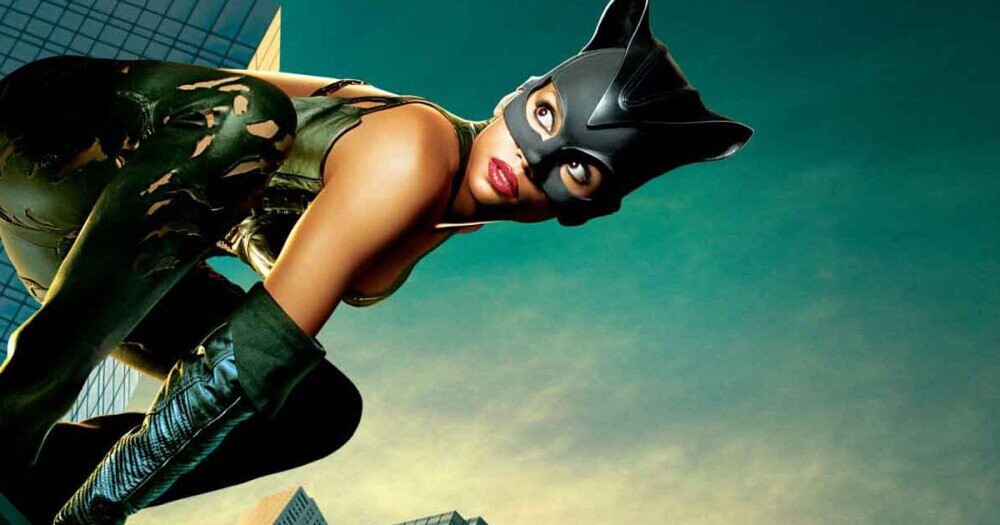
The costume backlash was loud and immediate. Fans were already unhappy that this Catwoman was not Selina Kyle, and the revealing design became an easy symbol of everything they thought the movie misunderstood. To be fair, some of that reaction was predictable comic-book purism. But some of it was tied to a real discomfort at how the film confused empowerment with exposure.
Catwoman clearly wanted its heroine to seem liberated, fierce, and sexually self-possessed. Yet the camera often treats her less like a subject with agency and more like an object wrapped in editorial lighting. That tension never goes away. The movie gestures toward female empowerment, then keeps stepping on its own message with imagery that feels designed to sell posters first and ideas second.
This is part of why the film has aged in such a weird way. On one hand, it is easy to defend Berry’s performance and acknowledge the sexist intensity of some of the backlash. On the other hand, the movie itself really does make choices that feel trapped between post-Matrix cool, early-2000s male-gaze nonsense, and a half-finished feminism seminar.
Can Camp Save It?
Here is where the internet enters, carrying a tray of hot takes and a ring light. In the streaming era, Catwoman has found younger viewers willing to approach it as camp, kitsch, or accidental comedy. That reaction is real. It should not be dismissed. Some films survive not because they are good in the traditional sense, but because they are singular enough to inspire fascination. Catwoman definitely qualifies as singular. No one has ever confused it with a sensible creative decision.
Camp, however, is not the same thing as redemption. A movie can be enjoyable because it is a mess and still remain a mess. Watching Catwoman today can be entertaining in the way that a chaotic awards show speech or a wildly overdecorated wedding cake can be entertaining. You admire the audacity. You laugh at the excess. You maybe take a picture. That does not mean the structure underneath is sound.
The current affection for the film says more about modern viewing habits than it does about the movie’s quality. Audiences now love reclaiming cultural castoffs. They enjoy irony, camp aesthetics, and anti-canon superhero oddities. But even under that friendlier lens, Catwoman still stumbles over basic storytelling, character logic, and tonal consistency.
What a Real “Catwoman” Redemption Would Look Like
If Berry ever did get the chance to revisit the character as a director, the path forward is surprisingly clear. First, give Catwoman sharper stakes and a stronger emotional engine. Second, let the character be dangerous, witty, conflicted, and fully in control of her own moral messiness. Third, trust the audience to handle sensuality without turning every scene into a perfume ad that wandered into an action set.
Most of all, a modern Catwoman movie would need clarity about what makes the character compelling. She is not just “Batman-adjacent woman in leather.” She is a survivor, a schemer, a flirt, a thief, a romantic problem, and often the smartest person in the room. The 2004 film gave us fragments of that energy but never built a coherent character out of them.
Berry, notably, understands at least part of that missed opportunity. Her comments over the years suggest she knows the original played too small, too shallow, and too safe where it should have gone bigger, sharper, and stranger. That is the most convincing argument for a do-over: not nostalgia, but diagnosis.
So, Are Its Sins Too Great?
As a movie? Yes. Catwoman is too flawed to be rescued by retroactive goodwill alone. Its box-office failure, weak reviews, and enduring reputation were not the product of one unfair pile-on, even though Berry undoubtedly absorbed more personal ridicule than she deserved. The movie misjudged its character, undercut its themes, flattened its stakes, and buried its star beneath style choices that now look like relics from a particularly confused corner of 2004.
As a cultural artifact, though, it is more complicated. Berry’s performance has survived. The film’s historical importance has survived. The conversation around how Hollywood treats women, especially Black women, in failed franchise experiments has become more nuanced. And the internet, bless its chaotic little heart, has granted the movie a strange second life as camp memorabilia.
That may be the real redemption. Not proving that Catwoman was secretly great, because it was not, but recognizing that the story of the film is bigger than its failures. It is about a star who took the hit, laughed at herself publicly, kept going, and now has the perspective to say exactly how the movie should have been made in the first place.
So yes, Halle Berry deserves another shot at Catwoman. The 2004 movie does not deserve acquittal, but Berry absolutely deserves an appeal.
Experience, Memory, and the Strange Afterlife of “Catwoman”
One of the most interesting experiences surrounding Catwoman is how differently the movie plays depending on when and how people meet it. For audiences who saw it in 2004, the experience was often shaped by expectation. Superhero movies were entering a new prestige phase, comic-book fans were increasingly protective of canon, and Berry was coming in with serious star power. Viewers expected a sleek, major-studio superhero event. What they got instead felt like a glam-fantasy detour full of odd tonal swings and a plot that never quite escaped its own absurdity. That gap between expectation and reality made the disappointment feel even larger.
For younger viewers discovering it later on cable, streaming, or in meme compilations, the experience can be weirdly lighter. They do not always bring the same baggage about Batman mythology or early-2000s franchise hopes. They meet the movie as an artifact, almost like a pop-culture fossil with glossy claws. Watched that way, Catwoman can feel less like a betrayal and more like an accidental time capsule: the editing is frantic, the costuming is aggressively of its era, and the seriousness of the film sits right next to moments so overcommitted they turn into comedy. That creates a different kind of pleasure.
There is also the experience of watching Berry herself move through the chaos. Even people who dislike the movie often remember her commitment, her physicality, and her refusal to phone it in. That matters. A truly dead-on-arrival performance usually kills any chance of a movie developing afterlife affection. Berry prevents that. She gives the audience something to latch onto, even when the surrounding material is wobbling like a high heel on a broken fire escape.
Then there is the communal experience of reevaluation. Online culture loves a comeback story, especially one involving a famously mocked project. Once enough people start saying, “Actually, this is camp,” the film changes function. It becomes social. People quote scenes, share screenshots, defend the costume, rank the basketball flirtation among cinema’s great acts of nonsense, and turn the movie into a party object. That does not make the film better in craft terms, but it does make the act of watching it more fun. Sometimes a movie survives because it becomes a conversation before it becomes a classic.
Still, the most lasting experience linked to Catwoman may be Berry’s own. She endured the ridicule, accepted the Razzie with humor, kept the role in perspective, and eventually reached the point where she could talk about the film not just with pain, but with analysis. There is something admirable in that. The movie may remain a cautionary tale, but the way Berry has handled its legacy feels almost like the performance the film itself never delivered: poised, sharp, self-aware, and impossible to reduce to one bad review cycle.