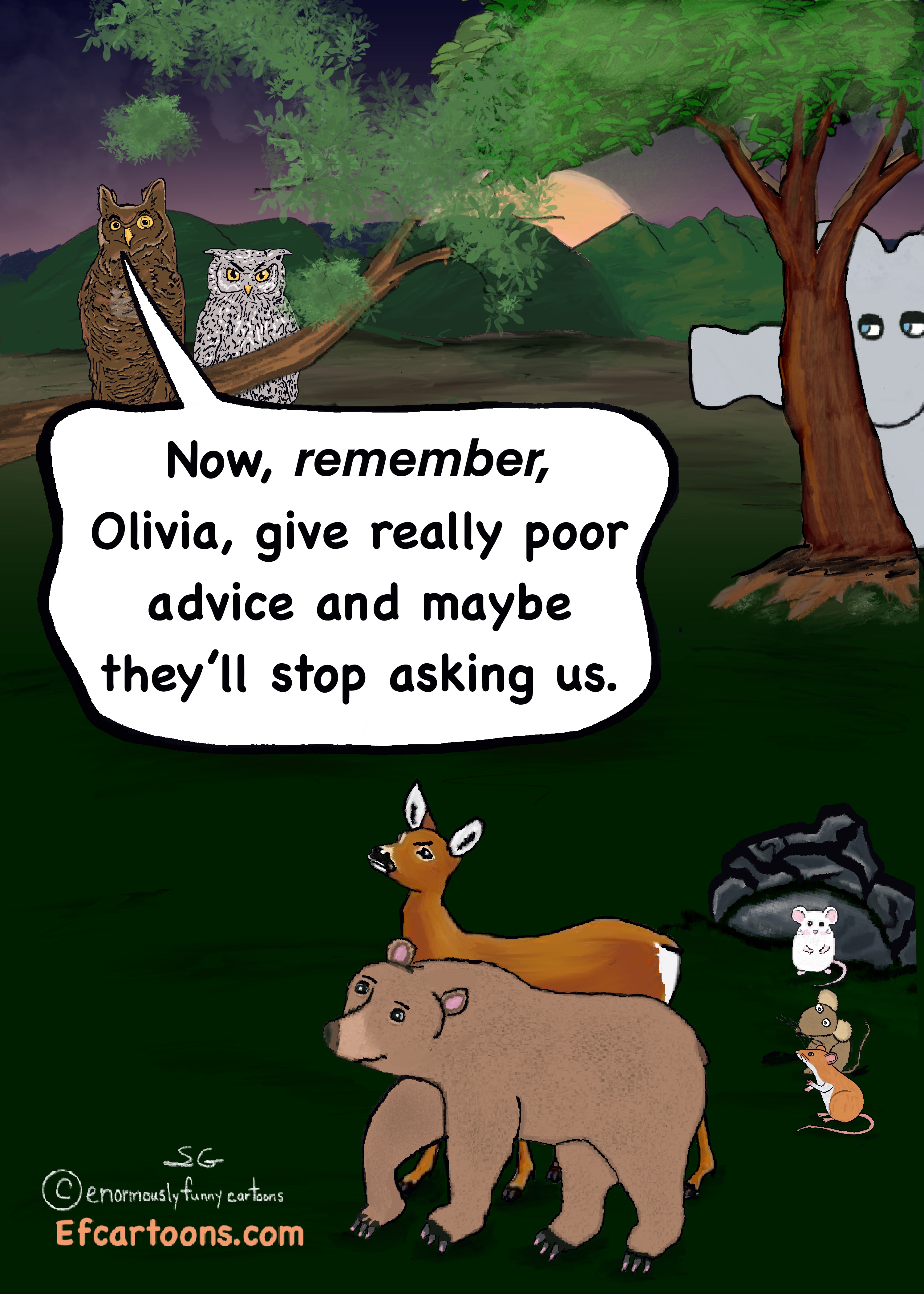
Owls have one of the best publicists in the animal kingdom. They appear on book covers, school logos, graduation decorations, and every third “knowledge” meme floating around the internet. If an animal wears glasses in a cartoon, there is a decent chance it is an owl. The branding is crystal clear: owls are wise.
There is just one small issue with this reputation. Real owls are not tiny feathered philosophers perched in oak trees pondering ethics and tax policy. They are highly specialized predators built for silence, darkness, speed, and precision. They are impressive, yes. Elegant, often. Mildly spooky, definitely. But “wise” in the human sense? Not really. A more honest title might be spectacularly well-equipped murder marshmallows with excellent hearing.
That is where Unwise Owls begins. This article is not here to insult owls. Quite the opposite. It is here to rescue them from a very old misunderstanding. Owls do not deserve admiration because they resemble professors. They deserve admiration because evolution turned them into bizarre, brilliant hunting machines that look calm while doing outrageously weird things.
Why Owls Got Branded as Wise in the First Place
The “wise owl” image did not come out of nowhere. In Western tradition, owls became linked with Athena, the Greek goddess of wisdom, and that symbolic pairing has had serious staying power. Add in those huge forward-facing eyes, the stern expression, the tendency to sit still for long stretches, and the effect is powerful. Owls do not look frantic or goofy the way some birds do. They look like they have already read the room and judged everyone in it.
Humans are also suckers for animals that appear to make eye contact. Owls face forward more than many birds, so they seem more “thoughtful” to us. Their facial discs frame the eyes like a built-in portrait mode, and their posture gives them that dignified “headmaster who knows you copied your homework” vibe. We look at an owl and project seriousness onto it. The owl, meanwhile, is probably deciding whether that rustle in the leaves is dinner.
Culture piled on from there. In some traditions, owls symbolized wisdom and protection. In others, they were omens of death, darkness, or bad luck. That contradiction is part of what makes owls so fascinating: they have rarely been seen as ordinary. People have spent centuries turning them into symbols because they are active when we are not, hard to spot, and deeply strange by bird standards.
Why “Wise” Is the Wrong Word
Owls are not dumb. Let’s get that out of the way. But they are also not famous among scientists for the same kind of flexible problem-solving that makes corvids and parrots the overachievers of the bird world. If you want birds that recognize faces, solve puzzles, manipulate tools, learn socially, and generally behave like tiny gothic engineers, crows and ravens usually steal that spotlight.
Owls shine in a different category. Their greatness is less about improvising clever tricks and more about being exquisitely adapted to a particular lifestyle. They are specialists. A Barn Owl does not need to reinvent physics. It needs to hear a mouse under grass, fly almost silently, hit the target in low light, swallow lunch, and move on with the confidence of an apex introvert.
That difference matters. Humans often confuse human-like intelligence with all forms of animal success. But survival is not an IQ contest scored by crossword performance. An owl’s talents are anatomical, sensory, and behavioral. It is a master of being an owl, not a feathered version of your smartest classmate. In fact, experts who work with owls often describe them as slow or stubborn in training situations, which is not a moral failing. It simply means their brains are optimized for a different job description.
So the phrase unwise owls is not a put-down. It is a correction. Owls are not wise because wisdom suggests deliberation, reasoning, and broad judgment. Owls are effective because they are intensely specialized. They are less philosophers of the forest and more night-shift professionals with extraordinary hardware.
The Face of Wisdom Is Mostly an Optical Illusion
Those eyes are dramatic for a reason
One of the biggest reasons owls seem wise is the face. Owl eyes are enormous relative to skull size, and they are not shaped quite like human eyes. They are more elongated and held in place by bony structures, which means they do not roll around in their sockets the way ours do. An owl cannot casually glance sideways with just its eyes. If it wants to look somewhere, it has to move the whole head.
That is why owl head rotation feels so uncanny. It looks supernatural, but it is really a workaround. Fixed eyes create a narrow, forward-looking field that is excellent for binocular vision and depth perception, especially in dim light. The dramatic head-turning is compensation, not magic. In other words, the bird is not performing a mystical act of insight. It is basically saying, “My eyeballs are mounted weirdly, give me a second.”
Ear tufts are not ears, because of course they are not
If owls were designed by a prankster, ear tufts would make perfect sense. Many people assume those feathery points on species like Great Horned Owls are the actual ears. They are not. They are display feathers. The real ear openings are hidden under feathers on the sides of the head, and in many species they are asymmetrical. That asymmetry helps owls pinpoint sounds with astonishing accuracy.
So the famous “horns” are fake ears, and the real ears are hidden. This feels on-brand for owls. They routinely appear to be one thing while actually being another. Wise face? Hunting machine. Ear tufts? Decorative deception. Silent ghost of the woods? Sometimes yes, sometimes just a bird getting screamed at by smaller birds.
The facial disc is a built-in sound funnel
The circular arrangement of feathers around an owl’s face is not just there to make it look important in profile photos. It functions like an acoustic dish, helping collect and direct sound toward the ear openings. In species that rely heavily on hearing, this feature becomes a major part of their hunting toolkit. The face is not just expressive. It is equipment.
Silent Flight: The Real Superpower
If owls have a superpower that deserves legendary status, it is not “wisdom.” It is stealth. Many owls have specialized feather structures that reduce flight noise, allowing them to approach prey without broadcasting their arrival like a squeaky shopping cart. Researchers have long debated whether silence primarily helps owls sneak up on prey or helps them hear prey better while flying. The answer may be some of both, depending on the species and what it hunts.
Either way, the result is extraordinary. A hunting owl can move through the dark with a level of quiet that has inspired engineers studying quieter fans, turbine blades, and aircraft design. That is the kind of fact that should replace every lazy “wise old owl” cliché. The bird is not tutoring woodland creatures in literature. It is accidentally helping humans rethink aerodynamics.
Great Gray Owls add another layer of absurd excellence. Their facial discs are enormous, and they can localize prey beneath snow by sound. That means an owl can hunt something it cannot see by interpreting tiny auditory clues and punching through winter cover with startling precision. If that sounds less like wisdom and more like biological wizardry, good. We are finally getting somewhere.
Owls Also Do Plenty of Things That Look Ridiculous to Humans
They get mobbed
Owls may look intimidating, but daylight can be socially rough. Smaller birds often mob owls, especially during breeding season, because owls prey on sleeping birds and nestlings. If a songbird spots an owl during the day, it may start calling loudly, and suddenly the owl becomes the least popular creature in the neighborhood. More birds join in, diving, scolding, and generally making the owl regret ever choosing that branch.
This is one of the funniest real-life corrections to the wise owl stereotype. The supposedly solemn sage of the forest is sometimes just sitting there getting yelled at by a furious committee of sparrows. Not a parliament of owls, by the way. Most real birders would simply call it a flock.
They swallow prey whole and cough up pellets
Owls are iconic in classrooms partly because of pellets, those compact bundles of fur, bones, teeth, and other indigestible leftovers that they regurgitate. This is less glamorous than wisdom and much more informative. Pellets reveal what owls eat, how they hunt, and how ecosystems are structured. They are gross, useful, and very on brand.
There is something wonderfully deflating about this. Humans gave owls a mythology of insight. Owls responded by swallowing mice whole and later producing a tidy little evidence capsule full of rodent bones. Nature loves balance.
Some owls refuse to follow the “normal owl” script
Take the Burrowing Owl. Instead of hiding in trees and ruling the night from a creepy silhouette, it lives on the ground in burrows and can be active in daylight. It looks like an owl that accidentally joined the wrong ecosystem and then decided it actually liked the neighborhood. Species diversity among owls is a good reminder that there is no single owl personality. “Owl” is a body plan, not a personality test result.
The Real Genius of Owls
The best way to appreciate owls is to stop measuring them against human ideas of wisdom and start looking at what they actually do better than almost anything else. They hear with eerie precision. They hunt in darkness. They navigate forests and fields with near-silent wings. They exploit niches ranging from snowy open landscapes to deserts, grasslands, old-growth forests, and city edges.
Even among owls, adaptations vary beautifully. Some species rely more on hearing, some more on vision. Some are nocturnal, some crepuscular, and a few are active by day. Some nest in cavities, others borrow old nests, and some go full rebel and nest underground. A Northern Pygmy-Owl can cache prey. A Great Horned Owl can take an astonishing variety of food. A Great Gray Owl can hear a meal under snow. None of that is “book smart.” All of it is extraordinary.
So perhaps the better phrase is not wise old owl but wildly well-designed owl. Less poetic, maybe. Much more accurate.
Why Owls Still Need Us to Get the Story Right
Myths can be charming, but bad myths can be costly. In some places, owls have been feared as omens or linked to superstition. In others, they are admired but still vulnerable to habitat loss, development, pesticides, vehicle strikes, and broader ecosystem decline. Grassland owls face pressure when open habitat disappears. Forest owls suffer when mature habitat is fragmented. In the western United States, the conservation situation around spotted owls and expanding barred owls has become so serious that it has triggered major federal management action.
This is where the title Unwise Owls becomes useful in a second way. The unwise part is not the owl. It is us, whenever we prefer a charming symbol to ecological reality. It is unwise to reduce owls to mascots. It is unwise to fear them because of folklore. It is unwise to admire them while quietly erasing the habitats they need.
The more we learn about owls, the less they resemble cartoon professors and the more they resemble what they truly are: highly refined predators whose survival depends on intact landscapes, healthy prey populations, and humans willing to be less sentimental and more responsible. That version is not less interesting. It is far better.
Experiences With “Unwise Owls”: What People Actually Notice in the Real World
If you spend enough time around owls, the myth starts to loosen all by itself. Not because the birds become less impressive, but because they become more real. One of the most common owl experiences is hearing one before you ever see it. The call arrives first, often from a patch of darkness you thought was empty. Suddenly the night feels occupied. Then you finally spot the bird, and instead of looking mystical, it often looks practical. Focused. Busy. Slightly annoyed that you are there.
Another common experience is realizing how much of an owl’s image depends on timing. At dusk, an owl can seem noble beyond description. At noon, after being discovered by crows, it can look like a feathery celebrity trying to leave a restaurant through the back door. Birders know this feeling well. You hear a commotion, follow the noise, and find a perfectly camouflaged owl pretending none of this is happening while ten smaller birds publicly roast it. It is hard to keep calling that bird a symbol of wisdom when it resembles an exhausted night-shift worker caught in fluorescent lighting.
There is also the strange intimacy of finding owl pellets. You are walking under a favorite roost tree, maybe near a fence line or woodland edge, and there on the ground are these compact gray bundles that look unimpressive until you remember what they are. Suddenly the owl becomes less of an idea and more of a participant in a food web. The bird hunted here. Ate here. Rested here. Left behind proof. A lot of people first understand owls not through mythology, but through the shock of discovering that science class was correct and yes, that really is a mouse skull.
Then there is the experience of watching an owl move. Photos make owls seem still, almost carved. In life, they can be startlingly fluid. The head turns. The body compresses. The whole bird becomes an arrow with feathers. What feels wise from a distance feels intensely physical up close. You stop thinking about symbolism and start thinking about mechanics: hearing, angle, timing, strike.
Maybe that is the real lesson of unwise owls. The closer people get to actual owls, the less they need the old clichés. The birds are better than the branding. They do not need graduation caps or fables to be memorable. They need darkness, habitat, prey, and a little respect. And once you have heard one call from somewhere just beyond the porch light, or watched one slip through the trees without a sound, the old “wise owl” label feels much too small. You come away with a better word than wise. You come away with wild.